When Was the Crossbow Invented in Europe? A Detailed Historical Guide
The crossbow was invented in Europe sometime before the 5th century BC, with the earliest evidence linked to the ancient Greek gastraphetes. Its use then declined after the Roman era, reemerging around the 10th century AD, evolving into a key medieval weapon. This timeline answers when was the crossbow invented in Europe and highlights its unique European history compared to Asian models.
History enthusiasts, medieval reenactors, and students researching ancient warfare can expect a clear overview of how the crossbow developed, spread, and changed in Europe. You will also learn why crossbows vanished for centuries, their mechanical innovations, military and hunting roles, church bans, and eventual obsolescence.
Key Takeaways
- The earliest European crossbow evidence dates to the 5th century BC, predating the Roman period.
- European crossbows disappeared from records between the 5th and 10th centuries AD, unlike continuous Asian use.
- Medieval European crossbows featured mechanical innovations like steel prods and winches to handle higher draw weights.
- The crossbow’s silent shooting made it a favored hunting tool in Europe until the 18th century.
- The 14th-15th centuries marked the crossbow’s peak as a military weapon in Europe before firearms emerged.
- The Catholic Church banned crossbows for warfare due to their lethal efficiency against knights.
When Did the Crossbow First Appear in Europe?

The crossbow first appeared in Europe around the late 5th century BC, with the earliest evidence linked to the ancient Greek gastraphetes. This early crossbow type used a composite bow mounted on a stock, employing a mechanism that allowed a soldier to brace the weapon against the abdomen for more powerful shots. Archaeological remains of the gastraphetes provide the first clear indication of crossbow technology in Europe, distinguishing it from other torsion siege engines like the ballista, which were not hand-held crossbows.
Historical records confirm that references to crossbows in Europe are sparse prior to the medieval period. Some evidence suggests Byzantium may have used crossbows by the 11th century AD, given the presence of crossbow troops in southern Italy during the Battle of Hastings in 1066 AD. However, widespread mentions of crossbows in European documents only become common during the 12th and 13th centuries, coinciding with advancements in design and mechanical innovation.
Archaeological findings like bronze trigger mechanisms from the tomb of Marquis Yi of Zeng in China, dating to around 500 BC, substantiate the early use of crossbows in Asia well before their European appearances. Repeating crossbows, which could fire multiple bolts without reloading each time, are documented in ancient Chinese records from the 4th century BC, but these do not appear in Europe at that time. The crossbow in China evolved separately and earlier, yet the late 5th century BC gastraphetes in Greece marks Europe’s entry into crossbow technology.
Crossbows in Europe initially served primarily as hunting tools or for minor siege use rather than as dominant battlefield weapons. Their mechanical design, using a rolling nut trigger mechanism, laid the groundwork for the later medieval European crossbows. By the 13th century AD, composite European crossbows incorporated stronger materials and more elaborate trigger systems, sometimes reaching draw weights comparable with or exceeding those of Asian crossbows. Steel crossbows emerged by the 14th century, further increasing their power and battlefield effectiveness.
Timelines for the crossbow’s introduction to Europe follow a clear progression: development of the gastraphetes around the late 5th century BC; very limited use or mention in subsequent centuries; possible but unclear use in Byzantine forces by the 11th century AD; and finally, widespread deployment with improved mechanics during the 12th and 13th centuries. European texts and depictions confirming crossbow use increase significantly from the late 11th century onward, such as images from the 1086 Catalan manuscript illustrating cavalry with crossbows.
Exact archaeological evidence in Europe remains limited compared to Asia, but the combination of early Greek crossbows, medieval mechanical designs, and historical mentions indicate the crossbow’s gradual integration into European warfare and hunting from the late classical period through the medieval era. Recognizing this timeline helps understand the weapon’s long development and its varying importance in European military history.
How Did Early European Crossbows Differ from Asian and Greek Models?
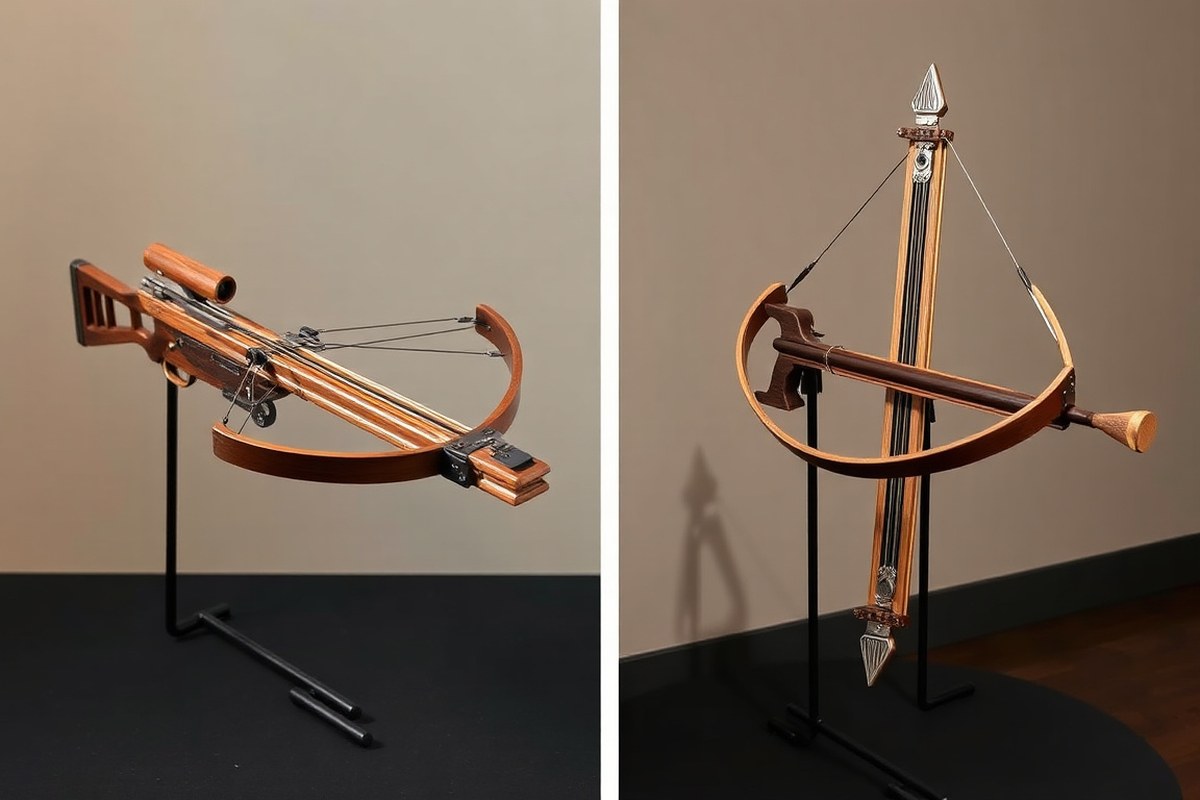
Early European crossbows differed significantly from their Asian and Greek predecessors in terms of power stroke length, trigger mechanisms, and firing speed. While Chinese models offered longer draw lengths and sophisticated bronze triggers, Greek designs like the gastraphetes focused on use but lacked the same compact trigger systems. Unlike in China, repeating crossbows were rare in Europe, highlighting distinct military and technological priorities.
Chinese Crossbow Features
Chinese crossbows were known for a longer power stroke, around 51 cm (20 inches), which allowed them to store more energy and thus shoot bolts with greater force and range. Many Chinese crossbows included advanced bronze trigger mechanisms dating back to the 5th century BCE, which provided durability and reliable firing. A notable Chinese innovation was the repeating crossbow, or Chu-ko-nu, which used a lever-action allowing multiple bolts to be fired rapidly, up to 28 to 48 shots per minute, despite having a shorter range compared to single-shot designs.
The repeating crossbow’s unique firing mechanism made it particularly suitable for defensive roles in mass infantry formations and siege situations in ancient China. Its relatively quick reload and firing rate made it fundamentally different from early European counterparts, which prioritized power over rapid firing. The emphasis on mechanical sophistication in triggers and lever systems shows a strong tradition of metallurgical and engineering skill in ancient Chinese warfare technology.
Greek Gastraphetes Characteristics
The gastraphetes, often described as an ancient Greek crossbow dating to the late 5th century BCE, featured a distinctive cocking method involving the user’s stomach, providing use to draw the bowstring. Unlike Chinese models, the gastraphetes did not employ bronze triggers but used a slider and hook system or later a simple nut mechanism. This design allowed for greater drawing force compared to handheld bows but remained a manually intensive weapon to reload.
Designed primarily for siege and naval warfare, the gastraphetes had a longer draw length, closer to Chinese models than medieval European crossbows, improving its power, while its release mechanism was less mechanically complex. It was not intended for rapid fire and lacked features such as repeating capabilities. This made it effective for targeted, high-impact shots during early Mediterranean warfare but impractical for infantry skirmishing at speed.
European Crossbow Innovations
Medieval European crossbows typically featured shorter power strokes, usually between 10 and 18 cm (3.9 to 7.1 inches), which resulted in less stored energy compared to Chinese or Greek models. Their trigger mechanisms relied on different latch and nut systems than the Chinese bronze triggers, often simpler but allowing for easier production with medieval technologies. Europeans focused on mechanical strength and materials that could handle high draw weights, supporting powerful single shots for both military and hunting purposes.
Repeating crossbows, as seen in China, did not gain traction in Europe. The slower reload times of European crossbows compared to longbows, combined with their powerful bolts, made rapid-fire repetition less critical. Improvements focused on mechanical windlasses and spanning devices to cock higher tension bows rather than developing lever-operated repeating shots. The design emphasis was on raw penetrating power and ease of use under battlefield conditions, differing from both Chinese rapid-fire and Greek siege-focused technologies.
When handling or replicating ancient crossbows, always consider the material strength and safety, as older trigger systems may not contain the power of modern replicas without reinforcement.
Why Was There a Gap in Crossbow Use in Europe After the Roman Era?
The disappearance of the crossbow in Europe between the 5th and 10th centuries relates closely to the societal upheaval and technological shifts following the fall of the Roman Empire. This period, often called the Early Middle Ages or the Dark Ages, saw a significant decline in centralized military organization and urban infrastructure. Without strong political and economic centers, the advanced military technologies such as the crossbow, which had some presence during Roman times, faded from widespread use and documentation. The absence of surviving images or references to crossbows from this era suggests they were either rarely used or overshadowed by other weapons.
During this gap, the longbow, simple bows, and various spear types replaced crossbows as the dominant missile and melee weapons across Europe. The longbow, especially in England, maintained a consistent role in warfare due to its relative ease of manufacture and training requirements compared to the complex mechanisms of the crossbow. Spears, swords, and other bladed weapons were also widespread because they suited the fragmented, often small-scale conflicts characteristic of the time.
Several interrelated causes explain why the crossbow declined in early medieval Europe. First, the collapse of Roman technological and military systems meant that the skilled craftsmanship and industrial capacity needed to produce effective crossbows were lost or diminished. Building a reliable crossbow requires precision in woodworking, metallurgy, and mechanical design, which were less accessible in a society recovering from political instability and economic hardship.
Second, the feudal structure that emerged during these centuries focused on mounted knights and infantry equipped with swords, spears, and simple bows, which were easier to produce and use with limited training. The crossbow, demanding more maintenance and higher manufacturing costs, was less practical in this context. Also, the crossbow’s tactical use depended on coordinated military formations and support, structures that were uncommon in the fragmented warfare of this time.
Third, trade networks that could have introduced or reintroduced crossbow technology from the East were weakened or disrupted after Rome’s fall. While crossbows were common in places like China from the Warring States period through to the Song dynasty (10th, 13th centuries), Europe remained largely disconnected from these developments until increased Mediterranean trade and the Crusades in the 10th and 11th centuries helped reintroduce the weapon. This long gap in contact limited the transmission of the mechanical know-how and design improvements necessary for the crossbow’s return.
In summary, the crossbow’s absence in Europe from the 5th to the 10th centuries results from the loss of the Roman military-industrial complex, the dominance of simpler and more accessible weapons, societal focus on feudal combat styles, and disrupted trade and communication with regions where crossbow technology remained in use. Its eventual reappearance in technologically advanced Mediterranean cities during the 10th and 11th centuries marked a return fueled by improvements in craftsmanship and renewed contact with cultures that preserved and refined the crossbow design.
How Did the Crossbow Reemerge and Spread in Medieval Europe?
The crossbow reemerged in Europe around the 10th century and quickly gained prominence in military use by the 12th century. Its comeback was driven by trade, warfare, and cultural exchanges centered in the Mediterranean. Italian city-states then refined the weapon, helping it spread across European battlefields as both a siege and infantry weapon.
Role of Mediterranean Trade
Trade routes across the Mediterranean were important conduits for the reintroduction of the crossbow to Europe. Contacts with the Byzantine Empire and Muslim states exposed Europeans to crossbow technology that had been continuously developed in the East since ancient times. These trade networks facilitated the exchange of military knowledge, including the composite bow technology that allowed smaller, more powerful crossbow prods. Merchant cities like Genoa, well-positioned along these routes, became hubs where crossbows and their associated techniques were widely adopted and further improved.
This commercial and cultural flow helped European armies acquire not only the physical weapon but also the expertise to manufacture them effectively. The availability of composite materials, such as horn, wood, and sinew, used in Asian crossbows influenced medieval European designs. This combination enabled soldiers without intensive training to use powerful ranged weapons, which shifted military tactics and allowed more widespread use beyond elite archers.
Impact of the Crusades
The Crusades in the late 11th and 12th centuries played a significant role in the spread of the crossbow throughout Europe. European knights and foot soldiers encountered advanced siege weapons and infantry tactics during campaigns in the Holy Land. These experiences demonstrated the crossbow’s value in penetrating armor and fortifications. For example, Richard I of England, reigning from 1189 to 1199, recognized the weapon’s potential and incorporated crossbowmen into his forces, which increased their use in English warfare.
Crossbowmen were notably effective in the kind of close-quarter and siege battles common in the Crusades, which helped generate broader interest in the weapon’s capabilities. This military contact also allowed for the transfer of improved designs and mechanical innovations observed from Eastern forces. The Crusades thus accelerated the adoption of the crossbow in central and northern Europe, beyond its initial strongholds around the Mediterranean.
Italian City-State Innovation
In the 12th and 13th centuries, Italian city-states such as Genoa and Venice became centers of crossbow innovation and production. Genoese crossbowmen gained a reputation as some of the finest mercenaries in Europe due to their skill and the quality of their weapons. Their expertise helped professionalize crossbow use in battles and naval defense.
These city-states refined the design and mechanics of the crossbow, introducing innovations such as more powerful prods made from laminated materials derived from Asian technologies. These improvements increased power and reliability while maintaining manageable size for infantry. Economic resources and skilled craftsmen allowed Italian cities to mass-produce crossbows, making them widely available to European armies.
Regions like northern Italy were among the first to adopt the crossbow on a large scale, using it effectively in the complex warfare of the period. The spread of these innovations northward into France and the Holy Roman Empire expanded the crossbow’s influence well beyond its Mediterranean origins, securing its role as a key weapon in medieval Europe’s evolving battlefields.
What Were the Key Mechanical Innovations in Medieval European Crossbows?
Medieval European crossbows underwent significant mechanical improvements from the 10th to the 15th centuries that increased their power and usability. Key innovations included stronger materials like steel for the bow (called the prod), mechanical drawing aids such as the windlass and cranequin, and refined trigger and stock mechanisms. These developments allowed crossbows to achieve draw weights up to 1,500 pounds, enabling them to penetrate armor where other weapons struggled.
Steel Prods and Their Advantages
Early crossbows used wooden or composite prods made from layers of horn, sinew, and wood. By the 14th century, European crossbows began to incorporate steel prods, which offered much greater strength and durability. Steel prods could store significantly more energy, allowing draw weights to rise from around 90, 270 pounds in wooden versions to between 700 and 1,500 pounds in steel models. This increase in draw weight boosted bolt penetration, especially against armored targets.
The tradeoff of steel prods was their heavier weight and increased stress on the crossbow’s structure. Because steel is less flexible than composite materials, prods needed precise forging and heat treatment to balance toughness and elasticity. Crossbows with steel prods became known as arbalests. These weapons required specialized spanning mechanisms to manage their high draw weights, as manually drawing such bows was impractical for the average soldier.
Drawing Mechanisms: Windlass and Cranequin
Mechanical aids became essential for spanning high draw weights. The windlass, in use by the 14th century, used a system of pulleys and cranks to multiply the force applied by the archer. This device could handle draw weights from 300 to 800 pounds in about 20 to 30 seconds. It was typically employed by professional soldiers and siege crews due to the time and equipment involved.
The cranequin, emerging in the 15th century, was a rack-and-pinion device operated by a small crank. It could handle even heavier draw weights, from 500 up to 1,000 pounds, with a quicker spanning time of 15 to 25 seconds. The cranequin was favored by knights, wealthy mercenaries, and hunters because it combined efficiency with portability.
Earlier mechanisms included simpler hand and belt hooks, used from the 11th to 13th centuries to draw bows up to about 150 pounds, taking 5 to 10 seconds. These were common among infantry and militia but were insufficient for the heavier steel prods.
Using a windlass or cranequin requires practice to avoid sudden release that can damage the crossbow or injure the user.
Trigger and Stock Engineering
The trigger mechanism evolved from basic levers to complex rolling nuts made from bone or antler, which securely held the high tension of steel prods. The rolling nut acted as a rotating catch that controlled the release of the bowstring with precision. This was critical for safely managing the immense stored energy without accidental firing.
Stocks were constructed from hardwoods shaped to provide stability and a consistent power stroke. Over time, stocks incorporated cheek rests and grooves to improve the user’s grip and aiming comfort. The length of the tiller and power stroke varied, but by the 14th century, stocks and bows were designed to balance compactness with sufficient use for spanning aids. Improvements in trigger systems and stock geometry made the crossbow easier to aim and fire under battle conditions, despite the weapon’s increasing size and power requirements.
How Was the Crossbow Used in European Military and Hunting Contexts?
The crossbow played a diverse tactical role in medieval European battles, functioning both as a ranged weapon for infantry and mounted troops. Armies commonly deployed mixed units of crossbowmen alongside archers and javelin throwers to provide flexible missile support. Infantry crossbowmen typically formed a frontline or positioned on flanks, delivering powerful, armor-piercing bolts that required less training to use effectively compared to the longbow. Mounted crossbowmen, although less common, increased battlefield mobility and could perform hit-and-run attacks or skirmishing roles. Their large triggers, some measuring over 23 centimeters in length in earlier models, facilitated easier shooting from horseback, albeit with a tradeoff in weapon size and reload speed.
In battle, crossbowmen were tasked with targeting enemy formations, cavalry, or siege crews. They excelled in disrupting advances and weakening heavily armored opponents thanks to the bolt’s penetrating power. Tactical use involved coordinated volleys timed with infantry charges or defensive holds, balancing slow reload times with the impact of a single bolt. Supporting crossbow fire behind shielded infantry created zones that slowed or broke enemy momentum. Commanders had to weigh the slower rate of fire against the crossbow’s ease of use; crossbow units often required about 15 to 30 seconds per bolt under battle conditions, but their psychological effect could be significant by forcing enemies to advance cautiously.
Mounted crossbowmen added another tactical dimension. Their mobility allowed quick repositioning under changing battle circumstances and enabled them to exploit gaps or flank slower, more cumbersome infantry. However, few medieval armies maintained large contingents of mounted crossbow troops due to the complexity and weight of crossbows suitable for horseback use. When present, they operated as auxiliary forces, coordinating with foot soldiers and archers for layered missile attacks.
Beyond the battlefield, crossbows had a long-standing reputation as effective hunting tools. Their quiet operation gave hunters a stealth advantage, important for stalking game without alerting animals. Compared to bows, crossbows required less continuous physical strength, allowing hunters with limited training or strength to achieve accurate and lethal shots. Hunting crossbows were often lighter and more compact than military versions, trading range and power for ease of carry through woodlands or uneven terrain. The ability to hold a cocked crossbow ready without fatigue made ambush hunting easier and increased success rates. This silent, efficient hunting method remained popular in Europe well after crossbows became obsolete in warfare, lasting into the 18th century and beyond.
Effectiveness on the battlefield depended heavily on training, positioning, and integration within combined arms tactics. Without proper support, crossbowmen could become vulnerable during their slow reloads. Successful use also required good coordination between mounted and foot units to capitalize on the weapon’s strengths while mitigating its weaknesses. In hunting, understanding local game behavior and environmental factors allowed hunters to optimize shot placement and stealth, turning the crossbow into a reliable tool for sustenance and sport alike.
Why Did the Church Ban Crossbows and What Was the Impact?
The Church banned crossbows in the 12th century mainly because of concerns over their brutal efficiency and impact on Christian warfare. Around AD 1098, the ruling elites of western Europe urged Pope Urban II to prohibit the weapon. It was seen as excessively deadly since it allowed relatively untrained combatants to kill heavily armored knights with ease. This upset the established military hierarchy, where skilled horseback warriors dominated. The Church feared that crossbows lowered the moral standards of war by enabling widespread slaughter and undermining the chivalric code.
Pope Innocent II formalized the ban in 1139 during the Second Lateran Council. The decree declared it illegal for Christians to use crossbows against other Christians, especially in conflicts like the Crusades. Penalties for violating the ban included excommunication, a severe spiritual punishment aimed at discouraging use. The prohibition was grounded in the notion that crossbows caused excessive suffering and disrupted societal order by empowering lower classes and peasants in battle. These rulings also reflected attempts to maintain knightly supremacy and limit the technological means of warfare to traditional weapons.
Despite the Church’s efforts, the ban on crossbows had limited enforcement and little effect on slowing their adoption. Crossbows remained widespread in Europe through the 12th to 16th centuries. Military commanders frequently ignored the Church’s restrictions, especially in crusading campaigns against Muslim forces, where all available weapons were used vigorously. The crossbow’s ease of use and effectiveness made it indispensable in siege warfare and field battles. In fact, its continued prevalence contributed to a significant shift in medieval warfare by allowing foot soldiers to challenge mounted knights, changing the tactics and social dynamics of battle.
The ban ultimately failed to suppress the crossbow’s military role but did influence social attitudes about its use. It highlighted tensions between religious doctrine and military necessity, as rulers balanced obedience to the Church with practical needs on the battlefield. Over time, the Church’s prohibition became more symbolic than practical, serving as a moral stance rather than a strict legal deterrent. The crossbow’s persistence also reflected the limitations of Church authority in regulating warfare technology, especially as European armies evolved toward more professionalized forces.
This shift contributed to the democratization of violence in medieval warfare. Crossbows allowed individuals without extensive training or wealth to pose lethal threats to elite knights. That transformation affected power structures on and off the battlefield, diminishing the exclusive military role of the aristocracy. The Church’s ban and its outcomes demonstrate how advances in weaponry interact with ethical, social, and political concerns, shaping the course of medieval European history.
When and Why Did Crossbows Become Obsolete in Europe?
Firearms replaced crossbows on European battlefields by the 1500s, marking the military crossbow as largely obsolete by the mid-16th century. The introduction of arquebuses and muskets provided distinct advantages that led armies to prefer firearms over crossbows. Firearms could deliver more powerful shots capable of piercing contemporary armor and required less physical strength and training to operate effectively. This shifted the balance of infantry armaments, especially as gunpowder weaponry rapidly evolved in range, lethality, and rate of fire.
The military crossbow had certain benefits, such as deadly accuracy and the ability to be used by relatively untrained soldiers. Innovations in the late medieval period introduced mechanisms like the pushlever and ratchet to aid cocking and allowed for mounted use. However, the cumbersome nature of the weapon and slower reload time compared to firearms eventually proved significant drawbacks. Muskets and arquebuses could fire multiple rounds in the time it took to reload a crossbow, increasing battlefield firepower and tactical flexibility.
Although the crossbow fell out of favor militarily by the 16th century, it continued in civilian use for hunting and sport. Civilian crossbows were simpler and often lighter, adapted for game hunting where precision and silence mattered more than the rate of fire. Some military theorists into the 17th century still cited crossbows for specific scenarios, but mass production and deployment clearly favored firearms. The crossbow’s design never vanished but was relegated to specialized roles rather than frontline combat.
| Feature | Crossbow | Firearm (Arquebus/Musket) |
|---|---|---|
| Reload Time | 15-30 seconds depending on mechanism | 10-20 seconds for early models |
| Effective Range | 100-150 yards | 200-300 yards |
| Training Required | Weeks to months (focus on strength and accuracy) | Weeks, primarily on loading and aiming |
| Penetration Power | Effective against mail, limited against plate armor | Could penetrate plate armor at close range |
| Weight & Mobility | Typically 10-15 lbs, bulky | Varied, muskets heavier but allowed for line infantry tactics |
The crossbow’s decline in warfare came down to firearm innovations that changed the economics and logistics of arming troops. Firearms required less physical strength and training, allowing larger standing armies composed of lower-skilled soldiers. This shift influenced tactics, making volleys of gunfire the dominant force over missile weapons. However, crossbows remained valuable outside major conflicts, used for hunting where their quiet operation and precision were preferred.
Always handle both crossbows and firearms with care, respecting safety precautions and local laws to prevent injury or legal issues.
Quick-Start Action Plan to Explore the European Crossbow Origins
Trace the distinctive invention and development of the crossbow in Europe by following these key steps based on historical evidence and design features.
- Initial Research: Start by reading about ancient siege and hunting weapons in Roman and early medieval Europe to understand the backdrop of early crossbow attempts. Look for sources referencing the 4th-5th centuries AD.
- Compare Early Designs: Study surviving descriptions or illustrations from both European and Asian contexts, focusing on the mechanical differences, such as the use of steel prods and windlass mechanisms. Verification is possible by checking museum catalogues or historical weaponry texts.
- Identify Usage Gaps: Examine timelines of military technology in Europe to pinpoint when Roman-era crossbows faded and medieval versions reappeared (roughly 10th-11th centuries). Confirm by consulting academic papers on medieval warfare transitions.
- Focus on Medieval Innovation: Explore technical advances from the 12th century onwards, especially the development of the stirrup and rolling nut trigger mechanisms distinct to Europe. Verify your findings through experimental archaeology or restoration reports.
- Study Military and Legal Contexts: Research how crossbows were deployed by European armies and why the church banned them in the 12th century, affecting their spread. Check primary sources like church councils’ records and medieval warfare accounts.
- Analyze Decline Factors: Investigate why firearms overtook crossbows in the 15th and 16th centuries by comparing effectiveness and ease of use. Historical battle reports and weapon performance studies can confirm this transition.
- Visit Historical Sites and Reenactments: Seeing reconstructed crossbows and demonstrations at castles or museums helps solidify understanding of their design and handling. Verify observations with expert commentary.
Frequently Asked Questions
When Was the Crossbow First Invented in Europe?
The earliest evidence of crossbow-like weapons in Europe dates back to the late 5th century BC with the Greek gastraphetes. This marks the origin before a long period of absence until the medieval era.
Why Did Crossbow References Disappear in Europe After the Roman Era?
Crossbow use and references vanish from the 5th to the 10th century AD likely due to declining military and technological interest during that period. Revival began as warfare tactics evolved in medieval Europe.
How Did Medieval Europeans Improve the Original Crossbow Design?
They added mechanical innovations like the windlass and goat’s foot lever, increasing power and ease of use. These advances made the weapon more lethal and practical on the battlefield.
What Role Did the Crossbow Play in Medieval European Armies?
It served both infantry and mounted troops as a powerful ranged weapon, especially prominent during the 14th and 15th centuries. It was valued for its ability to penetrate armor before firearms dominated.
Why Was the Crossbow Banned by the Church During Medieval Times?
The Church banned it for being seen as a cruel weapon that could kill from a distance without fair combat, impacting its use but not fully stopping its spread.
When Did the Crossbow Become Obsolete in European Warfare?
By the 16th century, gunpowder firearms like arquebuses and muskets made crossbows obsolete on the battlefield due to greater range and firepower.
Before You Go
The European crossbow emerged distinctly between the late Roman period and the medieval era, characterized by unique mechanical improvements that set it apart from earlier non-European designs. Its role in warfare and hunting evolved alongside significant social and technological changes, including church restrictions and the rise of gunpowder weapons. To deepen your knowledge, examine medieval arms collections or join a reenactment group specializing in historical crossbow use.