Top 10 Best Telescope for Long Distance Land Viewing Secrets!
Struggling with blurry images or a shaky view can ruin the experience of using a telescope meant for long distance land viewing. The best telescope for long distance land viewing offers a clear and stable image even when focusing on objects miles away. Cheap models often have plastic lenses and low magnification that cause distortion, making it frustrating to see fine details on distant buildings or wildlife.
A good telescope for this purpose typically has an objective lens diameter between 50mm and 80mm, which balances light gathering with portability. Magnification around 15x to 25x works well without excessive shakiness, especially if paired with a sturdy tripod mount.
Optical quality matters too, glass lenses with multi-coating improve clarity and reduce glare. A durable metal or high-quality plastic body resists weather effects and makes cleaning easier after outdoor use.
Need a Quick Check?
| Image | Product | Price |
|---|---|---|
Our Top Picks 1  | SVBONY SV28 Scope | Check Price |
Our Top Picks 2  | DiamondEdge 25-75×80 Scope | Check Price |
Our Top Picks 3  | 90mm Refractor Telescope | Check Price |
Our Selected Top 10 Telescope for Long Distance Land Viewing Worth Considering
This list features carefully chosen telescopes ideal for long distance land viewing, highlighting their performance, usability, and design. Each review explains the strengths and weaknesses, helping readers find options suited to different skill levels and viewing preferences.
1. SVBONY SV28 Spotting Scope
Watching distant landscapes or birds needs a clear view and flexible zoom. Great for beginners, the SVBONY SV28 Spotting Scope delivers reliable magnification with easy adjustments.
Its strongest feature is the 25-75x zoom that lets you switch views without fuss.
Setting up takes just minutes thanks to the manual focus and equatorial mount. The large 70mm lens pulls in plenty of light, helping views stay bright even at long distances.
The built-in sunshade helps cut glare, and the textured finish keeps a firm grip whether your hands are dry or wet.
The scope provides sharp, clear images once properly focused, making distant details stand out well. Solid waterproofing means it handles sudden weather changes without worry.
Most praise centers on the zoom capability and light gathering, while some users note the manual focus might need frequent tweaking to keep things sharp.
Many appreciate the strong zoom and bright views provided by the 70mm lens, which allow detailed observation at great distances. Some find the manual focus challenging because it demands frequent fine-tuning to maintain sharpness during extended use.
Anyone new to spotting scopes will find this model convenient, especially for outdoor birdwatching or enjoying distant scenery. Users wanting a fully auto-focused or quicker-adjust scope might want to look elsewhere for their needs.
Pros
- Wide 25-75x zoom range for varied distances
- Large 70mm lens for brighter, clearer images
- Waterproof design for unpredictable weather
- Non-slip finish improves handling in wet conditions
Cons
- Manual focus requires regular adjustment
- Equatorial mount may not suit all tripods
| Specification | Details |
|---|---|
| Zoom Ratio | 3:1 (25-75x) |
| Objective Lens Diameter | 70 millimeters |
| Focal Length | 380 millimeters |
| Mount | Equatorial Mount |
| Focus Type | manual |
| Field Of View | 64 feet |
2. DiamondEdge 25-75×80 Spotting Scope
25–75x magnification combined with an 80mm objective lens makes this spotting scope ideal for long-distance land viewing. Suited for beginners and enthusiasts who want clear, detailed images without complicated setup.
Its standout feature is the bright, colorful view thanks to the BAK4 prism and multi-coated optics.
Setup is straightforward with the manual focus and tripod mount compatibility. The larger 23mm eyepiece means easier viewing for longer sessions. A built-in phone holder adds convenience for casual photography or sharing the view on a smartphone.
The reflex finderscope helps quickly locate targets without hunting around.
Optical performance is sharp with good color accuracy and a wide field of view of 98 feet, which helps scan large areas. The build feels solid but remains portable enough for hiking. Most praise points to its reliable clarity; some reports mention the manual focus can take practice for precise adjustments.
Clear and bright images receive strong praise across reviews, making it dependable for spotting distant subjects. The common drawback involves the manual focus, which can be tricky to master for sharp detail at high magnifications.
Outdoor enthusiasts who want a versatile, clear spotting scope without extra electronic features will find this scope well suited. Those wanting easier or stabilized focusing might look for models with powered focus options instead.
Pros
- Large 80mm objective lens for bright images
- 25-75x magnification suitable for varied distances
- Multi-coated optics improve color accuracy
- Integrated phone holder for easy smartphone use
Cons
- Manual focus requires some getting used to
- Unpowered, no image stabilization feature
| Specification | Details |
|---|---|
| Eye Piece Lens Description | Bak4 Prism System |
| Mount | Tripod Mount Compatible |
| Focus Type | Manual Focus |
| Power Source | Unpowered |
| Finderscope | Reflex |
3. 90mm Refractor Telescope with Tripod
Adults, beginners, and kids intrigued by detailed lunar and planetary views will find this telescope a good fit. Its strongest point is the 90 mm aperture that captures bright, clear images suitable for serious long-distance land and celestial observations.
Setting up is straightforward thanks to the included altazimuth mount and tripod, which provide stability and smooth positioning. Switching between the three eyepieces and the 3x Barlow lens allows a wide magnification range from 36X to 450X. Manual focus demands patience but offers precise control.
Using the included finder scope makes target acquisition easier, and the phone adapter opens up options for casual astrophotography.
Its 90 mm fully coated optics deliver crisp images by minimizing light reflection. The build feels solid though not overly heavy, which helps during outdoor setups. Reviews commonly praise clear image quality and portability.
Complaints mostly mention manual focus requiring frequent adjustment and less ideal performance at the highest magnifications for some users.
The bright, clear images delivered by the 90 mm fully coated optics stand out most, making distant views distinct and enjoyable. Many find manual focusing requires patience and frequent tweaks, especially at high magnifications. Moving from one target to the next can take a little practice because of this.
People wanting a precise, hands-on experience and detailed lunar or land viewing will appreciate this scope. Those desiring quick auto-focus or consistently sharp views at extreme zooms might consider alternatives with motorized focusing or apochromatic optics.
Pros
- Large 90 mm aperture for bright images
- Wide magnification range 36X to 450X
- Includes tripod and finder scope
- Phone adapter supports casual photography
Cons
- Manual focus can be fiddly to adjust
- Highest magnifications may reduce image clarity
| Specification | Details |
|---|---|
| Eye Piece Lens Description | Kellner |
| Mount | Altazimuth Mount |
| Focus Type | Manual Focus |
| Focal Length Description | 900 millimeters |
| Field Of View | 1.8 degrees |
| Zoom Ratio | 450 multiplier x |
4. 20-60×80 HD Spotting Scope
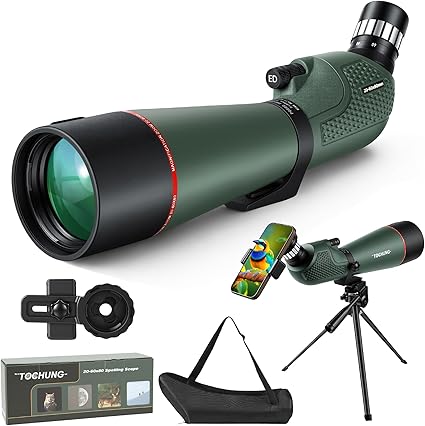
Boasting an 80mm objective lens and a zoom range from 20x to 60x, this spotting scope is ideal for anyone serious about long-distance land viewing. Its clearest feature is the bright and sharp image quality it delivers, making it suitable for birdwatching and shooting ranges alike.
Setting it up is straightforward with a tripod mount that keeps the scope steady during use. The manual focus allows precise control, important for locking onto distant targets.
A universal smartphone adapter lets you capture what you see without extra hassle. Day-to-day use benefits from the waterproof and fogproof design, so performance stays consistent across different weather conditions.
Optics are fully multi-coated, resulting in a vibrant, high-contrast image even at the highest 60x magnification. The build feels solid but not too heavy for occasional transport. Clear image detail is the strongest praise, while some users note the manual focus requires patience for fine adjustments, especially at maximum zoom.
Clear and sharp images at long distances are widely appreciated. Manual focusing, especially at 60x zoom, requires some patience and careful adjustment to get the best results. The waterproof and fogproof feature helps maintain image clarity in various weather situations, adding real value for outdoor enthusiasts.
Value and performance appeal to birdwatchers, shooters, and nature observers needing strong magnification with good image quality. People wanting quick autofocus or lighter, more compact scopes might want to look elsewhere for simpler handling.
Pros
- Bright, high-contrast viewing with 80mm aperture
- Waterproof and fogproof for outdoor use
- Universal smartphone adapter included
- Tripod mount ensures steady observation
Cons
- Manual focus feels slow at highest zoom
- Can be bulky for some users
| Specification | Details |
|---|---|
| Mount | Tripod Mount |
| Focus Type | Manual Focus |
| Compatible Devices | Smartphone |
| Field Of View | 1000 yard |
| Zoom Ratio | 20x-60x |
5. Celestron SkyMaster 25×70 Binoculars

Celestron SkyMaster 25×70 Binoculars offer strong 25x magnification and large 70mm lenses, making them great for long-distance land viewing. Ideal for serious hobbyists who want bright, detailed images when mounted on a tripod, these binoculars excel in clarity under low-light conditions.
Setting up involves attaching the binoculars to a tripod using the built-in ¼”-20 adapter, which fits most standard tripods. The center focus knob is easy to adjust, producing sharp views across the field. The multi-coated lenses and BaK-4 prisms improve brightness, so daily use at dawn or dusk delivers clear, vibrant images without too much effort.
Performance delivers bright, sharp images with minimal distortion thanks to BaK-4 prisms and multi-coated optics. Built with Porro prisms and a sturdy water-resistant body, they are reliable outdoors. The main praise is the clarity and brightness in low-light settings.
A common complaint points to the binoculars’ weight, which can feel heavy without the tripod mount.
Brightness and sharp image quality are consistently praised in reviews, especially for dawn and dusk viewing. The main drawback mentioned is the binoculars’ weight requiring tripod use for comfortable handling during extended observation sessions.
People who want detailed, bright views at long distances and don’t mind using a tripod will appreciate these binoculars. Those seeking lightweight, handheld options should consider alternative models.
Pros
- Bright and detailed views in low-light conditions
- Works well mounted on a standard tripod
- Comfortable eye relief for extended use
- Water-resistant for outdoor durability
Cons
- Heavy and bulky without tripod support
- Tripod sold separately, adding to setup needs
| Specification | Details |
|---|---|
| Magnification Maximum | 25 x |
| Objective Lens Diameter | 7 centimeters |
| Prism Type | Porro Prism |
| Eye Relief | 13 millimeters |
| Focus Type | Center Focus |
| Water Resistance Level | Water Resistant |
6. Celestron SkyMaster 20×80 Binoculars

Feeling sturdy in your hands, these binoculars deliver power and clarity for long-distance land viewing. Great for anyone using a tripod to explore landscapes or watch distant wildlife, their biggest strength lies in strong 20x magnification combined with big 80mm lenses for clear, bright visuals.
Setting up involves attaching the binoculars to a tripod using the simple built-in adapter, since their size and weight make handheld use tiring. Cleaning is straightforward thanks to multi-coated lenses that resist smudges.
Focusing is quick with the center focus wheel. Water resistance means you can use them near water or in mist without worry.
View sharpness and brightness stand out, especially in low light thanks to BaK-4 prisms that let more light reach your eyes. The sturdy Porro prism design adds depth to views, though the binoculars can feel heavy and bulky without a tripod.
Most praise centers on image quality, while many note the need for stable mounting to avoid shaking.
Bright, sharp images especially near dawn and dusk stand out as the best feature, thanks to BaK-4 prisms. The most frequent drawback mentioned is the bulk and weight, which makes handheld use impractical and mandates tripod support for comfortable viewing.
Anyone wanting crisp, detailed views over long distances in dimmer light will appreciate these binoculars. Those needing something lightweight or handheld should look for smaller, less powerful options instead.
Pros
- Bright views with BaK-4 prisms in dim light
- Strong 20x magnification for long-distance spotting
- Easy tripod mounting with built-in adapter
- Multi-coated lenses reduce glare and reflections
Cons
- Heavy and bulky, not suited for handheld use
- Tripod required for steady viewing outdoors
| Specification | Details |
|---|---|
| Magnification Maximum | 20 x |
| Objective Lens Diameter | 8 centimeters |
| Prism Type | Porro Prism |
| Eye Relief | 18 millimeters |
| Mount Type | Tripod Mount |
| Water Resistance Level | Water Resistant |
7. 90mm Refractor Telescope with AZ Mount

Great for anyone wanting detailed views of distant land features, this 90mm refractor offers bright images and fine tracking control. Its large aperture and versatile power options make it especially suitable for daytime landscapes and lunar observation, providing solid value without overcomplicating the setup.
Setup involves attaching the adjustable altazimuth mount with an accessory tray, which gives stable coarse and fine pointing control using slow-motion knobs. Switching between 32x and over 200x magnification is straightforward, aided by a reflex finderscope for quick target location.
The manual focus keeps the view sharp across varied distances, and full lens coating helps with brightness and clarity.
Image brightness and sharpness stand out, particularly for features like lunar craters and star clusters, thanks to the 90mm aperture and 800mm focal length. Construction feels sturdy, especially the Vertisteel AZ base mount, although some users note the manual focus requires patience. The biggest praise lies in holding targets steady, while the most common gripe is occasional difficulty with manual focusing precision.
Precision in tracking and a bright, detailed image are often praised, making it easy to follow moving targets like the moon. Some find manual focusing challenging, especially when switching between distant land and celestial objects. The coarse and fine adjustments help, but patience is necessary.
A good choice for enthusiasts who enjoy daytime nature and moon viewing and want adjustable magnification without complex electronics. Those wanting quick autofocus or lighter gear might want to explore other models. The stable mount suits backyard setups rather than travel-friendly use.
Pros
- Large 90 mm aperture for bright images
- Fine-tracking altazimuth mount
- Four magnification options including 240x
- Compatible with smartphones
Cons
- Manual focus can be tricky to adjust precisely
- Bulky mount adds some weight to carry
| Specification | Details |
|---|---|
| Aperture | 90 MM |
| Focal Length | 800 millimeters |
| Mount Type | Adjustable altazimuth tripod with accessory tray |
| Eyepieces | Kellner, 25 mm and 10 mm |
| Finderscope | Reflex |
| Focus Type | Manual Focus |
8. Celestron StarSense Explorer LT 80AZ Telescope

Lightweight aluminum construction and manual focus make this telescope ideal for those looking to explore long-distance land and celestial sights without complicated setup. Its biggest strength lies in integrating StarSense technology, enabling even beginners to find targets using a smartphone connection.
Setup is straightforward, attach your phone to the mount, launch the StarSense Explorer app, and follow the app’s guidance to aim the telescope. The included 25mm and 10mm eyepieces allow quick switching between wider views and closer zoom, with manual focus controlling clarity.
The altazimuth mount is easy to move for scanning landscapes or sky objects without gearing or motors.
Performance delivers clear views of distant land features and celestial bodies with fully coated optics reducing glare. Build is solid yet portable, designed for manual operation without external power, making it simple for outdoor use.
StarSense accurately guides you, though some mention the need for patience when aligning precisely. Complaints mainly mention limited zoom power at 2.5x for very distant targets.
StarSense technology effectively helps locate distant targets using smartphone sky recognition, praised for ease of use. The most frequent drawback is the minimal zoom range, which some find restrictive for very long-distance land viewing.
The telescope suits beginners seeking simple setup and guidance to enjoy both earth and sky viewing. Those requiring higher magnification or motorized tracking should look for other options better suited to advanced observations.
Pros
- Easy smartphone-assisted navigation
- Lightweight and portable design
- Manual focus for precise adjustments
- Fully coated glass optics for clarity
Cons
- Limited 2.5x zoom for extreme distances
- Patience required for accurate alignment
| Specification | Details |
|---|---|
| Eye Piece Lens Description | 25mm and 10mm eyepieces |
| Mount | Altazimuth Mount |
| Focus Type | manual Focus |
| Power Source | manual Operation Without External Power Source |
| Compatible Devices | Smartphone |
9. Celestron StarSense Explorer LT 114AZ Telescope

Easy smartphone integration makes locating distant land features surprisingly simple, fitting beginners and casual viewers well. The standout feature is its ability to guide you using your phone’s camera and StarSense app, turning complex navigation into a straightforward experience.
Setting it up involves attaching your smartphone to the dock and launching the StarSense Explorer app, which then directs you where to point with on-screen arrows. Manual focusing is smooth with the altazimuth mount, and swapping between the 25mm and 10mm eyepieces adjusts your view.
The included lithium metal battery powers it reliably, keeping it operational without constant replacements.
It performs admirably for long-distance land viewing with a focal length of 1000 millimeters delivering detailed images. The glass mirrors with aluminum and SiO₂ coating produce clear visuals. The mount is sturdy enough for steady viewing but requires manual control, with some users noting occasional challenges in keeping targets in sight.
The telescope’s strength lies in its guided navigation, but manual focus and tracking can demand patience.
Strongest praise highlights the app’s ability to guide you to targets easily, making navigation clear without prior knowledge. The typical complaint revolves around manual focus and mounting requiring a steady hand, which sometimes makes tracking objects a bit challenging.
People comfortable with manual telescope adjustments and smartphone usage will find this satisfying for land viewing. Those looking for motorized tracking or easier fine-tuning might look for other models offering automated control.
Pros
- Smartphone app guides viewing easily
- Two eyepieces for flexible zoom levels
- Lightweight and simple manual focus
- Decent magnification for long distances
Cons
- Manual focus can be tricky for beginners
- No motorized tracking for steady viewing
| Specification | Details |
|---|---|
| Focal Length | 1000 millimeters |
| Eyepieces Included | 25mm and 10mm |
| Mount | Altazimuth Mount |
| Coating | Aluminum and SiO₂ on glass mirrors |
| Zoom Ratio | 175 |
| Compatible Devices | Smartphone |
10. Smart Digital 4K Astrophotography Telescope

Bright optics and a digital 4K camera make this a standout telescope for long-distance land viewing and star gazing. The large 80mm aperture combined with a 300mm focal length delivers sharp detail far beyond typical entry-level models. Ideal for anyone eager to observe wildlife or explore distant scenery in sharp detail.
Setup involves mounting it on the included tripod, then connecting the auto-focus eyepiece or flipping out the external screen for group viewing. The dual screen option helps ease eye strain during extended sessions. Zooming up to 350x is smooth, bringing tiny details into view without constant adjustments.
Compatibility with smartphones and tablets lets you capture photos or videos with ease.
Image detail excels under various lighting thanks to the ultra-sensitive starlight CMOS sensor, allowing clear views even as light fades. The build feels sturdy, especially the orthoscopic eyepiece and reflex finderscope aiding accurate targeting.
Most praise focuses on the clean 4K imagery, while some users mention the need for nonstandard batteries as a drawback.
The main compliment is the telescope’s ability to deliver clear, bright 4K images, even of faint objects in low light. The most frequent complaint involves the unusual battery type, which can be inconvenient and require specific replacements.
Those focused on detailed, long-distance viewing will find the combination of optical power and digital enhancement useful. People prioritizing simpler power options or ultra-portable designs might consider alternatives better suited to travel or quick setup.
Pros
- 4K star-sensitive digital camera for crisp images
- Large 80mm aperture for bright viewing
- Dual screens reduce eye fatigue during observation
- Auto-focus simplifies sharp image capturing
Cons
- Requires nonstandard batteries
- Tripod may feel less stable in windy conditions
| Specification | Details |
|---|---|
| Eye Piece Lens Description | Orthoscopic |
| Mount | Tripod Mount |
| Focus Type | Auto Focus |
| Zoom Ratio | 350 |
| Focal Length Description | 300mm |
Best Telescopes for Long Distance Land Viewing Comparison
| Product | Magnification | Objective Lens Diameter | Mount Type | Additional Features |
|---|---|---|---|---|
| SVBONY SV28 Scope | 3:1 Zoom | – | Equatorial Mount | Waterproof, 45 degree |
| DiamondEdge 25-75×80 Scope | 25-75x | 80mm | Tripod Mount | Multi-coated Bak4 Prism |
| 90mm Refractor Telescope | 450x | 90mm | Altazimuth Mount | Fully Coated Optics |
| 20-60×80 HD Scope | 20x-60x | 80mm | Tripod Mount | Waterproof, Smartphone Adapter |
| Celestron SkyMaster 25×70 Binoculars | 25x | 70mm | Tripod Mount | Ultra sharp focus |
| Celestron SkyMaster 20×80 Binoculars | 20x | 80mm | Tripod Mount | Water Resistant |
| 90mm Refractor AZ Mount | – | 90mm | Adjustable Altazimuth | Fine-tracking AZ Mount |
| Celestron StarSense 80AZ | – | 80mm | Altazimuth Mount | StarPointer Red Dot |
| Celestron StarSense 114AZ | – | 114mm | Altazimuth Mount | Glass mirrors with coating |
| Smart Digital 4K Scope | 350x zoom | 300mm | Tripod Mount | Auto Focus, 4K Digital |
- Magnification3:1 Zoom
- Objective Lens Diameter–
- Mount TypeEquatorial Mount
- Additional FeaturesWaterproof, 45 degree
- Magnification25-75x
- Objective Lens Diameter80mm
- Mount TypeTripod Mount
- Additional FeaturesMulti-coated Bak4 Prism
- Magnification450x
- Objective Lens Diameter90mm
- Mount TypeAltazimuth Mount
- Additional FeaturesFully Coated Optics
- Magnification20x-60x
- Objective Lens Diameter80mm
- Mount TypeTripod Mount
- Additional FeaturesWaterproof, Smartphone Adapter
- Magnification25x
- Objective Lens Diameter70mm
- Mount TypeTripod Mount
- Additional FeaturesUltra sharp focus
- Magnification20x
- Objective Lens Diameter80mm
- Mount TypeTripod Mount
- Additional FeaturesWater Resistant
- Magnification–
- Objective Lens Diameter90mm
- Mount TypeAdjustable Altazimuth
- Additional FeaturesFine-tracking AZ Mount
- Magnification–
- Objective Lens Diameter80mm
- Mount TypeAltazimuth Mount
- Additional FeaturesStarPointer Red Dot
- Magnification–
- Objective Lens Diameter114mm
- Mount TypeAltazimuth Mount
- Additional FeaturesGlass mirrors with coating
- Magnification350x zoom
- Objective Lens Diameter300mm
- Mount TypeTripod Mount
- Additional FeaturesAuto Focus, 4K Digital
How to Choose the Right Telescope for Land Viewing
Choosing a telescope for long distance land viewing means focusing on clear image quality, easy adjustability, and durability. Prioritizing these factors ensures sharp, stable views and reduces the need for frequent replacements or upgrades, saving both money and frustration over time.
Optical Quality and Coatings
On bright, sunny days, glare can make distant objects nearly impossible to see clearly. This often comes from uncoated or poorly coated lenses that reflect light internally and cause haziness. Telescopes with multicoated optics significantly reduce this glare, producing sharper images with better contrast.
The difference is striking, especially in scenes with mixed lighting, such as bright skies behind shaded areas.
High-quality glass is equally important to avoid distortions and color fringing around the edges of objects. Lower-grade lenses can produce blurry or rainbow-like artifacts, frustrating efforts to get a clean view. Look for optics made from ED (extra-low dispersion) glass or similar materials to keep images crisp.
Multiple coatings on all air-to-glass surfaces, ideally three or more layers, also boost brightness and clarity in various light conditions.
Portability and Mount Stability
Carrying a heavy or bulky telescope limits where and how often it gets used. A device over a few pounds becomes tiring to transport on hikes or quick outings. Compact designs with lighter materials, like aluminum or carbon fiber, make a noticeable difference in daily usability.
High magnification amplifies even the smallest shake, ruining image stability. A sturdy mount or tripod with tight joints and decent weight helps prevent wobble. Quick-release mounts and simple adjustment knobs speed up setup and repositioning, so no viewing moment is lost.
Features like adjustable leg lengths or folding tripods improve both comfort and stability during extended land viewing sessions.
Durability and Weather Resistance
Outdoor viewing often means exposure to moisture, dust, and sudden temperature changes that cause fogging inside the optics. A telescope with waterproof and fogproof construction stays clear and reliable in these settings. Nitrogen or argon purging inside the tube is common to prevent internal fog buildup.
Durable housing materials like rubber-armored bodies protect against impacts and minor drops. Metal parts, especially anodized aluminum, resist rust and corrosion from rain or dew. Protective lens coatings also help guard the glass from scratches and dirt.
Frequent use in rough conditions demands gear built to last without sacrificing performance.
Ease of Use and Focus Mechanism
Achieving a sharp image at long distances requires a focusing mechanism that moves smoothly and precisely. Coarse focus knobs can be jerky or imprecise, making it difficult to find exact clarity. Models with dual-focus systems or fine-tuning capability allow better control, reducing eye strain.
Ergonomic features such as rubberized grip surfaces and adjustable eyecups enable comfortable viewing over long periods. A focus lock keeps the setting steady once found, especially useful when tracking distant objects. Practical design elements like properly placed controls prevent awkward hand positions that can tire users quickly.
Optimal Techniques for Maximizing Long Distance Land Viewing with Your Telescope
Clear and stable viewing over long distances depends largely on minimizing atmospheric disturbance. Choose calm days with little wind to reduce heat waves that blur the image.
Placing the telescope on a sturdy tripod cuts down shakes that interfere with detail. Adjust the focus slowly and steadily until the image sharpens, avoiding rapid changes that can make it harder to lock in on fine points.
Use the appropriate eyepiece to balance magnification and field of view; higher magnification reveals details but narrows what you can see and can intensify shakiness. A good starting point is a medium magnification where the image stays bright and clear rather than zooming in heavily and losing clarity.
Additional tips include:
- Allow the telescope to acclimate to outdoor temperature before use to reduce lens fogging.
- Scan the horizon with a wider field eyepiece to locate targets, then switch to a higher magnification.
- Use slow, precise movements on the mount to keep the object centered without overshooting.
Proper Maintenance and Care to Extend the Lifespan of Your Telescope
Keeping lenses free from dust and fingerprints is essential for sharp viewing. Use a soft microfiber cloth and lens cleaning fluid designed for optics.
Avoid household cleaners or rough materials that might scratch coatings. Store the telescope in a dry place that is protected from direct sunlight and extreme temperatures, which can warp components over time.
Check and tighten any screws or knobs regularly to maintain stability and precise alignment. Mechanical parts like focus wheels benefit from occasional light lubrication with silicone-based products, but take care not to over-apply. A protective dust cover when not in use can prevent accidental damage and grime buildup.
Routine maintenance includes:
- Cleaning lenses only when necessary to avoid unnecessary wear.
- Inspecting the tripod and mount for loose parts or signs of wear.
- Covering exposed parts during transport to prevent knocks and scratches.
Comparing Land Viewing Telescopes to Binoculars and Spotting Scopes for Versatility
Telescope optics generally provide greater magnification and detail for long-distance viewing compared to binoculars and spotting scopes. Binoculars offer convenience and ease of use, but their lower power can limit observation of fine details at extreme distances. Spotting scopes fall between binoculars and telescopes in magnification and tend to be more portable than large telescopes.
The tradeoff involves size, weight, and stability. Telescopes require tripods and can be bulky, while binoculars are handheld.
Spotting scopes often have angled eyepieces for comfort over longer viewing sessions. For land viewing across miles, telescopes excel in resolving distant objects but demand more setup.
Choosing between them depends on your priorities:
- Use binoculars for quick scans, short distances, or moving targets.
- Spotting scopes perform well for moderate distances and fieldwork that requires some portability.
- Telescopes suit users focused on detailed observation at long range where time for setup is not an issue.
People Also Asked
How Do I Properly Care for a Telescope After Long Distance Viewing?
Clean the lenses carefully with a soft, lint-free cloth to avoid scratches. Store the telescope in a dry place to prevent moisture buildup. Use a protective case to keep it safe during transport and avoid exposure to dust and dirt.
What Size Telescope Is Ideal for Detailed Land Observation?
A telescope with an aperture around 60 to 80 millimeters works well for detailed land viewing. Larger apertures gather more light, improving clarity, but make the setup heavier and less portable. Consider stability and ease of use too.
Are There Any Safety Precautions When Using a Telescope Outdoors?
Always avoid pointing the telescope directly at the sun to protect your eyes and the optics. Make sure the tripod is on a level surface to prevent tipping. Use lens caps when not in use to keep the glass clean and undamaged.
How Long Does a Typical Telescope Last with Regular Use?
A well-maintained telescope can last many years, often over a decade. Regular cleaning and proper storage are key to preserving its performance. Check parts like the mount and focuser periodically for wear or damage.
What Are Common Problems Faced When Using Telescopes for Land Viewing?
Fogging inside the lenses is common, especially in humid conditions. Adjusting focus can be tricky without a stable mount, leading to shaky images. Dust and dirt on lenses often reduce image quality, so regular cleaning helps.
Conclusion
Choosing a good telescope for long distance land viewing means focusing on clear optics, stable mounting, and suitable magnification. Clear optics make sure images are sharp and detailed, while a steady mount prevents shaky views. Having the right magnification helps you see far without losing image quality.
Consider how much space you have for storage and how often you plan to use the telescope before buying. Setting a realistic budget helps narrow down options.
Check the comparison table and the detailed reviews above to find the best match for your needs.