Top 10 Best Telescope Binoculars That Will Blow Your Mind!
Struggling with blurry or shaky views is a familiar problem for anyone using poorly made binoculars or telescope combos. The best telescope binoculars blend magnification with stability to avoid frustrating sightings of stars or distant animals. A lower-quality model often shakes too much or fails to focus sharply, which defeats the purpose of carrying such gear into the field or on a camping trip.
Weight and magnification are crucial in these devices. Most reliable telescope binoculars offer a magnification between 15x and 25x with lens diameters around 50-70mm for good light intake. Materials play a key role as well: aluminum or magnesium bodies resist weather better than plastic.
Proper eye relief, often 15mm or more, matters for comfort and safety, especially for eyeglass wearers. Lastly, lenses with multi-coating help deliver clearer images and can simplify cleaning without smudging.
Need a Quick Check?
| Image | Product | Price |
|---|---|---|
Our Top Picks 1  | Celestron SkyMaster 15×70 | Check Price |
Our Top Picks 2  | Celestron Cometron 7×50 | Check Price |
Our Top Picks 3  | Celestron SkyMaster 25×70 | Check Price |
Our Selected Top 10 Telescope Binoculars Worth Your Money
This list features a selection of high-quality telescope binoculars that balance performance and usability. Each review highlights key features, suitability for different users, and the strengths and weaknesses to help you make an informed choice based on your needs.
1. Celestron SkyMaster 15×70 Binoculars
Powerful 15x magnification combined with large 70mm objective lenses makes these binoculars ideal for astronomy or long-distance viewing. They suit anyone who wants detailed, bright images and is ready to set them up on a tripod for stability.
Their strength lies in providing clear, sharp views in low-light conditions like dusk or dawn.
Setup involves attaching the binoculars to a tripod using the built-in ¼”-20 adapter, which takes seconds. Everyday use relies on manual center focus, allowing precise adjustments. The water-resistant design means occasional damp weather won’t cause issues.
Eye relief of 18 millimeters helps reduce eye strain during extended use. Handling feels solid but requires stable support because of the size and weight.
These binoculars deliver bright, sharp images thanks to BaK-4 prisms and multi-coated lenses. They work well in dim lighting, letting you see intricate details in the night sky or faraway objects. Most praise highlights the image quality and clarity.
The biggest complaint is the need for a tripod due to their heavy build, making handheld use impractical for long periods.
Celestron SkyMaster 15×70 binoculars provide significant magnification paired with large 70mm lenses that let in a lot of light. Sharp and bright views, especially in low light situations like dusk or night sky watching, come from BaK-4 prisms. The main drawback is their size and weight, which almost always require mounting on a tripod for steady viewing.
People interested in detailed, long-distance observation or stargazing will appreciate the clear views these binoculars offer. Those wanting a more compact, handheld model for general outdoor use should consider smaller options. SkyMaster is practical for serious viewing but might be cumbersome for casual or mobile activities.
Pros
- Bright views using BaK-4 prisms
- Water resistant for outdoor use
- Tripod-ready with ¼”-20 adapter
- Multi-coated lenses reduce glare
Cons
- Too heavy for handheld use
- Tripod not included
| Specification | Details |
|---|---|
| Magnification Maximum | 15 x |
| Objective Lens Diameter | 7 centimeters |
| Eye Relief | 18 millimeters |
| Prism Type | Porro Prism |
| Water Resistance Level | Water Resistant |
| Focus Type | Center Focus |
2. Celestron Cometron 7×50 Binoculars
Anyone starting out in astronomy will appreciate these binoculars for their simplicity and bright views. Ideal for scanning large sections of the night sky like the Milky Way, their biggest strength lies in the balance between a wide field of view and clear image quality.
Setting up is straightforward with the individual manual focus and diopter adjustment that lets you tailor sharpness to your eyes. Their 7X magnification makes objects easy to track without excessive shakiness.
The tripod mount option adds stability for longer viewing sessions, while water resistance means light moisture won’t be a problem outside.
Black-coated Porro prisms and multi-coated optics deliver surprisingly clear and bright images with good contrast. The large 50mm lenses gather a lot of light, filling the view even in low light. Users often note how comfortable the eye relief is, but some mention that the focus can be a bit slow to dial in precisely, which might take some patience.
The brightest praise is aimed at the clear, well-lit images thanks to the 50mm lenses and multi-coated optics. The most frequent complaint concerns the manual focus, which some find a bit sluggish to get just right during stargazing.
People wanting easy-to-use astronomy binoculars with a good field of view will enjoy this pair. Those looking for higher magnification or quicker focusing might want to explore other options better suited to detailed planetary viewing or faster adjustments.
Pros
- Wide field of view for easier sky scanning
- Water resistant for outdoor use
- Comfortable 13mm eye relief
- Tripod mount compatible for steady viewing
Cons
- Manual focus can feel slow to adjust
- Limited magnification for detailed observation
| Specification | Details |
|---|---|
| Magnification Maximum | 7 x |
| Objective Lens Diameter | 50 millimeters |
| Field of View | 6.8 degrees |
| Focus Type | Manual Focus |
| Water Resistance Level | Water Resistant |
3. Celestron SkyMaster 25×70 Binoculars
Powerful 25x magnification paired with 70mm objective lenses make these binoculars ideal for both astronomy and long-distance land viewing. Best suited for those comfortable using a tripod to handle their weight and size, they deliver bright, detailed images in low light conditions.
Setting up involves attaching the binoculars to a standard photo tripod using the built-in ¼”-20 adapter, which secures them quickly and firmly. Daily use requires manual center focus, allowing you to fine-tune sharpness across the field of view. Water resistance adds durability for outdoor use, while multi-coated lenses help reduce glare for clearer viewing.
These binoculars excel at providing sharp, bright views thanks to BaK-4 prisms and large objective lenses. The build feels solid and designed for stability when mounted, but the size and weight mean handheld use is impractical.
Strongest praise highlights the brightness and clarity during dawn, dusk, or night; the biggest complaint is the need for a tripod due to bulk and weight.
Many appreciate the clarity and brightness of images in low light, making these binoculars great for night sky watching. The main drawback encountered is their bulk and weight, which effectively requires a tripod to achieve steady views.
Those focused on detailed astronomy or distant terrestrial observation while using a tripod will find these binoculars suit their needs well. Anyone seeking a lightweight, handheld option should consider other models with lower magnification and smaller lenses.
Pros
- Bright, sharp views with BaK-4 prisms
- Works easily with standard photo tripods
- Multi-coated lenses for better clarity
- Water resistant for outdoor use
Cons
- Too heavy for handheld use comfortably
- Must be mounted on tripod for stable viewing
| Specification | Details |
|---|---|
| Magnification Maximum | 25 x |
| Objective Lens Diameter | 7 centimeters |
| Focus Type | Center Focus |
| Eye Relief | 13 millimeters |
| Prism Type | Porro Prism |
| Water Resistance Level | Water Resistant |
4. Travel Telescope 70mm Refractor with 10×50 Binoculars

Travel Telescope 70mm Refractor with 10×50 Binoculars offers a solid setup for anyone keen on both stargazing and outdoor activities. Best suited for travelers and casual astronomers, it stands out with a large 70mm aperture that delivers brighter, clearer images, making distant views easier to enjoy.
Setting up involves positioning the altazimuth mount and manually focusing on targets. The included Kellner eyepieces and 3X Barlow lens let you adjust magnification from 20X up to 132X, while the binoculars provide a wide 45-degree field of view.
Using the smartphone adapter adds a simple way to capture what you see, enhancing both day and nighttime observations.
Its build supports both land and astronomical viewing with fully multi-coated lenses and a reflex finderscope aiding quicker target location. The device handles well with solid optics for detailed viewing. Most praise centers on sharp, bright images, with a common complaint regarding the manual focus requiring patience when changing views under varying light conditions.
Bright and clear images are the highlight, thanks to the large aperture and multi-coated lenses. Users often find focusing manually a bit challenging, especially when switching between different views rapidly or in low light.
Ideal for travelers who want both binoculars and a telescope in one kit. Those needing fast or automated focusing may want to consider other options beyond manual setups.
Pros
- Large 70mm objective lens for bright imaging
- Wide 45-degree field of view binoculars
- Includes 3X Barlow lens for zoom flexibility
- Smartphone adapter for convenient imaging
Cons
- Manual focus can be slow to adjust
- Need batteries to power the telescope
| Specification | Details |
|---|---|
| Eye Piece Lens Description | Kellner |
| Mount | Altazimuth Mount |
| Focus Type | Manual Focus |
| Power Source | Battery Powered |
| Finderscope | Reflex |
| Field Of View | 45 degrees |
5. 16×52 Monocular Telescope

Using a handheld monocular with a 16x magnification really brings distant scenes right up close. Ideal for those who love outdoor adventures like hiking or bird watching, it delivers bright, clear images that make spotting wildlife or watching sports far more engaging.
The single biggest strength is its powerful view packed into a compact, durable design.
Daily use means relying on the manual focus to quickly adjust views as you move through different scenery. It’s lightweight and easy to carry, slipping into a backpack or pocket without fuss.
The fully multi-coated lens helps keep images sharp in various lighting conditions, and the waterproof, fogproof, and shockproof features make it a dependable companion on all sorts of outings. No batteries needed so it’s always ready.
Performance stands out with the 52mm objective lens providing a bright field of view at 5.8 degrees, great for scanning horizons or following fast action. The prism type and coatings work well to deliver crisp, vibrant images. The build is solid, designed to handle rough outdoor use without damage.
Most praise centers on the strong optical clarity, while the main complaint involves the manual focus needing a steady hand for the sharpest view.
Bright, crisp images are the standout feature thanks to the fully multi-coated 52mm lens and 16x magnification. The biggest limitation comes with the manual focusing, which can be tricky to dial in perfectly without careful movement.
This monocular suits outdoor enthusiasts seeking a rugged, reliable viewing tool for wildlife spotting and events. Anyone needing quick autofocus or a larger field of view should look at other options better suited to those needs.
Pros
- Bright, clear images with 16x magnification
- Durable: waterproof, fogproof, and shockproof
- Compact and easy to carry outdoors
- No batteries needed for immediate use
Cons
- Manual focus requires steady hand for clarity
- Field of view could be wider for some activities
| Specification | Details |
|---|---|
| Magnification | 16x |
| Objective Lens Diameter | 52mm |
| Field Of View | 5.8 degrees |
| Focus Type | Manual Focus |
| Coating | Fully Multi-Coated |
| Waterproof, Fogproof, Shockproof | Yes |
6. Celestron SkyMaster 20×80 Binoculars

Strong magnification and large objective lenses make these binoculars a solid choice for serious stargazers or long-distance land observers. The standout feature is the 20x power paired with 80mm lenses, delivering bright and detailed images best enjoyed with a tripod.
Great for anyone wanting to see distant objects clearly without jumping to a telescope just yet.
Setup involves attaching the binoculars to a tripod via the built-in ¼”-20 adapter, which fits quickly on most standard tripods. Daily use focuses on taking advantage of the center focus feature for sharper views.
Water resistance means occasional light moisture won’t be damaging during outdoor sessions, and the multi-coated lenses provide brighter images through BaK-4 prisms, especially around dawn, dusk, or nightfall.
The binoculars deliver sharp, bright images due to their large objective lenses and efficient light transmission. The solid build supports steady viewpoints on a mounted tripod, though the size and weight usually require this extra support. Reviews mention excellent clarity for astronomical and long-distance viewing, but the binoculars are too heavy to hold steady by hand for long.
Consistently praised for providing bright, detailed views at 20x magnification with BaK-4 prisms, the main drawback is the binoculars’ size and weight, which almost always require mounting on a tripod for steady observation. They work best for anyone who plans to spend lengthy sessions looking at distant objects, especially at night.
Those who want powerful, long-distance viewing with excellent light transmission will appreciate these binoculars. People needing something lightweight or handy for casual, quick use might prefer smaller, less powerful models that can be used comfortably by hand. This set belongs on a tripod for the best experience.
Pros
- Powerful 20x magnification for detailed distant views
- Large 80mm lenses gather plenty of light
- Built-in tripod adapter fits standard mounts
- Water resistant for outdoor use
Cons
- Too heavy to comfortably hold without tripod support
- Tripod not included, must buy separately
| Specification | Details |
|---|---|
| Magnification Maximum | 20 x |
| Objective Lens Diameter | 8 centimeters |
| Field of View | 3.7 degrees |
| Eye Relief | 18 millimeters |
| Prism Type | Porro Prism |
| Focus Type | Center Focus |
7. 12×50 Monocular with Phone Adapter and Tripod
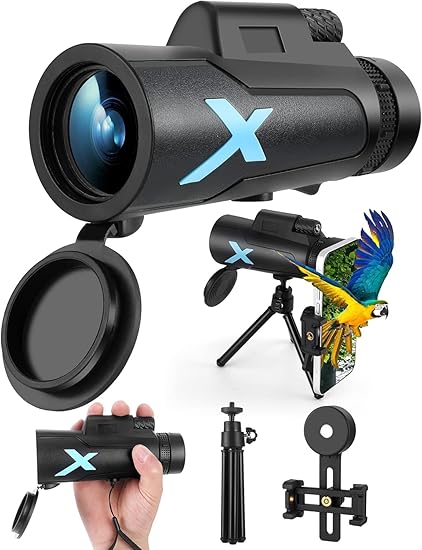
Metal and glass come together in a compact design built for outdoor use. Ideal for hikers, bird watchers, and travelers, it provides sharp, clear images with its 12x magnification. Its biggest strength lies in the clarity and brightness offered by the large BAK4 prism lens and Fully Multi-Coating technology.
Setup is straightforward with a manual focus that lets you quickly adjust for crisp views. The included tripod adapter adds stability for extended viewing, and the phone adapter allows easy photo and video capture through the lens. Large eyepieces help reduce eye strain, and it works well whether you wear glasses or not thanks to adjustable eye relief.
No batteries needed makes it ready anytime.
Picture quality lives up to the specifications, delivering bright and color-accurate images with minimal distortion across its 6.5° field of view. Build quality feels solid, offering comfortable handheld use and easy tripod mounting.
The sharpest feedback points to the sharp image quality, while some users mention that manual focusing takes a bit of getting used to. The monocular is reliable but not waterproof.
Bright and clear images with 12x power are the highlight, making it excellent for detailed outdoor viewing. Manual focus requires patience to master but offers precise control once familiar. The build stands up well to handheld and tripod use but does not protect against moisture or rough weather.
Anyone wanting bright views for bird watching, hiking, or sports events will find this useful, especially with the phone adapter for capturing moments. Those expecting waterproof features or quick autofocus might want to explore other options better suited to tough environments or fast-moving subjects.
Pros
- High-contrast, color-accurate images
- Large eyepieces reduce eye strain
- Includes phone adapter for easy capturing
- Tripod mount adds viewing stability
Cons
- Manual focus can be tricky at first
- Not suitable for rainy or wet conditions
| Specification | Details |
|---|---|
| Power | 12x Magnification |
| Objective Lens | 53mm |
| Field Of View | 6.5 degrees |
| Eye Piece Lens | Multi-coated with Adjustable Eye Relief |
| Mount | Tripod-adaptable with Standard 1/4-inch Thread |
| Focus Type | Manual Focus |
8. 18×70 Astronomy Binoculars

High magnification stands out immediately, with 18x power and a large 70mm aperture making it ideal for astronomy and long-distance viewing. Perfect for anyone wanting a detailed look at the night sky or faraway landscapes. Its biggest strength lies in its ability to gather plenty of light for clear images, even in low-light conditions.
Setting up involves mounting it on a tripod, which keeps the view steady despite the high magnification. The center focus knob is easy to adjust, letting you sharpen the image comfortably.
It has a manual focus type with an 18mm eye relief that suits most users, and you can attach a smartphone to capture views directly. The waterproof design means you won’t worry about using it outdoors in damp environments.
Its optical performance is impressive, delivering sharp and bright images thanks to BAK-4 prisms and fully multi-coated lenses that reduce reflections. The build quality feels solid and ready for regular use outdoors, although some users note the weight can make handheld use tiring without a tripod. The manual focus and diopter adjustment help refine the view, but the field of view narrows due to the 18x magnification.
Images come through crystal clear and bright, complemented by great light transmission from the BAK-4 prisms and multi-coated lenses. Many find the binoculars heavy, making the tripod essential for comfortable viewing over long periods.
Those who enjoy detailed stargazing or spotting distant objects with steady focus will be satisfied with these binoculars. Casual users or those needing wider fields of view might prefer lighter models with less magnification.
Pros
- Strong 18x magnification for detailed views
- Large 70mm aperture for better light gathering
- Waterproof design for outdoor use
- Compatible with smartphones for capturing images
Cons
- Can feel heavy without tripod support
- Narrow field of view at highest zoom
| Specification | Details |
|---|---|
| Magnification Maximum | 18x |
| Objective Lens Diameter | 7 centimeters |
| Eye Relief | 18 |
| Prism Type | Roof Prism with BAK-4 glass |
| Field of View | 70.41 meters |
| Water Resistance Level | Waterproof |
9. Occer 12×25 Compact Binoculars

High magnification combined with a wide field of view makes the Occer 12×25 Compact Binoculars a solid choice for anyone who wants detailed views without bulky gear. Perfect for hiking and bird watching, it’s the clear pick when you want power and portability in one package.
Setting up is really straightforward thanks to the center focus dial which makes adjusting quick. The adjustable eye cups work well for both eyeglass wearers and non-wearers, giving you a lot of flexibility. Its waterproof design and compact size mean it can easily handle outdoor adventures without weighing you down or fussing over the weather.
Image clarity stands out with fully multi-coated optics and BAK-4 prisms delivering sharp, bright views even in lower light. The build feels solid and comfortable to hold, with rubber eyepieces that pull down neatly for glasses.
Some users mention that focusing can take a bit longer than expected, but the crisp pictures generally balance that out well.
The optics provide bright, clear images that suit bird watchers and travelers who need zoom without bulk. Pull-down rubber eyepieces make it easier for people who wear glasses to get a good view. Some find the manual focus requires more patience than expected, especially when switching views quickly.
This model works well for outdoor enthusiasts who value portability and decent magnification in varying light conditions. Those needing faster autofocus or superior low light viewing might want to consider more specialized binoculars.
Pros
- 12x magnification with wide field of view
- Adjustable eye cups for eyeglass users
- Waterproof and compact for outdoor use
- Fully multi-coated optics for clear images
Cons
- Manual focus can feel a bit slow to adjust
- Small exit pupil limits low light performance
| Specification | Details |
|---|---|
| Magnification Maximum | 12 |
| Objective Lens Diameter | 25 millimeters |
| Field of View | 7.5 degrees |
| Eye Relief | 20 millimeters |
| Prism Type | BAK-4 |
| Water Resistance Level | Waterproof |
10. 12×25 Pocket Binoculars

Catching glimpses of distant birds or enjoying a concert in the open air becomes easier with compact optics that fit right in your pocket. Ideal for travelers, hikers, and nature watchers, these binoculars bring a solid 12X magnification without weighing you down, making them great for quick outings where packing light is key.
Carrying them feels like adding almost no extra bulk to your backpack, thanks to their lightweight and foldable design. Adjusting focus is straightforward, using a smooth center-focus knob alongside the right eye lens to suit your vision. The waterproof feature means they can handle an unexpected drizzle while spotting wildlife or scenic views.
These binoculars deliver a clear and wide view field, letting you spot things more easily with their 12X power and fully multi-coated lenses. The BAK4 prism improves image quality, providing sharp details even with the 25 mm lens diameter.
A common drawback is that the manual focus can feel a bit challenging to fine-tune quickly, especially in fast-moving situations.
A frequently praised feature is the binoculars’ lightweight, pocket-friendly design that fits into any day’s plans with ease, combined with clear images thanks to the BAK4 prism. Most users find manual focusing a bit finicky, which can slow down quick spotting attempts or adjusting between distances.
People wanting a compact, travel-ready optic will appreciate these binoculars, especially for daytime or well-lit settings. Those requiring faster focus adjustments or better performance in low light might look for options with larger lenses or autofocus mechanisms.
Pros
- Lightweight and easy to carry anywhere
- Clear optics with fully multi-coated lenses
- Waterproof for outdoor durability
- Wide field of view covers more at once
Cons
- Manual focus can be tricky under quick shifts
- Smaller lens diameter limits low light use
| Specification | Details |
|---|---|
| Magnification Maximum | 12 x |
| Objective Lens Diameter | 25 millimeters |
| Field of View | 6 degrees |
| Focus Type | Center Focus |
| Water Resistance Level | Waterproof |
Best Telescope Binoculars Comparison Table
| Product | Magnification | Objective Lens Diameter | Mount Type | Water Resistance |
|---|---|---|---|---|
| Celestron SkyMaster 15×70 | 15x | 70mm | Tripod Mount | Water Resistant |
| Celestron Cometron 7×50 | 7x | 50mm | Tripod Mount | Water Resistant |
| Celestron SkyMaster 25×70 | 25x | 70mm | Tripod Mount | – |
| Travel 70mm Refractor & Binoculars | 20x | 70mm | Altazimuth Mount | – |
| 16×52 Monocular Telescope | 16x | – | Handheld Monocular | – |
| Celestron SkyMaster 20×80 | 20x | 80mm | Tripod Mount | Water Resistant |
| 12×50 Monocular with Adapter | 12x | – | Handheld/Tripod Adaptable | – |
| 18×70 Astronomy Binoculars | 18x | 70mm | Tripod Mount | Waterproof |
| Occer 12×25 Compact | 12x | 25mm | No Mount | – |
| 12×25 Pocket Binoculars | 12x | 25mm | – |
- Magnification15x
- Objective Lens Diameter70mm
- Mount TypeTripod Mount
- Water ResistanceWater Resistant
- Magnification7x
- Objective Lens Diameter50mm
- Mount TypeTripod Mount
- Water ResistanceWater Resistant
- Magnification25x
- Objective Lens Diameter70mm
- Mount TypeTripod Mount
- Water Resistance–
- Magnification20x
- Objective Lens Diameter70mm
- Mount TypeAltazimuth Mount
- Water Resistance–
- Magnification16x
- Objective Lens Diameter–
- Mount TypeHandheld Monocular
- Water Resistance–
- Magnification20x
- Objective Lens Diameter80mm
- Mount TypeTripod Mount
- Water ResistanceWater Resistant
- Magnification12x
- Objective Lens Diameter–
- Mount TypeHandheld/Tripod Adaptable
- Water Resistance–
- Magnification18x
- Objective Lens Diameter70mm
- Mount TypeTripod Mount
- Water ResistanceWaterproof
- Magnification12x
- Objective Lens Diameter25mm
- Mount TypeNo Mount
- Water Resistance–
- Magnification12x
- Objective Lens Diameter25mm
- Mount TypePocket
- Water Resistance–
How to Choose the Best Telescope Binoculars
Choosing telescope binoculars involves considering magnification, lens quality, and size to ensure clear, stable views without strain. Prioritizing these factors helps you avoid costly mistakes and improves your viewing experience by matching the binoculars to your specific needs and environment.
Optical Magnification and Lens Diameter
Trying to telescope binoculars with too high magnification often leads to shaky images that make it difficult to focus on stars or distant objects. Magnification above 15x requires steady hands or support, as the field of view narrows and images shake more easily. Lower magnifications, around 8x to 12x, offer a wider view and more stable image, making casual stargazing or birdwatching smoother.
Lens diameter plays a key role in how bright images appear. Larger lenses, for example 50mm or above, gather more light, which is helpful under low-light conditions like dusk or detailed night sky observations. Smaller lenses are lighter but produce dimmer images.
Balancing magnification and lens size ensures the binoculars remain easy to hold steady while still providing clear, bright views.
Build Quality and Materials
Frequent outdoor use shows how housing materials affect durability. Rubber-armored or metal bodies stand up better against knocks and moisture compared to cheap plastic. Some models also offer weather-resistant seals, which protect the optics during dew or light rain.
These features prevent internal fogging and prolong the binoculars’ lifespan.
Weight directly impacts comfort during long handheld sessions. Lighter models around 500 grams reduce arm fatigue, but may sacrifice build toughness.
Lens coatings, like fully multi-coated optics, make a big visual difference by cutting glare and enhancing contrast. Skimping on coatings often results in washed-out images, especially when looking toward bright light sources.
Ergonomics and Handling
Grip and size matter for extended use, especially if your hands are small or large. Some binoculars have textured rubber grips that provide a firm hold, unlike smooth plastic which can slip when sweaty. Compact models fit easily in hands and pockets but can be harder to focus precisely due to smaller focus knobs.
Diopter adjustment helps provide a sharp image for each eye, but it needs to be easily reachable and smooth to turn. A bulky or stiff focus ring slows down focusing effort and frustrates fast changes in viewing distance. Portability depends on size and weight, so travel-friendly options often sacrifice lens diameter to stay lightweight and compact.
Tripod Compatibility and Mounting Options
Many higher-power binoculars include threaded tripod sockets, allowing mounting on standard tripods. Without this option, holding magnifications above 12x steady by hand becomes challenging, leading to blurred or jittery images.
Tripod adapters stabilize the view and reduce hand tremor effects during longer observation sessions.
Mounting on a tripod significantly improves comfort when viewing for extended periods or through detailed scopes. Stability reduces eye strain and allows steady tracking of moving objects like wildlife or celestial bodies.
Some models come with quick-release mounts, while others need separate adapters, so checking compatibility with your tripod is essential.
Optical Features and Accessories
Optical features such as phase-corrected prisms provide sharper contrast and better color fidelity compared to standard designs. These subtle improvements become noticeable during prolonged use, where image clarity matters most.
The availability of accessory items like lens caps, padded carrying cases, and neck straps adds convenience and protects the optics during transport.
Compatibility with additional filters or attachments extends functionality. For example, some models accept sun filters for solar viewing or external lenses for closer zoom.
These options are often overlooked but can greatly expand the range of observation possibilities without buying new binoculars.
Maximizing Your Viewing Experience: Tips for Using Telescope Binoculars
The clarity of your view depends heavily on how you adjust the telescope binoculars. Start by setting the interpupillary distance to match the space between your eyes; this ensures both lenses are aligned properly. Use the central focusing wheel to bring objects sharply into view, and then fine-tune with the diopter adjustment, typically found on one eyepiece, to compensate for any difference in focus between your eyes.
For steadier viewing, rest your elbows on a solid surface or use a tripod adapter if your binoculars have one. This reduces shake that can blur your image, especially at higher magnifications.
Scanning the night sky or landscapes slowly prevents missing small, distant details. Avoid touching the lenses to prevent smudges; rather, carry a lens cloth if a quick clean is needed. These practical steps help you get the most out of your telescope binoculars, providing clear and comfortable views.
Proper Maintenance and Care to Extend the Life of Your Telescope Binoculars
Keeping telescope binoculars in good condition starts with protection from dust, moisture, and extreme temperatures. Store them in a padded case when not in use to avoid scratches and impact damage. Lens caps should always cover the lenses unless you’re actively observing.
Cleaning lenses requires care: use a soft brush or air blower to remove loose particles first. Follow with a microfiber cloth and lens cleaning solution designed for optics; avoid household cleaners or paper towels which can scratch surfaces.
Check moving parts like the focusing wheel regularly for smooth operation. A small amount of manufacturer-recommended lubricant can help when they feel stiff, but avoid applying too much. Avoid exposing the binoculars to direct sunlight for long periods, as this can damage coatings or internal components.
Proper maintenance keeps the optics clear and the mechanical parts functioning well, extending the life of your telescope binoculars.
Common Mistakes to Avoid When Choosing and Using Telescope Binoculars
Choosing telescope binoculars without considering your specific needs often leads to disappointment. Many buy models with very high magnification thinking it means better views, but higher power reduces the field of view and increases image shake. Assess how and where you plan to use them, scenery, astronomy, or wildlife, before deciding on specs like magnification and lens diameter.
Larger lenses gather more light but add weight and bulk.
Using telescope binoculars without stabilizing support is another common mistake. Hand-holding high-powered binoculars causes a shaky image, making it hard to focus on details.
Investing in a tripod or resting your elbows on a firm surface improves stability and viewing comfort. Also, not adjusting the interpupillary distance or diopter settings leads to eye strain and blurry images. Spending a few minutes calibrating these settings for your eyes pays off in a clearer, more enjoyable experience.
People Also Asked
How Do I Properly Care for Telescope Binocular Lenses?
Use a soft microfiber cloth to clean the lenses gently and avoid touching them with fingers. Store the binoculars in a protective case when not in use to prevent dust and scratches. Avoid cleaning the lenses too often as it might wear down coatings over time.
What Size Telescope Binoculars Are Suitable for Beginners?
Telescope binoculars with 7x or 10x magnification and 50mm objective lenses suit beginners well. This size offers a good balance between clear views and manageable weight. Avoid heavier, larger lenses that are harder to hold steady without a tripod.
Are Telescope Binoculars Safe to Use for Extended Periods?
Telescope binoculars are safe for extended use if not aimed directly at the sun. Many models have rubber eye cups to make long viewing sessions more comfortable. Taking breaks prevents eye strain, especially when observing in low light or with high magnification.
How Long Do High-Quality Telescope Binoculars Typically Last?
High-quality telescope binoculars can last many years if properly maintained. Regular cleaning and storing out of extreme temperatures keeps optical elements intact. Mechanical parts like hinges may need occasional tightening or adjustment over time.
What Common Problems Should I Watch for with Telescope Binoculars?
Common issues include fogging inside the lenses, loose focusing mechanisms, and scratches on the glass. Fogging often happens if the binoculars are not waterproof or sealed well. Testing the focus and alignment before use helps detect problems early.
Conclusion
Choosing the right telescope binoculars comes down to a few key points: clarity of the image, ease of use, and suitable magnification for your viewing purposes. Size and weight also matter, especially if you plan to carry them around for long periods. It’s important that the optics deliver a clear, bright picture without being too heavy or complicated to handle.
Think about where you’ll use them most and how much you want to spend. Smaller models work well for casual use in confined spaces, while larger options might suit open areas but require a steady setup.
Check the comparison table and reviews above to find the best match for your needs and budget before making your decision.