Top 13 Best Marine Radio for Beginners You Can’t Miss!
Using a low-quality marine radio often leads to frustrations like poor signal clarity or unreliable range right when clear communication is critical. Many people searching for the best marine radio for beginners find themselves dealing with radios that either interrupt during conversations or fail to pick up emergency channels consistently. These problems can make any boating trip stressful and unsafe, especially for newcomers who rely on their radio to stay connected and informed on the water.
The best marine radios for beginners typically stand out by offering durable construction that resists saltwater corrosion, compact design for easy installation in small cockpits, and sufficient transmission power around 25 watts to cover standard coastal ranges. A straightforward interface with large, clearly labeled buttons also matters since quick access to channel 16, the international distress frequency, can be crucial. Radios rated with IPX7 or better water resistance handle splashes and brief immersion, which is essential for most recreational boaters to maintain reliable communication under real conditions.
Need a Quick Check?
| Image | Product | Price |
|---|---|---|
Our Top Picks 1  | Cobra BlueBound 350 | Check Price |
Our Top Picks 2  | Uniden UM385BK VHF | Check Price |
Our Top Picks 3  | Retevis RM15 VHF | Check Price |
Our Selected Top 13 Marine Radio for Beginners for Different Needs
These reviews cover a range of marine radios designed for beginners with different needs and skill levels. Each product is evaluated based on performance, suitability for various users, and key strengths and weaknesses, helping you find the best option for your specific boating requirements.
1. Cobra BlueBound 350 VHF Marine Radio
Bright orange floating core makes it easy to spot and retrieve if it goes overboard. Ideal for beginners looking for a compact and reliable marine radio built with safety and practicality in mind.
Setup is straightforward, and switching between 1, 3, or 6 watts lets you manage power based on your range needs. The day/night LCD display helps in staying visible under any lighting or weather conditions. Battery saver mode extends usage time, making it useful during long trips or unpredictable weather.
Communication is clear up to 25 miles using the VHF channel range of 98. Waterproof construction and a buoyant frame give confidence during rough seas. Common praise highlights its easy visibility and dependable emergency alarm.
Sometimes the battery life at 12 hours can feel short on longer outings.
The high-visibility floating core and emergency alarm are praised most often for safety and ease in emergencies. Common complaints focus on the 12-hour battery life not lasting through very long outings without recharge.
Anyone needing a clear, easy-to-use marine radio for day trips or coastal boating will find this suitable. Those planning longer journeys or requiring longer battery life might want to look for options with extended power capabilities.
Pros
- High visibility floating core for easy retrieval
- Selectable power levels optimize battery life
- Day/night display suits all lighting conditions
- Emergency alarm adds extra safety
Cons
- Battery life may be limited for extended trips
- Compact size might reduce ease of handling
| Specification | Details |
|---|---|
| Number of Channels | 98 |
| VHF Power | Switchable 1/3/6 Watts |
| Water Resistance Level | Waterproof |
| Battery Average Life | 12 hours |
| Talking Range Maximum | 25 mile |
2. Uniden UM385BK Fixed Mount Marine VHF Radio
Clear communication and reliable alerts stand out with this radio. Suited for beginners sailing smaller boats or fishing trips, it offers safety and ease in one compact unit. Its biggest strength lies in combining crucial safety features like weather alerts and DSC into a user-friendly design.
Setting up the radio is straightforward, and it plugs into a 12-volt power source. The handheld mic lets you transmit while staying focused on steering, which makes using it practical and efficient.
You’ll find its triple watch feature handy, as it listens to multiple marine channels and weather alerts all at once without constant tuning.
Performance-wise, it covers a talking range up to 25 miles, suitable for coastal communication. The radio complies with IPX4 waterproof standards, so it can handle rain and splash without problems. Reviews often mention how dependable the weather alerts are for early warnings, while some users note the limited battery life as a drawback.
Weather alerts are praised for giving early warnings, which is reassuring while on the water. Some find the battery life shorter than hoped, which means keeping spares ready might be necessary. The compact design and intuitive controls make daily use manageable and comfortable.
Sailors needing basic, reliable communication and alert features will appreciate this radio. Those regularly Venturing far offshore or requiring more channel options might want to explore models with expanded range or power.
Pros
- Triple watch monitors multiple channels at once
- Weather alert keeps you informed about storms
- Handheld mic allows easy transmission while driving
- Waterproof to handle splashes and rain
Cons
- Batteries tend to drain faster than expected
- Limited to 40 channels only
| Specification | Details |
|---|---|
| Number of Channels | 40 |
| Talking Range Maximum | 25 mile |
| Voltage | 12 volts |
| Water Resistance Level | Waterproof |
| Connectivity Protocol | DSC (Digital Selective Calling) |
3. Retevis RM15 6W Marine VHF Radio
For anyone new to marine radios who values toughness and safety, this unit stands out thanks to its waterproof and floating design. It suits beginners looking for reliable communication during fishing or boating, especially where saltwater exposure is a concern.
The main strength lies in its durability combined with safety features that aren’t usually standard in entry-level radios.
Setting up takes just a few moments, with the included battery ready to go right out of the box. Its IP68 rating makes it worry-free around water, while the floating design ensures you won’t lose it if dropped overboard.
The emergency strobe is a handy feature that activates in water, giving extra visibility. Everyday use is straightforward with 88 channels accessible and NOAA weather alerts to keep you informed on the water.
The radio communicates clearly within its 16 km range, and the two-way noise reduction helps cut down background sounds, making conversations easier to understand. Saltwater corrosion is not a concern thanks to resistant charging contacts. The build is solid but some users mention weight could be lighter for extended handheld use.
It’s durable and dependable with some trade-offs on comfort.
The radio’s strongest praise is its ability to float and stay functional even when immersed in saltwater, which reduces worries about accidental drops. A repeated drawback mentioned is the weight, which some find tiring when holding for long periods. The emergency strobe light is also a well-noted safety boost.
Those who spend a lot of time fishing or boating in saltwater will appreciate the durability and safety features here. Beginners seeking a straightforward, reliable VHF radio will find this suitable. For users prioritizing lighter, more compact radios or standard batteries, alternative models may be better options.
Pros
- Waterproof to IP68 standard
- Floats on water surface
- Emergency strobe light activates in water
- Corrosion-resistant contacts
Cons
- Heavier than some handheld radios
- Uses nonstandard battery type
| Specification | Details |
|---|---|
| Number of Channels | 88 |
| Talking Range Maximum | 16 km |
| Water Resistance Level | Waterproof (IP68) |
| Battery Average Life | 10 hours |
| Voltage | 5 volts |
4. Uniden Atlantis 275 Handheld Marine VHF Radio

Staying connected and safe on the water becomes a priority for beginners who need a reliable marine radio that won’t weigh them down. The Uniden Atlantis 275 Handheld Marine VHF Radio suits newcomers due to its compact size and powerful 6-watt transmission, making it ideal for small boaters who want straightforward, dependable communication.
Setting up the radio involves just popping in the included AA battery, making it ready to use quickly. Its large LCD screen with distinct day (white) and night (red) backlight ensures easy reading in all lighting conditions.
The built-in flashlight and emergency strobe light come in handy when you’re on deck or signaling for help, while the compact floating design means it’s always within reach, even if dropped overboard.
With a maximum range of 36 miles, the radio delivers strong, clear communication across open water. It’s built tough to meet waterproof standards IPX8 and will keep working even after splashes or submersion. Many appreciate its bright screen and floating feature.
Some users mention wanting more than 25 channels, which can feel limiting in busy areas. It’s a sturdy and user-friendly device that prioritizes safety and simplicity.
The clear, large screen and floating design stand out as the most praised features, helping users stay connected safely close by. The limited number of channels is a frequent concern, possibly restricting communication options in crowded marine areas. The built-in light functions add valuable safety measures during emergencies.
People just starting with boating and who value straightforward operation will find this radio practical and reliable. Those needing extensive channel options or longer battery life might want to look at other models offering more advanced features or higher power.
Pros
- Compact and floats if dropped overboard
- Large, easy-to-read LCD with day and night backlight
- Emergency strobe light plus built-in flashlight
- Simple to use with included AA battery
Cons
- Only 25 channels available for communication
- Single AA battery may require frequent replacement
| Specification | Details |
|---|---|
| Number of Channels | 25 |
| Talking Range Maximum | 36 mile |
| Water Resistance Level | Waterproof (IPX8 / JIS8) |
| Battery Type | 1 AA battery (included) |
| Screen Size | 25mm (h) x 40mm (w) |
5. Standard Horizon HX210 Handheld Marine VHF Radio

Boasting a 3-year waterproof warranty and an IPX7 rating, it suits beginners needing a reliable, durable marine radio. Its biggest strength lies in the built-in water-activated emergency strobe light, which adds a valuable safety feature without complicating use.
Setup is straightforward thanks to the E20 easy-to-operate menu system. The compact case fits comfortably in hand, and switching power levels between 6W, 2.5W, and 1W gives flexibility for different communication ranges up to 5 miles.
Day-to-day use is practical with the high-resolution dot matrix LCD display and programmable function keys. Charging happens swiftly on the included desktop rapid charger.
Performance-wise, it reliably transmits across all USA, International, and Canadian channels with a crystal-clear reception for both marine and FM radio bands. Built solid enough to float and resist water pressure for up to 30 minutes at 1 meter deep, it handles the marine environment well. Praise focuses on its sturdy waterproof build; some users find the display difficult to read in bright sunlight.
Many appreciate the waterproof design and emergency strobe light, which improve safety on the water. The commonly noted drawback is difficulty viewing the full dot matrix display clearly when outdoors in bright conditions.
Ideal for recreational boaters needing dependable basics and some extra safety features. Those requiring longer range or superior screen visibility might want to explore other options.
Pros
- Water-activated emergency strobe for added safety
- Compact design fits comfortably in hand
- Includes FM broadcast band receiver
- Rapid 3-hour charger for quick battery top-up
Cons
- Display can be hard to read in bright sunlight
- Maximum talking range is limited to 5 miles
| Specification | Details |
|---|---|
| Water Resistance Level | Waterproof (IPX7) |
| Talking Range Maximum | 5 mile |
| Number of Channels | 200 |
| Output Power | Selectable 6W / 2.5W / 1W |
| Battery Type | 1 Lithium Ion battery required (1850 mAh) |
| Frequency Range | 76 – 108 MHz |
6. Icom M25EVO Marine VHF Radio

Ideal for beginners stepping into marine radio use, this lightweight VHF fits well for casual boating or kayaking. Its strongest selling point is the floating design combined with waterproof protection, giving a reassuring backup if dropped in water.
Setup is straightforward thanks to USB-C fast charging, allowing quick top-ups anywhere without fussing over special chargers. The slim design makes it easy to hold and carry during long trips, while the 11-hour battery life supports extended time on the water. The radio’s 15 channels cover essential marine communications without overwhelming complexity.
Communication clarity generally holds steady across the 5-mile talking range, important for safety and coordination offshore or near shore. It’s built to IPX7 water resistance standards, so brief submersion or heavy spray won’t harm it. Most praise focuses on the floating feature making retrieval easier, while some users mention wishing for more channels or longer range on busy waters.
The floating and waterproof design stands out as an excellent safety feature that users really appreciate. At the same time, some find the channel selection and range somewhat limiting for more demanding marine environments. Battery life and quick charging reduce downtime noticeably during day trips.
Users focused on casual boating and beginner-friendly operation will find a compact, reliable companion here. Those needing more channels or longer range for professional or offshore use might look elsewhere for a radio offering wider coverage and features.
Pros
- Floats and flashes for easy retrieval in water
- Lightweight and compact design
- Long 11-hour battery life
- Fast charging with universal USB-C ports
Cons
- Limited to 15 channels
- 5-mile range may feel short on open water
| Specification | Details |
|---|---|
| Number of Channels | 15 |
| Battery Life | 11-Hour |
| Water Resistance Level | Water Resistant (IPX7) |
| Talking Range Maximum | 5 mile |
| Charging | USB-C Fast Charging |
| Weight | 7.8 oz |
7. Uniden Atlantis 155 Handheld Marine VHF Radio
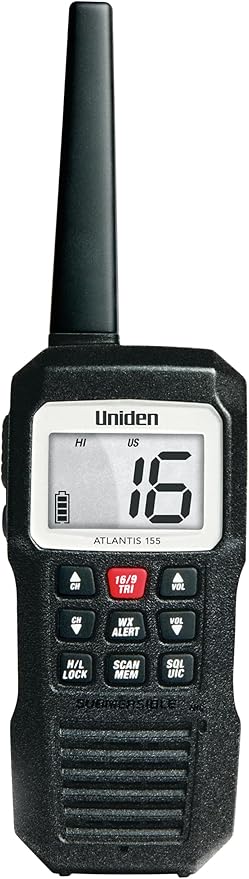
Perfect for beginners stepping into marine communication, the Uniden Atlantis 155 stands out with its floating, submersible design that keeps you connected and safe on the water. Its large, easy-to-read LCD screen makes it simple to use, even for those new to marine radios.
Setting up is straightforward since it requires just four AAA batteries, which come included. The display switches between paper white backlight for daytime and red backlight at night, helping you read the screen clearly in different lighting.
The radio’s compact design doesn’t cut corners on essential safety functions, making it a solid choice for everyday boating needs.
It handles marine communication reliably within a 15-kilometer range and meets tough waterproof standards, even clearing water from the speaker after submersion. Customers praise its rugged build and dependable performance, though some find the battery life of about 10 hours limiting for longer trips without spare batteries.
The radio’s floating capability and water-clearing speaker receive strong praise for safety and durability on the water. The most common complaint is its limited battery life, which may require carrying extra batteries for extended trips.
People new to marine radios wanting a reliable and easy-to-read model will find this a solid choice. Those needing longer battery performance or more channels might want to look at other options.
Pros
- Floats on water to prevent loss
- Largest LCD screen in its class
- Clear speaker sound after water submersion
- Paper white and red backlight for all lighting
Cons
- Battery life lasts about 10 hours only
- Limited to 16 channels
| Specification | Details |
|---|---|
| Number of Channels | 16 |
| Talking Range Maximum | 15 kilometer |
| Battery Average Life | 10 hours |
| Water Resistance Level | Waterproof |
| Number of Batteries | 4 AAA batteries required (included) |
8. Uniden MHS75 Handheld Marine VHF Radio

Uniden MHS75 Handheld Marine VHF Radio is built to withstand wet and tough conditions, making it ideal for beginners who need a durable, reliable marine radio. Its biggest strength lies in its waterproof design and floating capability, ensuring it keeps working even when the environment gets rough on the water.
Setting up involves just inserting the included AA battery, and you’re ready to go. Switching between 1, 2.5, and 5 watts allows for flexible communication range and battery saving. Handling the device during daily use is simple, with 16 channels available and a comfortable grip, so checking in or calling for help feels straightforward and responsive at all times.
Communication comes through clearly up to 15 kilometers, depending on the power setting. The rugged design with a full JIS8 waterproof rating means it can be submerged for 30 minutes at five feet without issues. Most find the build reliable and tough; although some mention the limited channel count as a downside for more advanced needs.
Reliable waterproofing and floating design make it stand out for day-to-day rough water use. The most common issue is the small number of available channels which limits communication options in crowded waterways.
Those new to marine radios or with basic channel demands will appreciate this radio’s durability and simplicity. People needing a wider range of channels or longer battery life might want to consider other models.
Pros
- Waterproof to a full JIS8 rating
- Float design prevents loss overboard
- Multiple power levels for range flexibility
- Includes AA battery for immediate use
Cons
- Limited to 16 channels only
- Power source may require frequent replacement
| Specification | Details |
|---|---|
| Water Resistance Level | Waterproof |
| Power Settings | 1 / 2.5 / 5 Watts |
| Number of Channels | 16 |
| Battery Type | 1 AA battery (included) |
| Talking Range Maximum | 15 kilometer |
| Submersible Time | 30 minutes at five feet |
9. Retevis RM01 3W Marine VHF Radio

Feels light and easy to carry, perfect for beginners heading out on the water. Ideal for youth sailing, fishing, kayaking, or motorboating, it’s made to handle marine environments while being simple to operate.
Its biggest strength is definitely the waterproof design combined with floating capability, so it’s built to survive accidental drops in the sea.
Setting it up is straightforward since it runs on standard AAA batteries, which come included, so no complicated charging routines. Using it day-to-day means you can easily clip it to your wrist with the lanyard and trust it’ll stay secure.
The 88 channels give plenty of options to stay in touch, and quick vibrations help keep water out during wet adventures.
It performs reliably when transmitting over the 156-174 MHz VHF band, and the signal comes through clear over the 3-watt power output. Built tough with salt and corrosion resistance, it holds up well in marine conditions. The ultra-tight knob on the charging port is good for waterproof seal, although a few mention the battery life isn’t as long as hoped.
Lightweight design and strong waterproof features stand out in daily use, especially around water. The radio floats and resists salt and corrosion well, making it easy to carry during sailing or kayaking. The secure charging port keeps moisture out. Some find the button layout confusing, and the volume may not get loud enough in windy conditions.
Ideal for beginners needing a simple, reliable marine radio for casual boating or fishing. Those who require more channels, longer battery life, or louder sound may want to explore higher-end models. It suits short trips rather than professional or long-duration marine communication.
Pros
- Lightweight and portable for easy handling
- Floats instantly after falling in water
- Strong salt and corrosion resistance
- 88 channels with NOAA weather support
Cons
- Battery life may feel short for extended trips
- Requires several AAA batteries instead of rechargeable pack
| Specification | Details |
|---|---|
| Power | 3 W |
| Channels | 88 |
| Water Resistance Level | IP67 waterproof |
| Voltage | 1.2 volts |
| Batteries Required | 5 AAA (included) |
10. Uniden UM725G Marine VHF Radio

Perfect for beginners stepping into marine communication, the Uniden UM725G offers secure boat-to-boat text messaging. Its standout feature is the ability to send private texts, which is rare for VHF radios and adds a layer of privacy not found in most models.
Setting up the UM725G is straightforward, running on 12 volts direct current and plugging into your boat easily. Daily use is practical thanks to its digital display that’s simple to read.
Weather updates through NOAA channels keep you informed, and the included speaker microphone makes chatting hands-free a breeze. Connecting to other devices via NMEA protocols is handy for boaters with compatible systems.
It performs solidly over all US, Canada, and international marine channels with power options at 1 or 25 watts to suit short or long distances, claiming a talking range up to 36 miles. Its IPX8 waterproof rating means you can trust it in wet conditions without worry. Reviews praise the private text feature but some mention occasional complexity with advanced settings as a downside.
Private text messaging is the biggest highlight, allowing users to communicate discreetly without broadcasting over common radio channels. The waterproof design supports real marine conditions, though some find the setup and advanced features not entirely intuitive at first.
Boaters who want privacy and weather updates on a durable unit will appreciate it. Those looking for more simplicity or extra channels might want to consider other options with fewer technical steps or wider channel selections.
Pros
- Private boat-to-boat text messaging
- IPX8 submersible waterproof rating
- NOAA weather channels with alerts
- Dual power options for long-range communication
Cons
- Advanced settings can be complicated for beginners
- Limited to 25 channels, fewer than some competitors
| Specification | Details |
|---|---|
| Number of Channels | 25 |
| Talking Range Maximum | 36 mile |
| Voltage | 12 volts_of_direct_current |
| Water Resistance Level | Waterproof |
| Connectivity Protocol | NMEA 0183 or NMEA 2000 |
11. Uniden MHS338BT Handheld Marine VHF Radio

Rugged and designed to float, the Uniden MHS338BT Handheld Marine VHF Radio suits beginners looking for a durable, waterproof option with easy-to-use features. Its biggest strength lies in combining waterproof design with an integrated GPS and emergency lighting, making it reliable on the water.
Setting it up involves placing the radio in its drop-in charging cradle, where the Li-ion battery charges conveniently. Daily use is straightforward with clear buttons, and the automatic backlight switching helps you read the display in daylight or nighttime without manual adjustments.
NOAA weather alerts keep you updated, while Bluetooth connectivity pairs easily with an iPhone for added convenience.
With a max 6-watt transmit power, communications can reach up to 5 miles, covering most small boat trips effectively. The radio’s build feels solid, meant to withstand water immersion thanks to its IPX8 rating, and it floats if dropped in water.
Users appreciate the GPS and waterproof features most; some mention the limited number of channels as a drawback.
The radio is praised for its waterproof design and built-in GPS, which help keep communication steady and safety reinforced on the water. Its most common downside is the restricted channel availability, which can limit flexibility in crowded marine areas. Emergency lighting adds an important safety layer that users find reassuring.
Anyone starting out who needs a tough, reliable radio with easy navigation will find this model well-suited. Those requiring a wider channel selection or longer range might want to consider alternatives with more features tailored for advanced use or longer-distance communication.
Pros
- IPX8 submersible and floats in water
- Integrated GPS with favorite position saving
- Water-activated emergency strobe and flashlight
- Automatic backlight switching day and night
Cons
- Limited to 25 channels for communication
- Range maxes out around 5 miles
| Specification | Details |
|---|---|
| Transmit Power | 6 WATT |
| Number of Channels | 25 |
| Water Resistance Level | Waterproof (IPX8) |
| Talking Range Maximum | 5 mile |
| Battery Type | Product Specific (included) |
| Connectivity Protocol | Bluetooth |
12. Retevis RM21 5W Marine VHF Radio

Clear communication stands out immediately with this marine radio, perfect for beginners who want straightforward use on the water. Its biggest strength lies in advanced noise cancellation, making talk easy even with engine noise or waves in the background.
Setting it up is simple, with just one battery included and intuitive buttons for noise cancellation and monitoring. Switching between high, medium, and low power modes adapts the range to your needs, while a battery saver helps keep you connected throughout a day of boating or fishing. The floating design and waterproof rating mean it stays protected around water.
Voice clarity remains solid thanks to the built-in noise-canceling microphone, handling background sounds well. The solid waterproof build meets IP67 standards, giving confidence in wet environments.
Many praise how well noise is controlled, but some find the 10-hour battery life a bit short for longer trips.
Many find the noise cancellation effective at cutting out engine and wave sounds, leading to clear voice transmission. The common downside noted is the battery life, which can run out during extended outings without easy replacement.
This radio suits beginners who value ease of use and noise clarity during typical boating or fishing trips. Those needing longer battery life or higher power for extended range might want to look at other options.
Pros
- AI noise cancellation reduces wind and engine sounds
- Floating and waterproof design for water safety
- Adjustable power levels to save battery
- Simple one-button operation for key functions
Cons
- Battery life limited to about 10 hours
- Maximum 5W power may limit long-distance range
| Specification | Details |
|---|---|
| Number of Channels | 88 |
| Talking Range Maximum | 5 watts |
| Water Resistance Level | Waterproof (IP67) |
| Battery Average Life | 10 hours |
| Voltage | 7.4 volts_of_direct_current |
13. Pyle PLMRB29B Marine Bluetooth Stereo Radio

Bluetooth connectivity makes the Pyle PLMRB29B a solid choice for beginners who want easy music streaming and hands-free calling on the water. It suits those looking for a simple stereo that connects with smartphones and tablets without extra complications.
Setup involves mounting the in-dash console and pairing your Bluetooth device, which takes just a few minutes. Day-to-day, you can stream Pandora or Spotify directly from your phone, and calls come through the built-in mic with caller ID shown on the screen. Controls via remote or hand button make changing tracks or answering calls convenient while boating.
Audio performance matches its specs well, delivering clear sound through four channels at 300 watts total output. The stereo casing feels solid but not overly rugged, which fits casual use better than rough conditions.
Strong praise usually goes to its easy Bluetooth setup and quality sound. Common complaints mention the LCD screen being hard to read in bright sunlight.
The radio delivers reliable Bluetooth audio streaming and clear hands-free calls, highly praised for simplicity. The main drawback is the LCD digital display, often mentioned as difficult to see in direct sunlight while boating.
People wanting straightforward music and calls from their phone will appreciate this stereo. Those needing rugged, sunlight-friendly screens or more advanced marine features may want to consider other options.
Pros
- Easy Bluetooth pairing with many devices
- Built-in mic for hands-free calling
- Remote control adds convenience
- Supports Pandora and Spotify streaming
Cons
- LCD display hard to read in sunlight
- Not designed for very rough marine environments
| Specification | Details |
|---|---|
| Connectivity Technology | Bluetooth |
| Output Wattage | 300 watts |
| Number of Channels | 4 |
| Supported Internet Services | Pandora |
| Connector Type | USB, 3.5mm Jack, RCA |
Best Marine Radios for Beginners Comparison Table
| Product | Channels | Range | Battery Life | Waterproof |
|---|---|---|---|---|
| Cobra BlueBound 350 | 98 | 25 mile | 12 hours | Waterproof |
| Uniden UM385BK VHF | 40 | 25 mile | – | Waterproof |
| Retevis RM15 VHF | 88 | 16 km | – | IP68 Waterproof |
| Uniden Atlantis 275 | 25 | 36 mile | – | Waterproof |
| Standard Horizon HX210 | 200 | 5 mile | – | Waterproof |
| Icom M25EVO VHF | 15 | 5 mile | – | Water Resistant |
| Uniden Atlantis 155 | 16 | 15 km | 10 hours | Waterproof |
| Uniden MHS75 VHF | 16 | 15 km | – | Waterproof |
| Retevis RM01 VHF | 88 | – | – | Waterproof |
| Uniden UM725G VHF | 25 | 36 mile | – | Waterproof |
| Uniden MHS338BT | 25 | 5 mile | – | Waterproof |
| Retevis RM21 VHF | 88 | 5 watts | – | Waterproof |
| Pyle PLMRB29B Radio | – | – | – | – |
- Channels98
- Range25 mile
- Battery Life12 hours
- WaterproofWaterproof
- Channels40
- Range25 mile
- Battery Life–
- WaterproofWaterproof
- Channels88
- Range16 km
- Battery Life–
- WaterproofIP68 Waterproof
- Channels25
- Range36 mile
- Battery Life–
- WaterproofWaterproof
- Channels200
- Range5 mile
- Battery Life–
- WaterproofWaterproof
- Channels15
- Range5 mile
- Battery Life–
- WaterproofWater Resistant
- Channels16
- Range15 km
- Battery Life10 hours
- WaterproofWaterproof
- Channels16
- Range15 km
- Battery Life–
- WaterproofWaterproof
- Channels88
- Range–
- Battery Life–
- WaterproofWaterproof
- Channels25
- Range36 mile
- Battery Life–
- WaterproofWaterproof
- Channels25
- Range5 mile
- Battery Life–
- WaterproofWaterproof
- Channels88
- Range5 watts
- Battery Life–
- WaterproofWaterproof
- Channels–
- Range–
- Battery Life–
- Waterproof–
How to Choose the Right Marine Radio
Choosing the right marine radio depends on factors like ease of use, reliable signal range, and essential safety features. Prioritizing these ensures clear communication and helps avoid costly mistakes or dangerous situations while on the water.
Ease of Use
On the water, a radio with complicated controls can turn a minor issue into a serious safety hazard. Buttons that are too small or confusing to operate slow down important communications. Radios designed with intuitive controls allow quick channel changes and access to emergency functions even under stress.
A clear, backlit display makes reading channels and settings easier during nighttime or rough weather conditions.
Simple channel scanning and preprogrammed options save time by letting you switch to the right frequency fast. Look for radios with large, well-spaced buttons and displays rated for low-light visibility. Some models include dedicated emergency buttons accessible without menu navigation, which can make a big difference in urgent moments.
Durability and Weather Resistance
Marine radios often get splashed or dropped, so rugged construction is crucial. Radios with waterproof ratings like IPX7 handle immersion in water without damage, and corrosion-resistant materials protect the device from salt spray and humidity over time.
Expect solid-feeling builds designed to absorb impacts without breaking.
Sealing around buttons and connection ports limits water and dust entry, which can otherwise cause malfunctions. Look for models specifically labeled as weather-resistant with sealed or covered ports. These features ensure the radio keeps working even during heavy rain or after accidental drops on deck.
Power and Battery Life
Transmission power impacts the range and clarity of communications on the water. A radio with at least 5 watts of output is common for typical boating needs, providing a reliable connection within several miles. Battery life is equally important; prolonged trips demand units that can operate for many hours or days.
Rechargeable batteries save money and reduce waste but plan for charging options such as USB ports or compatible chargers. Some radios support alternative power sources like AA batteries, handy if recharging isn’t possible. Knowing the expected talk and standby times helps avoid being caught without power when it matters most.
Safety and Compliance Features
Emergency signaling is critical, and radios featuring Digital Selective Calling (DSC) make sending distress alerts fast and precise. This function automatically transmits the boat’s identity and location to nearby vessels and rescue authorities.
Radios that comply with marine communication regulations include all required channels and emergency frequencies, ensuring legal use and access to important broadcasts.
Built-in NOAA weather alerts provide timely storm warnings, giving valuable time to prepare. Distress features such as dedicated SOS buttons or automatic channel switching improve safety by making critical operations easier when it matters most. Verify that the radio’s certifications match your region’s standards.
Compatibility and Connectivity
Connecting a radio to an external antenna can substantially improve reception and transmission, which is important for larger boats or remote locations. Check whether the model supports antenna upgrades or has ports for integrating with your boat’s existing electronics.
Compatibility with standard marine channels ensures you can communicate with other vessels and shore stations effectively.
Some radios offer the choice between handheld portability and fixed-mount installation. Handheld units provide mobility for small crafts or easy carry, while fixed units are better for bigger boats requiring stable setups.
Select based on the type of boat and how you plan to move during your time on water.
Tips for Effective Communication Using Marine Radios
Marine radios work on specific VHF channels dedicated to marine communication, with channel 16 being the emergency and calling channel. Keeping your radio tuned here when you start out ensures you’re always able to reach help or other vessels.
Speak clearly and keep your messages brief, especially in emergencies.
Useful tips to keep in mind:
- Press the push-to-talk button firmly before speaking and release it after you finish.
- Identify your vessel by name and location before transmitting a message.
- Use simple language and avoid unnecessary chatter on emergency channels.
- Listen for a few seconds before speaking to ensure the channel is clear.
Practicing these habits early helps avoid confusion and ensures messages are understood quickly and accurately.
Common Mistakes to Avoid When Operating a Marine Radio
One common mistake with marine radios is forgetting to check the battery or power source before heading out. A dead battery leaves you without crucial communication.
Also, many beginners hold the microphone too far from their mouth or talk too fast, making messages unclear.
Other frequent errors include:
- Not using channel 16 to call before switching to a working channel.
- Broadcasting personal conversations on public channels, which is against regulations.
- Failing to perform regular radio checks to confirm proper function.
- Neglecting to read the user manual to understand all features and functions.
Staying aware of these mistakes can improve safety and make marine communication more reliable for everyone onboard.
Comparing Handheld vs. Fixed Marine Radios for Beginners
Handheld marine radios offer portability and convenience, especially for small boats or as a backup device. They are lightweight and easy to carry, which is helpful when moving around the vessel or launching a dinghy. However, their battery life is limited and speakers can be less loud than fixed units.
Fixed marine radios are permanently installed, generally offering more power and larger antennas for better range. These are better suited for larger boats and regular boating activities where hands-free use and higher durability matter.
Their bigger screens and buttons can also make operation simpler in rough conditions.
Choosing between the two depends on your specific needs. A handheld can suffice for coastal day trips, while fixed radios fit better for extended trips or offshore travel.
Some boaters use both to cover different situations effectively.
People Also Asked
How Do I Choose the Right Marine Radio Size for Beginners?
Pick a compact marine radio that fits well in your boat’s available space and is easy to operate. Radios with simple controls and clear displays tend to work better for beginners. Consider one that can be mounted easily and doesn’t take up too much room on your dashboard.
What Safety Features Should a Beginner Look for in Marine Radios?
Look for a marine radio with emergency alert features like a DSC (Digital Selective Calling) button and waterproof casing. These help in distress situations and protect the radio from water damage, key for staying safe on the water. Some models also include built-in GPS for more accurate emergency location.
How Do I Properly Care for and Maintain a Marine Radio?
Keep the radio clean and dry, wiping it down after use, especially in salty or wet conditions. Remove it from high heat or direct sun for long periods to prevent damage. Check the battery regularly to ensure it holds charge and replace worn parts like antenna seals as needed.
Are Marine Radios Compatible with All Types of Boats and Devices?
Most marine radios work on standard VHF frequencies and can be used on different types of boats. However, compatibility with other devices depends on brand and model, so read the manual. Radios usually connect with external GPS or audio gear, but you might need additional cables or adapters.
What Common Problems Do Beginner Marine Radio Users Face?
Common issues include difficulty with signal reception, battery problems, and confusion over channel selection. Beginners might also struggle with microphone calibration or setting up emergency features properly. Practicing basic operations before heading out helps avoid these problems on the water.
Conclusion
Choosing a marine radio for beginners comes down to a few key points. Look for clear audio quality, a durable build, and easy-to-use controls.
Having essential features like NOAA weather alerts and a decent channel range also helps. These basics make handling emergencies and day-to-day communication simpler.
Think about where you’ll install the radio and how often you’ll use it before deciding. A model that fits well in your space and matches your budget will serve better over time.
Take another look at the comparison table and the picks above to find one that matches your needs without extra complications.