Top 12 Best Spotting Telescope That Will Blow Your Mind!
Using a cheap or poorly made spotting telescope often means struggling with blurry images, shaky views, or uncomfortable handling. The best spotting telescope provides a clear, stable view, essential for birdwatching, hunting, or target shooting. Without sharp optics and reliable construction, even a slight breeze can ruin the experience and make it frustrating to focus on small details at a distance.
Key factors that separate a good spotting telescope from a poor one include the quality of the lenses, optical magnification, and build durability. Lenses with multi-coating reduce glare and improve light transmission, essential for clear observation in various lighting conditions.
Magnifications between 20x to 60x are common, but higher power often requires a sturdy tripod and good glass quality to avoid distortion. A solid, weather-resistant body ensures the scope holds up outdoors and stays easy to clean after use in rough environments.
Need a Quick Check?
| Image | Product | Price |
|---|---|---|
Our Top Picks 1  | Smart Telescope Refractor | Check Price |
Our Top Picks 2  | Celestron C90 Maksutov | Check Price |
Our Top Picks 3  | Celestron Ultima 22-66×100 | Check Price |
Our Selected Top 12 Spotting Telescope Worth Buying
This list features carefully chosen spotting telescopes that cater to different needs and skill levels. Each review covers performance, ideal users, strengths, and limitations, helping readers find the most suitable option for their viewing preferences.
1. Smart Telescope Refractor Auto-Focus
Enjoying clear views of distant landscapes or night skies can be tricky without the right gear. Ideal for those who want sharp, detailed images from far away, this spotting telescope stands out most for its powerful zoom and crisp, bright visuals.
Perfect for enthusiasts who appreciate detailed, high-resolution views without complicated setups.
Setting it up involves attaching the telescope to a tripod mount, which keeps it steady for use. Auto-focus means adjusting the focus is automatic, so you don’t have to fiddle with knobs while trying to get a sharp image.
Controlling the telescope via a mobile app or a wireless remote adds convenience, letting you capture photos and videos easily without introducing vibrations that blur the image.
The 80mm aperture and 300mm focal length deliver bright views even in low light. Magnification can reach up to 350x, allowing detailed observation of distant objects.
The build is solid and includes an orthoscopic eyepiece for clear optics and a reflex finderscope for easy aiming. Most praise points to the sharp 4K imaging quality, while some users mention the reliance on the app for control can be limiting if the connection is unstable.
The most praised feature is the sharpness and clarity of the images, especially when using the auto-focus with the 4K camera. The most common drawback mentioned is the occasional instability in app connectivity, making remote control less reliable during some sessions.
Anyone looking for detailed long-distance views with easy focusing and image capture will appreciate this model. Those who prefer a fully manual device or dislike depending on smartphone apps for operation might want to consider an alternative.
Pros
- Crystal-clear images with 4K resolution
- Auto focus keeps views sharp with ease
- Wireless remote and app provide flexible control
- Sturdy tripod mount reduces shake during use
Cons
- App control can lag or disconnect at times
- Reliance on mobile device for full functionality
| Specification | Details |
|---|---|
| Aperture | 80mm |
| Focal Length | 300mm |
| Zoom Ratio | 350 |
| Focus Type | Auto Focus |
| Mount | Tripod Mount |
| Eye Piece Lens | Orthoscopic |
2. Celestron C90 Maksutov Spotting Scope
Compact and lightweight with a 90mm Maksutov-Cassegrain optical design, this spotting scope is built for those who want bright, sharp views of distant targets without lugging around heavy gear. It’s suited for bird watchers, nature observers, and anyone after crisp detail in a portable package.
Setting it up is simple since it comes with a manual focus and an equatorial mount for smooth adjustments. The built-in 8×21 erect image finderscope helps quickly locate subjects. Its multi-coated lenses ensure clearer images, and its compatibility with smartphones makes digiscoping straightforward.
Carrying it is easy thanks to its folded light path design that keeps it small.
It performs well in both daytime nature spotting and nighttime astronomy due to its 1250mm focal length and 39x zoom ratio, delivering detailed and bright images. The scope is solidly built, though some note the manual focus takes a bit to get used to. The biggest positive is the sharp image quality, while the main drawback is the need for a steady hand or tripod for best results.
The Celestron C90 Maksutov Spotting Scope delivers clear and bright views for bird watching, nature observation, and even astronomy. Its compact design makes it easy to carry, fitting comfortably in small bags without much weight. Some find the field of view narrow compared to other scopes, which can affect quick target acquisition during fast movements.
Ideal for those who want a versatile spotting scope that doubles as a telephoto lens for photography. It suits outdoor enthusiasts who appreciate lightweight gear and detailed viewing at long distances. People needing a wider viewing angle or a larger aperture for low-light use may want to consider larger, more specialized spotting scopes instead.
Pros
- Compact size for easy transport
- Sharp and bright views with multi-coated lenses
- Camera adaptable for smartphone use
- Equatorial mount allows precise positioning
Cons
- Manual focusing needs steady handling
- Best used with a tripod for stability
| Specification | Details |
|---|---|
| Eye Piece Lens Description | Plossl |
| Mount | Equatorial Mount |
| Focus Type | Manual Focus |
| Finderscope | 8×21 Erect Image Finderscope |
| Focal Length Description | 1250 millimeters |
| Zoom Ratio | 39 multiplier x |
3. Celestron Ultima 22-66×100 Spotting Scope
Outdoor enthusiasts wanting clear, long-distance views will find this spotting scope fits right in. Its 100mm objective lens and 22-66x zoom let you get a detailed look at birds, wildlife, or distant landscapes.
The angled 45° viewing helps keep your neck comfortable during long observation sessions.
Setting it up is straightforward thanks to the extended tripod mounting plate, which helps keep things stable. Adjusting focus manually feels natural, while zooming in and out with the eyepiece delivers smooth transitions. Carrying it around is simple with the included soft case, and you can easily keep the lenses clean using the lens cloth provided.
It delivers bright, clear images thanks to its multi-coated optics, which reduce glare and improve color and contrast. Built to stand up to outdoor conditions, it is waterproof, fogproof, and even offers UV protection. Most users praise how sharp and vibrant their views are.
A common gripe is that the manual focus can take some getting used to for quick adjustments.
The multi-coated lenses consistently deliver sharp and bright views with impressive color accuracy, making it enjoyable for detailed observation. Some users note that manual focusing requires patience and can slow down quickly locking onto fast-moving subjects.
People who enjoy birdwatching, nature spotting, or scenic viewing will appreciate the versatility and image quality. Those wanting faster, more intuitive focusing or a simpler mount might want to look for different options.
Pros
- Large 100mm objective lens for bright images
- Multi-coated optics improve color and contrast
- Waterproof and fogproof for outdoor use
- Includes accessories like carrying case and lens cloth
Cons
- Manual focus needs practice for quick changes
- Equatorial mount might be complex for beginners
| Specification | Details |
|---|---|
| Eye Piece Lens Description | 22-66x zoom |
| Mount | Equatorial Mount |
| Focus Type | Manual Focus |
| Coating | Multi-Coated |
| Field Of View | 45 degrees |
| Focal Length Description | 540 millimeters |
4. Kowa TSN-99A Prominar Angled Spotting Scope

Angled spotting scopes with a wide zoom range of 30-70x don’t come much sharper or clearer than this one. Ideal for birdwatchers and outdoor enthusiasts, it stands out thanks to its large 99mm fluorite crystal lens that delivers impressive color fidelity and bright images. Comfortable viewing is easy thanks to the angled design that won’t strain your neck during long sessions.
Setup is straightforward once mounted on a tripod, and the wide zoom eyepiece lets you switch magnification smoothly between 30x and 70x, fitting various spotting needs. Designed for use from dawn to dusk, it handles changing light conditions well thanks to its optical coatings that reduce glare.
The angled body keeps views steady and comfortable, especially if you’re tracking moving subjects like birds or targets.
Expect crisp, high-contrast images that really bring details into view without color distortion. The build features quality materials designed for durability, offering smooth integration with compatible Kowa accessories. Users often praise the clarity and brightness, while the most frequent downside mentioned is the scope’s bulkiness, making it a bit heavy to carry around all day.
High praise centers on its sharp, vibrant images with excellent color fidelity made possible by the 99mm fluorite crystal lens and coatings that cut chromatic aberrations. A common complaint is how heavy and bulky the scope feels during prolonged carrying or handheld spotting sessions.
Birdwatchers and those using a tripod for stationary viewing will appreciate the optical quality and comfort of the angled design. Anyone needing a lightweight, easily portable scope for fast hikes or all-day carrying might look at smaller, lighter models instead.
Pros
- Large 99mm pure fluorite crystal lens
- Comfortable angled design for extended viewing
- Wide zoom range with smooth magnification changes
- Enhanced light transmission from optical coatings
Cons
- Relatively heavy, not ideal for light packing
- Bulk can make handheld use tiring
| Specification | Details |
|---|---|
| Objective Lens Diameter | 9.9 centimeters |
| Magnification Maximum | 70 x |
| Lowest Useful Magnification | 30 x |
| Field Of View | 105 |
| Compatible Devices | Kowa 77/88 line scopes and accessories |
5. SVBONY SV28 100mm Spotting Scope

SVBONY SV28 100mm Spotting Scope offers strong magnification and bright images, ideal for outdoor enthusiasts who want to observe wildlife or shoot targets in detail. Its biggest strength lies in the 100mm aperture lens, which delivers a significant boost in brightness, especially useful during low-light hours.
Setting it up is straightforward with the Altazimuth mount, and manual focus lets you hone in on subjects accurately. The zoom ranges from 25x to 75x, letting you switch between wide views and detailed close-ups easily. Bright images come from the fully multi-coated lens, making it easier on the eyes during extended use.
You can even connect your smartphone for quick photos.
Performance-wise, the scope provides impressive clarity and detail at various distances, particularly aiding in long-range viewing and target shooting. The build feels solid, and the BAK4-Porro eyepiece contributes to clear visuals.
Most users praise its brightness and zoom range, though some find manual focus a bit tricky at higher magnifications.
The most frequent praise revolves around its bright, detailed view even when light is limited, thanks to the large 100mm lens and multi-coated optics. However, controlling focus manually, especially at maximum magnification, is often cited as a challenge that requires patience.
People looking to observe wildlife or shoot targets with high detail will find this scope suits their needs well, especially in low light. More casual users or those wanting quick adjustments may want to consider scopes with easier focusing systems or lighter models for portability.
Pros
- Bright images in low light
- Wide zoom range for varied viewing
- Compatible with smartphones
- Solid construction and good optics
Cons
- Manual focus can be difficult to fine-tune
- Heavier than smaller spotting scopes
| Specification | Details |
|---|---|
| Lens Aperture | 100mm |
| Magnification Range | 25x to 75x |
| Coating | Fully Multi-Coated (FMC) |
| Eyepiece Lens | BAK4-Porro |
| Focus Type | Manual Focus |
| Mount Type | Altazimuth Mount |
6. Flagship 20-60×80 Spotting Scope

Finding distant details feels natural with this scope in hand. Designed for birdwatchers, hikers, or anyone wanting sharp long-distance views, its standout feature is a wide 20x to 60x zoom range paired with smooth focusing. It’s easy to adjust, delivering clear, vivid images when you need them most.
Getting started is straightforward thanks to the manual focus that responds well to subtle turns. Its altazimuth mount makes moving the scope from side to side or up and down smooth and direct. Attaching a smartphone is simple with the included adapter, letting you capture or share what you see.
It holds its focus reliably through outdoor adventuring, even in damp conditions, given its water-resistant design.
Optics impress with sharpness and brightness, thanks to the fully multi-coated 80mm lens and BAK4 prism. Visuals come through crisp across the zoom range, from wide views to close inspections.
The most frequent praise centers on the image quality. Some users point out the manual focus requires patience for fine details, especially at higher magnifications.
Image quality stands out, delivering bright and sharp visuals across all zoom levels, but fine-tuning focus takes some getting used to. High magnifications amplify the need for steady hands, which can be a challenge without a tripod.
Those who want detailed viewing for birdwatching, archery, or stargazing will find this scope reliable and bright. Users needing ultra-portability or faster autofocus might look elsewhere, as this one balances power with manual controls and a larger frame.
Pros
- Variable power zoom from 20x to 60x
- Bright, clear view with 80mm fully multi-coated lens
- Compatible with smartphone adapter for photos
- Water resistant and fog-proof design
Cons
- Manual focus requires steady hand and patience
- Bulky size for carrying on long hikes
| Specification | Details |
|---|---|
| Magnification | 20x to 60x |
| Objective Lens | 80mm fully multi-coated green film |
| Field Of View | 82.9–48 feet / 1000 yards |
| Focus Type | manual |
| Mount | Altazimuth |
| Finderscope | Reflex |
7. DiamondEdge 25-75×80 Spotting Scope
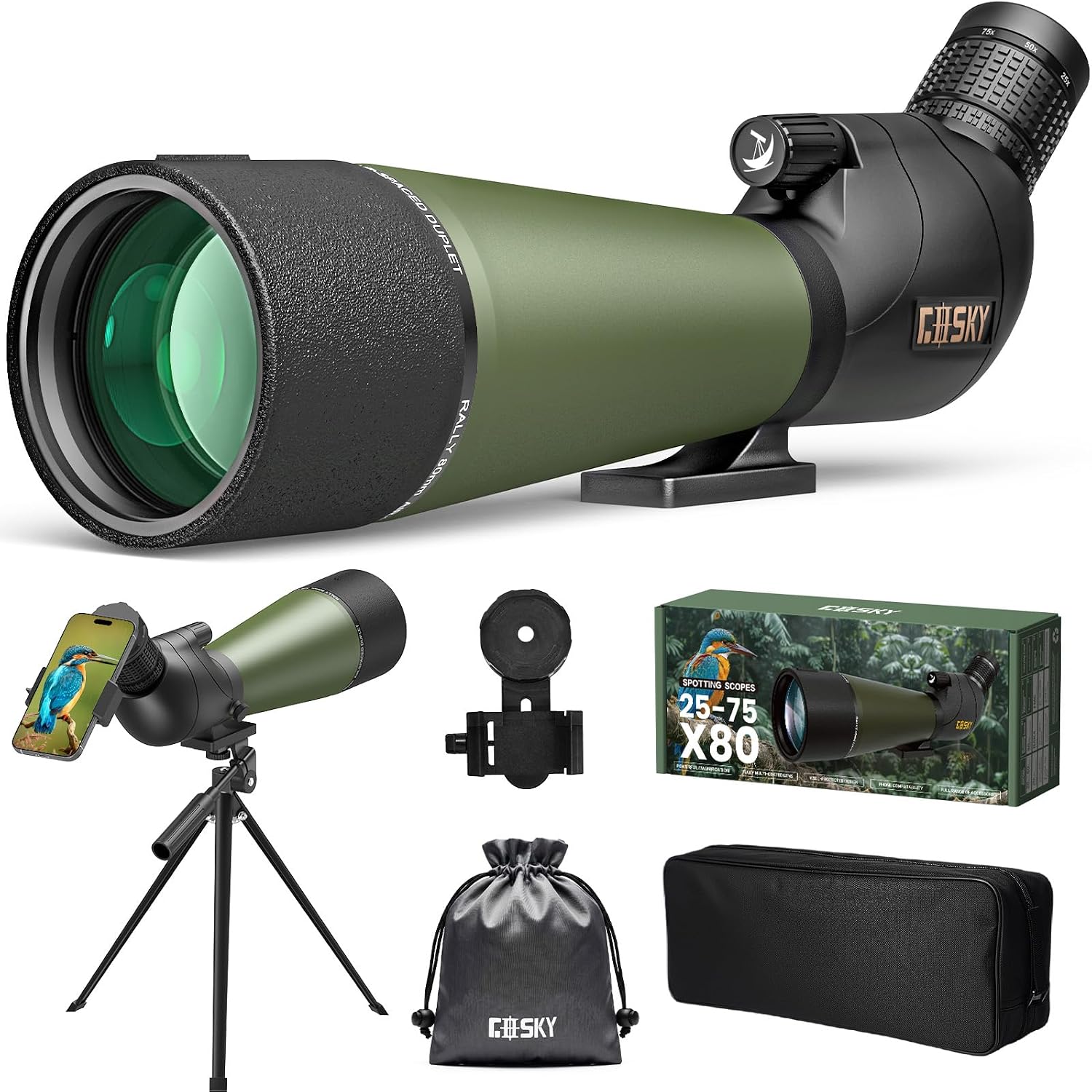
Great for birdwatchers, hikers, and hunters, this spotting scope offers impressive clarity and strong zoom range. Its biggest strength is balancing high magnification with a bright, wide field of view, making detailed observation easier without straining your eyes.
Setup requires mounting on a tripod, and the manual focus allows precise adjustments to bring subjects into sharp view. The integrated phone holder works well for attaching a smartphone for photos or videos. The reflex finderscope helps quickly locate distant targets, while the multi-coated optics keep colors vivid and images bright during daily outdoor use.
With a large 80mm objective lens and a magnification capacity from 25x to 75x, it delivers excellent image clarity and color accuracy. The Bak4 prism system contributes to sharp visuals, and the scope’s solid construction feels reliable. Most praise focuses on the bright, detailed images, while a common complaint is the manual focus being a bit slow for quick tracking.
Bright images and great color accuracy make detailed wildlife viewing enjoyable. The manual focusing system is precise but can be sluggish when tracking fast-moving subjects. Users appreciate the wide field of view and integrated phone holder, though it lacks any electronic aids for stabilization or lighting.
Ideal for outdoor enthusiasts who want high detail under varied conditions without extra electronics. Those needing rapid focus changes or image stabilization during active use might prefer a different model with powered features or more advanced tracking.
Pros
- Bright, clear images with excellent color accuracy
- Wide 98 feet field of view at 1000 yards
- Integrated phone holder for easy smartphone attachment
- Large 23mm eyepiece for comfortable viewing
Cons
- Manual focus can feel slow for quick adjustments
- Unpowered design means no image stabilization
| Specification | Details |
|---|---|
| Eye Piece Lens Description | Bak4 Prism System |
| Mount | Tripod Mount Compatible |
| Focus Type | Manual Focus |
| Power Source | Unpowered |
| Focal Length Description | 25-75x Magnification With 80mm Objective Lens |
| Field Of View | 98 feet |
8. 20-60×80 HD Spotting Scope
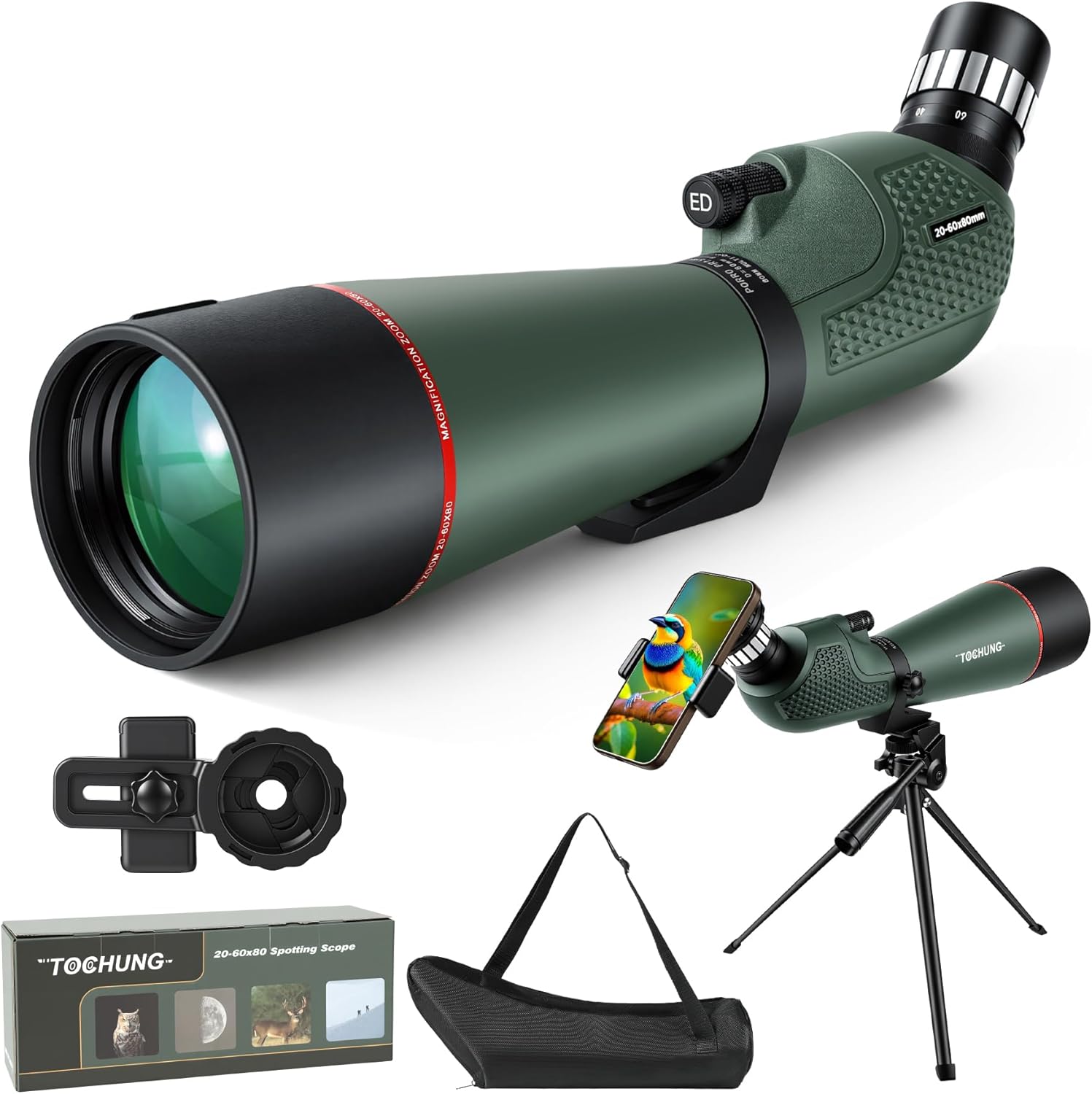
Built around an 80mm large-aperture objective lens with fully multi-coated optics, the 20-60×80 HD Spotting Scope suits outdoor enthusiasts needing clear, bright views from a distance. Its biggest strength lies in delivering sharp, high-contrast images across a wide zoom range, perfect for birdwatching or target spotting.
Setting up involves mounting the scope on a tripod for stability, then manually focusing to lock onto details. The fully multi-coated lens keeps the view bright even at 60x zoom, while the waterproof and fogproof design means it holds up well in different weather.
A smartphone adapter lets you capture what you see, handy for sharing or reviewing later.
Performance stays consistent across the zoom range, showing clear details up to 1000 yards. The build feels solid and durable, ready for rough outdoor use.
Most users appreciate the bright, sharp view and zoom flexibility. The main complaint involves the manual focus, which can be fiddly when trying to track moving subjects.
The scope delivers bright, high-contrast images with strong zoom, praised for clarity and distance. Manual focusing is often noted as tricky, especially when tracking fast or moving targets.
Anyone wanting clear, long-distance views in varied outdoor conditions will find it useful. Those needing quick autofocus or handheld use might want to look at other options better suited to those needs.
Pros
- Large 80mm objective lens for bright viewing
- Continuous 20x to 60x zoom for precise detail
- Waterproof and fogproof for outdoor use
- Universal smartphone adapter included
Cons
- Manual focus can be difficult for moving objects
- Requires tripod for stable viewing at high zoom
| Specification | Details |
|---|---|
| Mount | Tripod Mount |
| Focus Type | Manual Focus |
| Zoom Ratio | 20x-60x |
| Field Of View | 1000 yard |
| Additional Features | Fully Multi-Coated Optics, Waterproof & Fogproof, Universal Smartphone Adapter |
9. Monocular 8×42 Compact Waterproof Scope

Compact size and waterproof design make it perfect for outdoor enthusiasts who want clear, wide-angle views on the go. Its biggest strength lies in delivering bright, detailed images through the all-glass optics and FMC Superior BAK-4 prism, ideal for spotting distant wildlife or scenery.
Setup is simple with manual focus and an altazimuth mount that lets you pan smoothly. The rubber exterior feels secure in your hand, and the lens cover protects against dust and moisture.
It’s easy to carry around without bulky gear, and you can attach smartphones or cameras to capture what you see, making it versatile for different outdoor activities.
Performance is sharp with 8X magnification and a wide 42mm lens, offering a large field of view at 360ft/1000yards. The waterproof and fogproof build holds up well against tough weather.
Most praise points to its clear, bright images, while some mention the manual focus takes practice to get perfectly sharp views.
High-quality optics deliver clear and wide views appreciated in every use. The manual focus feature can be tricky at first, often needing adjustment when viewing fine details.
Great for hikers, birdwatchers, and casual spotters who want portability combined with solid image quality. Not ideal for those needing quick autofocus or long-term tracking of moving targets.
Pros
- Wide-angle, high-definition optics with sharp clarity
- Waterproof, fogproof, dust-proof, and shockproof design
- Rubber finish feels secure and durable outdoors
- Compatible with cameras and smartphones
Cons
- Manual focus requires patience to achieve sharpness
- Altazimuth mount limits precise tracking of moving subjects
| Specification | Details |
|---|---|
| Magnification | 8X |
| Objective Lens Diameter | 42mm |
| Field of View | 360ft/1000yards |
| Focus Type | Manual Focus |
| Mount | Altazimuth Mount |
| Prism Type | FMC Superior BAK-4 Green Film Prism |
10. Celestron Ultima 20-60×80 Angled Spotting Scope

Ideal for outdoor enthusiasts who want clear, detailed views at long distances, the Celestron Ultima 20-60×80 Angled Spotting Scope shines with its powerful 20-60x zoom paired with an 80mm objective lens. Its angled design makes viewing comfortable in various positions, making it stand out among other spotting scopes.
Setting up is straightforward with the included extended tripod mounting plate and a soft carrying case for easy transport. Manual focus allows for precise adjustments, and the zoom eyepiece works well for switching magnification without hassle.
The reflex finderscope helps quickly locate subjects, and protection features like fogproof and waterproof build add confidence during use in changing weather conditions.
The multi-coated lenses on the optics boost brightness and contrast, producing vivid images. The overall build feels solid and durable, suited for field use. Reviews often mention crisp image quality as a major plus, while some note challenges in focusing quickly at higher zoom levels, reflecting the manual focus limit.
Clear and bright views thanks to multi-coated lenses make spotting objects easy on the eyes, though focusing at the highest magnification takes patience because of the manual focus system. The waterproof, fogproof features add reliability in varying weather.
Anyone needing a powerful, all-purpose spotting scope for nature or distant viewing will appreciate it. Those looking for faster autofocus or a lighter setup might want to explore other options better suited to quick adjustments or travel convenience.
Pros
- Wide zoom range from 20x to 60x
- Multi-coated optics improve brightness and color
- Waterproof and fogproof construction for outdoor durability
- Includes accessories for digiscoping and carrying
Cons
- Manual focus can be slow to adjust at high zoom
- Relatively large and may feel bulky to carry
| Specification | Details |
|---|---|
| Eye Piece Lens Description | 20-60x zoom |
| Mount | Millimeters |
| Focus Type | manual focus |
| Field Of View | 64 degrees |
| Focal Length Description | 480 millimeters |
11. SVBONY SV406 20-60×80 Spotting Scope

Birdwatching or wildlife viewing often demands clear images at a distance, which this spotting scope handles well with its strong zoom capability. It suits outdoor enthusiasts who want a versatile scope that delivers vibrant, true-to-life colors and a wide field of view to track animals without losing detail.
Setting it up is straightforward thanks to the altazimuth mount that allows smooth movement in both directions. The manual focus works well for adjusting sharpness precisely, and the compact size makes it easy to carry around during hikes or trips. Waterproof and fogproof features mean using it in different weather conditions doesn’t require extra gear or worry.
Viewing through the large 80mm lens at magnifications between 20x and 60x produces sharp, crisp images with minimal distortion. Build quality leans toward durable, with good waterproof sealing to keep moisture out.
The most frequent praise focuses on its clear field of view and color reproduction, while the main downside is needing careful handling during manual focus to avoid slow adjustments.
Images remain sharp with vibrant colors even at high zoom thanks to the large objective lens and quality optics. Manual focus is praised for precision but can feel sluggish during quick adjustments, especially in moving wildlife scenarios.
People who want a rugged, portable scope with strong zoom for birdwatching or scenic viewing will appreciate this one. Anyone needing faster autofocus or easier zoom control should consider other options.
Pros
- Large 80mm lens collects plenty of light
- Compact and portable design
- True color reproduction in images
- Waterproof and fogproof for outdoor use
Cons
- Manual focus can be slow to adjust
- Zoom range requires steady hands for best clarity
| Specification | Details |
|---|---|
| Magnification | 20-60x |
| Objective Lens Diameter | 80mm |
| Mount Type | Altazimuth |
| Focus Type | Manual Focus |
| Waterproof and Fogproof | Yes |
| Field of View | 38 meters |
12. Maven CS.1 15-45x65mm Spotting Scope

With a 15-45x magnification range, this spotting scope suits anyone needing clear long-distance views, from hunters to birdwatchers. Its biggest strength lies in the premium ED glass that delivers sharp detail and true-to-life color at any zoom level.
Setting up involves mounting it on a tripod and using the center focus to quickly get a clear picture. The zoom eyepiece lets you switch from wide-angle views to high magnification without hassle.
Lightweight and waterproof, it adapts well to outdoor conditions, while the reflex finderscope helps in scanning and locking onto subjects fast.
The image quality stays crisp across all magnification thanks to extra-low dispersion glass and multi-coated lenses enhancing light transmission. The build feels solid but remains manageable in weight.
Most people praise the clarity and color accuracy, though a few mention the zoom can require some steady hands or a tripod to avoid shakiness during high magnification.
The crystal-clear detail thanks to premium ED glass consistently impresses, making distant targets and wildlife stand out sharply. The zoom allows smooth transitions but requires careful handling at the top end to avoid shaky images. Everyday use favors stable setups like tripods rather than hand-holding at max zoom.
Anyone who values image clarity for outdoor spotting will appreciate this scope, particularly hunters and birdwatchers. Those needing extreme portability with less focus on maximum zoom stability might want to explore lighter or lower magnification options.
Pros
- Sharp images with true color accuracy
- Zoom range from wide to detailed views
- Lightweight and waterproof for outdoor use
- Easy to focus with center focus mechanism
Cons
- High magnification demands very steady support
- Reflex finderscope can be tricky in bright light
| Specification | Details |
|---|---|
| Eye Piece Lens Description | Fully multi-coated eyepiece lens design |
| Mount | Tripod Mount |
| Focus Type | Center Focus |
| Field Of View | 64.5 degrees |
| Focal Length Description | 162.5 millimeters |
| Zoom Ratio | 15 multiplier x |
Best Spotting Telescopes Comparison Table
| Product | Mount Type | Focus Type | Zoom/Magnification | Compatible Devices |
|---|---|---|---|---|
| Smart Telescope Refractor | Tripod Mount | Auto Focus | 350x Zoom | Computer, Tablet, Smartphone |
| Celestron C90 Maksutov | Equatorial Mount | Manual Focus | 39x Magnification | Smartphone |
| Celestron Ultima 22-66×100 | Equatorial Mount | Manual Focus | 22-66x Zoom | Camera |
| Kowa TSN-99A Prominar | – | – | 30x-70x Magnification | Kowa scopes only |
| SVBONY SV28 100mm | Altazimuth Mount | Manual Focus | 25x-75x Zoom | Smartphone |
| Flagship 20-60×80 | Altazimuth Mount | Manual Focus | 60x Magnification | Smartphone |
| DiamondEdge 25-75×80 | Tripod Mount Compatible | Manual Focus | 25x-75x Magnification | Camera, Smartphone |
| HD 20-60×80 Scope | Tripod Mount | Manual Focus | 20x-60x Zoom | Smartphone |
| Compact 8×42 Monocular | Altazimuth Mount | Manual Focus | 8x Magnification | Camera, Headphone, Smartphone |
| Celestron Ultima 20-60×80 | Millimeters (unclear) | Manual Focus | 20x-60x Zoom | Cameras, Smartphones |
| SVBONY SV406 20-60×80 | Altazimuth Mount | Manual Focus | 20x-60x Zoom | WIFI Camera |
| Maven CS.1 15-45×65 | Tripod Mount | Center Focus | 15x-45x Magnification | Equatorial Mount |
- Mount TypeTripod Mount
- Focus TypeAuto Focus
- Zoom/Magnification350x Zoom
- Compatible DevicesComputer, Tablet, Smartphone
- Mount TypeEquatorial Mount
- Focus TypeManual Focus
- Zoom/Magnification39x Magnification
- Compatible DevicesSmartphone
- Mount TypeEquatorial Mount
- Focus TypeManual Focus
- Zoom/Magnification22-66x Zoom
- Compatible DevicesCamera
- Mount Type–
- Focus Type–
- Zoom/Magnification30x-70x Magnification
- Compatible DevicesKowa scopes only
- Mount TypeAltazimuth Mount
- Focus TypeManual Focus
- Zoom/Magnification25x-75x Zoom
- Compatible DevicesSmartphone
- Mount TypeAltazimuth Mount
- Focus TypeManual Focus
- Zoom/Magnification60x Magnification
- Compatible DevicesSmartphone
- Mount TypeTripod Mount Compatible
- Focus TypeManual Focus
- Zoom/Magnification25x-75x Magnification
- Compatible DevicesCamera, Smartphone
- Mount TypeTripod Mount
- Focus TypeManual Focus
- Zoom/Magnification20x-60x Zoom
- Compatible DevicesSmartphone
- Mount TypeAltazimuth Mount
- Focus TypeManual Focus
- Zoom/Magnification8x Magnification
- Compatible DevicesCamera, Headphone, Smartphone
- Mount TypeMillimeters (unclear)
- Focus TypeManual Focus
- Zoom/Magnification20x-60x Zoom
- Compatible DevicesCameras, Smartphones
- Mount TypeAltazimuth Mount
- Focus TypeManual Focus
- Zoom/Magnification20x-60x Zoom
- Compatible DevicesWIFI Camera
- Mount TypeTripod Mount
- Focus TypeCenter Focus
- Zoom/Magnification15x-45x Magnification
- Compatible DevicesEquatorial Mount
How to Choose the Right Spotting Telescope
Choosing a good spotting telescope depends on factors like magnification, lens quality, and portability, as these affect clarity and ease of use. Getting these right ensures better viewing experiences and prevents frustration or costly replacements down the line.
Optical Quality
Looking through a spotting scope with unclear lenses quickly leads to eye strain and missed details, especially over long observation sessions. Lens clarity and coating play a critical role in delivering sharp, bright images.
High-quality lenses usually have multi-coatings that cut down glare and increase light transmission, making distant objects pop against the background. Without these coatings, images tend to look dull or hazy, which becomes frustrating during birdwatching or target shooting.
Magnification is key for seeing detail, but too much can narrow the field of view and make finding objects harder. Typical useful magnification ranges from 15x to 60x.
A wider field of view, measured in feet at 1000 yards or degrees, usually helps with tracking moving targets or scanning areas. A good balance between magnification and field of view makes the scope practical for varied distances and purposes.
Build and Durability
Outdoor gear takes a beating from rain, dust, and bumps in transit. A spotting device built with sturdy, weather-resistant materials protects the optics inside and keeps the scope working through rough conditions. Models with rubber armor or sealed bodies prevent water and dust ingress, which would otherwise degrade image quality and durability over time.
Weight is often a trade-off between stability and portability. A bulky, heavy scope can provide steady views but becomes a pain to carry on hikes or long trips.
Choosing a device that balances solid construction with a manageable size makes transport easier while still feeling stable in use. Solid metal or reinforced plastic are common materials that hold up well.
Mounting and Stability
Even the best optics don’t help if hand shake blurs the image. Using a compatible, sturdy tripod or mount reduces unwanted movement and keeps the view steady. Cheaper scopes often come with flimsy mounts that are difficult to adjust or wobble easily.
Easy angle adjustment matters for scanning landscapes or following moving subjects. Smooth yet firm knobs or levers allow quick repositioning without the scope slipping out of place. Some scopes include built-in vibration-dampening features that improve stability, helping reduce eye fatigue and boost precision over time.
Ease of Use and Ergonomics
Extended viewing sessions strain the eyes and hands unless the eyepiece and focus controls feel comfortable and intuitive. An eyecup that accommodates eyewear and smooth, precise focus knobs allow for fine-tuning without fuss.
Some models offer right- or left-handed focus placement, which helps users find the most natural grip.
Adjustable stands or mounting brackets that accommodate different user heights or sitting positions prevent awkward postures. Sealing the optics with waterproof and fogproof features avoids lens fogging during sudden temperature changes or humid conditions, maintaining clear views without constant maintenance.
Additional Features
Protective accessories like lens caps and padded carrying cases help prevent scratches and damage during transport or storage. Without these, the glass can get nicked or dirt can collect, reducing clarity and potentially causing costly repairs.
Some devices offer compatibility with smartphone adapters, allowing users to capture photos or videos through the scope. Checking for this feature can extend the device’s usefulness beyond just viewing.
Reliable warranty coverage and accessible customer support provide reassurance that problems will be addressed without excessive hassle.
Proper Techniques for Maximizing Your Spotting Telescope’s Performance
Spotting telescopes work best when mounted steadily on a tripod. Handheld use often results in shaky images, making it difficult to see details clearly.
Start by adjusting the tripod so the telescope is at a comfortable eye level. Use the focus knob slowly; fine adjustments can bring distant objects into sharper view without overshooting. Checking the weather conditions also helps, clear, dry air improves visibility more than humid or foggy conditions.
Position the telescope so you’re looking through the least amount of atmospheric turbulence, usually closer to the ground or behind natural windbreaks. Avoid touching the telescope while looking through it to prevent vibration.
For easier targeting, use the finderscope or a red dot sight to line up your subject before looking through the main lens.
Essential Maintenance and Care Tips for Longevity
Keeping a spotting telescope in good condition requires regular cleaning and protective measures. Use a soft brush or air blower to remove dust from lenses before wiping with a microfiber cloth. Avoid using household cleaners or paper towels, as they can scratch the glass coatings.
Store the telescope in a padded case to prevent bumps and scratches when not in use. It’s important to keep the lens caps on when the telescope is idle to protect the optics from dirt and moisture.
After using the telescope outdoors, especially in humid or salty environments, wipe down the body and tripod to prevent corrosion. Periodically check tripod screws and mounting points to ensure they remain tight and stable, which helps maintain clear and steady viewing.
Comparing Spotting Telescopes to Binoculars and Monoculars for Outdoor Use
Spotting telescopes provide higher magnification and superior image detail compared to binoculars and monoculars. They are larger and usually require a tripod, making them less portable but better suited for long-distance viewing like birdwatching or target spotting. Binoculars offer a wider field of view and are easier to carry, often preferred for quick scanning or close-range observation.
Monoculars are compact and lightweight, good for casual use or when space is limited, but they generally lack the clarity of higher-quality spotting telescopes at extended distances. Choosing between these depends on the balance of portability, magnification, and stability needed for your outdoor activities.
People Also Asked
How Do I Properly Clean and Maintain a Spotting Telescope?
Use a soft brush or air blower to remove dust before wiping lenses gently with a microfiber cloth and lens cleaner. Avoid touching lenses directly with fingers to prevent smudges. Store it in a padded case when not in use to protect from dirt and damage.
What Size Spotting Scope Works Best for Bird Watching?
A 20-60x magnification with a 60-80mm objective lens generally works well for bird watching, balancing magnification and brightness. Higher magnification can make the image shakier and darker, so choosing a mid-range size helps maintain clarity and ease of use.
Can Spotting Telescopes Be Safely Used in Rainy Conditions?
Most spotting scopes are not fully waterproof but can handle light rain with sealed and fog-resistant features. Using a rain cover or plastic bag can further protect the scope in wet weather, preserving the optics and mechanics over time.
How Long Does a Typical Spotting Telescope Last with Regular Use?
Typical spotting telescopes can last several years if maintained properly, including cleaning lenses and storing in dry conditions. Regularly checking screws and tripod connections prevents wear that could shorten its lifespan.
What Are Common Problems When Using a Spotting Telescope Outdoors?
Common issues include image shake from wind, difficulty focusing on fast-moving subjects, and moisture fogging the lens. A sturdy tripod and weather-sealed scope mitigate many of these problems for clearer and steadier views.
Conclusion
Choosing a spotting telescope comes down to a few key points: clear optics for sharp images, a sturdy mount for steady viewing, and ease of use for quick adjustments. Weight and size matter too, especially if you plan to carry it around for outdoor activities.
Think about where you’ll use the telescope most and how often. A compact model suits occasional trips, while a larger setup fits regular backyard observing.
Check the comparison table and detailed picks above to find a telescope that fits your space and budget without compromising on viewing quality.