Top 12 Best Spotting Scopes for Birding You Can’t Miss!
Watching birds through a blurry or shaky lens is frustrating and can easily ruin a quiet morning outdoors. The best spotting scopes for birding bring distant birds into sharp view without the annoying shake or distortion that cheap scopes often have.
Many beginners struggle with scopes that are too heavy to carry or have complex settings that are hard to adjust while on the move.
Good spotting scopes for birding usually weigh between 2 and 4 pounds, which balances stability with portability. Glass quality is key, fully multi-coated lenses reduce glare and improve brightness, especially in low light. Practical magnification typically ranges from 20x to 60x, with 30x or 40x being most useful for steady, clear images.
A waterproof, fog-proof body helps in damp conditions, and a simple twist or focus knob makes quick adjustments easier during active birding sessions.
Need a Quick Check?
| Image | Product | Price |
|---|---|---|
Our Top Picks 1 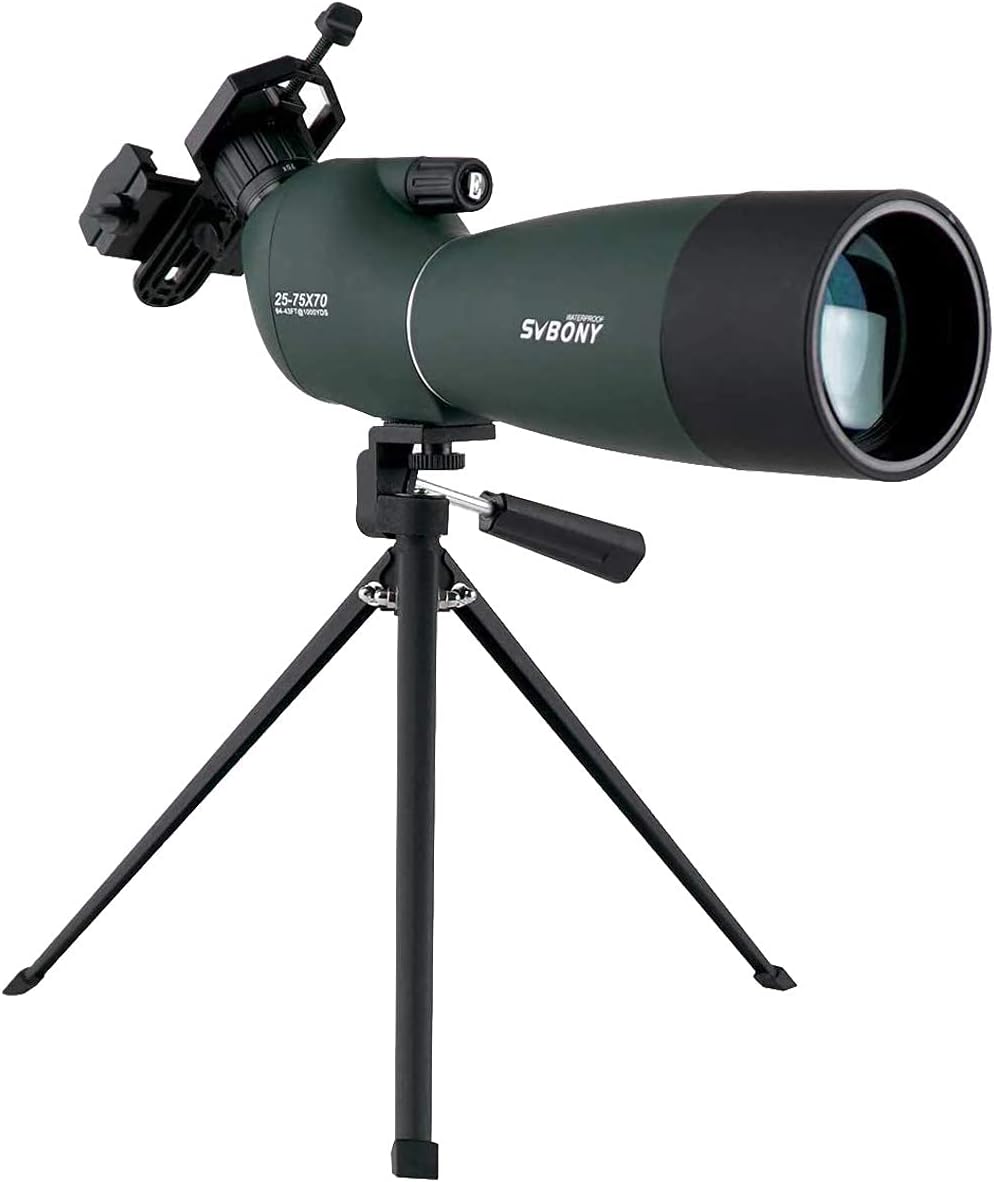 | SVBONY SV28 Scope | Check Price |
Our Top Picks 2  | Falcon 20-60×85 Scope | Check Price |
Our Top Picks 3  | Celestron Hummingbird ED 56mm | Check Price |
Our Selected Top 12 Spotting Scopes for Birding Worth Your Money
This list features carefully chosen spotting scopes ideal for birdwatching, highlighting their performance, suitability for different users, and key advantages and drawbacks. Each review helps readers understand which scope matches their specific needs and preferences.
1. SVBONY SV28 Spotting Scope
Great for beginners looking to get started with birding, the SVBONY SV28 has a solid zoom range that lets you adjust easily from distance to closer views. Its strong point is the 70mm objective lens that pulls in plenty of light for clearer daytime observations.
Setting up involves attaching it to a tripod, which fits well thanks to the equatorial mount. Changing magnification is straightforward with its 25-75x zoom eyepiece, allowing smooth manual focus adjustments. The built-in sunshade is handy when the sun is bright, cutting down glare without extra fuss.
Optics deliver sharp images with decent field of view and color thanks to the FMC coating on the lenses. The waterproof feature adds reliability outside.
Most praise notes how the large lens brings bright, detailed views. On the downside, some find manual focusing a bit challenging when trying to track fast-moving birds.
People appreciate how bright and clear views get thanks to the 70mm lens and FMC coating. Common issues appear around the manual focus, especially when trying to keep moving subjects sharp at high magnification.
Anyone starting birding who wants solid image brightness and a zoom range will like this scope. Users needing quick focusing on quick action may want to look at models with automatic focus. The scope’s waterproof quality adds durability for outdoor adventures.
Pros
- Easy zoom adjustment from 25-75x magnification
- Waterproof design suitable for outdoor use
- Large 70mm objective lens gathers plenty of light
- Non-slip finish feels secure in wet conditions
Cons
- Manual focusing can be tricky on fast birds
- Equatorial mount may require more setup effort
| Specification | Details |
|---|---|
| Eye Piece Lens Description | Zoom eyepiece |
| Mount | Equatorial Mount |
| Focus Type | manual |
| Compatible Devices | Camera, tripod |
| Coating | FMC |
| Focal Length Description | 380 millimeters |
| Field Of View | 64 feet |
| Zoom Ratio | 3:1 |
2. Falcon 20-60×85 Spotting Scope
Birdwatching often calls for close-up views without missing much in the surroundings. The Falcon 20-60×85 Spotting Scope fits perfectly for nature enthusiasts looking to study birds in detail thanks to its powerful magnification and wide field of view.
Setup is straightforward with the adjustable tripod that goes from a handy 13.3 inches to a full 63 inches, making it easy to get the view just right whether you are sitting or standing. Manual focus lets you quickly adjust to catch sharp images, while the included smartphone compatibility lets you easily snap photos of your observations.
The 85mm objective lens and BAK4 prism deliver bright, clear, and colorful images that stand out even in low-light conditions like early morning or dusk. Its weatherproof design adds to confidence when used outdoors.
Most users note how crisp the viewing is at high magnifications, while the manual focus can take some getting used to for quick wildlife spotting.
Experience is mostly positive as bright, colorful views stand out during low light hours, appealing to birders who enjoy detailed observation. The manual focus gets noted for slowing down quick adjustments, presenting a challenge when tracking rapid wing movements in the wild.
Those valuing high magnification and image quality will find great use here, especially during calm observation sessions. Anyone needing fast autofocus or a compact scope for travel might want to explore other options better tailored to quick changes and portability.
Pros
- Wide 101ft field of view at 20x magnification
- Bright images with FMC coating and BAK4 prism
- Tripod adjusts from 13.3in to 63in for comfort
- Smartphone compatibility included
Cons
- Manual focus can be slow for fast-moving birds
- Larger objective lens makes it less portable
| Specification | Details |
|---|---|
| Magnification | 20-60x |
| Objective Lens Diameter | 85mm |
| Field Of View | 101ft-48ft/1000 yards |
| Focus Type | manual focus |
| Mount | Tripod Mount |
| Additional Features | Wide field of view, weatherproof, adjustable tripod, smartphone compatibility |
3. Celestron Hummingbird ED 56mm Spotting Scope
Sharp, clear images come from the ED lens optical system, making this scope ideal for birdwatchers who value clarity and portability. Its 9-27x magnification covers both binoculars and spotting scopes, fitting nicely into a vest pocket or small bag for easy transport during long outings.
Carrying this micro-sized spotting scope is straightforward thanks to its small size and light weight. Manual focus works smoothly, and the close focus distance of 10 ft.
suits birders aiming to study nearby birds with precision. A built-in rechargeable battery powers its functions, while fully multi-coated lenses keep visibility high, even in dim light or mist.
Images remain sharp and colors vivid during use in various outdoor conditions, backed by waterproof and nitrogen-filling to resist fogging and moisture. The scope adapts well to tripods or window mounts, enhancing stability during longer observations. Strong points include rugged weather protection, while some find the 1.7-degree field of view a bit narrow for sweeping scenes.
Users appreciate the sharp, true-to-life colors and the waterproof design that stands up to wet or humid conditions. A frequent downside is the limited field of view, which some find restrictive for scanning wide areas quickly.
Birdwatchers who prioritize image clarity and portability will find this scope well-suited for their needs. Those seeking wider views or less manual focusing effort might prefer other models better tailored to those priorities.
Pros
- Compact size fits in vest or coat pockets
- Clear, vivid images with ED lens optics
- Close focus distance ideal for birding
- Waterproof and nitrogen filled for durability
Cons
- Narrow 1.7-degree field of view limits scope
- Manual focus requires steady hands
| Specification | Details |
|---|---|
| Magnification Range | 9-27x |
| Close Focus Distance | 10 ft. / 3m |
| Coating | Fully Multi-Coated |
| Power Source | Internal rechargeable battery |
| Field Of View | 1.7 degrees |
| Mount | Tripod adaptable |
4. Athlon Optics Forerunner 20-60×80 Spotting Scope

Birders looking for detailed long-range views will appreciate this scope’s powerful zoom and sharp images. It’s built for adults who need precise spotting for birdwatching or hunting, with magnification that goes from 20x to 60x as its standout feature.
Setting up the scope is straightforward since it comes with a tripod for stable viewing. The dual focus system makes adjusting sharpness quick and exact, which helps when tracking fast or distant birds.
Thanks to its weatherproof design, it holds up well outdoors, even in damp or foggy conditions, making daily use reliable and consistent.
Image clarity remains clear and bright due to the fully multi-coated lenses, making it easy to see fine details at high zoom levels. The aluminum build feels solid without being excessively heavy at 2.47 kg. Many appreciate how tough and weather-resistant it is.
The most common downside is that with 80mm lenses, it’s a bit bulky to carry around for long hikes.
Users praise the scope’s ability to deliver bright, sharp images with easy-to-use dual focus controls. The main drawback is its weight, which can feel cumbersome for long trips on foot. It excels when used from a stationary position or a vehicle.
Those who want a strong zoom and high-quality optics for birding in one spot will find this scope fitting well. People needing something lighter or more portable might want to look at smaller alternatives better suited for fast-moving nature walks.
Pros
- Zoom range from 20x to 60x for detailed views
- Fully multi-coated lenses for bright, true colors
- Durable, waterproof, and fog-proof for outdoor use
- Dual focus knobs for precise adjustments
Cons
- Relatively heavy to carry for extended periods
- Size makes it less convenient for quick hikes
| Specification | Details |
|---|---|
| Magnification | 20-60x |
| Objective Lens Diameter | 80mm |
| Package Weight | 2.47 kg |
| Material | Aluminum |
| Warranty | Lifetime |
5. Vortex Crossfire HD 20-60×80 Spotting Scope

Vortex Crossfire HD 20-60×80 Spotting Scope stands out by combining high-quality optics with great value, ideal for birders who want sharp images without overspending. Its bright HD lenses deliver clear details at a wide range of magnifications, making it well-suited for both beginners and experienced bird watchers.
Setting up requires just attaching the spotting scope to any Arca-Swiss compatible tripod, streamlining the process and keeping things stable in the field. The zoom range from 20x to 60x lets you quickly adjust your view depending on the distance and lighting. The anti-reflective coatings help maintain brightness even when conditions aren’t perfect, so you get good visibility during early mornings or late afternoons.
Performance-wise, the sharpness and color accuracy are impressive, with minimal color fringing around edges thanks to the special glass used. The body feels solid enough for outdoor use, though some might notice it’s a bit bulky to carry around for long hikes. Praise often highlights the outstanding clarity at various magnifications, while common grumbles mention the weight and size as minor inconveniences.
The sharp image quality and clear colors stand out, making distant birds easier to see with little color distortion. On the flip side, the scope’s weight and size are common factors that can slow down movement or tire users when carried for extended periods in the field.
Those who prioritize crisp optics and stable mounting will appreciate this model, especially for stationary birdwatching. People needing a lightweight, compact setup for fast hikes might want to consider smaller or lighter alternatives.
Pros
- Exceptional resolution and edge-to-edge sharpness
- Anti-reflective coatings improve low-light visibility
- Wide zoom range from 20x to 60x
- Easy tripod mounting with Arca-Swiss compatibility
Cons
- Heavier than some other spotting scopes
- Bulkier design can be hard to carry on long walks
| Specification | Details |
|---|---|
| Objective Lens Diameter | 8 centimeters |
| Magnification Maximum | 60 x |
| Lowest Useful Magnification | 20 x |
| Compatibility | Arca-Swiss foot for tripods |
6. DiamondEdge 25-75×80 Spotting Scope
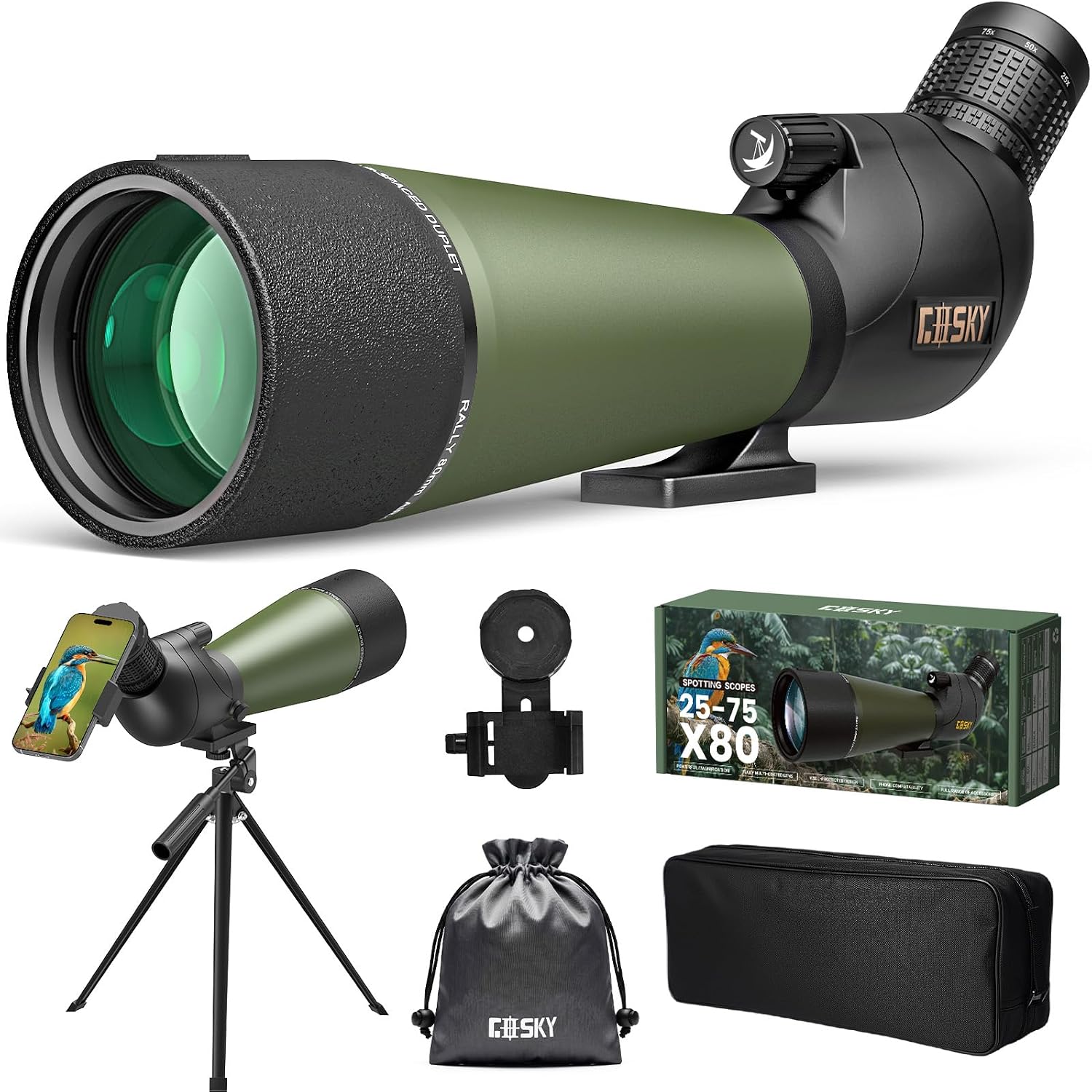
Gosky DiamondEdge 25-75×80 is a spotting scope built for birdwatchers who need powerful magnification paired with clear, bright images. Its strongest trait lies in the sharpness and color accuracy that come from an 80mm objective lens combined with a multi-coated BAK4 prism system, great for detailed wildlife observation.
Setting up involves a manual focus that feels intuitive once you get the hang of it. The larger 23mm eyepiece makes viewing comfortable and offers a wide field of view, which helps in tracking moving birds. Attaching it to a tripod stabilizes the image, and the integrated phone holder lets you snap photos through the lens with ease during your outings.
The scope delivers on clear, bright images even at high magnification, thanks to the multi-coated optics and BAK4 prism. Its build quality feels solid and reliable without being overly heavy.
The biggest plus from feedback is how bright and detailed the images appear. A common downside is the manual focus, which some find a bit fiddly when trying to quickly lock onto a subject.
Clear, bright images and great color accuracy stand out as the product’s strongest features. Users appreciate the wide field of view but often mention the manual focus takes practice and can slow quick spotting moments.
Birders who value image quality and plan longer viewing sessions will enjoy this scope. Those seeking quick auto-focus or a lighter, more compact device might want to consider other options.
Pros
- Wide 23mm eyepiece for easier viewing
- Bright, sharp images with excellent color accuracy
- Compatible with cameras and smartphones
- Tripod mount for stable viewing
Cons
- Manual focus can be tricky during fast action
- Unpowered with no built-in illumination
| Specification | Details |
|---|---|
| Magnification | 25-75x |
| Objective Lens Size | 80mm |
| Prism Type | BAK4 Prism System |
| Coating | Multi-coated |
| Focus Type | Manual Focus |
| Eye Piece Lens | 23mm |
7. Vortex Viper HD Spotting Scope

Glassing with the Vortex Viper HD 20-60×85 Angled scope feels precise and clear, great for birders who want sharp views and flexible eye relief. Its biggest strength lies in delivering vivid high-definition images that stand out, especially in low light, making it an excellent choice for serious bird watchers.
Adjustments are straightforward thanks to the smooth helical focus, which is easy to fine-tune for crisp images and keeps the scope compact for carrying. The multi-position eyecup helps provide comfortable eye relief during longer viewing sessions, and the locking collar lets you rotate the scope to find the best angle without hassle. Pulling out the built-in sunshade effectively cuts glare in bright situations.
The optical system produces bright, sharp images thanks to quality components and XR anti-reflective coatings, specialized for low-light conditions. It’s a water- and fog-proof design, built to withstand rough outdoor environments.
The focus smoothly brings distant birds into sharp view. A common praise highlights its clarity and brightness, while some mention the eyecup rotation can feel a bit stiff.
The scope provides outstanding image clarity and brightness, especially in low light, thanks to premium lenses and coatings. Fog proof and waterproof design adds durability, though the eyecup rotation mechanism may require extra effort to adjust smoothly.
Those prioritizing sharp optics and versatile eye relief will find this scope well suited to their needs. Birders wanting a lighter or more compact option might want to consider models with smaller objective lenses or simpler designs.
Pros
- Bright and vivid high-definition images
- Helical focus provides smooth, precise adjustments
- Multi-position eyecup for comfortable viewing
- Built-in sunshade reduces glare effectively
Cons
- Eyecup rotation can be slightly stiff
- Heavier due to large 85mm objective lens
| Specification | Details |
|---|---|
| Objective Lens Diameter | 8.5 centimeters |
| Magnification Maximum | 60 x |
| Focus Type | Individual Focus (Helical Focus) |
| Field of View | 4.25 degrees |
| Water Resistance Level | Waterproof |
| Coating | Multiple anti-reflective coatings on all air-to-glass surfaces |
8. Unbranded 20-60×60 Angled Spotting Scope

Lightweight and versatile, this spotting scope fits outdoor enthusiasts who prioritize portability without sacrificing clear vision. Its biggest strength lies in the combination of compact size and adjustable magnification, making it easy to carry during long hikes or birding trips.
Setup is quick with the included 14-inch tabletop tripod, which offers a stable base even on uneven surfaces like grass or gravel. The tripod’s wider legs ensure it won’t tip over easily.
The scope weighs just 1.31lbs, and the soft shoulder-strap case lets you sling it over your shoulder without feeling burdened. Adjusting the magnification from 20x to 60x is smooth and practical for spotting details at various distances.
Optical clarity is solid given the HD optics designed for outdoor use, providing a wide field of view of over 3,200 feet. Construction feels lightweight but durable, suitable for travel and quick setups.
Most users appreciate its stability and ease of transport, while some mention that the relatively small objective lens limits brightness in low light conditions.
The scope is praised for its stable tripod and portability, making travel simple and comfortable. Commonly noted, the smaller lens size reduces image brightness when lighting is poor, which can affect spotting early or late in the day.
Those who enjoy hiking or birding at well-lit times will appreciate the lightweight design and steady setup. Anyone needing brighter images for dawn or dusk viewing might want to explore options with larger objective lenses.
Pros
- Lightweight and easy to carry over long distances
- Stable tripod with wider legs for uneven ground
- Wide field of view for spotting birds at distance
- Adjustable magnification from 20x up to 60x
Cons
- Small objective lens limits brightness in dim light
- Tripod height may be too short for standing use
| Specification | Details |
|---|---|
| Magnification Minimum | 20x |
| Magnification Maximum | 60x |
| Objective Lens Diameter | 6 centimeters |
| Eye Relief | 17 millimeters |
| Field Of View | 3280.84 feet |
| Weight | 1.31 lbs |
9. Celestron Ultima 22-66×100 Spotting Scope

Built with a durable design and a large 100mm objective lens, the Celestron Ultima 22-66×100 spotting scope suits anyone who enjoys serious birding or long-distance outdoor viewing. Its main strength lies in its versatile 22-66x zoom, allowing clear views from near to far with an angled 45° eyepiece for comfortable observation.
Setup involves mounting the scope on an equatorial mount using the extended tripod plate, which keeps it stable during use. Manual focus requires a bit of attention but feels precise once dialed in. The included zoom eyepiece with integrated T-adapter works well for attaching a camera, making digiscoping possible.
Carrying it around is easier with the soft case and the lens cloth helps keep the multi-coated glass clear for bright images.
Performance shines in bright, detailed views with good color and contrast thanks to the multi-coated optics on every lens. Build quality supports outdoor use with fogproof, waterproof, and UV-protection features. The strongest praise comes from the sharpness and brightness of the image.
Some users found the manual focusing a bit slow and the weight somewhat noticeable for long hikes.
Sharpness and brightness of views receive high marks thanks to the multi-coated lenses, while the manual focus requires patience to get perfect clarity. The scope is built tough with weatherproof features but can be a bit bulky and heavy for carrying over long distances.
Those wanting excellent zoom flexibility and outdoor durability will be happy with this scope. People seeking lightweight gear or faster focusing might want to look for lighter or autofocus options instead.
Pros
- Sharp image with bright, multi-coated optics
- Zoom range from 22x to 66x magnification
- Includes T-adapter for easy camera connection
- Waterproof and fogproof for outdoor use
Cons
- Manual focus can be slow to adjust
- Feels heavy during extended carrying periods
| Specification | Details |
|---|---|
| Eye Piece Lens Description | 22-66x zoom |
| Mount | Equatorial Mount |
| Focus Type | Manual Focus |
| Field Of View | 45 degrees |
| Zoom Ratio | 3:1 |
10. Vortex Diamondback Spotting Scope

Bright and clear images stand out with this spotting scope, built for serious birders wanting versatile, powerful optics in a compact design. Suited for someone carrying gear on long walks, it combines strong magnification with handy features for comfort and adaptability.
Setting up is straightforward thanks to a twist-and-lock collar that lets you adjust the angle quickly. The built-in retractable sunshade keeps glare down in bright sunlight. Twisting the eyecup adjusts eye relief for comfort, while the smooth focus wheel makes quick adjustments easy without over-fiddling.
Its lightweight design makes it less tiring to carry during long birding trips.
Images stay bright and sharp because of fully multi-coated lenses, even when zooming far in from 20x up to 60x magnification. The scope’s weather-sealing with nitrogen purging means it won’t fog up or get damaged in wet conditions, useful out in the field. Most praise focuses on clear views and ease of use, while some mention the manual focusing takes a steady hand.
The scope delivers bright, sharp images combined with reliable weatherproofing, but some users find manual focusing requires a steady, practiced hand. The eye relief and zoom function contribute to comfort, but the smaller exit pupil size might affect views at dawn or dusk.
Anyone needing a lightweight, versatile scope for daytime birding will appreciate this model’s design and optics. People wanting quick auto-focus or better low-light performance might want to explore other options.
Pros
- Compact and lightweight for easier carrying
- Clear view thanks to XR fully multi-coated lenses
- Waterproof and fogproof for tough weather conditions
- Adjustable eyecup and sunshade improve comfort
Cons
- Manual focus can feel fiddly without practice
- Exit pupil diameter may limit low light use
| Specification | Details |
|---|---|
| Objective Lens Diameter | 1 inch |
| Magnification Maximum | 60x |
| Eye Relief | 20 millimeters |
| Focus Type | Manual Focus |
| Coating | Fully Multi-Coated |
11. Maven CS2A 26-66×85 Spotting Scope
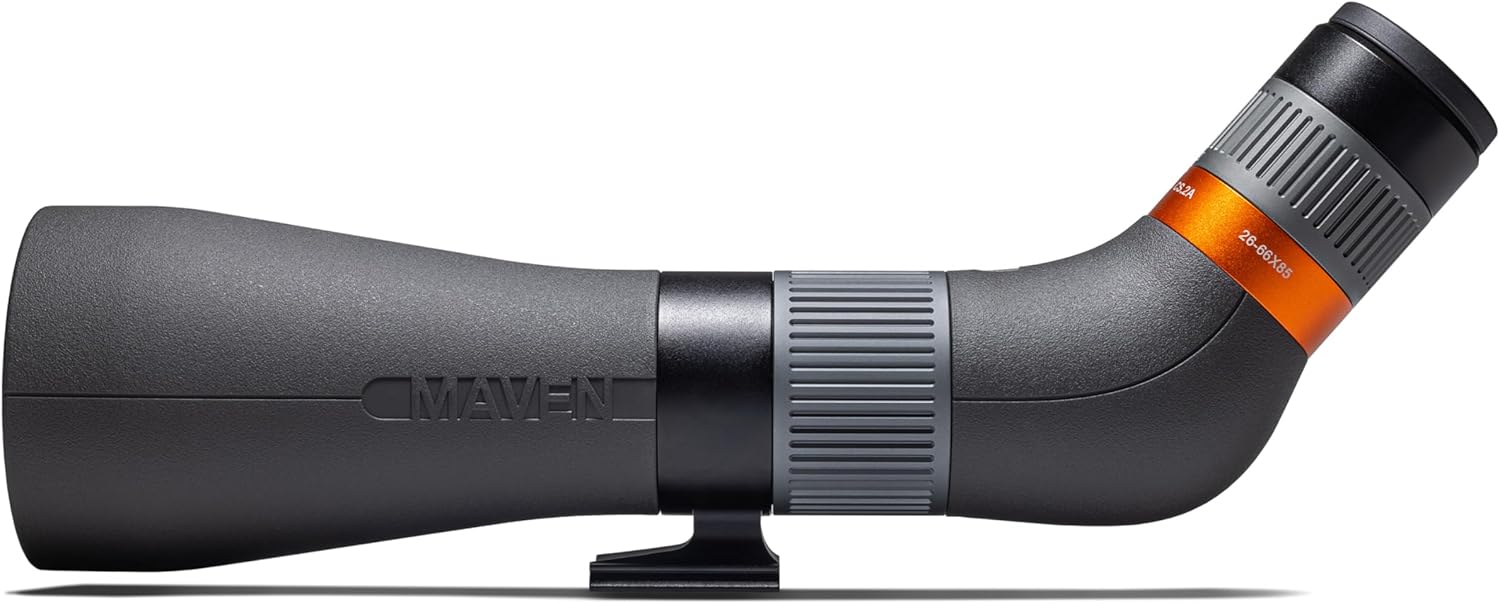
Choosing this spotting scope means going for outstanding clarity and great performance in low-light conditions, ideal for serious birders who want the best image quality possible. Its biggest strength lies in the premium extra-low dispersion glass combined with a large 85mm objective lens that keeps colors true and details sharp.
Setting it up is straightforward, and the zoom range from 26x to 66x lets you track birds at various distances without losing clarity. The large lens gathers plenty of light, so early mornings or overcast days won’t feel limiting. It’s designed to be steady on a tripod, making those long observation sessions comfortable rather than tiring.
It delivers crisp, high-contrast views thanks to the ED glass, showing sharp details and accurate colors. The build feels solid and reliable, suitable for outdoor use, though it is a bit on the heavier side compared to smaller scopes.
Users often praise its bright images and zoom range, but some mention it can be bulky to carry around all day.
The crystal-clear detail and color accuracy from the ED glass paired with the bright 85mm lens are the main highlights, providing great views when light is less than ideal. The most frequent complaint concerns its size and weight, which makes it less convenient for those wanting a compact scope.
Those who prioritize image sharpness and low-light clarity will appreciate this spotting scope, especially for stationary bird watching. People seeking a lighter, more portable option may want to explore smaller scopes instead.
Pros
- Exceptional clarity with extra-low dispersion glass
- Excellent low-light performance from 85mm lens
- Wide zoom range from 26x up to 66x
- Sharp, high-contrast images with true color accuracy
Cons
- Can feel bulky for long carrying sessions
- Requires a sturdy tripod for best stability
| Specification | Details |
|---|---|
| Objective Lens Diameter | 8.5 centimeters |
| Magnification Maximum | 66 x |
| Lowest Useful Magnification | 26 x |
| Zoom Ratio | 2.5:1 |
12. Maven CS.1 15-45×65 Spotting Scope

Watching birds in their natural habitat calls for crystal-clear images and flexibility in magnification. Perfect for birders who need a reliable and sharp viewing experience, the Maven CS.1 15-45×65 Spotting Scope stands out for its high-quality ED glass that delivers clear and detailed views at varying distances.
Setting it up is straightforward on any tripod thanks to the tripod mount and solid center focus design. The 15-45x zoom eyepiece lets you switch quickly from scanning wide areas to zeroing in on fine details without fuss.
Fully multi-coated lenses improve light transmission, making early morning or late afternoon birdwatching much easier. It is also lightweight and waterproof, which helps during long outdoor sessions and unpredictable weather.
Performance-wise, the extra-low dispersion glass provides crisp, high-definition images that reduce color fringing, making birds look true to life. Its build is durable without feeling bulky, suitable for carrying around all day. Strong praise points to the sharp imagery across the zoom range.
On the downside, some find the zoom ring a bit stiff, affecting quick adjustments.
The spotting scope is praised most for its sharp, high-definition images without much color distortion, thanks to the extra-low dispersion glass. The common complaint is about the stiff zoom ring that can slow quick changes in magnification.
Those who want detailed, true-to-life views at varying distances will be happy with this scope, especially birders who do long daytime observations. People needing faster zoom adjustments or more compact gear might prefer a different model.
Pros
- Exceptional clarity with extra-low dispersion glass
- Wide 15-45x magnification flexibility
- Lightweight and waterproof for outdoor use
- Fully multi-coated lenses improve light transmission
Cons
- Zoom ring can feel stiff during adjustments
- Requires tripod for steady viewing at higher magnifications
| Specification | Details |
|---|---|
| Magnification Range | 15-45x |
| Objective Lens Diameter | 65 millimeters |
| Focal Length | 162.5 millimeters |
| Field of View | 64.5 degrees |
| Focus Type | Center Focus |
| Coating | Fully Multi-Coated |
Best Spotting Scopes for Birding Comparison Table
| Product | Magnification Range | Objective Lens Diameter | Coating | Focus Type |
|---|---|---|---|---|
| SVBONY SV28 Scope | 3:1 zoom | – | FMC | Manual |
| Falcon 20-60×85 Scope | 20-60x | 85mm | – | Manual |
| Celestron Hummingbird ED 56mm | – | 56mm | Fully Multi-Coated | Manual |
| Athlon Forerunner 20-60×80 | 20-60x | 80mm | – | – |
| Vortex Crossfire HD 20-60×80 | 20-60x | 80mm | – | – |
| DiamondEdge 25-75×80 Scope | 25-75x | 80mm | Multi-coated Bak4 prism | Manual |
| Vortex Viper HD Scope | Up to 60x | 85mm | Proprietary coatings | – |
| Unbranded 20-60×60 Angled | 20-60x | 60mm | – | – |
| Celestron Ultima 22-66×100 | 22-66x | 100mm | Multi-Coated | Manual |
| Vortex Diamondback Scope | 20-60x | 1 inch (~25mm) | Fully Multi-Coated | Manual |
| Maven CS2A 26-66×85 | 26-66x | 85mm | – | – |
| Maven CS.1 15-45×65 | 15-45x | 65mm | Fully Multi-Coated | Center Focus |
- Magnification Range3:1 zoom
- Objective Lens Diameter–
- CoatingFMC
- Focus TypeManual
- Magnification Range20-60x
- Objective Lens Diameter85mm
- Coating–
- Focus TypeManual
- Magnification Range–
- Objective Lens Diameter56mm
- CoatingFully Multi-Coated
- Focus TypeManual
- Magnification Range20-60x
- Objective Lens Diameter80mm
- Coating–
- Focus Type–
- Magnification Range20-60x
- Objective Lens Diameter80mm
- Coating–
- Focus Type–
- Magnification Range25-75x
- Objective Lens Diameter80mm
- CoatingMulti-coated Bak4 prism
- Focus TypeManual
- Magnification RangeUp to 60x
- Objective Lens Diameter85mm
- CoatingProprietary coatings
- Focus Type–
- Magnification Range20-60x
- Objective Lens Diameter60mm
- Coating–
- Focus Type–
- Magnification Range22-66x
- Objective Lens Diameter100mm
- CoatingMulti-Coated
- Focus TypeManual
- Magnification Range20-60x
- Objective Lens Diameter1 inch (~25mm)
- CoatingFully Multi-Coated
- Focus TypeManual
- Magnification Range26-66x
- Objective Lens Diameter85mm
- Coating–
- Focus Type–
- Magnification Range15-45x
- Objective Lens Diameter65mm
- CoatingFully Multi-Coated
- Focus TypeCenter Focus
How to Choose the Best Spotting Scope for Birding
Choosing a good spotting scope for birding involves considering factors like magnification, lens quality, and portability to ensure clear views and ease of use. Getting these right helps avoid frustration and saves money by providing reliable performance suited to your birdwatching needs.
Optical Quality and Coatings
Using a scope with poor lens coatings becomes obvious after just a few minutes; colors look washed out, and sharp details blur at the edges. Fully multicoated lenses significantly reduce flare and increase light transmission, which helps maintain accurate colors and sharpness in varied lighting. Spotting scopes with cheap coatings often show distortion and purple fringing, known as chromatic aberration, around birds, especially against bright skies.
The type and quality of prisms inside affect both image brightness and the scope’s size. Roof prisms tend to offer a more compact design but often require precise alignment to keep the image bright and sharp. Porro prisms usually produce a brighter image with less distortion but make the body bulkier.
Picking between these depends on whether you prioritize compactness or image brightness in typical birding conditions.
Durability and Weather Resistance
Scoping outdoors means facing sudden rain or heavy dew. Models that are waterproof and fogproof provide real confidence since moisture won’t fog up the lenses or damage internal components. Non-resistant scopes risk fogging during temperature changes, ruining a quick sighting.
The build material plays a major role in durability; metal alloys and high-grade polycarbonate plastics handle occasional drops or bumps better than cheaper plastic housings.
Extra protection comes from durable lens caps and a rubber armor coating on the body. Lens caps guard against scratches when the scope is in a bag or backpack, while rubber armor cushions impacts and improves grip. Without these features, it’s easy to end up with scratches or dents that reduce optical quality and handling.
Portability and Weight
Long hours in the field make a heavy or bulky scope difficult to carry and set up. A good birding scope usually weighs between 1.5 to 3 pounds, striking a balance between solid construction and portability.
Many users find something compact enough to fit in a small bag or sling strap the easiest to move around with all day.
The ease of mounting is another practical consideration. Scopes that quickly attach to a tripod save time adjusting while spotting restless birds.
At the same time, a design that works comfortably for handheld use keeps things flexible during hikes or quick stops. Compact scopes with foldable or twist-up eyecups also speed up setup during unpredictable outdoor breaks.
Eye Relief and Comfort
The distance between the eyepiece lens and your eye, known as eye relief, matters a lot for comfortable viewing, especially for those wearing glasses. Scopes with at least 15mm of eye relief prevent your glasses from blocking part of the image, making longer sessions less tiring. Shorter eye relief forces awkward positioning that quickly becomes uncomfortable.
Comfort also depends on eyecup design and adjustment options. Soft, adjustable eyecups reduce pressure around the eye socket.
A smooth focusing mechanism with clear resistance avoids accidental slipping while fine-tuning the image. Many scopes include a diopter adjustment ring, which allows you to compensate for small vision differences between eyes, making each bird’s details crisp and clear without strain.
Proper Techniques for Using Spotting Scopes in Birding
Stability matters a lot when using spotting scopes for birding. Holding the scope steady can make a big difference in image clarity. Using a tripod is almost essential, especially with higher magnifications that amplify hand movements.
Positioning yourself comfortably and adjusting the tripod height also helps keep the view stable over longer periods.
Proper focusing techniques come next. Slowly turning the focus knob allows you to sharpen the image without overshooting.
Begin with a lower magnification to locate the bird, then zoom in for detailed views. Adjusting the eyepiece diopter is important if you wear glasses, as it fine-tunes the focus according to your eyesight.
- Work in shaded areas or use a hood to reduce glare.
- Use slow, deliberate movements to track birds at a distance.
- Keep the scope pointed slightly downward to avoid dust settling inside.
Maintaining and Cleaning Your Spotting Scope for Optimal Performance
Cleaning a spotting scope correctly prevents damage to the lenses and preserves image quality. Avoid wiping lenses dry unless there’s no loose dust or dirt, as rubbing can cause scratches.
Instead, use a soft air blower or a fine brush to remove particles gently before applying any cleaning solution.
Lens cleaning solutions should be designed specifically for optical glass. Apply the liquid to a microfiber cloth, not directly on the lenses, to prevent moisture seeping into the scope’s interior.
Regularly check lens caps and the protective cover for a secure fit to reduce dirt accumulation.
- Store the scope in a padded case when not in use.
- Keep the scope dry; moisture can lead to fungus growth on lenses.
- Wipe the body with a damp cloth to clear off dust and dirt.
Common Mistakes to Avoid When Choosing and Using Spotting Scopes
Choosing a spotting scope based only on magnification is a common mistake. Higher zoom doesn’t always mean better image quality.
Often, scopes with moderate magnification and wider fields of view provide clearer, brighter images and are easier to handle in the field.
Another frequent error involves ignoring the weight and size of the scope. Carrying heavy or bulky models can reduce comfort during long birding sessions.
Checking the durability and waterproof features is important, but lightweight models can offer a better balance for outdoor use.
- Don’t overlook eyepiece compatibility and ease of focus adjustment.
- Test how well the scope adapts to different light conditions if possible.
- Avoid buying scopes without a tripod or mounting options, as these are crucial for steady viewing.
People Also Asked
How Do I Choose the Right Size Spotting Scope for Birding?
Select a spotting scope size that balances portability with image clarity; smaller scopes are easier to carry but might sacrifice some light gathering. Consider how far and often you will be hiking, since heavier scopes can quickly become tiring to carry for long distances.
What Is the Proper Way to Clean and Care for a Spotting Scope?
Use a soft brush or cloth to remove dust before cleaning lenses with a proper lens cleaner. Avoid touching lenses with fingers and store the scope in a protective case after use to prevent scratches and moisture buildup.
Are Spotting Scopes Safe to Use in Bright Sunlight Conditions?
Spotting scopes are generally safe to use in bright sunlight but never look directly at the sun through the lens to avoid serious eye damage. Use lens caps and sunshades to protect the optics and yourself.
How Long Do Spotting Scopes Typically Last with Regular Use?
With regular use and proper care, a spotting scope can last 10 years or more. Keeping it clean, dry, and stored in a safe place helps maintain its condition over time.
What Common Problems Should I Watch for with Spotting Scopes?
Common problems include lens fogging, loose focus mechanisms, and damaged or dirty lenses. Regularly checking and maintaining your scope minimizes these issues and keeps observations clear.
Conclusion
Choosing a spotting scope for birding mainly depends on the clarity of the image, how easy it is to carry around, and the zoom range. Clear optics allow you to see fine details, while a compact design helps if you walk a lot. A flexible zoom helps in spotting birds at different distances without needing to switch equipment.
Consider where you will use the scope most and how much you want to spend. A lighter, affordable model might be better for casual outings, while a heavier, pricier one can work for serious birdwatching trips.
Look back at the comparison table and earlier suggestions to match a scope to your specific needs.