Top 10 Best Range for Binoculars That Will Blow Your Mind
Trying to spot birds or distant landmarks through a cheap pair of binoculars often ends in frustration. The image might blur or shake, making it hard to focus on details.
Choosing the best range for binoculars means finding the right balance between zoom power and clarity, so the view stays sharp without wobbling out of control.
Good binoculars usually have a magnification between 8x and 10x, which offers enough zoom without losing stability. Lens quality and coating affect brightness and clarity, especially in low light.
The size and weight also matter; something too bulky can tire the hands quickly, while a comfortable grip helps maintain steady focus during longer use. Waterproofing and fog-proofing are important too, especially for outdoor use in varying weather conditions.
Need a Quick Check?
| Image | Product | Price |
|---|---|---|
Our Top Picks 1  | High Powered 20×50 | Check Price |
Our Top Picks 2  | SVBONY SV28 Spotting Scope | Check Price |
Our Top Picks 3  | 4K Night Vision Binoculars | Check Price |
Our Selected Top 10 Range for Binoculars for Different Needs
This list showcases a variety of binoculars tailored for different activities and preferences. Each review highlights how the binocular performs, its ideal user, and its main advantages and drawbacks, helping readers make informed choices based on their specific needs.
1. High Powered 20×50 Binoculars
High Powered 20×50 Binoculars suit people wanting sharp, distant views with strong magnification. Great for bird watching, hunting, or concerts, their standout strength is the clear view at 20x zoom that keeps faraway details crisp and visible.
Setting these binoculars up is straightforward, with a center focus knob that quickly adjusts clarity. Their compact and portable design makes them easy to carry during hikes or camping trips. The waterproof, shock-resistant build adds durability for outdoor use.
Compatibility with a tripod mount and smartphones lets you steady your view or capture what you see.
Performance impresses with a 168-yard field of view at 1000 yards and anti-reflective coatings that reduce glare. Their Porro prism system offers good image brightness.
Built tough, they handle rough conditions well though some may find the manual focus a bit slow for fast-moving scenes. The balance of power and portability draws most praise.
The clear 20x zoom and wide 168-yard field of view allow watching distant subjects with lots of detail. Many find manual focusing less quick when tracking moving things, which can be a drawback for sports or wildlife action.
People who mostly watch static or slow-moving scenes outdoors will like these. Those needing rapid focus changes or super-bright low-light views might want to consider other binoculars more suited to dynamic or dusk conditions.
Pros
- High 20x magnification for detailed distant viewing
- Waterproof and shock resistant for outdoor use
- Compatible with tripod mounts and smartphones
- Compact and easy to carry for travel
Cons
- Manual focus can be slow on moving targets
- Exit pupil diameter of 2.5 mm may reduce brightness in low light
| Specification | Details |
|---|---|
| Magnification Maximum | 20 x |
| Objective Lens Diameter | 50 millimeters |
| Field of View | 1000 yard |
| Focus Type | Center Focus |
| Water Resistance Level | Waterproof |
| Prism Type | Porro Prism |
2. SVBONY SV28 Spotting Scope 25-75×70
Constructed with a large 70mm objective lens and a non-slip waterproof exterior, this spotting scope suits beginners and novices who want a clear view of birds or distant scenes. Its strongest point is the 25-75x zoom, which offers flexible magnification for various scenarios without complicated adjustments.
Setup involves attaching it to a tripod and placing the equatorial mount for steady viewing. Changing magnification is simple and quick, allowing smooth zoom from 25x to 75x.
The extendable sunshade reduces glare, and the manual focus system lets you dial in sharp images. The waterproof and non-slip finish means it holds well even in damp conditions.
Performance delivers a bright and detailed image thanks to the large lens and FMC coating. The spotting scope works well across different light levels and distances, maintaining clarity throughout zoom ranges.
Build quality feels solid with a sturdy barrel. Reviews show praise for brightness and zoom range; common complaints include manual focusing taking time and some bulkiness.
The most common praise highlights the scope’s brightness and effective zoom range allowing clear observation over varied distances. Complaints often mention that manual focusing slows down quick target acquisition and the size makes it less convenient for travel.
People who want to explore birdwatching or scenery at different zoom levels with a solid device will appreciate it. Those needing ultra-light or rapid autofocus might look at other options better suited for fast-paced use.
Pros
- Large 70mm lens for better light gathering
- Easy zoom adjustment from 25x to 75x
- Waterproof with non-slip finish
- Extendable sunshade reduces glare
Cons
- Manual focus requires patience for sharpness
- Heavier and bulkier than smaller scopes
| Specification | Details |
|---|---|
| Zoom Ratio | 3:1 |
| Eye Piece Lens Description | Zoom eyepiece |
| Focus Type | manual |
| Mount | Equatorial Mount |
| Field Of View | 64 feet |
3. 4K Night Vision Binoculars with Rechargeable Battery
Powerful night vision with true color clarity stands out immediately. Designed for night explorers who want detailed, vivid views in dark conditions, these binoculars combine advanced tech and long battery life to keep up with demanding outdoor adventures.
Setup involves charging the built-in 10000mAh battery and inserting the included memory card for video recording. Day-to-day use includes manual focus adjustment and a 5x zoom, suited for camping, hunting, or security tasks.
Backlit buttons help operate it in darkness while the tripod mount allows stable viewing during extended sessions.
Performance delivers sharp and clear imagery thanks to the 4-inch HD TFT screen and the starlight sensor, providing bright views in low light. The waterproof build adds durability against outdoor elements.
The most frequent praise highlights the long 22-hour battery life, whereas some note that the fixed focus requires patience to get just right.
Clear and vivid night vision combined with extended battery life gets consistent praise, while the fixed manual focus requires some patience to fine-tune. The waterproof build adds confidence when used in various outdoor conditions.
Nighttime campers, hunters, and wildlife observers who value long use and video recording will appreciate this model. Those seeking a lighter, faster focusing binocular might want to explore other options.
Pros
- Long 22-hour rechargeable battery life
- Clear night vision in true color
- Waterproof design for outdoor use
- Includes memory card for recording
Cons
- Fixed focus can be tricky to adjust quickly
- Relatively large objective lens adds weight
| Specification | Details |
|---|---|
| Objective Lens Diameter | 60 centimeters |
| Magnification Maximum | 5 x |
| Power Source | Rechargeable Battery (10000mAh) |
| Focus Type | Manual Focus |
| Water Resistance Level | Waterproof |
| Zoom Ratio | 5x |
4. Celestron SkyMaster 25×70 Binoculars

SkyMaster 25×70 binoculars are built for anyone seeking power beyond the usual handheld range, especially good for astronomy and long-distance viewing. Their standout feature is 25x magnification paired with large 70mm lenses, making distant objects much clearer and brighter compared to smaller binoculars.
Setting these up requires a tripod, as they are heavy and powerful. The built-in ¼”-20 adapter clips on easily to most tripods, so you won’t struggle to hold them steady.
Daily viewing is mostly comfortable thanks to multi-coated lenses that reduce glare and sharp focus knobs that let you zero in on details quickly.
You get ultra-sharp focus across the whole field of view and bright images thanks to BaK-4 prisms. The build feels solid though a bit bulky, which means it’s less about hand-held spontaneity and more about stable, planned observation sessions.
Many note how bright and detailed the views are, while some mention the weight as a downside.
Bright and detailed images stand out as a key strength thanks to BaK-4 prisms and large lenses. The frequent drawback mentioned is the weight and bulk, which makes it less practical without a tripod.
People seeking clear views of distant objects during stargazing or land surveys will appreciate these binoculars. Those wanting something lightweight or easy to carry around by hand may want to look for smaller models instead.
Pros
- Bright, sharp views in low light conditions
- Easy tripod mounting with built-in adapter
- Ultra sharp focus across the field of view
- Multi-coated lenses to reduce glare
Cons
- Heavy and bulky, not suited for hand-held use
- Tripod required for steady viewing
| Specification | Details |
|---|---|
| Magnification Maximum | 25 x |
| Objective Lens Diameter | 7 centimeters |
| Focus Type | Center Focus |
| Prism Type | Porro Prism |
| Eye Relief | 13 millimeters |
| Mount Type | Tripod Mount |
5. Occer 12×25 Compact Binoculars

Watching birds or scouting trails demands clear vision and portable gear. Compact binoculars with 12x magnification and a wide field of view work great for outdoor activities like hiking and travel.
The Occer 12×25 stands out by bringing far-reaching views without weighing you down.
Setting them up is simple thanks to center manual focus and adjustable eye cups that fit both eyeglass wearers and those without. The rubber eyepieces pull down for close viewing with glasses, or rise up for more focus without them. A 25mm objective lens captures plenty of light, and the binoculars are waterproof, ready for outdoor conditions.
Image quality impresses with fully multi-coated lenses and BAK4 prisms delivering clear and bright views, even in lower light. Build quality feels solid and portable, easily carrying during hikes.
Most users find the 12x magnification sharp and the field of view wide, while a common drawback is the relatively small exit pupil which can affect comfort during extended viewing sessions.
The binoculars provide a clear and bright image with their multi-coated lenses and BAK4 prism, praised for detailed views. The small exit pupil often causes eye strain during long use, limiting comfort for some users.
Those who want a lightweight, high-magnification binocular for quick outdoor spotting will appreciate this model. People planning extended viewing sessions may want to consider options with larger exit pupils or softer focus controls.
Pros
- 12x magnification for detailed distant viewing
- Adjustable eye cups fit eyeglass wearers comfortably
- Waterproof design suitable for outdoor use
- Compact and portable for travel and hiking
Cons
- Small exit pupil can strain eyes over time
- Manual focus requires careful adjustment
| Specification | Details |
|---|---|
| Magnification Maximum | 12 |
| Objective Lens Diameter | 25 millimeters |
| Field of View | 7.5 degrees |
| Eye Relief | 20 millimeters |
| Prism Type | BAK-4 |
| Coating | Fully Multi-Coated |
6. Vortex Triumph HD 10×42 Binoculars

With 10x magnification and 42mm objective lenses, these binoculars offer clear, detailed views ideal for hunting or hiking. Their standout feature is the HD optical system that provides sharp images and rich color, making them well-suited for anyone needing reliable, high-quality optics in the outdoors.
Daily use involves a simple center focus wheel that allows quick adjustments. The compact design and rubber armor offer a comfortable grip and protect the binoculars from shocks.
Nitrogen purging prevents fogging, which is a big plus when moving through humid or changing environments. Setup is straightforward, and the tripod mount option supports steady viewing during longer observation sessions.
The optical clarity stands out with minimal chromatic aberration, providing crisp edges and good light transmission. The units feel solid yet not too heavy, contributing to a balanced experience on long outings. A common complaint is the relatively narrow field of view, which may require more spotting adjustments.
Most praise goes to the durability and image quality, especially in varying weather conditions.
Clarity and color accuracy receive consistent praise, thanks to the HD optics and multi-coated lenses, providing detailed views in diverse conditions. However, the relatively narrow field of view sometimes requires extra effort to keep moving subjects framed.
Those who prioritize image sharpness and durability in outdoor settings will find these binoculars fitting. Individuals needing wider viewing angles or ultra-lightweight gear may want to explore other models better suited to those preferences.
Pros
- Fully multi-coated lenses for sharp, bright images
- Waterproof and fog proof for all-weather use
- Shockproof rubber armor improves grip and durability
- Manual center focus for precise adjustments
Cons
- Narrow 0.67-degree field of view limits peripheral vision
- Some find it bulky for extended handheld use
| Specification | Details |
|---|---|
| Magnification Maximum | 10 x |
| Objective Lens Diameter | 42 millimeters |
| Water Resistance Level | Waterproof |
| Field of View | 0.67 degrees |
| Eye Relief | 17 millimeters |
7. Vortex Crossfire HD 12×50 Binoculars
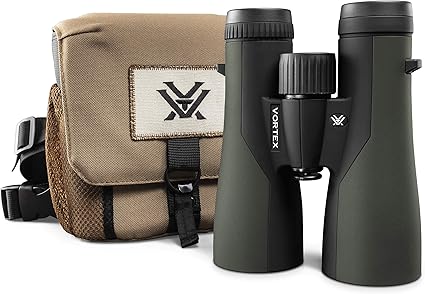
Ideal for serious hunters and outdoor enthusiasts, these binoculars offer 12x magnification with 50mm lenses for clear, bright views over long distances. Their standout feature is sharp image quality with accurate colors, making them suited to spotting game or wildlife in varied light conditions.
Setup is straightforward with a center focus wheel that adjusts both barrels simultaneously, plus adjustable eyecups that twist up or down for comfort whether you wear glasses or not. Fully multi-coated lenses help brighten images even in low light.
The compact roof prism design keeps the binoculars easily portable and durable enough for rugged use.
Performance delivers detailed, edge-to-edge sharp views while controlling color fringing well. Waterproof and fog proof features mean reliability in wet or cold weather. Strong construction feels solid and built to last.
Most praise highlights clear image quality; a common drawback is that eye relief could be better for those with glasses.
Exceptional resolution and strong color accuracy stand out as key strengths in everyday use while some find the 15 millimeter eye relief a bit tight with eyeglasses. Images remain bright thanks to fully multi-coated lenses and 50mm objective diameter, helping in dimmer conditions.
This set will satisfy those needing powerful magnification and sharp detail for hunting or wildlife observation. Users relying heavily on glasses or wanting longer eye relief might prefer looking at other models designed specifically for comfort with eyewear.
Pros
- Sharp image clarity with excellent color fidelity
- Adjustable eyecups ideal for glasses wearers
- Waterproof and fog proof for outdoor durability
- Compact and sturdy roof prism design
Cons
- Eye relief feels short for some eyeglass users
- Manual focus requires frequent adjustment at times
| Specification | Details |
|---|---|
| Magnification Maximum | 12 x |
| Objective Lens Diameter | 50 millimeters |
| Eye Relief | 15 millimeters |
| Field of View | 273 feet |
| Water Resistance Level | Waterproof |
| Focus Type | Center Focus |
8. 10-30×50 Zoom Binoculars

High-power zoom capability sets these binoculars apart, offering a flexible 10-30x magnification range suited for wildlife watching, sports events, and scenic views. The large 50mm eyepiece delivers bright, crisp images from a distance, making it perfect for users who want sharp detail over long distances.
Setup involves manual center focusing and a simple diopter adjustment that lets you fine-tune the view. Carrying the portable unit is easy, and it fits comfortably for extended use.
Its waterproof design means you won’t have to worry about sudden rain outdoors while watching birds or at a football game. Using a tripod is an option for added steadiness during extended viewing sessions.
Visual performance impresses with high-contrast images thanks to BAK-4 prisms and FMC multi-coated lenses allowing up to 99.5% light transmission. The build feels solid with anti-reflective coatings and a 22mm eye relief that works well with glasses. Common feedback highlights a very sharp picture, while a few mention the zoom can be a little tricky to adjust smoothly in fast-moving situations.
Most praise centers on the clarity and brightness of the image at high magnifications, thanks to the quality prisms and coatings. The most common issue involves the zoom mechanism, which some find tricky to operate smoothly, especially when trying to quickly adjust focus on moving subjects.
Those seeking a versatile binocular with a strong zoom range and good low-light performance will appreciate this model. Users looking for easy zoom control or autofocus might prefer other options that work better for fast-paced action or casual use.
Pros
- Adjustable zoom from 10x to 30x magnification
- Bright, sharp images with high light transmittance
- Waterproof design for rugged use outdoors
- Compatible with tripod for steady viewing
Cons
- Zoom adjustment can feel stiff during quick changes
- Manual focus requires practice for sharp images
| Specification | Details |
|---|---|
| Magnification Maximum | 30 x |
| Objective Lens Diameter | 50 millimeters |
| Eye Relief | 22 millimeters |
| Focus Type | Manual Focus |
| Water Resistance Level | Waterproof |
| Prism Type | Porro Prism |
9. 20×70 Binoculars

20×70 Binoculars deliver impressive 20x magnification, ideal for spotting distant details during outdoor activities like bird watching or hiking. It suits anyone needing a clear and bright view in various lighting conditions, with a standout feature being the large 70mm objective lens that captures as much light as possible.
Setup involves adjusting the center focus and fine-tuning the diopter to match your eyesight, thanks to the +/-5 diopters range. The 26mm eyepiece is a comfortable size, providing a wide view without straining.
Despite its 2.8-pound weight, it’s manageable for day trips, though not something you’d want to carry all day without a rest. Manual focus keeps things straightforward without complex controls.
Performance shines in delivering sharp, bright images, especially in low-light, courtesy of the anti-reflective coated lenses. The build centers on roof prisms, which keep the overall size compact despite the high magnification and large aperture. A frequent plus is the clear, detailed viewing experience, but the binoculars are not water resistant, which limits use in wet conditions.
Bright and detailed images with the large lenses stand out as the biggest plus, while the lack of water resistance and noticeable weight are the main drawbacks noted. Manual focus is easy but requires gentle handling during use.
Ideal for anyone wanting strong magnification for bird watching or sports outdoors, especially in clear or low-light settings. Not suited for rough, wet conditions or long hikes where light gear is preferred.
Pros
- High 20x magnification for detailed distant views
- Large 70mm objective lens for bright images
- Comfortable 26mm eyepiece for wider views
- Simple manual center focus mechanism
Cons
- Relatively heavy at 2.8 pounds
- No water resistance limits outdoor use in wet weather
| Specification | Details |
|---|---|
| Magnification Maximum | 20 x |
| Objective Lens Diameter | 7 centimeters |
| Focus Type | Center Focus |
| Weight | About 2.8 lbs |
| Exit-Pupil Diameter | 3.5 millimeters |
| Water Resistance Level | Not Water Resistant |
10. Halo Optics K2000 Rangefinder Binoculars 10×42

Using these binoculars feels solid and reliable right away, especially for anyone who needs precise distance info like hunters or sports fans. The standout feature is the built-in angle intelligence that gives true horizontal distances no matter the elevation, which really sets it apart in the field.
Setup is straightforward with manual focus and a compact design that fits comfortably in hand thanks to its no-slip ergonomic build. The IPX7 waterproof and fogproof rating means you won’t have to worry about weather, while the scan mode makes spotting and ranging targets a smooth process.
A 10x magnification with 42mm lenses offers good balance between power and brightness.
Performance-wise, the rangefinder is accurate and easy to read, even in low light thanks to its fully multi-coated lenses. The magnesium chassis feels tough and light, perfect for outdoor use.
A common downside is the manual focus, which might feel slower when trying to lock on quickly, but most appreciate the durable and weatherproof design above all.
The rangefinder excels in providing true horizontal distances with dependable accuracy and stands up well to tough weather conditions thanks to its waterproof and fogproof build. Many appreciate the solid feel and clarity but note the manual focus means you have to take your time to get a precise view.
Hunters and sports enthusiasts who need reliable distance measurement at various angles will find this model suits their needs perfectly. Users wanting faster autofocus or a wider field of view might consider looking elsewhere for different options.
Pros
- Accurate true horizontal distance calculation
- Comfortable no-slip ergonomic design
- Weatherproof with IPX7 rating
- Durable and lightweight magnesium chassis
Cons
- Manual focus can slow target locking
- Field of view is somewhat narrow at 6 degrees
| Specification | Details |
|---|---|
| Magnification Maximum | 10 x |
| Objective Lens Diameter | 42 millimeters |
| Water Resistance Level | Waterproof |
| Focus Type | manual focus |
| Field of View | 6 degrees |
| Coating | Fully Multi-Coated |
Best Binoculars Range Comparison Table
| Product | Magnification | Objective Lens Diameter | Specific Uses | Mount Type |
|---|---|---|---|---|
| High Powered 20×50 | 20x | 50 mm | Bird Watching, Camping, Concert | Tripod Mount |
| SVBONY SV28 Spotting Scope | – | – | – | Equatorial Mount |
| 4K Night Vision Binoculars | 5x | 600 mm | – | – |
| Celestron SkyMaster 25×70 | 25x | 70 mm | Astronomical, Terrestrial Viewing | Tripod Mount |
| Occer 12×25 Compact | 12x | 25 mm | Bird Watching, Hiking, Travel | No |
| Vortex Triumph HD 10×42 | 10x | 42 mm | Bird Watching, Hunting, Sport | Tripod Mount |
| Vortex Crossfire HD 12×50 | 12x | 50 mm | Hunting | Tripod Mount |
| Zoom 10-30×50 Binoculars | 30x | 50 mm | Bird Watching, Sport, Travel | Tripod Mount |
| High Power 20×70 | 20x | 70 mm | Bird Watching, Hiking, Sport | – |
| Halo K2000 Rangefinder 10×42 | 10x | 42 mm | Hunting, Shooting, Sports | – |
- Magnification20x
- Objective Lens Diameter50 mm
- Specific UsesBird Watching, Camping, Concert
- Mount TypeTripod Mount
- Magnification–
- Objective Lens Diameter–
- Specific Uses–
- Mount TypeEquatorial Mount
- Magnification5x
- Objective Lens Diameter600 mm
- Specific Uses–
- Mount Type–
- Magnification25x
- Objective Lens Diameter70 mm
- Specific UsesAstronomical, Terrestrial Viewing
- Mount TypeTripod Mount
- Magnification12x
- Objective Lens Diameter25 mm
- Specific UsesBird Watching, Hiking, Travel
- Mount TypeNo
- Magnification10x
- Objective Lens Diameter42 mm
- Specific UsesBird Watching, Hunting, Sport
- Mount TypeTripod Mount
- Magnification12x
- Objective Lens Diameter50 mm
- Specific UsesHunting
- Mount TypeTripod Mount
- Magnification30x
- Objective Lens Diameter50 mm
- Specific UsesBird Watching, Sport, Travel
- Mount TypeTripod Mount
- Magnification20x
- Objective Lens Diameter70 mm
- Specific UsesBird Watching, Hiking, Sport
- Mount Type–
- Magnification10x
- Objective Lens Diameter42 mm
- Specific UsesHunting, Shooting, Sports
- Mount Type–
How to Choose the Right Binocular Range
Choosing the right binocular range depends on factors like magnification, field of view, and intended use, as these affect clarity and ease of viewing. Selecting the appropriate specifications ensures better performance and prevents overspending on unnecessary features or dealing with inconvenient equipment.
Optical Quality and Coatings
Outdoor binoculars often perform poorly in bright sunlight or low light without proper lens coatings. Glare and reflections can wash out the view or cause eye strain during prolonged use. Lens coatings help reduce these issues by minimizing light loss and reflections, which improves clarity and sharpness.
Prism type also plays a big role. Roof prisms tend to be more compact but require precise alignment and better quality coatings to avoid softer images, while Porro prisms usually offer better image depth and sharpness in cheaper models.
Good optics show colors more naturally and with better contrast, which is critical for birdwatching or wildlife observation. Look for fully multi-coated lenses, which ensure multiple layers of anti-reflective coating on all lens surfaces.
A quality BAK-4 prism improves light transmission and keeps edge-to-edge sharpness clear. Without these, colors can appear dull, and the image may lose detail, making spotting fine features harder.
Size, Weight, and Portability
Binoculars that are bulky or heavy quickly become uncomfortable, especially during long hikes or birdwatching sessions. Smaller models around 7×25 or 8×25 are lightweight and easy to carry but might sacrifice some viewing power or brightness. Larger sizes like 10×42 provide better image detail but often need a tripod for steady viewing, especially if you have shaky hands.
Travel and outdoor activities demand compact designs that fit easily into bags or pockets without adding much weight. Folding models or those with rubber armor offer extra grip and protection without bulk.
Consider how long you’ll be holding them, handheld use favors lighter, smaller binoculars, while heavier options might work better on a tripod for stable views during extended observation periods.
Durability and Weather Resistance
Outdoor use means facing moisture, temperature changes, and accidental drops. Binoculars with permanent seals and nitrogen or argon purging prevent internal fogging caused by humidity or rapid temperature shifts.
Waterproof ratings provide confidence in rain or wet conditions, but be sure to check product details carefully since water resistance varies between models.
Rugged materials like rubber armor help absorb shocks from bumps and falls and protect lenses from scratches. Aluminum or magnesium housing offers durability without adding excessive weight.
Some binoculars also come with reinforced lens edges or scratch-resistant coatings that maintain clarity even after rough use. These features make a noticeable difference if you use binoculars for hiking, boating, or harsh environments.
Ease of Use and Comfort Features
Getting a clear and comfortable view depends heavily on how well the binoculars adjust to your eyes. Adjustable eyecups allow use with or without glasses, which changes the eye relief distance and affects the field of view. The interpupillary distance adjustment ensures both eyes align correctly to avoid double images or eye strain.
The focus mechanism should operate smoothly without stiff spots or too much looseness. Coarse and fine focusing options let you zero in quickly and precisely on subjects.
Comfort also comes from textured grips and ergonomic shapes that fit naturally in your hands, preventing slips during long sessions. These practical features reduce fatigue and make it easier to keep tracking moving targets.
Understanding Optimal Viewing Conditions for Binoculars
Light plays a critical role in how far you can see through binoculars. Evening or early morning light often offers clearer and sharper views compared to glaring midday sun because the angle of light is softer, reducing haze.
Moisture and dust in the air also affect clarity, so dry, clear days increase effective viewing distance significantly. The quality of the objective lens affects how much light enters the binoculars. Larger lenses gather more light, which helps in low-light conditions, extending the useful range.
Magnification matters, but higher isn’t always better. Increasing magnification narrows your field of view and makes the image shakier without a tripod.
Balancing lens size and magnification is key to finding the ideal range for your needs.
- Larger objective lenses improve brightness and range in low light
- Clear air conditions increase viewing distance
- Moderate magnification avoids shaky images and a too-narrow field
Common Mistakes That Reduce Binoculars’ Effective Range
Holding binoculars unsteadily reduces how far you can effectively see. Even a slight shake magnifies by the binoculars’ zoom level, making distant objects appear blurry. Using both hands to steady your view or resting your elbows on a solid surface stabilizes the image considerably.
Failing to adjust the focus correctly also limits clarity and range. Each eye may require a different focus setting, so relying on a single dial without fine tuning can blur details.
Overusing magnification without proper support leads to a shaky and hard-to-see image. Cleaning the lenses regularly prevents dust and smudges from interfering with light transmission.
Neglecting lens maintenance dulls the image, shortening practical viewing range.
- Steady grip reduces image shake and improves clarity
- Adjust focus for each eye individually
- Keep lenses clean to prevent dimming the view
Comparing Binoculars with Alternative Optical Devices for Extended Viewing
Spotting scopes generally provide higher magnification and are better suited for viewing at very long distances compared to binoculars. However, they are bulkier and usually require a tripod. Monoculars offer a compact alternative with magnifications similar to binoculars but only use one eye, which can reduce depth perception.
Binoculars provide a balanced image with both eyes engaged, improving detail recognition and reducing eye strain during extended use. Cameras with zoom lenses allow image capture and detailed inspection later but require additional setup and battery power.
For casual extended viewing without carrying extra gear, binoculars often strike the best balance between magnification, portability, and ease of use.
- Spotting scopes excel in long-distance viewing with high magnification
- Monoculars are lightweight but lack depth perception
- Binoculars offer comfort and balanced vision for prolonged use
- Cameras capture and let you review views after observation
People Also Asked
How Do I Properly Clean and Maintain My Binoculars?
Use a soft brush or air blower to remove dust before gently wiping lenses with a microfiber cloth and lens cleaner. Avoid using household cleaners or rough materials to prevent scratching the lenses. Storing binoculars in a protective case also helps keep them clean and safe between uses.
What Size Binoculars Are Ideal for Bird Watching Trips?
Binoculars with 8×42 magnification are a popular choice for bird watching due to a good balance of magnification and brightness. They provide enough zoom for detail while remaining stable for handheld use, making it easier to spot moving birds without too much shake.
Are Binoculars Safe to Use for Children and Teenagers?
Binoculars are generally safe for children and teenagers when used properly. Choosing models with lightweight design and rubber grip helps kids hold them comfortably. Supervision is recommended to prevent misuse or pointing at the sun, which can cause eye damage.
How Long Do High-Quality Binoculars Typically Last with Regular Use?
Well-made binoculars can last many years if treated carefully and stored properly. Regular cleaning and avoiding impacts extend their life. Some people keep the same pair for a decade or more without significant issues, especially if they are not exposed to extreme conditions.
What Are Common Problems to Watch for with New Binoculars?
New binoculars may have alignment issues, causing double vision or blurry edges, which should be checked before buying. Loose parts or stiff focus wheels can also affect use. Testing binoculars outdoors before purchase helps identify any optical or mechanical problems early.
Conclusion
Choosing the right range for binoculars depends mainly on what you need to see and how far away it usually is. Consider the field of view and image clarity because they affect your viewing comfort and detail. Also, think about the size and weight since you will be holding them for extended periods.
Pick binoculars that fit your usual environment and how often you plan to use them, balancing quality with cost. For a quick refresher on features and options, refer back to the comparison table and product summaries above to find what matches your needs best.