Top 13 Best Progressive Shotgun Reloading Press You Need!
Small parts jam frequently and uneven priming happens when using a low-quality reloading press. The frustration mounts as wasted components and time pile up. Choosing the best progressive shotgun reloading press means avoiding these issues by using equipment designed to smoothly cycle multiple rounds at once, maintaining consistent pressure and alignment for every shell.
Durability is key; heavy-duty cast iron or steel frames resist flex, ensuring precise sizing over long runs. Stroke length and shell holders must fit your specific calibers to prevent misfeeds and damage. A reliable press offers enough leverage so you don’t need brute strength but still compresses powder and crimps shells firmly.
Ease of cleaning or swapping shell plates also matters since shotgun loads vary widely and presses can get dirty fast.
Need a Quick Check?
| Image | Product | Price |
|---|---|---|
Our Top Picks 1  | Lee Precision II 12GA | Check Price |
Our Top Picks 2  | Frankford Arsenal X-10 | Check Price |
Our Top Picks 3  | Dillon XL750 Reloading | Check Price |
Our Selected Top 13 Progressive Shotgun Reloading Press Worth Your Money
This list features a carefully chosen selection of progressive shotgun reloading presses designed for efficiency and precision. Each review covers performance qualities, ideal users, and key advantages and drawbacks, helping readers make informed decisions based on their specific reloading needs and experience levels.
1. Lee Precision II Shotshell Reloading Press 12 GA
Reloading 12-gauge shotgun shells becomes much more manageable with the Lee Precision II Shotshell Reloading Press. Targeted at people who hunt or shoot regularly, it offers dependable power and a sturdy build that stands up to the repetitive demands of shotshell reloading.
Its biggest strength lies in its ability to deliver consistent loads with good precision.
Setting up the press is fairly straightforward, thanks to its relatively compact size and manageable weight of 1.95 kg. The dimensions, just over 10 by 8 inches with a height close to 9 inches, make it fit comfortably in a standard workspace without hogging too much room. Daily use feels balanced with its multi-material construction, which handles the mechanical strain of pulling and resizing shells without needing much maintenance.
Functionally, it performs well on delivering reliably sized shotshells every time. The body and components feel solid enough for long sessions, reflecting the brand’s focus on durability.
Most noticeable praise highlights how well it handles heavy use without frequent jams, while the main complaint centers on the press weight being slightly heavier to move for some users.
Repeatedly praised for its reliable consistency in reloading 12-gauge shells, the press holds up well through extended use without frequent jams. Some users find the physical effort to operate it slightly tiring due to its weight and resistance in the movement. It is a trade-off between solid mechanics and lighter ease of use.
Those regularly loading 12-gauge shells for hunting or sport shooting will find this press strong and dependable enough. However, people looking for a lighter or more versatile press that handles multiple shell sizes might want to explore other options better suited to varied demands.
Pros
- Compact size fits most reloading benches
- Solid construction supports heavy use
- Consistent shell sizing with every pull
- Simple setup and operation
Cons
- Heavier press movement during operation
- Limited to 12-gauge shotshells only
| Specification | Details |
|---|---|
| Package Weight | 1.95 kg |
| Item Dimensions LxWxH | 10.08 x 8.23 x 9.09 inches |
| Package Dimensions LxWxH | 19 x 8.35 x 3.5 inches |
| Model Name | Lee Precision 90011: 12G Load-All Ii |
| Color | Multi |
2. Frankford Arsenal X-10 Progressive Reloading Press
Ten stations make the Frankford Arsenal X-10 Progressive Reloading Press ideal for anyone wanting a versatile, all-in-one reloading setup. Suited for both beginners and experienced reloaders, it shines with smooth, efficient operation thanks to integrated ball bearings and an included powder measure.
Setting it up is straightforward, featuring an intuitive design for quick tool head and shell plate swaps. The roller handle activates the press smoothly, and built-in LED illumination keeps your workspace well-lit, which is handy during intricate tasks.
Automatic specialized stations handle measuring, priming, feeding, and indexing to keep things moving without constant adjustments.
The metal build feels solid and well engineered to minimize powder spillage during use. Precision in operation stands out, especially with the ball bearings ensuring less friction and smooth cycling. The most common gripe revolves around its weight, nearly 43 kg, making it less portable and requiring a sturdy bench for support.
Users appreciate the smooth action facilitated by ball bearings and the helpful LED illumination, making detailed reloading easier. The tendency of the press to be heavy and bulky reflects in the difficulty of relocating it, sometimes limiting the space available for other gear.
The press is ideal for someone with a dedicated reloading station who can set up a sturdy bench for stability. Those looking for a lighter, more portable option might want to explore smaller, simpler presses instead.
Pros
- Automatic specialized stations for diverse tasks
- Integrated LED lights brighten the working area
- Ball bearings deliver smooth and precise operation
- Easy to change tool heads and shell plates
Cons
- Heavy weight requires a strong, stable bench
- Package size takes up considerable workspace
| Specification | Details |
|---|---|
| Stations | 10-Station Design |
| Dimensions (L x W x H) | 30 x 18 x 17.5 inches (Package) |
| Weight | 42.92 kg (Package Weight) |
| Material | Metal |
| Included Components | Powder Measure, LED Lighting |
3. Dillon Precision XL750 Progressive Reloading Machine
Reloading with high speed and precision suits those who need to crank out large volumes of shotgun shells regularly. Ideal for hobbyists and serious reloaders, this machine’s biggest strength is producing cartridges quickly without sacrificing accuracy.
Setting up requires purchasing caliber conversion kits and reloading dies separately, which allows customization for various calibers. The aluminum body keeps it sturdy yet manageable despite its weight.
Operating it involves using a foot pedal to maintain a steady rhythm, making daily reloading more efficient. Cleaning is straightforward thanks to its accessible parts and solid construction.
Performance delivers rapid cartridge production thanks to its high-speed progressive design. The aluminum build feels durable and reliable for long-term use.
Praise often highlights its lifetime warranty and how well it handles large batches. The main complaint revolves around needing additional components to fully operate, as it comes as a base model without dies or caliber kits.
Dillon Precision XL750 Progressive Reloading Machine produces cartridges rapidly, making it suitable for those needing high output. The loading process is smooth but requires buying caliber conversion kits and dies separately, which some might find inconvenient. Setup can be time-consuming, but the machine runs reliably once calibrated, saving time on large-volume reloading tasks.
High-volume reloaders or those familiar with progressive presses will appreciate the XL750’s speed and capacity. People new to reloading or those who prefer a simpler system might find it overcomplicated and should consider single-stage presses. Shooters who don’t need rapid reloading might find the extra features unnecessary and better suited to less complex options.
Pros
- High-speed cartridge production
- Durable lightweight aluminum build
- Lifetime warranty included
- Compatible with various calibers (with kits)
Cons
- Caliber conversion kits sold separately
- Dies not included in base model
| Specification | Details |
|---|---|
| Package Dimensions (L x W x H) | 31 x 15 x 15 inches |
| Package Weight | 39 pounds |
| Material | Aluminum |
| Color | Blue |
| Model Name | XL750 Reloader |
| Warranty Description | Lifetime Warranty |
4. Lee Precision Shotshell Reloading Press 20 GA

Designed for those looking to reload 20 gauge shotshells with ease, this Lee Precision press stands out with its lightweight build and simple operation. Perfect for hunters and hobbyists who value portability and straightforward setup, its biggest strength lies in how easy it is to carry and operate compared to bulkier presses.
Setting it up is quick since the press is compact at just over 20 inches long but very light at 0.8 kg. The handle feels sturdy without adding unnecessary bulk, making daily use less tiring.
Operating it doesn’t require complicated adjustments or a learning curve, which helps speed up the reloading process and keeps things practical for casual or frequent sessions.
It performs its primary function of reloading shotshells reliably. The build quality shows American manufacturing pride, though it’s mostly made from non-metal materials, which might affect long-term durability.
The strongest point from users is how easy it is to carry and use, while common feedback points to the material choice affecting longevity under heavy use.
Ease of use and light weight consistently earn praise, making it quick to set up and handle. A recurring complaint mentions that the materials feel less rugged, which could limit how much reloading it withstands over time.
Someone wanting a portable and straightforward press for occasional loads will be satisfied. Those planning high-volume reloading or needing a very durable machine might look for heavier, metal-based options.
Pros
- Lightweight and easy to carry
- Simple to operate for beginners
- Compact size saves space
- Made in the USA
Cons
- Material may not endure heavy use
- Lack of metal parts could affect durability
| Specification | Details |
|---|---|
| Item Weight | 0.8 kg |
| Item Dimensions LxWxH | 3.6 x 20.1 x 9.2 inches |
| Package Weight | 1.7 kg |
| Package Dimensions L x W x H | 19.8 x 8.5 x 3.8 inches |
| Material | Other |
| Country of Origin | United States |
5. Lee Precision 223 Remington Pro 4000 Press Kit

Lee Precision 223 Remington Pro 4000 Press Kit stands out for its ease of use and quick cartridge changeover, fitting reloaders who want efficiency without complicated adjustments. Its modular design allows tailoring automation levels, making it a solid choice for both newcomers and experienced reloaders looking for versatility.
Setup takes little time thanks to the breech lock quick change feature that works in all four positions without adjustments. Cartridge and primer size swaps happen in seconds.
The included hex wrench and tool rack keep everything organized. Using the ergonomic wood grip roller handle makes each pull feel comfortable, and the auto case placer adds convenience without needing tuning for every step.
Reloading runs smoothly with the integrated through ram primer disposal keeping things clean. The polypropylene construction holds up well to regular use, offering a sturdy feel without excessive weight at around 6.23 kg. Praised for straightforward operation, the main complaint revolves around occasional minor stiffness in moving parts right out of the box, which loosens with use.
Many appreciate the smooth operation and non-stop production ability owing to no adjustments needed during caliber or primer changes. A few note a bit of stiffness at first use, but this eases up after some hours of handling. The whole setup runs quietly and consistently once broken in.
This kit suits reloaders wanting quick changes and a modular, adaptable setup for 223 Remington and similar cartridges. Reloaders prioritizing metal construction and lighter initial action might seek alternative presses with more rigid frames and fewer plastic parts.
Pros
- Quick cartridge and primer size changeover
- No adjustments needed for cartridge swaps
- Ergonomic wood grip roller handle
- Built-in primer disposal tube
Cons
- Initial stiffness in moving parts reported
- Material could feel less durable than metal counterparts
| Specification | Details |
|---|---|
| Item Package Dimensions (L x W x H) | 20 x 10 x 8 inches |
| Package Weight | 6.23 kg |
| Item Dimensions (L x W x H) | 20.2 x 9.6 x 7 inches |
| Material | Polypropylene |
| Included Components | Lee Precision 223 Remington Pro 4000 Press Kit |
6. Lee Precision Breech Lock Pro Progressive Press

Reloading shotgun shells feels straightforward and reliable with the Lee Precision Breech Lock Pro Progressive Press. It’s geared toward reloaders who want an easy setup and flexible automation without constant tweaking.
The modular design and quick cartridge changeover stand out as its biggest strengths, saving time and reducing hassle.
Setting up requires no complicated adjustments, which makes switching between cartridges or primer sizes simple and fast. The included breech lock bushings and primer arms cover different calibers with built-in storage for the hex wrenches, so tools stay organized. Using the ergonomic wood grip roller handle gives a comfortable feel during repeated presses, keeping the process smooth day to day.
This press performs its core task with consistency and ease, thanks to strong build quality and thoughtful design. It weighs 10.6 pounds, providing solid stability without being too cumbersome. The fastest cartridge changeover time without adjustments is a high point.
Some mention the weight can make it less portable and the setup rack could be larger or more accessible.
This press is praised for its very quick cartridge changeover without needing adjustments, making daily reloading efficient. The common drawback experienced involves its weight, which limits moving it around frequently, and the small storage rack designed for hex wrenches, which some find a bit cramped.
People looking for a stable, easy-to-use press with flexible automation will find this a solid choice. Those needing a lighter, more portable option or more spacious tool storage might want to consider other models. Its strength lies in smooth operation and speed rather than compactness.
Pros
- Quick cartridge and primer changeover with no adjustments
- Modular design allows custom automation
- Ergonomic wood grip roller handle included
- Hex wrenches stored conveniently on the press
Cons
- Press weight may reduce portability
- Storage rack for hex wrenches could be larger
| Specification | Details |
|---|---|
| Item Dimensions LxWxH | 18 x 10 x 8 inches |
| Item Weight | 10.6 pounds |
| Package Dimensions L x W x H | 17.32 x 9.53 x 7.4 inches |
| Package Weight | 4.94 kg |
| Included Components | Press with (4) breech lock bushings, priming arms, ergonomic handle, hex wrenches with storage rack |
7. Lyman All-American 8 Turret Press

Heavy duty and reliable, the Lyman All-American 8 Turret Press suits anyone serious about shotgun reloading who wants flexibility in die setups. Its biggest strength lies in the large 8-station turret, allowing you to work with multiple die sets without time-consuming swaps.
Setup involves mounting a sturdy cast iron frame and threading in the large turret, which can be removed easily when swapping to a different one. The included straight line primer feed handles both large and small primers, simplifying the process of feeding primers without constant adjustments.
Its powder coat finish reduces wear and helps keep the press looking good. The press’s weight and size make it a solid fixture at your bench.
The press performs smoothly on a daily basis, turning out consistent reloads thanks to the heavy-duty construction and sturdiness of the cast iron frame. Strong build quality is often praised for durability and stability during use. Some users find the turret large and a bit cumbersome, but it greatly reduces downtime swapping dies.
The powder coat holds up well under normal handling, protecting the press from corrosion.
Users regularly highlight the solid build and smooth operation under load as major positives. The sizable turret streamlines switching between die sets but may take up considerable space and feel large for compact workstations.
Reloaders needing multiple die sets and durability will benefit greatly, finding time saved in turret swaps. People with limited bench room or those wanting a lighter press might look for smaller alternatives better suited to tight spaces.
Pros
- Holds two complete 4-die sets or four 2-die sets
- Cast iron frame offers strong stability
- Easy turret removal for fast die changes
- Includes primer feed with large & small tubes
Cons
- Turret size can be bulky on smaller benches
- One-year warranty may feel short for heavy use
| Specification | Details |
|---|---|
| Item Weight | 28 pounds |
| Item Dimensions LxWxH | 20 x 24 x 18 inches |
| Package Weight | 12.86 kg |
| Package Dimensions L x W x H | 18.66 x 9.02 x 7.48 inches |
| Included Components | 8-station turret, turret bolt, large and small primer tubes, straightline primer feed |
8. MEC 9000GN 12 Gauge Press

Heavy-duty steel construction gives this progressive shotgun reloading press a solid and sturdy feel, ideal for serious reloaders handling 12 gauge shells. It fits best with users looking for a dependable setup that balances power with precision loading steps in a compact design.
Setup involves mounting the press securely to a workbench; all necessary components come included. Daily reloading benefits from its grabber system, which consistently holds shells during each stage.
The press offers straightforward operation without excessive adjustments, making the loading cycle smooth and repeatable for regular use.
Performance excels in maintaining proper shell alignment and reliable cycling with clean, consistent results. Built by Mayville Engineering under United Sporting Company’s name, it has a reputation for durability. Most users praise how solid the mechanics feel, though some find the initial setup a bit cumbersome due to its weight and size.
Users often highlight the solid feel and consistent shell handling as the press’s strongest attributes. The most common issue mentioned involves its weight and bulkiness, which can complicate initial positioning and setup on the bench.
This press suits reloaders who want durability and steady performance in a relatively compact frame. Someone looking for a more portable or lightweight option might want to consider other models better suited for mobility or less permanent setups.
Pros
- Heavy steel construction for durability
- Grabber system secures shells effectively
- Progressive design speeds up reloading process
- Compact footprint fits small work areas
Cons
- Heavy weight makes initial setup tricky
- Not ideal for those needing ultra-light equipment
| Specification | Details |
|---|---|
| Brand Name | MAYVILLE ENGINEERING |
| Model | 9000GN12 |
| Type | shot shell reloading press |
| Included Components | Presses |
| Number of Items | 1 |
| Number of Packs | 1 |
9. Lee Precision Reloading Equipment

Lee Precision’s Classic Turret Press Kit is a solid choice for anyone starting out in progressive shotgun reloading. Its biggest strength lies in providing everything needed to begin, including a Pro Auto-Drum powder measure suited for handgun and small rifle cartridges.
It’s practical and unpretentious, ideal for both beginners and those sticking with basic setups.
Setting up involves attaching the press, which is not included with the bench plate shown in photos, meaning you’ll need to accommodate that separately. Day-to-day use feels straightforward with the turret design speeding up die changes.
The included powder measure and riser handle moderate volumes well, making it fitting for smaller calibers. Its compact size keeps it manageable without taking much bench space.
The press performs steadily for general reloading tasks. Construction appears durable and well-made in the USA. The main praise focuses on its reliability and included powder measure that simplifies loading handgun and small rifle rounds.
The common downside points out that the bench plate for mounting must be purchased independently, which may surprise new reloaders expecting a full kit.
The included Pro Auto-Drum powder measure makes loading small cartridges straightforward and dependable. The additional cost and effort to acquire a bench plate for mounting often catches users off guard.
Reloaders focusing on handgun and small rifle cartridges will find the kit fitting and easy to handle. Those needing a more complete package or intending to reload larger cartridges may want to explore other presses that accommodate broader requirements out of the box.
Pros
- Includes powder measure and riser
- Good for handgun and small rifle cartridges
- Compact and practical design
- Durable, made in the USA
Cons
- Bench plate mounting system sold separately
- Not suited for large rifle cartridges
| Specification | Details |
|---|---|
| Item Package Dimensions (L x W x H) | 16.5 x 11.2 x 10.2 inches |
| Item Weight | 0.3 kg |
| Package Weight | 9.41 kg |
| Model Year | 2012 |
| Included Components | Classic Turret Press Kit |
| Pro Auto-Drum Powder Measure | Included with riser |
10. Hornady Lock-N-Load Progressive Reloading Press

Designed for serious reloaders who prioritize volume and speed, Hornady’s Lock-N-Load offers a comprehensive setup for rapid ammo production. The major strength lies in its intuitive system that lets you crank out cartridges quickly without sacrificing precision, making it ideal for those who value efficiency over simplicity.
Setup involves assembling the Lock-N-Load AP Press with its included case and bullet feeders, along with the Cartridge Bins and precision tooling. Daily reloading sessions benefit from its smooth handle pull and the case-activated powder drop, which all work in sync to maintain a steady pace.
The kit’s various components keep your workflow organized and reduce downtime during operation.
Performance consistently delivers fast and accurate cartridge production, aided by solid steel construction that feels sturdy and reliable. The machine smoothly cycles with each pull, though some find the initial setup somewhat complex. Most praise centers on its speed and capabilities during production runs, while the main drawback noted is its relatively large footprint and weight, making it less portable.
Fast, smooth operation with a single pull of the handle stands out in daily use, making it a truly efficient press for high-volume reloading. The biggest downside remains its overall weight and size, which can limit placement options or transport convenience.
Reloaders who produce large quantities regularly will appreciate the system’s speed and integrated feeders. Those looking for a lighter or simpler press for occasional use might find a smaller model better suited to their needs.
Pros
- Highly intuitive reloading system
- Includes nearly 30 essential tools and accessories
- Steel construction adds durability
- Supports rapid cartridge production
Cons
- Heavy and bulky, not easy to move
- Setup can be complicated for beginners
| Specification | Details |
|---|---|
| Package Dimensions (L x W x H) | 33.8 x 19.7 x 13.2 inches |
| Package Weight | 60.4 pounds |
| Item Dimensions (L x W x H) | 31.75 x 15 x 13 inches |
| Included Components | Cartridge Bins (x3), Case Activated Powder Drop, Case Feeder, Bullet Feeder, Die Bushing (10-pack), Pistol Metering Insert |
| Material | Steel |
| Warranty | No-Risk, Lifetime Warranty |
11. Lee Precision II Shotshell Reloading Press 16 GA
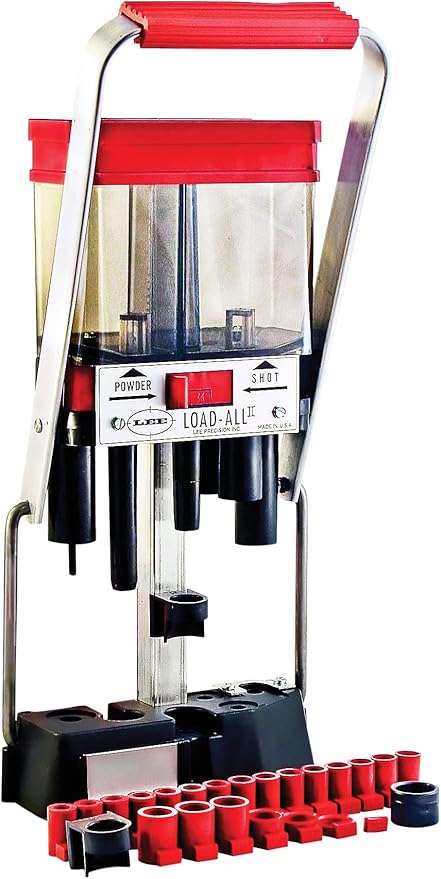
Reloading 16-gauge shotgun shells gets simpler with a press designed to fit that specific need. Perfect for hunters and shooters who want a dependable tool catering just to 16 GA shotshells, it stands out by focusing on reliability and precise sizing during loading.
Setting up the press is straightforward thanks to its compact size and manageable weight of 1.7 kg. Handling it day to day involves straightforward steps that match the machine’s focused design.
Its multi-colored, solid frame doesn’t occupy much space and feels steady during each stroke, making the reloading process consistent and controlled.
Performance revolves around reliably resizing and seating shotshell components with minimal fuss. It’s built with durable materials suitable for regular sporting goods use, balancing well between lightweight and stability. The strongest point noticed is its precise operation, while the most often mentioned downside is limited to just 16 GA compatibility, so versatility is not its strong suit.
The press is praised for its precise, reliable loading of 16 gauge shells with consistent performance. A frequent note is its single-gauge limitation, which restricts use to one shell size.
Those focused on 16 GA shotshell reloading will find it functional and well-made. Anyone needing multi-gauge capability or more material details may want to explore different models.
Pros
- Designed specifically for 16 gauge shotshells
- Compact and easy to handle
- Durable construction supports regular use
- Simple, no-frills setup and operation
Cons
- Only compatible with 16 gauge shells
- Material details not extensively specified
| Specification | Details |
|---|---|
| Item Weight | 1.7 kg |
| Item Dimensions LxWxH | 5.08 x 6.77 x 1.06 inches |
| Package Weight | 2.16 kg |
| Package Dimensions L x W x H | 20.5 x 11 x 5.5 inches |
| Model Name | Lee Precision 90015: 16G Load-All Ii |
12. Dillon Precision BL550 4-Station Progressive Press Kit

Four stations make this progressive press a solid choice for anyone starting or growing their reloading skills. It simplifies the process by handling multiple steps in one pull and includes everything needed to reload efficiently right away.
Best suited for beginners aiming to learn quickly with reliable equipment.
Setup comes straightforward with clear instructions covering each part of the kit, from the case lube to the primer flip tray. Daily use benefits from included tools like the powder funnel die and scale that help keep measurements consistent. The press’s aluminum build keeps weight down but feels sturdy, allowing smooth cycling through the four progressive stations without much effort.
Reloading speed holds up well since multiple actions happen in a single pull, improving productivity compared to single-stage presses. The main construction is strong aluminum painted blue, offering durability and a solid feel.
Most praises highlight how beginner-friendly and complete the kit is, while a common complaint is related to the size and weight being somewhat bulky for small workspaces.
The setup is praised for including everything needed to start reloading and making the learning curve manageable. Common drawbacks focus on its larger footprint and weight, which might feel cumbersome in tighter spaces.
Anyone eager to learn progressive reloading with straightforward guidance will find this press helpful. Those with limited space or looking for a lighter, more compact machine might want to consider other options.
Pros
- Complete starter kit with essential tools included
- Aluminum build balances strength and weight
- Four stations handle multiple reloading steps
- Clear instructions simplify learning process
Cons
- Relatively heavy at 27 pounds
- Size may not suit small work areas
| Specification | Details |
|---|---|
| Item Package Dimensions L x W x H | 30.5 x 16 x 13 inches |
| Package Weight | 27 pounds |
| Material | Aluminum |
| Stations | 4 |
| Included Components | 3-Die Set, Reloading Machine, Calipers, Powder Trickler, Scale |
13. RCBS 6-Station Turret Reloading Press

Reloading enthusiasts looking for flexibility in their setup will appreciate the RCBS 6-Station Turret Reloading Press. Ideal for intermediate skill levels, it stands out by allowing both single-stage and progressive use, adapting to how fast or controlled you want to load shells.
Setup involves securing the heavy cast iron base and attaching dies to the turret head, which stays firmly locked in place thanks to a positive detent system. Changing dies is quick since the turret rotates without losing alignment. The press can be run at whatever pace suits your workflow, offering control or volume depending on your needs.
The cast iron frame handles consistent pressure, keeping the press stable during use. Die alignment stays precise so cases come out uniform every time. A common highlight is the solid feel and durability of the unit, while the main complaint concerns its weight, which makes it less portable but adds to its steadiness.
The press receives strong praise for its durable cast iron construction and reliable die alignment which stays accurate through use. On the downside, its heavy weight is often noted as a drawback, making it less convenient to move or transport frequently.
People who reload mostly from a dedicated bench and want the ability to switch quickly between dies will be well served. Those needing a lighter setup for on-the-go or field use might want to consider smaller, more compact presses instead.
Pros
- Heavy cast iron build ensures stability
- Positive die alignment detent system
- Can run single stage or turret mode
- Flexible speed for volume or control
Cons
- Relatively heavy at 19 pounds
- Size may limit portability
| Specification | Details |
|---|---|
| Item Weight | 19 pounds |
| Item Dimensions (LxWxH) | 1 x 6 x 6.25 inches |
| Package Weight | 8.7 kg |
| Package Dimensions (LxWxH) | 16.34 x 6.34 x 5.87 inches |
| Model Name | 88901 |
| Material | Blend |
Best Progressive Shotgun Reloading Presses Compared
| Product | Weight | Material | Warranty | Suggested Users |
|---|---|---|---|---|
| Lee Precision II 12GA | 0.17 kg | Other | – | mens |
| Frankford Arsenal X-10 | 42.92 kg | Metal | 1 Year Manufacturer | – |
| Dillon XL750 Reloading | 39 pounds | Aluminum | Lifetime Warranty | unisex-adult |
| Lee Precision 20GA Press | 0.8 kg | Other | – | unisex-adult |
| Lee Precision 223 Pro 4000 | 6.23 kg | Polypropylene | – | unisex-adult |
| Lee Breech Lock Pro | 10.6 pounds | – | See manufacturer | unisex-adult |
| Lyman All-American 8 | 28 pounds | – | 1 year manufacturer | – |
| MEC 9000GN 12GA | – | – | – | – |
| Lee Precision Reloaders | 0.3 kg | Other | – | unisex-adult |
| Hornady Lock-N-Load | 60.4 pounds | Steel | Lifetime Warranty | – |
| Lee Precision II 16GA | 1.7 kg | Other | – | unisex-adult |
| Dillon BL550 4-Station | 27 pounds | Aluminum | Lifetime Warranty | unisex-adult |
| RCBS 6-Station Turret | 19 pounds | Blend | – | unisex-adult |
- Weight0.17 kg
- MaterialOther
- Warranty–
- Suggested Usersmens
- Weight42.92 kg
- MaterialMetal
- Warranty1 Year Manufacturer
- Suggested Users–
- Weight39 pounds
- MaterialAluminum
- WarrantyLifetime Warranty
- Suggested Usersunisex-adult
- Weight0.8 kg
- MaterialOther
- Warranty–
- Suggested Usersunisex-adult
- Weight6.23 kg
- MaterialPolypropylene
- Warranty–
- Suggested Usersunisex-adult
- Weight10.6 pounds
- Material–
- WarrantySee manufacturer
- Suggested Usersunisex-adult
- Weight28 pounds
- Material–
- Warranty1 year manufacturer
- Suggested Users–
- Weight–
- Material–
- Warranty–
- Suggested Users–
- Weight0.3 kg
- MaterialOther
- Warranty–
- Suggested Usersunisex-adult
- Weight60.4 pounds
- MaterialSteel
- WarrantyLifetime Warranty
- Suggested Users–
- Weight1.7 kg
- MaterialOther
- Warranty–
- Suggested Usersunisex-adult
- Weight27 pounds
- MaterialAluminum
- WarrantyLifetime Warranty
- Suggested Usersunisex-adult
- Weight19 pounds
- MaterialBlend
- Warranty–
- Suggested Usersunisex-adult
How to Choose the Right Progressive Shotgun Press
Selecting a progressive shotgun press depends on durability, ease of use, and consistent performance to handle high-volume reloading efficiently. Prioritizing these factors ensures reliable operation, reduces waste, and saves time and money by minimizing errors and equipment failure.
Build Quality and Materials
After using several reloading presses, the difference between metal and plastic components becomes clear fast. Metal parts, especially steel or cast iron, handle continuous pressure much better without flexing or breaking.
Presses with plastic parts tend to wear out or crack after a few hundred reloads, causing misalignment issues. Corrosion is another concern; steel frames with a powder-coated or anodized finish resist rust even in humid conditions, whereas untreated metals or plastics can degrade unexpectedly.
A sturdy frame is non-negotiable for consistent performance. Presses that feel solid and heavy tend to maintain alignment under repeated lever pulls, minimizing skipped primers or uneven crimps. Look for machines with components marked as hardened steel or brass in contact areas and frames weighing over 15 pounds for better durability.
Compatibility and Caliber Support
Reloading shotgun shells across different sizes gets frustrating if the press isn’t versatile. Models that support a broad range of calibers, from 12 gauge down to 20 gauge or 28 gauge, save time and money because you don’t need separate equipment.
Adaptability also means compatibility with various brands and shell types, including low-brass and high-brass cases.
Changing shell dies should be straightforward. Presses with quick-release or tool-less die change systems reduce downtime, especially if you switch loads or calibers often.
Check that the press accepts standard 7/8×14 threaded dies, the common size for shotshell reloading, to keep your options open.
Ease of Operation
The feel of the lever or handle during reloading makes a big difference in long sessions. A smooth, consistent action with minimal resistance prevents hand fatigue and helps maintain precise control over each step. Uneven or jerky operation quickly leads to sloppy crimps or improperly seated primers.
Ergonomics play a big role. Handles with comfortable grips and the right length give better leverage without forcing awkward wrist angles. Controls and adjustment points should be easy to reach and clearly marked, allowing quick tweaks without stopping every few shells.
Precision and Consistency
Consistent shotshell dimensions come down to how well the press sizes, seats, and crimps every shell with repeatable accuracy. A press that delivers uniform powder charges and primer seats without variation is key for safe and reliable ammunition. Tolerance for minor handling mistakes, such as slightly bent primers or off-center shells, helps prevent complete misloads.
Look for machines known for tight tolerances on shell sizing and crimping. Presses that can keep powder charge weights within a fraction of a grain and seat primers flush every time make reloading less stressful.
Uniform crimps reduce the chance of shells failing in the field.
Safety Features
Safety cannot be overlooked during reloading. Effective mechanisms to prevent accidental primer ignition protect both the press and the operator. Primer cups that lock firmly into place and require proper alignment before firing reduce accidents.
Shell holders that securely grip cases without slipping also stop jams and repetitive hand adjustments. Fail-safe features like spring-loaded handles or automatic primer feed blockages minimize injury risk during operation. Choosing a press with these safeguards builds confidence, especially during high-volume runs.
Optimizing Your Reloading Workflow with a Progressive Shotgun Press
Progressive shotgun presses can significantly speed up the reloading process by performing multiple stages of reloading with each pull of the handle. One of the main advantages is the ability to load several rounds simultaneously, which can save a lot of time during large reloading sessions. These presses often include multiple stations that handle tasks such as resizing, priming, powder charging, and seating the shot and wad.
Using shell holders and quick-change dies helps maintain accuracy and consistency, reducing errors in each round. The process also benefits from a steady and consistent approach; avoiding rushing through steps ensures every round is properly assembled.
Keep your workspace organized and have all materials at hand to maintain a smooth and efficient flow. With practice, users can reduce the time spent per shell without sacrificing quality or safety in their reloads.
Essential Maintenance Practices to Extend the Life of Your Press
Regular cleaning and lubrication are crucial for keeping a progressive shotgun press functioning properly. Powder residue and dirt can accumulate in moving parts, leading to wear or operational issues. After each use, wiping down the press with a cloth and using a small brush to clean hard-to-reach spots helps prevent buildup.
Essential maintenance steps include:
- Checking all nuts, bolts, and screws periodically to ensure they are tight.
- Lubricating pivot points and sliding areas with recommended oils or greases.
- Inspecting shell holders and dies for wear and replacing worn parts promptly.
- Monitoring the alignment of various stations to prevent misfeeds or jams.
Consistent care helps extend the press lifespan and maintains the precision necessary for safe and reliable reloading.
Comparing Progressive Presses to Single-Stage and Turret Alternatives
Progressive presses provide higher volume output by completing multiple operations per handle pull, which differs from single-stage and turret presses. Single-stage presses require performing one reloading step at a time, offering more control but at a slower pace.
Turret presses hold several dies on a rotating head, allowing the shooter to index between operations manually, which balances speed and control but still demands more manual intervention than progressives.
The choice depends on reloading priorities. Progressive presses are suited for users focused on quantity and efficiency with consistent shell sizes, while single-stage presses work well for precision and customization during handloading.
Turret presses provide flexibility and moderate throughput but involve more steps per shell. Handling complexity tends to increase with progressive designs, requiring more setup and adjustment but delivering faster results compared to other types.
People Also Asked
How Do I Properly Size Shells with a Progressive Shotgun Press?
Properly sizing shells involves adjusting the die so it resizes the hull to the proper length and crimp. It helps to measure resized shells occasionally to ensure consistent sizing and prevent feeding issues.
What Safety Tips Should I Follow When Using a Progressive Press?
Always wear safety glasses and keep your fingers away from pinch points. Also, make sure the workspace is clean to avoid mixing primers or powder accidentally.
How Long Does a Typical Progressive Shotgun Reloading Press Last?
A typical progressive shotgun press can last many years with regular maintenance such as cleaning and lubricating moving parts. Replacing worn springs and bushings helps preserve smooth operation.
What Common Problems Occur When Using a Progressive Shotgun Press?
Common problems include shell hang-ups, inconsistent powder charges, and primer seating issues. Regularly checking adjustments and cleaning the powder measure can minimize these problems.
Are All Shotgun Shell Components Compatible with Every Press Model?
Not all components are compatible with every press model; check the manufacturer’s specifications for shell length and diameter limits. Using the correct shell gauge and size prevents damage to both the press and components.
Conclusion
Picking a progressive shotgun reloading press comes down to how reliable it is, the ease of use, and how well it fits the kind of ammo you want to make. A solid, consistent feed and straightforward adjustments matter more than extra features. The press should handle typical loads without frequent jams or errors.
Consider how much space you have and how often you plan to reload before deciding on a model. Something compact might suit occasional use, while a larger machine could work better for heavier workloads.
Check the comparison table and the earlier picks to match a press with your needs and budget.