Top 13 Best PCP Pump Models That Will Blow Your Mind!
Using a low-quality air pump for PCP air rifles often leads to frustration from slow fills, leaks, or pumps that overheat mid-session. The best pcp pump handles pressure efficiently and delivers air consistently without requiring excessive effort or time.
Without a reliable pump, topping up your air rifle’s reservoir can become a tedious chore that affects performance and enjoyment.
Key factors that distinguish a good pcp pump include durable, high-pressure rated materials like aircraft-grade aluminum or sturdy steel to withstand pressures up to 3000 psi or more. The pump’s size and weight also matter, as too heavy or bulky units make frequent pumping tiring. An effective pump features a smooth action to reduce user fatigue and airtight seals to prevent leaks.
Safety valves and easy-to-clean components help ensure long-term reliability and safe operation during repeated use.
Need a Quick Check?
| Image | Product | Price |
|---|---|---|
Our Top Picks 1  | VEVOR PCP Pump | Check Price |
Our Top Picks 2  | Quick Connect PCP Pump | Check Price |
Our Top Picks 3 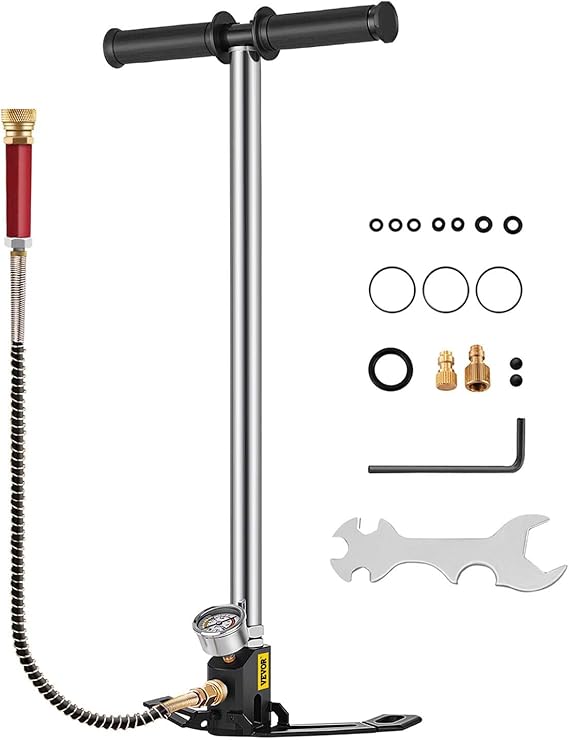 | BestEquip PCP Pump | Check Price |
Our Selected Top 13 Pcp Pump for Every Budget
This list features a variety of PCP pumps suited for different budgets and needs. Each review covers the pump’s performance, ideal users, and highlights both strengths and weaknesses to help you make an informed choice based on your specific requirements.
1. VEVOR PCP Hand Pump
VEVOR PCP Hand Pump stands out for its sturdy stainless steel construction and a labor-saving design that reduces effort by about 30% compared to traditional pumps. It’s ideal for those needing a reliable, portable manual pump with a high maximum pressure suitable for pistol and rifle PCP cylinders.
Setting the pump up is straightforward thanks to its simple manual operation. The glycerin-filled gauge makes watching the pressure easy and accurate, so you can confidently top off your PCP cylinders without guesswork.
Its portable size and design make it convenient to carry for outdoor activities like hunting or sport shooting.
The pump reliably reaches 4500 psi, meeting high-pressure demands with fairly good airflow at 5 liters per minute. Crafted from rust-proof stainless steel, durability is solid, ensuring long-term use without performance fading. The most frequent praise highlights how much easier pumping feels on the arms, while some mention it requires sustained effort during longer fills.
The pump’s strongest point is its ability to reach high pressure with less arm strain than other manual pumps, credited by many. The most common downside is that pumping remains physically demanding when filling larger tanks or fully empty cylinders.
People who hunt or shoot casually and want a sturdy pump that can handle typical PCP cylinders will appreciate this model. Those needing quicker fills or less physical exertion during extended use might consider electric alternatives instead.
Pros
- High pressure capability up to 4500 psi
- Labor-saving design reduces effort by 30%
- Durable stainless steel construction
- Accurate glycerin-filled pressure gauge
Cons
- Requires sustained effort for complete fills
- Manual pumping can be tiring over time
| Specification | Details |
|---|---|
| Power Source | hand pump |
| Air Flow Capacity | 5 liters per minute |
| Maximum Pressure | 4500 psi |
| Operation Mode | manual |
2. PCP Hand Pump with 8mm Quick Connect
PCP Hand Pump with 8mm Quick Connect offers manual high-pressure filling for PCP air systems without the need for electricity. Perfect for those preferring a hands-on approach, it excels at delivering precise pressure up to 4500 PSI, giving direct control over the filling process in any setting.
Setting up involves connecting the pump using its 8 mm female quick-connect fitting to the PCP system’s fill probe. The integrated pressure gauge is essential during daily use, letting you watch pressure build steadily and stop exactly at the recommended level.
There’s no reliance on power sources, so it’s handy outdoors or where electricity isn’t accessible.
Performance-wise, it reliably generates pressure up to 4500 PSI in three stages, allowing careful, step-by-step pumping without overfilling. The build feels solid and durable, mostly featuring a copper connector that fits securely. A strong point many mention is the accurate pressure gauge, while the usual downside is that hand-pumping can require considerable effort over time.
The pump’s accurate gauge lets users fill PCP air systems precisely without overshooting pressure limits. A common complaint revolves around the physical effort needed for hand-pumping, especially during long fills at high pressure.
People who need a portable, electricity-free solution and don’t mind manual work will find this pump suitable. Those looking for convenience or less physical strain might prefer electric or compressor-based alternatives.
Pros
- Does not require electricity for operation
- Clear, integrated pressure gauge
- Fast connection with 8 mm quick-connect fitting
- Generates pressure up to 4500 PSI
Cons
- Manual pumping can be physically demanding
- Pressure gauge may be difficult to see in low light
| Specification | Details |
|---|---|
| Power Source | Handheld |
| Maximum Pressure | 4500 psi |
| Operation Mode | Manual |
| Connector Type | 8 mm copper female quick connector |
3. BestEquip PCP Hand Pump
Feels solid and powerful in hand, the BestEquip PCP Hand Pump suits anyone who needs serious pressure for their air guns. Its biggest strength lies in squeezing out maximum air with less effort, making it a good pick for terrain users seeking reliable power without too much strain.
Setup is straightforward since it’s a manual hand pump, no batteries or cords needed. The non-slip handle gives a comfortable grip, so using it repeatedly doesn’t feel tiring. A 3-stage design compresses air efficiently, allowing you to pump faster and with less muscle burn, while the rust-proof stainless steel barrel means little worry about wear even after regular use.
Performance is strong, hitting up to 4500 psi without much struggle. The build feels sturdy thanks to the thickened steel construction, promising durability over time. Most praise focuses on how much easier pumping becomes compared to basic models.
Common complaints mention the manual effort still required and the slower air flow, which means it’s not the fastest option out there.
The pump’s most noted advantage is saving 30% effort compared to similar hand pumps, making it easier to reach high pressures like 4500 psi. Users appreciate the sturdy stainless steel barrel, although some find the pumping speed slower and still physically demanding.
This pump suits those who want a reliable manual option with significant pressure capacity and don’t mind putting some muscle into it. Users needing faster fills or less physical strain may want to explore electric or pumped alternatives.
Pros
- Max pressure reaches 4500 psi
- Rust-proof 304 stainless steel barrel
- Comfortable, non-slip handle grip
- Compresses air with 30% less effort
Cons
- Requires physical effort to operate
- Air flow relatively slow at 5 L/minute
| Specification | Details |
|---|---|
| Power Source | hand pump |
| Air Flow Capacity | 5 liters per minute |
| Maximum Pressure | 4500 psi |
| Operation Mode | manual |
4. GOYOJO PCP Air Compressor

Great for beginners and hobbyists, the GOYOJO PCP Air Compressor offers solid power and versatility in a compact design. Suited for inflating PCP airguns and mini dive tanks, its biggest strength lies in easy setup combined with reliable pressure control.
Setup is straightforward thanks to the integrated transformer that removes the need for an extra adapter. Day-to-day use is made simple with both AC and DC power options and an automatic shut-off feature that prevents overfilling.
The built-in gauge helps keep track of pressure without extra equipment. Its portability means you can take it to the shooting range or outdoor sites without hassle.
It delivers up to 4500 psi reliably for various small high-pressure gear. The oil-free pump reduces maintenance, supporting consistent performance.
The unit feels well-made and safe due to its streamlined power delivery system. Common praise focuses on dependable air flow and ease of use, while some find the noise level of 70 dB noticeable during operation.
Reliable pressure control and user-friendly features stand out as the best qualities. Some find the 70 dB noise level more noticeable than expected, especially during longer fills.
People needing a straightforward, portable compressor for small tanks or PCP airguns will appreciate this option. Those looking for quieter operation or faster fill times for large tanks might want to explore alternatives.
Pros
- Automatic shut-off for safety
- Built-in pressure gauge included
- Works with both AC and DC power
- Portable size for easy transport
Cons
- Noise level can be distracting
- Air flow capacity may be slow for large tanks
| Specification | Details |
|---|---|
| Maximum Pressure | 4500 psi |
| Power Source | 12V DC or 110V/220V AC |
| Noise | 70 db |
| Air Flow Capacity | 6.8 liters per minute |
| Maximum Power | 350 watts |
5. PCP Hand Pump with Oil-Moisture Filter

Aluminum construction makes this hand pump sturdy and lightweight, ideal for those using PCP rifles or paintball tanks. It suits anyone wanting a reliable fill without complex assembly, with its biggest strength being the pre-installed high-pressure parts that reduce setup time and risk of leaks.
Setup involves simply attaching the handle since key components like the quick-connect fitting and pressure gauge come pre-installed. Pumping feels smooth thanks to the 3-stage compression, which also cuts down the time needed to reach high pressure.
Monitoring pressure is straightforward with a fluorescent gauge showing both PSI and BAR scales clearly during use.
The pump manages up to 4,500 PSI reliably, making it strong enough for most PCP airguns and paintball tanks. Its aluminum build adds durability without being cumbersome. Users praise the smooth pumping strokes, though some mention the weight might be tiring during extended use.
The pre-assembly reduces leaks, but the absence of included additional accessories requires separate purchases.
Smooth pumping strokes and quick fills are the most praised features, making the reliability excellent during use. Some users find the weight tiring if pumping for long periods, especially without breaks. The pre-installed design helps avoid leaks and setup troubles, which is appreciated.
People wanting a solid, ready-to-use hand pump for PCP rifles or paintball tanks will like this model. Those needing a lighter pump or a kit with more accessories might want to check other options available in the market.
Pros
- Pre-installed high-pressure parts ready to go
- 3-stage compression for faster filling
- Clear dual-scale pressure gauge
- Aluminum body for good strength and weight
Cons
- Can feel heavy after long pumping sessions
- No extra accessories included in the package
| Specification | Details |
|---|---|
| Material | Aluminum |
| Maximum Pressure | 4,500 PSI |
| Package Weight | 2.56 kg |
| Dimensions (LxWxH) | 24.4 x 2 x 10.2 inches |
| Gauge Range | 0–6000 PSI (0–4500 PSI working) |
| Stages | 3-Stage Pre-Assembled |
6. TUXING 4-Stage PCP Hand Pump

Durable stainless steel construction and a 4-stage pumping system make it a solid choice for anyone who needs to fill a PCP air rifle or paintball tank manually. Best suited for those who want a hand pump that can reach high pressures while reducing the effort usually involved.
Setting up the pump is straightforward since it operates manually and connects directly to your tank. The ergonomic design helps reduce hand fatigue during long pumping sessions. Handling it day-to-day means less struggle with pressure build-up, thanks to the 4-stage mechanism that cuts down the effort by about 30% compared to older 3-stage models.
The pump reaches up to 4500 PSI (300 bar) efficiently, making it well-suited for high-pressure tasks. Built from high-quality stainless steel, it resists rust and fading, which adds confidence for regular outdoor use. Strong points include solid material and reduced pumping effort, while a common drawback is that manual operation still requires noticeable physical work.
The pump stands out for cutting pumping effort with its 4-stage design and solid stainless steel build that withstands fading and rust. However, users still experience noticeable physical strain during extended pumping sessions.
This pump fits well for those who want reliable manual filling with less effort than traditional models. Those wanting a completely hands-free or automatic option may find better choices elsewhere.
Pros
- High pressure up to 4500 PSI
- Ergonomic design reduces hand fatigue
- Rust-proof stainless steel body
- Requires 30% less effort than 3-stage pumps
Cons
- Manual pumping still demands physical effort
- Long sessions can be tiring despite ergonomic design
| Specification | Details |
|---|---|
| Maximum Pressure | 300 bar |
| Operation Mode | Manual |
| Power Source | Handheld |
| Material | Stainless Steel |
7. PCP Air Compressor Portable

Reliable power and flexibility make this a great choice for anyone needing a portable PCP pump that works just as well at home as in the field. Its biggest strength lies in the ability to run off either a car battery or a household outlet, giving you freedom of use wherever you are.
Setup is straightforward with the included alligator clips for car battery connection and an external power converter that plugs into regular 110V outlets. The oil-water separator ensures the air stays clean without any extra effort from you. The 8mm quick connector simplifies hooking up your airgun or tank, and the 32.4-inch hose gives enough maneuvering room during inflation.
Performance matches the specs with a maximum pressure of 300 bar and an oil-free design that protects your gear from contamination. The build feels solid and reliable, focusing on practicality rather than extra features. Most users appreciate the clean air delivery, while some mention the power input cables could be a bit longer for easier use in tight spaces.
The pump delivers clean, dry air thanks to its activated carbon filter, which users highly appreciate for protecting their airguns. Some note the cable length as restrictive during outdoor use, making placement a bit tricky. It handles pressure well but isn’t designed for large volume fills without pauses.
Great for shooters wanting flexibility to fill tanks at home or in the field with a 12V car battery. Those needing faster or higher-capacity filling might want to explore heavier-duty compressors or pumps with larger tanks. This is a solid middle ground for portability and performance.
Pros
- Dual power input for versatile use
- Built-in oil-water separator
- Portable and lightweight design
- Includes quick connector hose
Cons
- Power cables could be longer
- 0.5-liter capacity limits large fills
| Specification | Details |
|---|---|
| Voltage | 12 volts_of_direct_current |
| Maximum Pressure | 300 bar |
| Maximum Power | 250 watts |
| Hose Length | 32.4 inches |
| Compatible Hose Diameter | 8 millimeters |
8. GX H-4 PCP Hand Pump

Filling up a PCP tank can be exhausting, especially when the pump demands too many strokes or brings in moisture. The GX H-4 PCP Hand Pump suits users who want to save energy while keeping their air dry.
Its standout feature is the 3.5 stage high-pressure design that cuts down the number of strokes needed to fill a tank.
Setting up involves just grabbing the pump and connecting it to your tank. Day-to-day use feels easier than traditional hand pumps because each stroke pushes more air in. The built-in oil-moisture filter handles over 90% of moisture, letting you pump without worrying about wet air.
It’s manual, so no batteries or cords are involved, making it very portable and reliable in the field.
The pump performs its job effectively, pressurizing up to 310 bar with a smooth and steady airflow of 3 liters per minute. The 3.5 stage design really pares down the work required, with roughly 350 strokes to charge a 500cc tank from 1000PSI to 3000PSI. A sturdy build feels solid in hand, though the most frequent complaint is the number of strokes needed still feels like quite a workout.
The pump’s biggest strength lies in saving effort by compressing more air per stroke and keeping moisture out of the tank. Commonly, people find the stroke count still tiresome, especially when filling larger tanks.
Those who want to avoid electric pumps and prefer a manual solution with solid moisture protection will appreciate this. Users needing faster fills with less pumping might look elsewhere for an electric model.
Pros
- Reduces number of strokes per fill
- Effective oil-moisture filtration
- Portable, hand-powered design
- High maximum pressure of 310 bar
Cons
- Still requires many strokes for full fill
- Manual pumping demands physical effort
| Specification | Details |
|---|---|
| Power Source | hand |
| Air Flow Capacity | 3 liters per minute |
| Maximum Pressure | 310 bar |
| Operation Mode | manual |
| Oil-Moisture Filter | filters above 90% moisture |
9. Abahub High Pressure Hand Pump

Reaching up to 4500 PSI makes this hand pump perfect for anyone who needs to fill high-pressure air rifles, PCP air guns, or scuba tanks. Its standout feature is the powerful yet manageable pressure output that suits those who want a manual pump but don’t want to struggle to get their air tanks filled.
Setting it up is straightforward thanks to the 8mm quick connect female connector and car connector, which fit right onto compatible tanks. The pre-lubricated, low-maintenance design means it’s ready to use from the start and keeps pumping smooth day after day. The advanced three-stage compression system reduces the effort needed, so pumping won’t wear you out as quickly.
The pump handles its high-pressure job really well, getting tanks filled much faster than simpler models. Its build feels solid and reliable, built to last through heavy use.
Users often praise how efficiently it pumps despite being manual. The main complaint is that it still requires physical effort, which might be tiring during longer sessions.
Efficient pumping and high maximum pressure are strong points, making fast inflation easier despite the manual effort involved. The pump’s solid construction suits frequent use, but the pumping work remains physically demanding, especially with larger tanks.
Those who want a reliable hand pump for high-pressure needs will appreciate its capabilities and low upkeep. People looking to avoid physical strain might want to explore powered options instead for easier filling.
Pros
- Delivers up to 4500 PSI pressure output
- Low maintenance, pre-lubricated design
- Efficient three-stage compression system
- Includes quick connect and car connectors
Cons
- Requires physical effort to pump high pressure
- Manual operation might be tiring for long fills
| Specification | Details |
|---|---|
| Power Source | Handheld |
| Maximum Pressure | 4500 psi |
| Operation Mode | Manual |
| Compression System | Three-Stage |
| Connector Type | 8mm Quick Connect Female & Car Connector |
10. SMACO PCP Air Compressor
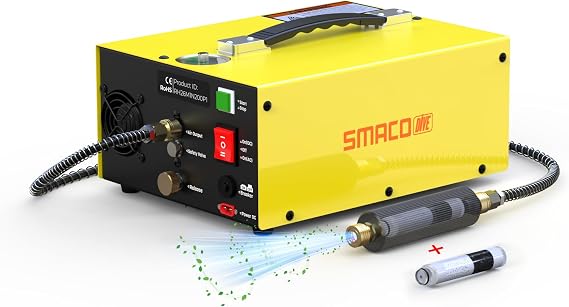
SMACO PCP Air Compressor suits anyone who often fills PCP or paintball air guns. Its standout feature is the built-in power converter that lets you plug it into either a car battery or a home outlet, making it handy in all kinds of settings.
It suits those needing portability without sacrificing power and control.
Setting up the compressor is straightforward thanks to the built-in power adapter that supports 12V car batteries and 110V/220V AC outlets. Daily use is made easy with the automatic shutoff feature which takes care of stopping the fill when your set pressure is reached.
The oil-free design means less mess and upkeep, so you can just focus on filling your air rifle quickly.
The compressor handles its job well, filling airguns to pressures up to 300 bar without lag. The build is compact with a 0.5-liter tank, so it doesn’t weigh you down when moving around. High marks come for reliable automatic shutoff and versatility in power sources.
Some users mention the 350-watt motor can take time on bigger fills, which calls for a bit of patience.
Users appreciate the automatic shutoff which frees their hands and saves time during fills. At the same time, some find the small 0.5-liter tank volume means the pump has to cycle often when filling bigger airguns. The built-in power adapter is praised for convenience across different locations.
This compressor is a solid choice for hobbyists who want portability and flexibility in power sources. Those needing faster fills or working with very large tanks might want a model with a bigger capacity or higher wattage motor.
Pros
- Operates with 12V car battery or AC outlet
- Stops automatically at set pressure
- Oil-free pump reduces maintenance
- Compact and easy to transport
Cons
- Filling larger tanks may take longer
- Limited tank volume requires frequent refills
| Specification | Details |
|---|---|
| Maximum Pressure | 300 bar |
| Power Source | Corded Electric (AC & DC adaptable) |
| Maximum Power | 350 watts |
| Tank Volume | 0.5 liters |
| Additional Features | Automatic Shut-Off, Oil-Free Pump, Portable |
11. VEVOR PCP Hand Pump with Oil-Moisture Filter

Designed for air rifle enthusiasts who want reliable high-pressure pumping without electric assistance, this hand pump stands out for its efficient compression system. It handles up to 4500 PSI per stroke, making it easier to reach high pressures compared to typical manual pumps.
Setting up involves unfolding the pedal for a firm footing, then using the sturdy stainless steel tube to pump air. The dual filtration system is handy for keeping moisture and oil out, so the air stays clean and dry.
Compact storage is simple thanks to the foldable parts, which also make carrying it less bulky.
Pressure delivery is strong and steady, capable of maxing out at 5800 psi when pushing past 4500 PSI strokes. The single-piece stainless steel tube and thick casing give it a tough feel and good durability on rough use.
Praise often mentions the filtration system’s effectiveness, while common complaints focus on the effort it takes at higher pressures.
Many highlight the dual filtration system that keeps air dry and free from oil contamination, which is valuable for maintaining rifle performance. On the downside, pumping at higher pressures can be physically demanding, making long fill sessions tiring.
Those regularly needing to pump up to 4500 PSI without electricity will appreciate its efficiency and sturdy build. People wanting a lighter workload or quicker refills might want to consider a powered compressor instead.
Pros
- Efficient pumping with reduced effort
- Dual filtration ensures clean, dry air
- Lightweight yet sturdy stainless steel tube
- Foldable design for compact storage and transport
Cons
- Requires physical effort at high pressures
- Folding mechanism may feel less secure for some
| Specification | Details |
|---|---|
| Maximum Pressure | 5800 psi |
| Pressure Delivered Per Stroke | 4500 PSI |
| Pump Tube Material | Stainless Steel |
| Filtration System | Oil-Moisture & Desiccant Filters |
| Storage | Foldable Pedal |
12. GX-E-CS4-I PCP Air Compressor

GX-E-CS4-I PCP Air Compressor by GX is known for its impressive four-stage compression system combined with water cooling, making it ideal for consistent PCP compressor filling. Its standout feature is the quiet operation at just 70db, suitable for those who want powerful performance without constant loud noise.
Setting it up is straightforward, running on a 12-volt corded electric power source. The design includes a water tank and grease reservoir at the top, helping maintain excellent cooling for up to five hours of continuous work.
The 19.6-inch hose length allows practical use without awkward positioning during inflation.
Performance-wise, it efficiently pumps air up to 400 bar with a steady airflow rate of 11 liters per minute. The build quality feels solid, supported by a 350-watt motor that keeps the compressor stable during operation. A frequent point of praise is the quiet running noise, but some mention the size and weight could make it less portable.
The GX-E-CS4-I is praised for its quiet and stable operation thanks to the water-cooling system, which supports long continuous runs. However, it is also noted for being somewhat bulky and less convenient to move around compared to smaller compressors.
Those who need a reliable and quiet compressor for extended PCP filling sessions will appreciate its design and features. People looking for a lightweight or highly portable unit might want to consider other models better suited for frequent travel or outdoor use without stable power access.
Pros
- Quiet operation at 70 decibels
- Water cooling allows 5 hours continuous use
- Accurate dual-pointer pressure gauge
- Automatic shut-off for safer use
Cons
- Relatively large and heavy for transport
- Requires access to 12V power source
| Specification | Details |
|---|---|
| Maximum Pressure | 400 bar |
| Tank Volume | 6.8 liters |
| Air Flow Capacity | 11 liters per minute |
| Maximum Power | 350 watts |
| Power Source | Corded Electric (12 volts) |
| Noise Level | 70 db |
13. VEVOR PCP Hand Pump 4 Stage

Feeling the steady pressure build with each pump stroke makes filling your PCP air gun much less of a chore. It suits people who want to reach high pressures without tiring out fast.
Its single biggest strength lies in being able to get up to 4500 PSI with noticeably less effort than regular manual pumps.
Setting it up is straightforward and the 4-stage design means you compress a lot of air smoothly each stroke. The built-in oil moisture filter keeps the air dry and clean, which gives you confidence in maintaining your equipment’s performance.
Operating it manually means you control every pump, and the energy-saving design means you don’t overexert yourself every time you fill up your rifle or even scuba tanks.
Pressing up to 4500 PSI clearly shows how powerful the pump is. It’s built solid enough to handle regular use, and the moisture filter is a big plus in protecting your gear from damage.
Most find it significantly reduces pumping effort, though some feel the manual action can still be tiring during extended fills. The filter system’s effectiveness is the most praised feature, while effort during continuous use is a common drawback.
The standout feature is its ability to reduce pumping effort by about 30% and provide dry, clean air thanks to the oil moisture filter. Common feedback points to the manual pumping action being tiring over long stretches, reflecting a trade-off between power and user fatigue.
People needing a reliable pump for high-pressure fills with good air quality will appreciate this model. Those looking for minimal physical effort or electric options might want to explore powered alternatives instead.
Pros
- Reaches high pressure up to 4500 PSI
- Built-in filter removes over 90% water content
- Uses 30% less effort than traditional pumps
- Manual control over air compression process
Cons
- Pumping can still be tiring for long sessions
- Manual operation lacks automation convenience
| Specification | Details |
|---|---|
| Maximum Pressure | 4500 psi |
| Operation Mode | Manual |
| Stages | 4 |
| Built-in Filter | Oil Moisture Filter |
Comparison of Top PCP Pumps Reviewed
| Product | Power Source | Maximum Pressure | Air Flow Capacity | Features |
|---|---|---|---|---|
| VEVOR PCP Pump | Hand pump | 4500 psi | 5 liters per min | Manual operation |
| Quick Connect PCP Pump | Handheld | 4500 psi | – | Quick connect 8 mm |
| BestEquip PCP Pump | Hand pump | 4500 psi | 5 liters per min | Manual operation |
| GOYOJO Air Compressor | 12V DC/110V AC | – | – | Portable, automatic shut-off |
| PCP Pump Oil Filter | Hand pump | 4500 psi | – | Aluminum, 1 Year warranty |
| TUXING 4-Stage Pump | Handheld | 300 bar | – | 4-Stage manual pump |
| Portable PCP Compressor | Corded Electric | – | – | Portable, 0.5L capacity |
| GX H-4 PCP Pump | Hand | 310 bar | 3 liters per min | Manual operation |
| Abahub High Pressure Pump | Handheld | 4500 psi | – | Manual operation |
| SMACO PCP Compressor | Corded Electric | – | – | 0.5L tank, portable |
| VEVOR Oil-Filter Pump | – | 5800 psi | – | Oil-filter pump |
| GX-E-CS4-I Compressor | Corded Electric | – | – | 6.8L capacity, silent |
| VEVOR 4-Stage Pump | – | 4500 psi | – | 4-Stage manual pump |
- Power SourceHand pump
- Maximum Pressure4500 psi
- Air Flow Capacity5 liters per min
- FeaturesManual operation
- Power SourceHandheld
- Maximum Pressure4500 psi
- Air Flow Capacity–
- FeaturesQuick connect 8 mm
- Power SourceHand pump
- Maximum Pressure4500 psi
- Air Flow Capacity5 liters per min
- FeaturesManual operation
- Power Source12V DC/110V AC
- Maximum Pressure–
- Air Flow Capacity–
- FeaturesPortable, automatic shut-off
- Power SourceHand pump
- Maximum Pressure4500 psi
- Air Flow Capacity–
- FeaturesAluminum, 1 Year warranty
- Power SourceHandheld
- Maximum Pressure300 bar
- Air Flow Capacity–
- Features4-Stage manual pump
- Power SourceCorded Electric
- Maximum Pressure–
- Air Flow Capacity–
- FeaturesPortable, 0.5L capacity
- Power SourceHand
- Maximum Pressure310 bar
- Air Flow Capacity3 liters per min
- FeaturesManual operation
- Power SourceHandheld
- Maximum Pressure4500 psi
- Air Flow Capacity–
- FeaturesManual operation
- Power SourceCorded Electric
- Maximum Pressure–
- Air Flow Capacity–
- Features0.5L tank, portable
- Power Source–
- Maximum Pressure5800 psi
- Air Flow Capacity–
- FeaturesOil-filter pump
- Power SourceCorded Electric
- Maximum Pressure–
- Air Flow Capacity–
- Features6.8L capacity, silent
- Power Source–
- Maximum Pressure4500 psi
- Air Flow Capacity–
- Features4-Stage manual pump
How to Choose the Best PCP Pump
Choosing a good PCP pump depends on its build quality, ease of use, and the pressure it can achieve. These factors ensure efficient filling without frequent maintenance or damage, ultimately saving money and reducing hassle over time. Reliable performance is key for long-term satisfaction.
Pressure Capacity and Output
Many users discover their pump isn’t up to the task after a few fills when pressure fails to stabilize or reaches a ceiling below their needs. Pumps that can reliably hit and maintain around 3000 to 4500 psi cover most standard airgun calibers and tank capacities.
Maintaining steady pressure throughout the pumping process improves refilling control and avoids damaging the airgun’s filling probe.
The difference between a top pump and a less capable one is often how consistently it holds pressure with each stroke. A model that fluctuates or drops significantly under load makes the process unpredictable and longer. Look for pumps that specify maximum output pressure clearly and have a tested range suitable for your specific airgun caliber and tank size.
Build Quality and Materials
Running a pump under high pressure repeatedly means materials need to withstand significant stress and avoid wear. Pumps made from high-grade aluminum or steel last longer than those with predominantly plastic components, which tend to fail around the seals and fittings first. Corrosion resistance matters when using the pump outdoors, near moisture or dirt.
Seals and connectors also dictate how often leaks emerge. Pumps with high-quality rubber or polyurethane seals maintain pressure better and require less maintenance. Stainless steel fittings resist rust and keep connections tight over extended use, making the operation smoother and safer.
Pumping Efficiency and Speed
Pumping efficiency quickly becomes clear after the first few refills; a pump that requires dozens of hard strokes to reach your pressure goals causes fatigue and frustration. Good models balance the number of pumps needed with manageable stroke effort and smooth mechanics, reducing exhaustion, especially during back-to-back fills.
Ergonomic handles and optimized lever lengths help distribute force more evenly. Some pumps use multi-stage designs to reduce the effort per stroke without sacrificing speed. Efficiency also relates to how much air is compressed per stroke, so check specs or user experiences for number of pumps needed to reach typical pressures around 3000 to 4500 psi.
Portability and Size
Carrying a pump to the range or on a hunt becomes easier if it keeps size and weight reasonable. Bulky or very heavy pumps slow down setup and sometimes require separate cases or holders, adding complexity.
Pumps around 15 to 25 pounds strike a manageable balance, and compact designs that fold or have removable legs save space during transport.
Features like rubber grips or textured surfaces improve handling, reducing slippage during pumping. A stable base or tripod legs help keep the pump steady on uneven ground, which is critical to avoid accidents or damage.
When a pump stands securely and fits in your vehicle or bag without needing extra room, it makes outdoor use less of a chore.
Safety Features
Working with high-pressure air requires strict safety measures built into the pump to prevent accidents. Pumps with built-in relief valves provide a fail-safe way to release excess pressure, protecting against overinflation or sudden bursts.
Visual pressure gauges help monitor filling progress and identify unsafe spikes early.
Locking mechanisms that secure connections and prevent accidental loosening or air release add another layer of security. Pumps meeting recognized safety certifications, such as CE or DOT standards, demonstrate that manufacturers considered hazard prevention seriously.
These features combined reduce risk during operation and upkeep.
Proper Maintenance and Longevity Tips for Your PCP Pump
Keeping a PCP pump in good shape relies heavily on routine maintenance. Regularly cleaning the pump and checking for any air or oil leaks helps prevent major issues.
It’s important to lubricate moving parts according to the manufacturer’s guidelines to reduce wear and extend the pump’s life. Avoid over-tightening fittings, since that can cause damage to seals or threads.
Steps to maintain your PCP pump:
- Flush the pump with clean water after use to remove dirt and debris.
- Inspect seals and O-rings for cracks or hardening; replace as needed.
- Store the pump in a dry location to prevent rust and corrosion.
- Follow pressure recommendations carefully; do not exceed maximum limits.
Maintaining consistency in these tasks ensures your pump stays reliable for many fills. Neglecting these basic steps often leads to faster wear and the need for costly repairs.
Common Mistakes to Avoid When Using a PCP Pump
One frequent error with PCP pumps is applying too much pressure too quickly, which strains seals and internal components. Moving the pump handle too fast or without smooth, steady strokes can introduce air bubbles, reducing fill efficiency.
Using adapters or fittings that don’t fit properly also causes leaks or damage.
Other common pitfalls include:
- Neglecting to check the pump’s pressure gauge before filling.
- Failing to release residual pressure before disconnecting the hose.
- Ignoring lubricant requirements on moving parts.
- Storing the pump in humid environments, which promotes corrosion.
Being mindful about these issues prevents premature wear and ensures better performance. Rushing or improper handling usually creates more problems than saves time.
Comparing Manual vs. Electric PCP Pumps: Pros and Cons
Manual PCP pumps offer good control over the fill speed and pressure, which some users prefer for delicate rifles. They don’t need a power source, so they’re great for use in remote areas. However, using a manual pump can be physically tiring, especially for high-pressure fills.
Electric PCP pumps handle large volumes quickly and require less effort from the user. They usually have built-in pressure cut-offs to prevent overfilling. These pumps might be more expensive upfront and require access to electrical power, limiting portability.
Manual pump advantages:
- Portability without power reliance
- Lower purchase cost
- Better control during filling
Electric pump advantages:
- Faster fill times
- Less physical labor
- Automated pressure regulation
Choosing between them depends on your typical usage scenarios and physical comfort with manual pumping.
People Also Asked
How Do I Properly Size a PCP Pump for My Airgun?
Choose a PCP pump based on the airgun’s fill pressure and reservoir volume. Make sure the pump can reach the maximum pressure your airgun requires to avoid underfilling. Consider the pump’s volume per stroke for faster filling.
What Safety Precautions Should I Follow When Using a PCP Pump?
Always wear safety glasses when pumping and check for leaks before use. Use the pump on a stable surface and do not exceed the recommended pressure for your airgun. Regularly inspect seals and fittings for wear to prevent accidents.
How Long Does a Typical PCP Pump Last with Regular Use?
A PCP pump typically lasts several years with proper maintenance. Regularly lubricate the pump and replace seals as needed to extend its life. Avoid over-pressurizing or forcing the pump to prevent premature wear.
Can I Use a PCP Pump with Different Caliber Airguns?
Yes, you can use one PCP pump with different caliber airguns if they share the same fill pressure requirements. Double-check the compatibility of connectors and pressure ratings to ensure safe fills across different rifles.
What Are Common Problems When Operating a PCP Pump and Solutions?
Common issues include leaks, stiff pumping action, and inaccurate pressure readings. Tighten fittings, lubricate seals, and calibrate the pressure gauge to fix these problems. Regular cleaning can also prevent dirt buildup that affects performance.
Conclusion
Choosing the best PCP pump depends mainly on how quickly it can fill your tank, how much effort it requires, and how durable it is. Accuracy in pressure readings also helps avoid overfilling. These factors make a real difference in everyday use, whether you’re filling a small or large air rifle tank.
Consider the space you have for storage, your budget, and how often you plan to pump air before making your choice. The comparison table above breaks down these details to help you find the pump that fits your needs.
Check the picks above for solid options that balance these practical aspects well.