Top 13 Best off Grid Walkie Talkies You Can’t Miss!
Headaches start when a cheap or poorly made walkie talkie loses signal miles from the nearest tower or dies mid-conversation. The frustration grows in remote areas where cell service is nonexistent and staying connected is critical. The best off grid walkie talkies avoid these problems by providing reliable communication without dependence on any network, using strong radio frequencies and batteries that last through long trips or power outages.
Durability stands out as essential, with many reliable units built from impact-resistant plastic and sealed against water and dust, often rated IP67 or better. Battery life is another key factor; good models typically run 12 to 18 hours on a single charge or set of batteries. Finally, range and clarity depend on power output, usually between 2 to 5 watts, and efficient noise reduction features that keep conversations clear in windy or noisy environments.
Need a Quick Check?
| Image | Product | Price |
|---|---|---|
Our Top Picks 1  | Retevis RB48 FRS | Check Price |
Our Top Picks 2  | Radioddity HD-2 Waterproof | Check Price |
Our Top Picks 3  | Retevis RT85 Dual Band | Check Price |
Our Selected Top 13 off Grid Walkie Talkies Picks for Every Need
This list features reliable off grid walkie talkies designed for various outdoor and emergency situations. Each review covers performance, ideal users, strengths, and limitations, helping readers choose the right device that fits their communication needs away from traditional networks.
1. Retevis RB48 FRS Walkie Talkies
Up to 20 hours of battery life makes these walkie talkies a solid choice for anyone needing long-lasting communication off-grid. The Retevis RB48 FRS units are built tough, ready for harsh conditions, and suit outdoor enthusiasts or emergency prep without hassle.
Setup is straightforward, with 22 channels available on the FRS frequency that requires no license. Day-to-day use gets easier thanks to dual push-to-talk buttons and glove-friendly controls.
Charging options include USB-C and a charging station, so keeping them powered during extended use is simple.
Communication stays stable across a wide range, covering up to 25 floors or 300,000 square feet with clear sound. The MIL-STD-810H build means these radios handle drops, dust, and water well.
Many users note how sturdy they feel, though a few mention the weight can be noticeable during long carries.
Durability stands out with these radios able to survive multiple 2-meter drops and resist dust and water deeply. The most frequent drawback is their weight, which can be tiring when carried for many hours without rest.
Anyone needing reliable, long-range communication in challenging environments will appreciate these walkie talkies. Those prioritizing light gear or louder volume may prefer alternatives with a slimmer, louder design.
Pros
- Military-grade durability withstands rough conditions
- Long battery life suitable for extended outdoor use
- Glove-friendly controls for ease of use
- License-free operation on FRS frequencies
Cons
- Clocking in weight is noticeable on long hikes
- Sound volume maxes out at 80 dB, not very loud
| Specification | Details |
|---|---|
| Number of Channels | 22 |
| Battery Average Life | 18 hours |
| Water Resistance Level | Waterproof (IP67) |
| Frequency Range | FRS |
| MIL-STD Rating | 810H |
2. Radioddity HD-2 Waterproof Walkie Talkies
Great for outdoor enthusiasts who need reliable communication in challenging environments, these walkie talkies stand out with their waterproof and rugged design. They handle rough weather and terrain well, making them ideal for activities like fishing, kayaking, or hiking in areas where weather can get rough and signal might be tricky.
Setup is straightforward, powered by four 9V batteries included in the box. The clip and carabiner make carrying easy during active use. The long battery life, rated up to 48 days, means less worry about replacements on extended trips.
The device’s silent operation is useful for discreet communication, while the emergency power output adds a useful backup feature in critical situations.
Communication is clear up to 4 miles in open spaces and performs decently through dense woods and valleys, which is impressive for its range class. Its IP67 rating ensures it can handle submersion in water and survive rough handling without damage. Most praise focuses on how dependable and sturdy it feels, while some users find the device a bit bulky compared to lighter options.
Clear communication through thick woods and valleys stands out as a key strength, while the size and battery requirement are common drawbacks mentioned. The device is durable and reliable under tough conditions but doesn’t offer the lightest design for portability.
Anyone needing rugged and waterproof communication for outdoor adventures will find it dependable. Those who prioritize a compact, lightweight walkie talkie might want to consider alternatives better suited for casual or lightweight use.
Pros
- Reliable waterproof protection with IP67 rating
- Clear audio over a variety of terrains
- Long battery life of up to 48 days
- Emergency power output included
Cons
- Requires four 9V batteries, which can be bulky
- Somewhat larger and heavier than similar models
| Specification | Details |
|---|---|
| Number of Batteries | 4 9V batteries required (included) |
| Talking Range Maximum | 4 mile |
| Water Resistance Level | Waterproof (IP67) |
| Number of Channels | 22 |
| Battery Average Life | 48 days |
| Frequency Range | FRS |
3. Retevis RT85 Dual Band Handheld Radios
Built to handle tough conditions with a reinforced, shock-resistant housing, the Retevis RT85 Dual Band Handheld Radios fit well for anyone needing reliable communication in challenging settings. Its standout feature is the clear and loud 5W audio output that keeps conversations crisp even around busy neighborhoods.
Setting it up involves a quick charge and familiarizing yourself with the LCD display and dual band frequencies. Day-to-day use benefits from 200 channels, so you don’t run out of options for clear channels. A single lithium-ion battery provides enough power for about 12 hours on a charge, which covers most outdoor activities you’d want it for.
The repeater support helps extend its range, making it handy in larger or obstructed areas.
Communication stays stable and intelligible thanks to the high output power and solid internal build designed to resist vibration and shock. The rugged housing gives the radio a firm grip and protects it well, though it lacks water resistance which requires some care against rain or spills. Users appreciate how loud the audio is but wish it could handle wet conditions better.
The radios deliver reliably clear sound and durable protection against shocks, praised consistently for performance in demanding conditions. The biggest drawback is the lack of water resistance, which means extra caution in wet environments.
Those who spend time outdoors in rough, dry conditions will find these radios very dependable. For users needing waterproof capabilities or digital frequency options, looking at other models may be a better choice.
Pros
- Reinforced housing for shock and vibration resistance
- Clear, loud audio from 5W high output
- Supports repeater to boost communication range
- Long battery life of about 12 hours
Cons
- Not water resistant, needs protection from moisture
- No digital frequency support, limited to analog FM
| Specification | Details |
|---|---|
| Number of Channels | 200 |
| Voltage | 7.4 volts_of_direct_current |
| Battery Average Life | 12 hours |
| Frequency Range | Analog |
| Connectivity Protocol | Analog FM |
4. GMRS&POC Dual Mode Long Range Walkie Talkies

GMRS&POC Dual Mode Long Range Walkie Talkies combine two communication methods in one device, perfect for people who need reliable connection whether they’re in a city or completely off-grid. Its strongest feature is the smart switch between unlimited-distance SIM-based global POC and short-range GMRS, adapting easily to various environments without swapping devices.
Setting it up involves activating the SIM-based POC mode for wide-area communication or switching to GMRS for local talk when out of network range. Day-to-day use benefits from 200 channels and dual-band support, letting conversations stay clear and flexible. The included lithium-ion battery powers it efficiently for years, even in places lacking LTE coverage.
The radios perform well in both modes, keeping communication steady in urban areas and off-grid spots. Built without water resistance but solidly constructed, the device’s biggest praise is its versatility and reliable connection. Common complaints focus on the lack of water resistance, limiting outdoor ruggedness during bad weather.
The strongest advantage is the ability to switch modes based on network availability, ensuring reliable communication everywhere. The main drawback many note is the lack of water resistance, which can be a problem in wet or harsh outdoor conditions.
Those needing flexible communication across different terrains will appreciate this device. It suits people working or adventuring in mixed urban and rural regions but is less ideal for users requiring rugged, weatherproof radios for extreme environments.
Pros
- Dual-mode allows global and local communication
- Supports 200 channels for flexible use
- Long battery life with lithium-ion included
- Switches automatically between POC and GMRS
Cons
- No water resistance limits outdoor use
- Limited battery life details under heavy continuous use
| Specification | Details |
|---|---|
| Number of Channels | 200 |
| Talking Range Maximum | 100000 mile |
| Voltage | 7.4 volts |
| Battery Type | Lithium Ion (included) |
| Battery Life | 3 years |
| Connectivity Protocol | LTE |
5. Midland GXT1000VP4 GMRS Two-Way Radios

Reliable communication across rugged locations stands out with these radios. Ideal for adults who need long range coverage beyond simple walkie talkies, they excel in outdoor settings like campgrounds, ski slopes, or job sites.
Their core strength lies in reaching your group well beyond standard phone signal limits.
Setup is straightforward as the package arrives fully charged and ready to work with two units, rechargeable battery packs, and a desktop charger. Using 50 channels and 142 privacy codes helps keep your conversations clear and private. The built-in NOAA scan keeps weather alerts at your fingertips, so you are aware of severe storms while out hiking or fishing.
Voice activation means you can talk hands-free, which is handy when driving or busy with gear.
Communication works solidly within a 36-mile range under good conditions, and the radios feel durable with water-resistant design suitable for outdoor use. Positive feedback often praises the range and weather alert features.
On the downside, battery life can be limited to about 10 hours, and switching between rechargeable packs and AA batteries might feel inconvenient at times.
Range and weather alert features receive strong praise for keeping communication reliable and safe in various outdoor activities. The most common downside mentioned involves limited battery life and the need to switch between rechargeable packs and AA batteries, which interrupts convenience.
Those spending extensive time off-grid and requiring dependable long-distance contact will appreciate these radios. People needing prolonged use without easy recharging options might want to consider alternatives with longer battery endurance.
Pros
- Long 36-mile maximum range
- Built-in NOAA weather alerts
- Hands-free voice activated transmission
- Comes ready with batteries and charger
Cons
- Battery life around 10 hours only
- Switching power sources feels awkward
| Specification | Details |
|---|---|
| Number of Channels | 50 |
| Talking Range Maximum | 36 mile |
| Water Resistance Level | Water Resistant |
| Battery Average Life | 10 hours |
| Voltage | 6 volts |
6. Airiton AI-K28 4G LTE POC Walkie Talkies

Great for anyone needing reliable communication over vast distances, these walkie talkies use 4G LTE to connect without traditional range limits. Perfect for off-grid adventures or work sites, their standout feature is truly unlimited range via cellular networks, making them unique among walkie talkies.
Setup is straightforward since the unit includes a preinstalled SIM card offering lifetime free high-speed data, so no monthly fees or subscriptions are needed. You can start using it right away by inserting the two 9V batteries it comes with. The device supports up to 200 channels and offers private or group encrypted calls, which is helpful for keeping conversations secure on the go.
Performance-wise, it handles long-distance communication efficiently, reaching up to 10,000 miles as long as there is cellular coverage. Its build is solid but not water-resistant, so it needs careful use in wet conditions.
Most users praise the unlimited range and easy setup. Common complaints focus on the lack of water resistance and reliance on cellular networks rather than traditional radio waves.
The lifetime free SIM card with unlimited nationwide data coverage is the biggest positive, allowing truly long-range communication with no extra fees. However, the lack of water resistance means this device won’t hold up well in rainy or wet environments without extra protection.
People needing guaranteed coverage over huge distances and access to cellular networks will find it very useful. Those frequently outdoors in rough, wet conditions or locations with poor cellular service might prefer traditional walkie talkies that don’t rely on LTE connection.
Pros
- Unlimited range with cellular network coverage
- Lifetime free SIM card included
- Supports one-on-one and group encrypted calls
- Comes ready to use with included batteries
Cons
- Not water resistant, careful in wet conditions
- Dependent on cellular networks for communication
| Specification | Details |
|---|---|
| Talking Range Maximum | 10000 mile |
| Number of Channels | 200 |
| Connectivity Protocol | LTE |
| Number of Batteries | 2 9V batteries required (included) |
| Water Resistance Level | Not Water Resistant |
7. Mountain Radio FRS Long Range Walkie Talkies

Thermoplastic protective covering and a shatterproof LED screen make these walkie talkies tough and reliable for outdoor adventures. Perfect for hikers, climbers, or anyone heading off the grid, their standout feature is the long-range transmission without requiring a license.
Getting these radios up and running is straightforward; the rechargeable lithium-ion battery lasts over four days, which is handy for extended trips. Attaching them to backpacks using a climbing-rated carabiner and metal-reinforced leash ensures they stay secure.
With 128 channels, it’s easy to find a clear frequency, and the water resistance adds confidence when weather turns bad.
Communication is solid up to around 1 to 5 miles in rough terrain, although the range can reach over 35 miles in open areas. Built to survive tough conditions, these radios avoid fragile clips that tend to break on other models.
The most frequent complaint is that the full 35-mile range is rarely achievable in wooded or mountainous areas.
These radios are praised for their rugged build and reliable battery life in cold and rough conditions. Many find the extended range promising, though typical backcountry use usually limits this distance significantly.
Those needing dependable communication on multi-day outdoor trips will appreciate these radios. Users requiring guaranteed maximum range in dense forest or mountains might consider alternative options better suited to those environments.
Pros
- Durable thermoplastic protective covering
- Shatterproof LED screen
- Long battery life over four days
- Secure climbing-rated carabiner attachment
Cons
- Range often limited to 1-5 miles in rough terrain
- Water resistant, but not fully waterproof
| Specification | Details |
|---|---|
| Number of Channels | 128 |
| Talking Range Maximum | 35 mile |
| Battery Average Life | 4 days |
| Connectivity Protocol | FRS |
| Water Resistance Level | Water Resistant |
8. Retevis RB48 Military-Standard Waterproof Radios

Retevis RB48 Military-Standard Waterproof Radios stand out with their rugged durability, designed for people who need reliable communication in extreme outdoor conditions. Perfect for off-grid use, their military-grade build is the biggest strength, providing confidence in harsh environments.
Setting up the radios is straightforward, and they work well even while wearing gloves thanks to dual push-to-talk buttons. The radios cover 22 channels on the FRS frequency range, allowing communication without a license. Weather alerts and vibration notifications keep you informed even in noisy or wet conditions, adding to daily usability when outdoors or off the grid.
Performance-wise, the radios deliver a talking range up to 3 miles, suitable for most outdoor adventures or work sites. Inside, industrial-grade components and a reinforced internal frame protect the sensitive parts against drops, vibration, and temperature swings. People appreciate the solid build and waterproof rating, but some find the reliance on 4 D batteries a drawback, affecting weight and replacement costs.
The radios are praised for their toughness and ability to withstand harsh weather and physical shocks, making them trustworthy off-grid companions. The main common complaint focuses on the weight and inconvenience of using four D batteries instead of a rechargeable pack.
Those needing rugged reliability in difficult environments will appreciate their durability and ease of use. Users seeking lighter radios or longer ranges might prefer other options. Great choice for outdoor workers or campers who prioritize sturdiness over compactness.
Pros
- Military-grade durability for extreme conditions
- Easily operated with gloves on
- Weather and vibration alerts included
- Long battery life of 18 hours
Cons
- Requires 4 bulky D batteries
- Maximum range limited to 3 miles
| Specification | Details |
|---|---|
| Number of Channels | 22 |
| Frequency Range | FRS |
| Talking Range Maximum | 3 mile |
| Battery Average Life | 18 hours |
| Water Resistance Level | Waterproof |
| Number of Batteries | 4 D batteries required (included) |
9. Motorola T802 Talkabout Two-Way Radios

Choosing a walkie talkie that can handle long distance communication and different weather conditions makes Motorola’s T802 a solid pick for outdoor adventures or off-grid living. It stands out with a maximum talking range of 35 miles and plenty of channels to dodge interference, which really helps in areas with a lot of radio traffic.
Setting it up is straightforward thanks to Bluetooth connectivity, allowing you to link with an app or compatible audio accessories. The rechargeable battery offers roughly 16 hours of use, while you can also run it on 3 AA batteries if needed. You get built-in weather alerts through NOAA channels and a flashlight right on the unit, making day-to-day communication and safety info easily accessible.
Performance excels with a wide UHF frequency range and 22 channels, paired with a weatherproof IP54 rating for good durability outdoors. It’s comfortable enough for long use and tough enough to handle typical outdoor conditions.
Users appreciate the reliable range and privacy codes, though some find the battery life limiting when relying solely on rechargeable power.
The biggest strength lies in the extensive channel and privacy code options combined with Bluetooth connectivity, allowing clear communication in busy or remote areas. Most common complaint revolves around the rechargeable battery’s 16-hour life, which may require swapping to AA cells during extended use without recharging.
Anyone needing reliable, long-distance support with weather alerts will appreciate this radio’s features. Those wanting full waterproof capabilities or longer rechargeable battery life might consider alternatives better suited to those needs.
Pros
- Long talking range up to 35 miles
- Bluetooth connection for app and accessories
- Built-in flashlight and NOAA weather alerts
- Wide selection of 2,662 channel combinations
Cons
- Rechargeable battery life can feel short
- Water resistance suits splashes, not full submersion
| Specification | Details |
|---|---|
| Number of Channels | 22 |
| Talking Range Maximum | 35 mile |
| Battery Average Life | 16 hours |
| Water Resistance Level | Water Resistant (IP54) |
| Number of Batteries | 3 AA batteries required (included) |
| Connectivity Protocol | Bluetooth |
10. Poclink POC-2-Titan 4G LTE POC Radios
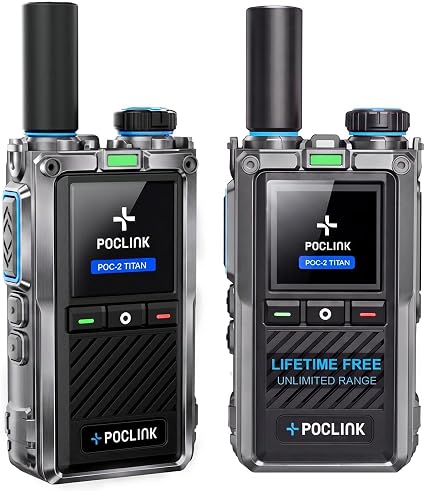
Staying connected far from cell towers can be daunting, but these walkie talkies handle that challenge well. Perfect for off-grid adventures or managing remote teams, their standout feature is coverage that reaches across countries without extra fees.
Quick to start using right out of the box, the lifetime free SIM card means you avoid monthly charges. Featuring 16 channels and noise reduction, conversations come through clear on your phone or dedicated device.
The weather-resistant and shockproof design holds up to rough outdoor conditions, making it reliable during camping, skiing, or emergency situations.
Communication stays strong even at distances up to 25,000 miles on a 4G LTE network compatible with major US carriers. The radios maintain good sound clarity without lag on calls, and the battery lasts about five days on a single charge. Some users find the nonstandard battery inconvenient for replacements.
The sturdy build handles impacts well, but water resistance isn’t full waterproof, so it’s best used with care around heavy moisture.
The radios deliver clear, lag-free sound over extremely long distances using LTE networks, which users appreciate for consistent connectivity. Most find the battery type inconvenient when needing a replacement, detracting slightly from overall usability.
Those who need reliable global communication without recurring costs will be satisfied with this product. People requiring fully waterproof units or easily replaceable batteries might need to explore other options better suited to those needs.
Pros
- Lifetime free SIM with no hidden fees
- Long range coverage up to 25,000 miles
- Weather resistant and shockproof design
- Supports over 80 countries globally
Cons
- Uses a nonstandard battery type
- Water resistance doesn’t equal full waterproofing
| Specification | Details |
|---|---|
| Number of Channels | 16 |
| Connectivity Protocol | LTE |
| Battery Average Life | 5 days |
| Water Resistance Level | Water Resistant |
| Frequency Range | 4G Band: B1/2/3/4/5/7/8/12/13/17/66/38/40/41 |
11. Kaito Voyager Ranger Long Range Walkie Talkies

Infinite power stands out thanks to the dual-crank technology, perfect when batteries or USB charging aren’t available. Designed for those living off the grid or in remote areas, it ensures emergency communication with reliable long-range capability and weather alerts to keep you informed at all times.
Setup is simple with just 10 channels and compatibility with other Kaito radios on the same frequencies. Daily use includes accessing NOAA weather alerts for storm or wildfire warnings. The integrated flashlight adds convenience, while the hand crank charges the device for emergency calls.
The radio feels sturdy and offers water resistance, so handling it outside isn’t a concern.
Performance impresses with dependable long-range communication and steady connection to weather channels. The build is solid and weather-resistant, ready for rough conditions.
The main praise is its reliable manual charging without dead battery worries, while some find the limited 10 channels a bit restrictive for broader communication needs.
Reliable manual charging is the standout feature praised, ideal for emergency use when power sources fail. Some users find the number of channels limited, which can restrict communication options compared to other radios with more channels.
Those needing a dependable emergency radio with built-in weather alerts and manual charging will appreciate this model. Users requiring more communication channels or standard batteries might want to explore alternative options.
Pros
- Manual hand crank provides power anytime
- Includes NOAA weather channels for real-time alerts
- Compatible with other Kaito radios on same channels
- Durable water-resistant build for outdoor use
Cons
- Limited to 10 channels for communication
- Nonstandard battery can be harder to replace
| Specification | Details |
|---|---|
| Number of Channels | 10 |
| Power Source | 1 Nonstandard Battery (included), hand crank, USB |
| Connectivity Protocol | Two-Way Radio Frequency |
| Water Resistance Level | Water Resistant |
| Additional Features | Integrated Flashlight, Weather Alert, Rechargeable |
12. MOICO 22 Channel FRS Two-Way Radios

Anyone needing reliable communication off grid, like campers or hikers, will appreciate these walkie talkies. They offer plenty of channels and privacy codes, making it simple to stay connected with a group.
Their standout feature is the variety of channels combined with the hands-free VOX function, which makes communicating without pushing buttons easier.
Setting them up is straightforward, with clear digital displays and a keypad lock to prevent accidental changes. Using the VOX feature, you can talk hands-free at three sensitivity levels, handy when your hands are full outdoors. Their lightweight design makes carrying them comfortable during daily use.
Battery life of around 12 hours suits medium-length trips well.
Communication covers up to 3 miles, which is solid for most outdoor adventures. They handle voice clearly on any of the 22 channels with 99 privacy tone combinations to avoid interference from other groups. The radios feel sturdy and shockproof, built to take some rough handling.
A common downside is relying on 4 AAA batteries, which might require frequent replacement on longer outings.
The radios consistently deliver clear voice communication with a good variety of channels and privacy codes. Users appreciate the VOX feature for hands-free talking, although many note the need to replace AAA batteries fairly often during extended use. Build quality stands out with shockproof and water-resistant features.
People spending day trips or short multi-day outings off grid will find these reliable and easy to use. Those needing longer range or rechargeable power may want to explore other options.
Pros
- 22 channels with 99 privacy code sets
- VOX hands-free function with three sensitivity levels
- Long-lasting battery life around 12 hours
- Lightweight and shockproof design
Cons
- Requires 4 AAA batteries, not rechargeable
- Maximum range limited to 3 miles
| Specification | Details |
|---|---|
| Number of Channels | 22 |
| Talking Range Maximum | 3 miles |
| Battery Average Life | 12 hours |
| Water Resistance Level | Water Resistant |
| Additional Features | Digital Display, Keypad Lock, Lightweight, Long Range, Shockproof |
13. G2pro+ IP67 Waterproof FRS Walkie Talkies

G2pro+ IP67 Waterproof FRS Walkie Talkies stand out for their tough design that handles rough outdoor conditions while offering a reliable six-mile communication range. Perfect for anyone needing a durable, waterproof radio when working or exploring off the grid.
Setting up the radios is simple, especially with the included lithium polymer batteries and USB-C charging compatibility. Using features like NOAA weather alerts and FM radio keeps you informed during outdoor adventures.
The dual watch and dual PTT functions make switching channels and managing conversations easy for daily tasks or group coordination.
Performance over six miles is clear, making it a solid choice for large spaces or job sites. Its IP67 rating means drops in water or heavy rain won’t stop these radios from working. The casing feels sturdy and shatterproof, matching the waterproof claim.
Most feedback praises its durability, while some find the bulkiness less convenient for pocket carry.
The radios withstand harsh conditions like rain and accidental water drops without damage, making durability the biggest selling point. Some users mention the walkie talkies can feel heavy and bulky, which might be less comfortable for casual carry.
Those spending extended time outdoors or on job sites needing tough, waterproof radios will appreciate these. People wanting lightweight, compact models for light recreational use might look for smaller devices instead.
Pros
- IP67 waterproof rating with floating design
- Long battery life of 120 hours
- NOAA weather alerts stay you informed
- Dual watch and dual PTT functions
Cons
- Bulky and not very pocket-friendly
- Limited to 22 communication channels
| Specification | Details |
|---|---|
| Number of Channels | 22 |
| Frequency Range | 462 – 467 MHz |
| Talking Range Maximum | 6 mile |
| Battery Average Life | 120 hours |
| Water Resistance Level | Waterproof (IP67) |
| Voltage | 3.7 volts_of_direct_current |
Comparison of Top off Grid Walkie Talkies
| Product | Channels | Water Resistance | Max Talking Range | Battery Type |
|---|---|---|---|---|
| Retevis RB48 FRS | 22 | Waterproof | – | 3.7 volts |
| Radioddity HD-2 Waterproof | 22 | Waterproof | 4 mile | 3.7 volts |
| Retevis RT85 Dual Band | 200 | Not Water Resistant | – | 7.4 volts |
| GMRS&POC Long Range | 200 | Not Water Resistant | 100000 mile | 7.4 volts |
| Midland GXT1000VP4 GMRS | 50 | Water Resistant | 36 mile | 8 AA batteries |
| Airiton AI-K28 LTE POC | 200 | Not Water Resistant | 10000 mile | 2 9V batteries |
| Mountain Radio FRS | 128 | Water Resistant | 35 mile | Rechargeable |
| Retevis RB48 Waterproof | 22 | Waterproof | 3 mile | 3.7 volts |
| Motorola T802 Talkabout | 22 | Water Resistant | 35 mile | 3 AA batteries |
| Poclink POC-2-Titan LTE | 16 | Water Resistant | – | 1 Nonstandard battery |
| Kaito Voyager Ranger | 10 | Water Resistant | – | 1 Nonstandard battery |
| MOICO 22 Channel FRS | 22 | Water Resistant | 3 mile | 1.5 volts |
| G2pro+ IP67 Waterproof | 22 | Waterproof | 6 mile | 3.7 volts |
- Channels22
- Water ResistanceWaterproof
- Max Talking Range–
- Battery Type3.7 volts
- Channels22
- Water ResistanceWaterproof
- Max Talking Range4 mile
- Battery Type3.7 volts
- Channels200
- Water ResistanceNot Water Resistant
- Max Talking Range–
- Battery Type7.4 volts
- Channels200
- Water ResistanceNot Water Resistant
- Max Talking Range100000 mile
- Battery Type7.4 volts
- Channels50
- Water ResistanceWater Resistant
- Max Talking Range36 mile
- Battery Type8 AA batteries
- Channels200
- Water ResistanceNot Water Resistant
- Max Talking Range10000 mile
- Battery Type2 9V batteries
- Channels128
- Water ResistanceWater Resistant
- Max Talking Range35 mile
- Battery TypeRechargeable
- Channels22
- Water ResistanceWaterproof
- Max Talking Range3 mile
- Battery Type3.7 volts
- Channels22
- Water ResistanceWater Resistant
- Max Talking Range35 mile
- Battery Type3 AA batteries
- Channels16
- Water ResistanceWater Resistant
- Max Talking Range–
- Battery Type1 Nonstandard battery
- Channels10
- Water ResistanceWater Resistant
- Max Talking Range–
- Battery Type1 Nonstandard battery
- Channels22
- Water ResistanceWater Resistant
- Max Talking Range3 mile
- Battery Type1.5 volts
- Channels22
- Water ResistanceWaterproof
- Max Talking Range6 mile
- Battery Type3.7 volts
How to Choose the Right off Grid Walkie Talkie
Choosing the right off grid walkie talkie depends on range, battery life, durability, and ease of use, as these factors ensure reliable communication in remote areas. Prioritizing these features helps avoid frequent replacements and connectivity issues, ultimately saving money and reducing frustration.
Range and Signal Strength
Trying to communicate in dense forest or hilly terrain with a basic handheld radio often results in lost messages or static-filled conversations. Radios with a longer effective range and strong signal capability make a difference in these environments. A realistic range varies from a couple of miles in urban areas up to 20 miles in open fields, but obstacles like buildings and trees cut signal strength dramatically.
Reliable radios for off-grid use keep transmissions clear even when separated by thick forests or valleys. Look for units that mention signal clarity in obstructed conditions and use amplitude modulation or frequency modulation that resists interference.
Radios with higher power output (around 5 watts) provide better range but draw more energy. Antenna quality also plays a role in maintaining communication over longer distances.
Battery Life and Power Options
Running out of battery far from a power source is a common frustration with handheld radios. Radios that run 10 hours or more of talk time without recharge offer a practical advantage. Options for both rechargeable and replaceable batteries add flexibility depending on trip length and resources.
Some radios feature power-saving modes that automatically reduce transmission power or go into standby when idle, extending battery life. Rechargeable lithium-ion batteries tend to provide steady performance and quick charging, while AA or AAA replaceable cells may be easier to swap in remote settings. Check battery capacity, usually listed in mAh, to estimate how long the radio will last in continuous use.
Durability and Weather Resistance
A few drops or a fall can ruin lesser radios quickly. Devices built with hard plastic housings or reinforced casing handle shocks and accidental impacts better during outdoor activities. Minimum water resistance, like an IPX4 rating, protects against splashes, but IP67 or above is preferable for full waterproofing in rain or submersion.
Dust and dirt also wear down radios not designed for rough terrain. Seals and covers over charging ports help prevent grit from causing malfunctions. Radios rated for extreme temperatures ensure functionality in hot deserts or cold mountains without performance drop or battery issues.
Ease of Use and Ergonomics
Operating a radio in stressful situations requires controls you can manage without looking. Large buttons spaced apart and intuitive layouts minimize fumbling.
Compact size and light weight make it easier to carry all day without strain, while still offering a firm grip even with gloves on.
Clear audio is critical; muffled or low volume causes missed messages. Radios allowing volume adjustment can tune sound to background noise levels. A bright display with backlight aids readability in low-light settings without complicating the interface.
Channel Availability and Privacy
Common channels get crowded fast, especially in popular outdoor areas. Radios offering 20 or more channels reduce interference and allow switching to avoid noise.
More channels mean better chances for clear contact among team members separated over distance.
Privacy codes or basic encryption mask transmissions, reducing the chance others will overhear conversations. Compatibility with popular brands or models lets groups mix units without losing connection, which matters for group outings or emergency communication setups.
Optimizing Signal Range for Remote Off-Grid Communication
Signal range relies heavily on terrain and device placement. Placing walkie talkies at higher points like hills or rooftops helps reduce obstacles that block signals. Carrying devices with clear line of sight between units makes a big difference, especially in backcountry or wooded areas where thick foliage interferes with transmissions.
Using walkie talkies that operate on higher power output can extend range, but this consumes more battery, so a balance is necessary. Avoiding deep valleys and dense urban settings where signal interference is common also helps maintain communication consistency.
- Keep antennas fully extended for maximum reach.
- Choose models with multiple channels to switch away from crowded frequencies.
- Consider external antennas in fixed off-grid bases to boost performance.
Testing your devices in the actual environment ensures you know the reliable communication radius before relying on them for critical uses.
Essential Maintenance Practices to Prolong Walkie Talkie Life
Regularly cleaning walkie talkies prevents dirt and debris from affecting buttons and connectors. Use a soft cloth and avoid harsh chemicals that could damage seals. Keeping battery contacts free from corrosion improves power delivery and prevents unexpected shutdowns during use.
Store devices in dry places with moderate temperatures to avoid moisture damage. When not in use for long periods, remove batteries to prevent leaks that can ruin internal components.
Charging batteries fully and avoiding overcharging maintains their lifespan and reliability.
- Test units periodically, even when stored, to make sure they power on and transmit properly.
- Inspect antennas for cracks or loose connections before trips.
- Replace worn-out belts or clips to prevent accidental drops.
Consistent upkeep keeps walkie talkies functioning well through rugged conditions and extended use.
Comparing Walkie Talkies to Satellite Phones for Off-Grid Adventures
Walkie talkies operate on radio frequencies without relying on satellites, making them dependable in areas without cellular or satellite coverage. This independence allows instant communication without delay or recurring fees. However, their range is limited to a few miles at best, particularly in obstructed terrain.
Satellite phones cover a broader area globally but require line of sight to orbiting satellites and often come with significant purchase and usage costs. Battery life varies, with satellite phones usually demanding more frequent recharges.
- Walkie talkies qualify as lightweight, straightforward tools for close-range group coordination.
- Satellite phones suit lone travelers needing emergency contact capabilities far beyond radio range.
- Cost and convenience should guide choice depending on specific off-grid needs.
Many off-grid enthusiasts carry both to cover short-range communication and distant emergency contact options.
People Also Asked
How Long Do off Grid Walkie Talkie Batteries Usually Last?
Batteries in off grid walkie talkies typically last between 12 to 24 hours of active use, depending on the model and settings. Keeping spare batteries or charging options like solar panels can help you stay connected longer during extended outings.
Are off Grid Walkie Talkies Compatible with Other Radio Brands?
Most off grid walkie talkies use FRS or GMRS frequencies and can communicate with other brands that operate on the same channels and frequency ranges. Verifying that the channel and privacy code settings match between devices is important for clear communication.
What Safety Precautions Should I Take Using off Grid Walkie Talkies?
Avoid transmitting while driving or operating machinery to prevent distractions, and keep your volume at a moderate level to protect your hearing. Having a pre-agreed call sign and emergency channel can be useful in situations requiring clear and quick communication.
How Do I Properly Care for and Maintain Walkie Talkies?
Store walkie talkies in a dry, cool place and clean contacts regularly to maintain battery life and reception quality. Regularly testing your units before trips helps identify any issues early and ensures they’re ready for use in the field.
What Are Common Problems with off Grid Walkie Talkies and Fixes?
Common issues include weak signal, battery drain, and static noise. Carrying extra batteries, adjusting antenna position, and minimizing interference from other electronics can often resolve these problems.
Conclusion
Choosing off grid walkie talkies comes down to a few key points: range, battery life, and durability. The radios need to cover the distance you’ll be communicating across, last long enough on a charge or batteries for your needs, and handle the outdoor conditions you’ll put them through.
Avoid models with features you won’t use, as they can complicate operation and add to the cost.
Think about where and how often you’ll use the walkie talkies before deciding. Match the model to your environment and budget for the best fit.
Check the comparison table and the detailed picks above to find options that suit different needs and settings. That way, you can choose equipment that works reliably for your off grid communication.