Top 13 Best Mid Range 1R Optic Everyone Must Own Now
One common frustration with sights for shooting at moderate distances is fogging or misalignment that ruins a shot. The best mid range 1r optic offers steady clarity without frequent adjustments, unlike cheaper models that can shift under recoil or weather exposure. Without that reliability, a clean follow-up shot can be tough, slowing down any practical use in the field.
Key aspects separating a solid mid range 1r optic include durable lens coatings that prevent fog and scratches, usually multi-layered to maintain clarity. Magnification typically stays fixed around 1x to keep target acquisition fast, but quality optics maintain sharp focus within 100 to 300 yards, the usual mid range target zone.
A well-designed housing made from aircraft-grade aluminum or similar materials balances toughness with manageable weight, and simple turret adjustments help make easy, precise tweaks in the moment.
Need a Quick Check?
| Image | Product | Price |
|---|---|---|
Our Top Picks 1  | Triton Ronin 2-10×32 | Check Price |
Our Top Picks 2  | Triton Orion HD 1-6×20 | Check Price |
Our Top Picks 3  | OSIGHT R Red Dot | Check Price |
Our Selected Top 13 Mid Range 1r Optic for Different Needs
This list features a variety of mid-range 1r optics designed for different uses and preferences. Each review covers performance, ideal users, and highlights strengths and weaknesses to help readers find the best fit for their specific needs.
1. Triton Ronin 2-10×32 SFP MPVO
Feels just right between a compact scope and longer-range precision optics. Suited for shooters needing flexibility from close to mid-range distances without the bulk of bigger scopes.
The standout feature is its versatile 2-10x zoom range that adapts well to different shooting scenarios.
Setup is straightforward with a clear F1 Duplex reticle that stays the same size regardless of zoom level, helping keep your aim consistent. Its 32mm objective lens keeps the overall weight down, making it easy to handle and quick to maneuver on the rifle. Switching between magnifications is smooth, making it great for varied field use or target practice.
Performs well as a general-purpose optic, offering more reach than a typical low power variable optic while still feeling lightweight. Built solidly for field use, its compact design doesn’t sacrifice durability. The most common issue noted is the second focal plane reticle not scaling with magnification, which some may find limiting for range estimation.
Offers a practical 2-10x magnification that blends field versatility with manageable size and weight. Most complaints focus on the reticle’s fixed size, which can make fine holdover adjustments harder at higher magnifications.
Ideal for shooters who want a flexible optic covering short to mid-range distances without adding bulk. Those needing dynamic reticle scaling or long-range precision may want to consider other options.
Pros
- Versatile zoom from 2 to 10 times magnification
- Lightweight and compact for easy handling
- Reticle size consistent at all magnifications
- Suitable for both range and field use
Cons
- Reticle does not adjust size with zoom
- May not suit precision shooters needing range estimation
| Specification | Details |
|---|---|
| Magnification Maximum | 10 x |
| Magnification Minimum | 2 x |
| Compatible Devices | Rifle |
| Reticle Type | F1 Duplex |
| Objective Lens Diameter | 32 mm |
2. Triton Orion HD 1-6×20 SFP LPVO
Strong optical clarity and flexible magnification make the Triton Orion HD 1-6×20 SFP LPVO a solid choice for anyone wanting dependable zoom range in a mid-sized package. It suits shooters who switch between quick target acquisition and longer-range precision without adding bulk to their rifle.
Setting it up is straightforward thanks to a compact design that fits well on most rifles. The 1-inch tube keeps the overall profile small. Daily use feels natural with a 1x setting that lets you instantly pick up fast targets and switches smoothly to 6x for more detailed shots.
The reticle stays clear throughout changes in magnification so you won’t have to recalibrate your aim.
The optic delivers sharp, bright images thanks to HD glass, which improves contrast and visibility at various light levels. The standard second focal plane reticle keeps the reticle size stable, preferred for familiarity on the field or range. Build is solid with a small 20mm objective lens that doesn’t add extra bulk.
Some users mention eye relief feels a bit tight at 7.7cm, which can be noticeable with rapid shooting.
Optical clarity and consistent reticle size stand out as strong points, providing sharp images and a familiar sight picture during magnification changes. Users sometimes find the eye relief limiting, particularly in fast shooting situations where quick positioning is needed.
The optic appeals to shooters wanting a versatile mid-range magnification without extra size or weight. Those needing longer eye relief or brighter images in very low light might want to explore other options with larger objective lenses or different eye relief measurements.
Pros
- Clear visuals with HD optical glass
- Compact 1″ tube fits many rifles
- Reticle size remains consistent in use
- Wide 1x view for fast target tracking
Cons
- Eye relief is relatively short at 7.7cm
- 20mm objective may limit light gathering
| Specification | Details |
|---|---|
| Magnification Minimum | 1 x |
| Magnification Maximum | 6 x |
| Objective Lens Diameter | 20 millimeters |
| Eye Relief | 7.7 centimeters |
| Reticle Type | C6 – BDC |
| Compatible Devices | Rifle |
3. OSIGHT R Enclosed Red Dot Sight
Aluminum construction and a clear multi-coated optical window define this enclosed red dot sight, suited for shooters who want quick target acquisition at mid-range distances. Its biggest strength lies in offering a large field of view combined with versatile reticle options to match different shooting scenarios.
Setting up involves mounting it on Micro T1/T2 footprint rails, which fits most common platforms. Day-to-day use benefits from the 12 brightness levels, including specialized night vision settings, controlled through easy-to-access buttons. The reticle system lets you switch between a precise dot, circle, or a combination, making it simple to adjust focus depending on your target distance.
Performance excels in delivering an undistorted sight picture thanks to advanced anti-glare technology. The build feels solid and durable while staying compact. The most praised feature is the expansive viewing area that speeds up target transitions.
A noted downside is the limited magnification fixed at 1x, which might restrict some mid-range precision demands.
Many appreciate the wide and clear viewing window allowing quick target acquisition without reticle starburst. The most frequent criticism targets the 1x magnification limiting its effectiveness beyond close engagement distances.
Those needing a reliable red dot for rapid aiming at short to mid distances will find it well-suited. Users seeking zoom or variable magnification for longer shots may want to consider other optic options.
Pros
- Large field of view for fast target transitions
- Multi-reticle system for flexible aiming options
- 12 brightness levels including night vision
- Advanced anti-glare, minimal reticle distortion
Cons
- Magnification fixed at 1x limits versatility
- Circle reticle may clutter view at certain distances
| Specification | Details |
|---|---|
| Magnification Maximum | 1 x |
| Magnification Minimum | 1 x |
| Mounting Type | Micro T1/T2 Footprint |
| Reticle Type | Dot |
4. Athlon Optics Ares ETR 1-10×24 FFP

Bright, sharp images stand out on this 1-10×24 1r optic, designed primarily for rifle shooters who want clear vision across a versatile range of distances. Its biggest strength is the extra-low dispersion glass that cuts down chromatic aberration, making colors true and images vivid.
Setting it up is straightforward, with a first focal plane reticle that adjusts size depending on magnification, allowing for precise aiming at all power levels. The illuminated reticle is particularly helpful in low light conditions like dawn and dusk, while the etched glass reticle ensures durability during regular handling and use in the field.
Performance-wise, it provides a crisp sight picture with no color fringing thanks to the special glass. It holds up well physically, with a sturdy build that can handle regular rifle use.
The most common issue from reviews is the limited objective lens diameter, which can affect brightness in very low light.
Sharpness and color accuracy get high marks in feedback for enabling clear shots, while the smaller objective lens is frequently noted as a drawback for dim conditions.
Shooters who prioritize daytime brightness and reticle precision will appreciate this optic. Those needing excellent low-light performance or a wider field might look for options with bigger lenses.
Pros
- Bright, sharp images with true color
- Illuminated reticle for low light use
- First focal plane for consistent reticle size
- Durable etched glass reticle
Cons
- Objective lens size limits brightness at night
- Limited field of view compared to larger scopes
| Specification | Details |
|---|---|
| Magnification Minimum | 1 x |
| Magnification Maximum | 10 x |
| Objective Lens Diameter | 24 millimeters |
| Field Of View | 15 degrees |
| Reticle Type | Duplex |
5. SIG SAUER Tango-MSR 1-6×24 LPVO

Perfect for anyone wanting clear optics and versatile zoom on a tactical rifle, the SIG SAUER Tango-MSR 1-6×24 LPVO stands out for its impressive light transmission and crystal-clear glass. It suits shooters looking for reliability in varying light without stretching the budget too much. Its brightest feature is how well it performs in low light.
Setting up is straightforward with a cantilever mount that keeps it steady on the rifle. Changing magnification is quick thanks to the integrated throw lever paired with a removable thread, making transitions smooth between close range and precision shots. The illuminated MSR BDC-6 reticle with 11 brightness levels suits different visibility conditions, so you have good control day or night.
The clarity from the low dispersion glass makes target acquisition fast and accurate at any zoom between 1 and 6 times. The build feels tough and dependable for regular tactical use. While many appreciate the light transmission, some mention that the reticle illumination can be a little intricate to adjust precisely in the field.
Users highlight the superior light transmission and sharp optics as the main benefit for accurate aiming. Common feedback notes some difficulty fine-tuning the reticle brightness quickly in certain lighting situations. The gear handles day-to-day shifts between bright and dim environments with ease.
The Tango-MSR suits shooters who want reliable clarity and flexibility in a compact scope with tactical features. Anyone prioritizing simple reticle controls or needing larger objective lenses might explore other options instead.
Pros
- Excellent optical clarity in various light
- Wide magnification range up to 6x
- 11 brightness settings for reticle illumination
- Quick magnification switch with throw lever
Cons
- Reticle brightness adjustment can be tricky
- Objective lens size could limit light gathering
| Specification | Details |
|---|---|
| Magnification Minimum | 1 x |
| Magnification Maximum | 6 x |
| Objective Lens Diameter | 24 millimeters |
| Reticle Type | Illuminated MSR BDC-6 Reticle |
| Mounting Type | Cantilever Mount |
| Compatible Devices | Rifle |
6. MidTen 4-16×50 AO Hunting Rifle Scope

When hunting in varying light conditions, having a versatile optic that adapts quickly is essential. Perfect for mid-range shooting, this setup combines multiple aiming aids into one package, making it ideal for hunters who want options without carrying extra gear. Its biggest strength lies in merging a riflescope with laser, red dot, and flashlight functionality.
Setting up is straightforward using the Picatinny mount, which fits most hunting rifles securely. Switching between the AO riflescope, green laser, red dot, and flashlight happens easily thanks to dedicated controls. The flashlight’s five brightness modes come in handy during dawn or dusk hunts while the adjustable illuminated reticle helps adjust aim precisely based on lighting and distance.
Magnification from 4x to 16x lets you zoom in on targets clearly without losing clarity. The 50mm objective lens brings in enough light for detailed viewing.
The build feels solid enough for regular hunting trips. Users appreciate the wide field of view and accurate reticle adjustments most. Some note that operating the multiple modes can feel a bit complex at first.
The optic’s strength is in its all-in-one setup that covers varied hunting conditions with illumination and aiming options. The most common drawback is complexity due to multiple features combined into one device, requiring time to get accustomed.
Hunters who want flexibility without swapping gear will appreciate the integrated lights and lasers. Anyone preferring simplicity or lighter setups might look for a more basic scope without extra attachments.
Pros
- Combo of scope, laser, dot sight, and flashlight included
- Red and green illuminated reticles with multiple brightness levels
- Class IIIA laser reaching over 300 meters
- Wide 50.85 feet field of view at 100 yards
Cons
- Multiple modes can be confusing to switch between
- Size and weight heavier than single-function scopes
| Specification | Details |
|---|---|
| Magnification Maximum | 16 x |
| Objective Lens Diameter | 50 millimeters |
| Magnification Minimum | 4 x |
| Compatible Devices | Picatinny Mount |
| Reticle Type | Illuminated Range Finding Reticle |
7. Triton Ronin 3-9×32 SFP MPVO

3-9x magnification offers a flexible zoom suited for close to mid-range shooting, making it a solid pick for those needing reach beyond an LPVO but wanting to avoid a full-size precision scope. Its compact 32mm objective keeps the setup manageable without adding extra bulk.
Setup is straightforward thanks to the Second Focal Plane reticle that remains the same size regardless of zoom level, making it easy to adjust quickly on the fly. The HD glass clarity ensures the view doesn’t get cloudy or distorted through the range of magnification, which is helpful for spotting targets without strain. Lightweight design fits well on practical rifles without making them front-heavy.
Optical performance delivers a clear sight picture across the magnification range, handling the core task of mid-range shooting reliably. Construction feels solid and compact, balancing durability with portability. The biggest compliment from users often highlights how clear and sharp the image stays, while some note the 32mm objective limits light gathering in low-light conditions.
Most praise centers on the optic’s clear and crisp image quality, providing reliability for mid-range shots. Commonly mentioned drawback is the somewhat restricted light gathering ability due to the 32mm objective, which can affect visibility in dim settings.
This scope fits well for shooters wanting a step up from basic LPVOs without jumping to bulky precision scopes. Those frequently hunting or shooting in low-light conditions might prefer optics with larger objectives for better light capture.
Pros
- Clear HD glass across zoom range
- Consistent reticle size at all magnifications
- Lightweight and compact design
- Versatile mid-range magnification
Cons
- Limited light transmission in low light
- Reticle not adjustable with zoom
| Specification | Details |
|---|---|
| Magnification Minimum | 3 x |
| Magnification Maximum | 9 x |
| Objective Lens Diameter | 32 millimeters |
| Reticle Type | F1 Duplex |
| Compatible Devices | Rifle |
8. DISCOVERYOPT HD 5-30×56 GEN2 FFP Rifle Scope

People who hunt or shoot at long distances will find this scope solid for its price range. It suits those needing precise adjustments and good clarity without going into the high-end market.
The biggest strength comes from its wide magnification range and precise zero stop turrets, perfect for dialing in long-range shots.
Setting up involves mounting it on a Picatinny rail, which is straightforward thanks to the 34mm main tube. Day-to-day use benefits from the fully multi-coated optics that keep your view clear, even in low light.
The first focal plane reticle scales with magnification, keeping holdovers accurate at every zoom level.
Performance here is quite sharp at all zoom settings, making it easier to spot targets at extreme ranges. The sturdy 34mm tube allows for plenty of elevation and windage adjustment, ensuring the rifle scope stays reliable in various conditions.
The main compliment is on the clarity and zero stop, while some users note the scope’s 25-foot field of view feels tight at max magnification.
The scope earns praise mainly for its sharp optics and the zero stop feature that lets you confidently reset your zero. Plenty of users mention the limited field of view as a drawback when zoomed in high, making target acquisition slower sometimes.
Those shooting at extreme distances or needing precise holdovers will appreciate the adjustments and clarity offered. People wanting a wider field of view or something lighter might want to consider other mid-range scopes instead.
Pros
- Wide 5-30x magnification range
- 34mm tube allows big elevation adjustment
- Precise 0.1 MRAD click turrets
- Fully multi-coated optics for clarity
Cons
- Narrow 25-foot field of view at max zoom
- Relatively bulky compared to smaller scopes
| Specification | Details |
|---|---|
| Magnification Minimum | 5 x |
| Magnification Maximum | 30 x |
| Objective Lens Diameter | 5.6 centimeters |
| Reticle Type | Mrad Ffp (first Focal Plane) |
| Mounting Type | Picatinny Mount |
| Field Of View | 25 feet |
9. DISCOVERYOPT ED-AR 1-8×24 LPVO Rifle Scope

Offering true 1x magnification with extra low dispersion glass, this optic stands out for delivering clear, bright images in low-light and quick target acquisition scenarios. Ideal for shooters who want a versatile mid-range scope that performs well close up and at moderate distances.
Mounting on a Picatinny rail is straightforward, and the 1-8x zoom range covers a wide variety of shooting needs from close quarters to mid-range shots. The Christmas Tree reticle helps keep track of holdover without clutter, and the sight remains bright and sharp thanks to the Japanese ED glass and high light transmission system.
Clarity remains impressive throughout the entire zoom range, especially in dawn or dusk light when many scopes struggle. The build feels solid and dependable without unnecessary bulk.
Common feedback highlights the excellent brightness and sharpness. A frequent downside mentioned involves the limited objective lens size, which may reduce performance in extremely dim conditions.
The scope consistently receives praise for its brightness and clarity at all magnifications, making it reliable during low-light hunting or tactical situations. However, some users note that the 24mm objective lens restricts light gathering in extreme dim environments, impacting visibility when light is scarce.
Those engaged mainly in close to mid-range shooting will find this optic suits their needs well, especially with quick target changes. Shooters seeking longer-range magnification or enhanced performance in very dark settings might consider alternatives with larger lenses or higher zoom levels.
Pros
- True 1x magnification for fast target acquisition
- ED glass ensures bright, clear images
- Compact size suitable for close to mid-range uses
- Christmas Tree reticle supports precise holdovers
Cons
- Objective lens diameter limits very low-light performance
- Maximum zoom may not suit very long distances
| Specification | Details |
|---|---|
| Magnification Minimum | 1 x |
| Magnification Maximum | 8 x |
| Objective Lens Diameter | 24 millimeters |
| Mounting Type | Picatinny Mount |
| Reticle Type | Christmas Tree Reticle |
10. LPVO SFP 1-8×28 Riflescope

Techhunters LPVO SFP 1-8×28 Riflescope offers a versatile zoom range from 1x to 8x, making it ideal for tactical shooters who need quick target acquisition and reliable performance. Its wide 28° field of view stands out, helping you spot targets fast at close to mid distances.
Setting up the scope on a Picatinny rail is straightforward thanks to the included mount. The 9-layer anti-reflective coating delivers clear sight even in varying light, while the 12-level illuminated reticle adjusts well to different brightness settings.
Eye relief at 8.6 cm is comfortable for steady aim during extended use.
The scope delivers sharp imaging throughout its zoom range, with strong durability from its aerospace-grade aluminum body. Praise often goes to the clarity and brightness of the optics, but some mention the reticle’s illumination can be too bright at lower settings.
The build quality matches the scope’s intended tactical use.
The clarity and brightness of the optics receive strong praise for making target acquisition quick and precise. A common complaint is about reticle illumination being overly intense in darker environments, which may require frequent adjustments during use.
Shooters who prioritize a broad field of view and adaptable reticle will appreciate this scope’s features. Those who need enhanced low-light performance or a subtler illumination might want to consider other options better suited for those needs.
Pros
- Wide 28° field of view for fast target spotting
- 12-level illuminated reticle adapts to light conditions
- Durable aerospace-grade aluminum construction
- Included mount simplifies Picatinny rail setup
Cons
- Illumination settings can be too bright at low levels
- Objective lens diameter limits low-light performance
| Specification | Details |
|---|---|
| Magnification Maximum | 8 x |
| Magnification Minimum | 1 x |
| Objective Lens Diameter | 28 millimeters |
| Mounting Type | Picatinny Mount |
| Field Of View | 28 degrees |
| Eye Relief | 8.6 centimeters |
11. 1-7×28 IR LPVO SFP Tactical Scope

Feels natural to switch between long shots and close targets thanks to the 1x-7x magnification range. Suited for those using 22lr rifles looking for precise but flexible optics in mid-range shooting.
Its biggest strength lies in how easily it adapts from both-eyes-open shooting to focused precision without losing clarity.
Setting up the scope is straightforward with its 30mm mounting system, and the locking turrets keep adjustments steady during use. The 1/10 MIL click increments feel tactile and precise, making windage and elevation tweaks confident every time.
The red illuminated reticle helps maintain visibility from bright daylight into dusk while the constant size on the second focal plane means targeting stays consistent across the zoom range.
Accuracy stays solid within the 90 MOA range, and the etched glass reticle means it won’t disappear without power. The build feels sturdy, designed with tactical settings in mind, and the eye relief holds up well at 15 cm for comfortable viewing. Praise often goes to the reticle’s clarity and illumination, while the smaller 28mm objective lens may limit light gathering in very dim conditions.
The etched glass reticle stays clear and usable even without illumination, which many find reliable, while the smaller lens size is noted for limiting performance in darker conditions. The turret locks prevent accidental adjustments when moving or during recoil.
This optic works well for shooters who want a flexible zoom range on a 22lr rifle and value precise, tactile adjustments. Those needing stronger low-light capability might consider scopes with larger objective lenses or different illumination setups.
Pros
- Wide 1-7x magnification covers close to mid-range
- Locking turrets prevent accidental zero shifts
- Red illuminated glass etched reticle visible without power
- Consistent reticle size on second focal plane
Cons
- 28mm objective lens limits low-light performance
- Eye relief of 15 cm may feel short for some users
| Specification | Details |
|---|---|
| Magnification Maximum | 7 x |
| Objective Lens Diameter | 28 millimeters |
| Magnification Minimum | 1 x |
| Mounting Type | 30mm scope mounts |
| Eye Relief | 15 centimeters |
| Reticle Type | Mil-Dot Reticle |
12. SIG SAUER Tango-MSR Compact 1-10×24

Offers a versatile 1-10x magnification range suitable for shooters needing quick shifts between close and long-distance targets. Its biggest strength lies in balancing fast target acquisition with precise shots at higher zoom, making it a solid mid-range optic for tactical and hunting rifles.
Setup involves mounting on a Picatinny rail, where the compact size and 24mm objective lens help keep the weight manageable. Using the 1x setting allows something closer to a red dot speed, while dialing up to 10x brings in fine details.
The illuminated BDC-10 reticle in the second focal plane ensures the reticle size stays the same throughout zoom levels, aiding consistent holdover during varied lighting conditions.
Performance shines in how well it adapts from close quarters to extended range shooting. The scope’s build feels sturdy enough for serious use, with a Picatinny mounting system that stays secure. The strongest praise focuses on the clear, high-contrast reticle aiding quick aim, while some find the limited 24mm objective lens a drawback for low-light performance at max zoom.
The clear, high-contrast illuminated reticle receives strong praise for aiding target acquisition, especially in dim conditions. However, the smaller 24mm objective lens can restrict performance when shooting in low-light or using the highest magnification settings.
This optic fits shooters seeking versatility between rapid close-range shots and detailed long-distance precision. Those looking for a larger lens for better low-light visibility or different reticle types might want to explore other models better tailored to those needs.
Pros
- Wide magnification range from 1x to 10x
- Illuminated BDC-10 reticle for low-light aiming
- Second focal plane keeps reticle size consistent
- Compact size suited for tactical rifles
Cons
- 24mm objective lens limits low-light clarity
- SFP reticle may not suit all shooter preferences
| Specification | Details |
|---|---|
| Magnification Minimum | 1 x |
| Magnification Maximum | 10 x |
| Objective Lens Diameter | 24 millimeters |
| Reticle Type | BDC |
| Mounting Type | Picatinny Mount |
| Thread Type | Picatinny |
13. SIG SAUER Tango-MSR 1-6×24 FFP
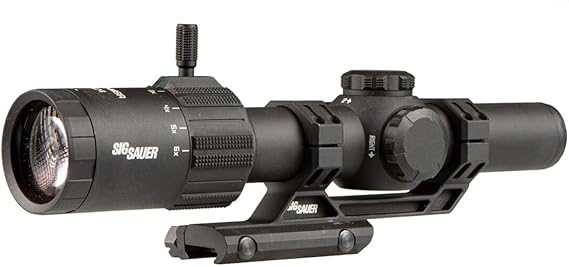
A tough and reliable scope made with durability in mind, the Tango-MSR 1-6×24 FFP suits anyone looking for solid performance in mid-range shooting. Its standout feature is the bright and clear optics, which make target acquisition easier in various light conditions.
Everyday use is straightforward thanks to the wide 1-6x magnification range, perfect for quick target transitions between close and intermediate distances. The illuminated MSR BDC-6 reticle helps in making adjustments for bullet drop and wind drift without extra calculations, while the cantilever mount allows for secure and consistent rifle attachment.
The scope delivers excellent optical clarity and reliable hitting power at mid-range distances. The construction feels sturdy and built for tactical use, though some mention the relatively small 24mm objective lens limits light gathering compared to larger scopes. Most users praise the reticle’s precision, but a few note brightness settings could be more varied.
Optical clarity and reticle precision are the scope’s strongest suits, helping shooters adjust quickly and accurately for distance and wind. The main complaint revolves around the smaller lens size, which means less light intake, especially noticeable in dusk or dawn conditions.
Ideal for shooters who need a tough, tactical scope with versatile magnification and detailed aiming points. Those prioritizing low-light performance might want to look for scopes with larger objective lenses instead.
Pros
- Excellent light transmission and optical clarity
- Illuminated MSR BDC-6 reticle for bullet drop holdovers
- Durable build suited for tactical use
- Wide field of view at lower magnifications
Cons
- 24mm objective lens limits light in low-light conditions
- Reticle brightness settings could be more adjustable
| Specification | Details |
|---|---|
| Magnification Range | 1 x to 6 x |
| Objective Lens Diameter | 24 millimeters |
| Reticle Type | Illuminated BDC Reticle |
| Field Of View | 124.8 feet |
| Mounting Type | Cantilever Mount |
Comparison of Best Mid Range 1R Optics
| Product | Magnification Range | Objective Lens Diameter | Reticle Type | Compatible Devices |
|---|---|---|---|---|
| Triton Ronin 2-10×32 | 2-10x | – | F1 Duplex | Rifle |
| Triton Orion HD 1-6×20 | 1-6x | 20mm | C6 – BDC | Rifle |
| OSIGHT R Red Dot | 1-1x | – | Dot | – |
| Athlon Ares ETR 1-10×24 | 1-10x | 24mm | Duplex | Rifle |
| SIG SAUER Tango-MSR 1-6×24 | 1-6x | 24mm | Illuminated MSR BDC-6 | Rifle |
| MidTen 4-16×50 Hunting | 4-16x | 50mm | Illuminated Range Finding | Picatinny Mount |
| Triton Ronin 3-9×32 | 3-9x | 32mm | F1 Duplex | Rifle |
| DISCOVERYOPT HD 5-30×56 | 5-30x | 56mm | Mrad Ffp | Rifle |
| DISCOVERYOPT ED-AR 1-8×24 | 1-8x | 24mm | Christmas Tree | Rifle |
| Generic LPVO 1-8×28 | 1-8x | 28mm | Illuminated | Rifle |
| IR 1-7×28 LPVO | 1-7x | 28mm | Mil-Dot | Rifle |
| SIG SAUER Tango-MSR Compact | 1-10x | 24mm | BDC | Rifle |
| SIG SAUER Tango-MSR 1-6×24 FFP | 1-6x | 24mm | Illuminated BDC | Rifle |
- Magnification Range2-10x
- Objective Lens Diameter–
- Reticle TypeF1 Duplex
- Compatible DevicesRifle
- Magnification Range1-6x
- Objective Lens Diameter20mm
- Reticle TypeC6 – BDC
- Compatible DevicesRifle
- Magnification Range1-1x
- Objective Lens Diameter–
- Reticle TypeDot
- Compatible Devices–
- Magnification Range1-10x
- Objective Lens Diameter24mm
- Reticle TypeDuplex
- Compatible DevicesRifle
- Magnification Range1-6x
- Objective Lens Diameter24mm
- Reticle TypeIlluminated MSR BDC-6
- Compatible DevicesRifle
- Magnification Range4-16x
- Objective Lens Diameter50mm
- Reticle TypeIlluminated Range Finding
- Compatible DevicesPicatinny Mount
- Magnification Range3-9x
- Objective Lens Diameter32mm
- Reticle TypeF1 Duplex
- Compatible DevicesRifle
- Magnification Range5-30x
- Objective Lens Diameter56mm
- Reticle TypeMrad Ffp
- Compatible DevicesRifle
- Magnification Range1-8x
- Objective Lens Diameter24mm
- Reticle TypeChristmas Tree
- Compatible DevicesRifle
- Magnification Range1-8x
- Objective Lens Diameter28mm
- Reticle TypeIlluminated
- Compatible DevicesRifle
- Magnification Range1-7x
- Objective Lens Diameter28mm
- Reticle TypeMil-Dot
- Compatible DevicesRifle
- Magnification Range1-10x
- Objective Lens Diameter24mm
- Reticle TypeBDC
- Compatible DevicesRifle
- Magnification Range1-6x
- Objective Lens Diameter24mm
- Reticle TypeIlluminated BDC
- Compatible DevicesRifle
How to Choose the Best Mid Range 1r Optic
Focus on clarity, durability, and appropriate magnification when selecting a mid range 1r optic, as these factors ensure accurate targeting and long-lasting performance. Choosing the right features prevents frequent replacements and costly adjustments, ultimately saving time and money.
Optical Clarity and Lens Quality
Using a sight that lacks multicoated lenses becomes obvious in low light or hazy conditions where the image darkens and contrast drops. This slows target acquisition and can lead to frustration during use. Optics with multicoated lenses provide brighter, clearer images by reducing glare and improving light transmission.
This clarity makes it easier to pick up on fine details quickly.
A clear lens helps maintain focus during fast movements, especially when shooting in varying conditions. Consider models that also offer scratch resistance and fogproof coatings.
This durability ensures lens clarity holds up over time, avoiding costly replacements or impaired vision through the scope.
Reticle Design and Illumination
The choice of reticle directly affects how quickly and accurately you can acquire targets. Simple crosshairs work for quick shots at short ranges, while mil-dot or BDC reticles aid in range estimation and holdovers during longer shots. Adjustable brightness on the reticle illumination is crucial for adapting to bright outdoor light or darker indoor environments.
Battery life plays a large role in usability. Batteries should last through several uses without frequent changes. Many optics now use easy-access compartments or common battery types, minimizing downtime.
A reliable reticle illumination system saves hassles and keeps you focused on the target instead of changing power sources.
Build Material and Durability
Your optic must tolerate rough handling without failing. Waterproof and fogproof features prevent internal damage from moisture and temperature changes.
Shockproof capabilities matter during recoil or accidental drops. These protections keep your sight functional in harsh conditions.
Weight impacts how balanced your setup feels. Heavier optics can make handling sluggish, especially in quick movements.
Choose sights with durable but lightweight materials like aircraft-grade aluminum to strike a good balance between strength and portability.
Magnification and Field of View
Close-quarters shooting demands a clear, undistorted view with no magnification delay. A 1x magnification setting provides natural target acquisition and fast scanning of the environment. This lets you move fluidly without adjusting your eye position.
The field of view should be wide enough to maintain situational awareness while keeping the target in sight. Some scopes offer slight magnification adjustments, around 1-1.5x, but many shooters prefer a fixed 1x for the clearest, fastest picture during quick engagements.
Mounting Compatibility and Adjustability
Compatibility with common rail systems like Picatinny or Weaver ensures the optic fits securely on a variety of firearms. Some models allow for tool-free installation and removal, which speeds up switching optics or stowing gear.
Adjustment for windage and elevation needs to be precise and cover enough range to zero the sight correctly at your preferred distances. Look for optics with tactile clicks or clear markings, which make fine-tuning reliable and repeatable without guesswork.
Optimizing Your Mid-Range 1R Optic for Different Lighting Conditions
Adjusting brightness settings on a mid-range 1R optic can make a significant difference when shifting between indoor, dusk, or bright daylight conditions. Many models offer multiple reticle illumination levels, which should be set low in dark environments to preserve night vision and increase in bright settings to maintain visibility. Using lens covers or flip-caps helps protect the optic from glare and damage when not in use, reducing the need for frequent cleaning.
Key points for lighting optimization:
- Test different illumination levels at various distances and lighting to find the best balance.
- Keep lens coatings clean but avoid over-cleaning to prevent scratches.
- Consider an anti-reflective lens coating on your 1R optic if available, which can improve clarity in harsh light.
Consistent adjustments and protective steps improve target acquisition speed and accuracy across lighting changes without constantly re-zeroing the optic.
Essential Maintenance Practices to Prolong the Lifespan of Your 1R Optic
Routine maintenance can significantly extend the practical lifespan of a 1R optical sight. Start with protecting the lens surfaces using caps or covers whenever the optic is not in use to prevent dust buildup and scratches.
Use a soft microfiber cloth to clean the lenses; avoid household cleaners or rough materials that can damage the coatings.
Maintenance checklist:
- After shooting sessions, inspect and remove any moisture or dirt from the lens and turret adjustments.
- Periodically check mounting screws to ensure the optic stays firmly attached without loosening.
- Store the optic in a dry, temperature-controlled environment to avoid dew formation and corrosion.
These simple steps help maintain clarity and mechanical reliability, making sure your 1R optic keeps performing consistently over time.
Comparing Mid-Range 1R Optics: Pros and Cons of Popular Models
Mid-range 1R optics typically vary in features such as reticle style, illumination options, and construction materials. Some models come with etched glass reticles that retain clarity without illumination, while others rely mainly on illuminated reticle systems. Weight and size also differ, which can influence the feel on your rifle and ease of handling.
Considerations when comparing models:
- Reticle versatility: Fixed pattern versus programmable illumination and pattern options.
- Build quality: Aluminum housing versus composite materials impacts durability and weight.
- Battery life: How long illumination stays active before a replacement or recharge.
Each model has trade-offs between cost, functionality, and durability, so match the optic’s strengths to your specific shooting needs and environment.
People Also Asked
How Do I Properly Clean and Maintain a Mid-Range 1r Optic?
Use a soft microfiber cloth to wipe the lens and avoid harsh chemicals that could damage coatings. Regularly check for dust or dirt and store the optic in a protective case when not in use to prevent scratches over time.
What Size Lens Covers Fit Most Mid-Range 1r Optics?
Most mid-range 1r optics fit lens covers sized between 40mm and 50mm diameter, depending on the model. It’s best to measure the objective lens diameter or check the product specifications to buy covers that fit snugly.
Are Mid-Range 1r Optics Safe for Intense Recoil Firearms?
Mid-range 1r optics are generally built to handle moderate recoil, but extremely heavy firearms may stress internal components over time. Confirm the optic’s rated recoil tolerance in the manual and secure mounts tightly to improve durability.
How Long Do Mid-Range 1r Optics Typically Last with Regular Use?
These optics often last several years under regular use if properly cared for, especially if stored correctly and not exposed to harsh environments. Battery life varies with use, so keeping spare batteries handy is practical.
What Are Common Issues Encountered with Mid-Range 1r Optics?
Common issues include lens fogging, loose mounting screws, and occasional reticle misalignment after heavy recoil. Regular maintenance like tightening mount screws and cleaning lenses helps prevent many of these problems.
Conclusion
Choosing the right mid range 1r optic comes down to clarity, durability, and reliable performance under different lighting conditions. How well the glass holds up and how easy it is to adjust can affect your experience more than extra features or flashy design. Weight and size also matter if you plan to carry it around a lot.
Consider where and how often you’ll use the optic before making a choice; a larger or heavier model might not suit close quarters or frequent movement. Keep your budget in mind too, aiming for a balance between cost and quality. The comparison table above can help you weigh these factors alongside the specific picks discussed earlier.