Top 13 Best Marine Radio for Jetski You Can’t Miss!
Many jetski riders find themselves struggling with marine radios that fog up, fail to pick up signals clearly, or simply quit after a short time. The best marine radio for jetski is designed to handle constant exposure to water and sun without breaking down. Radios that aren’t built specifically for jetski use often suffer from poor reception out on the water and can get damaged by salt spray or accidental drops.
Durability is key for marine radios on jetskis, with waterproof ratings such as IPX7 or higher being important to prevent water damage. Size and mounting options also matter since space on a jetski is limited and the control panel needs to be within easy reach.
A radio with a power output of at least 5 watts helps maintain clear communication over longer distances, which can be critical for safety on open water.
Need a Quick Check?
| Image | Product | Price |
|---|---|---|
Our Top Picks 1  | Cobra BlueBound 350 | Check Price |
Our Top Picks 2  | Uniden UM385BK Radio | Check Price |
Our Top Picks 3  | Icom M25EVO Blue | Check Price |
Our Selected Top 13 Marine Radio for Jetski for Different Needs
This list includes a variety of marine radios suited for different jetski users, from beginners to experienced riders. Each review covers how the radio performs, highlights its advantages and drawbacks, and explains which needs or conditions it best supports.
1. Cobra BlueBound 350 VHF Handheld Marine Radio
Using the Cobra BlueBound 350 on the water feels reassuring thanks to its bright orange floating core that’s easy to spot and grab. It’s compact enough for jetski rides and offers a solid balance of power and visibility, making it right for riders who want a dependable VHF radio without bulk.
Getting started is simple with clearly marked buttons and a sharp digital display that switches between day and night modes, so reading it is easy anytime. Power settings can be adjusted between 1, 3, and 6 watts, letting you save battery life or reach farther when needed. The radio’s waterproof design means it can handle splashes and dunking without worries during rides.
Transmitting and receiving signals works well within its 25-mile range, providing clear communication on the water. The solid waterproof build stands out, making it durable for rough conditions.
A common downside is the limited 12-hour battery life, which may require carrying a charger for longer trips. Still, the emergency alarm and battery saver mode add real safety and efficiency benefits.
The bright orange floating core is praised for easy retrieval if dropped, helping users avoid losing the radio in water. At the same time, the 12-hour battery life is often mentioned as a limit for those on extended outings without access to charging.
People who want a lightweight, easy-to-read radio with adjustable power and waterproof protection will appreciate it. Riders planning longer journeys or needing more power should consider radios with longer battery life or higher transmit wattage.
Pros
- Bright floating core prevents loss overboard
- Day/night display for easy screen visibility
- Switchable power saves battery as needed
- Waterproof build suitable for marine use
Cons
- Battery life lasts about 12 hours only
- Power output maxes at 6 Watts, limiting range
| Specification | Details |
|---|---|
| Number of Channels | 98 |
| Power | Switchable 1/3/6 Watts |
| Water Resistance Level | Waterproof |
| Battery Average Life | 12 hours |
| Talking Range Maximum | 25 mile |
2. Uniden UM385BK Fixed Mount Marine VHF Radio
Uniden UM385BK is designed for serious jet ski riders who want a reliable marine radio that keeps safety front and center. Its standout feature is the Digital Selective Calling (DSC), which sends your location during emergencies.
Compact yet packed with essential channels and weather alerts, it fits perfectly on smaller watercraft.
Setup is straightforward, running on 12 volts with simple mounting options. Daily use is user-friendly thanks to the handheld mic that stays within easy reach at the wheel, allowing quick broadcasts without distraction.
The triple watch feature keeps you tuned in to channel activity and weather warnings simultaneously, so you’re always informed while riding.
This marine radio delivers clear transmission up to a 25-mile range, which suits most coastal and inland waters. Its IPX4 waterproof rating means it handles splashing and rain well, though full submersion isn’t recommended. The rugged build inspires confidence, but some users mention that the compact size can make buttons a bit fiddly, especially in rough conditions.
The UM385BK is widely appreciated for clear communication and emergency location features, providing a real sense of safety on the water. Some users, however, find its buttons somewhat tricky to operate during rough rides or in wet conditions, which can slow reactions when quick radio use is required.
Those looking for a no-nonsense, reliable VHF radio with essential safety capabilities will find this a solid choice for jet skis. Riders needing a fully waterproof or larger-button model might want to consider alternatives better suited for extreme conditions or ease of use in choppy waters.
Pros
- Compact design fits small watercraft easily
- DSC sends location in emergencies
- Triple watch feature monitors multiple channels
- Water-resistant to rain and splashes
Cons
- Buttons can feel small and fiddly
- Waterproof rating doesn’t cover full submersion
| Specification | Details |
|---|---|
| Number of Channels | 40 |
| Talking Range Maximum | 25 mile |
| Voltage | 12 volts |
| Water Resistance Level | Waterproof (IPX4) |
| Connectivity Protocol | DSC (Digital Selective Calling) |
3. Icom M25EVO Blue Marine VHF Radio
Constructed with a waterproof and floating design, the Icom M25EVO suits anyone spending time on a jetski who values durability and safety. Its biggest strength is how well it handles water exposure, making it extremely reliable when you’re out on the waves.
Setting it up is simple thanks to its compact and lightweight build, weighing only 7.8 oz. The USB-C fast charging allows for quick power-ups from various sources, which is great for trips where charging options might be limited.
With an 11-hour battery life, it stays ready for communication all day out on the water without constant recharging.
The VHF radio covers up to 15 channels with a maximum talking range of 5 miles, ensuring clear communication in busy maritime areas. Its IPX7 waterproof rating means it can handle submersion, and it floats with a flashing light for easy recovery if dropped. Most find the water resistance and long battery life excellent, though some note the channel limit as a downside in crowded marine environments.
Many praise the durable waterproof design paired with the floating feature that quickly signals its location in water. However, some mention the limited number of channels as a restriction for certain marine users.
People who want a lightweight, water-ready radio with reliable battery life will appreciate this model. Those needing broader channel access or longer communication range might want to explore alternative options.
Pros
- Floats and flashes for easy retrieval
- Lightweight and compact for comfort
- Fast USB-C charging convenience
- Long 11-hour battery life
Cons
- Limited to 15 channels only
- Maximum range covers just 5 miles
| Specification | Details |
|---|---|
| Number of Channels | 15 |
| Battery Life | 11 hours |
| Weight | 7.8 oz |
| Water Resistance Level | Water Resistant (IPX7) |
| Maximum Talking Range | 5 mile |
| Charging Type | USB Type-C |
4. Uniden UM435BK Fixed Mount VHF Marine Radio

Submersible design makes it a top pick for jet ski riders focused on durability and safety. It works well for anyone needing a reliable marine radio that can handle rough water conditions without risking communication failure. Its biggest strength lies in being fully waterproof, ensuring it keeps working no matter how wet the ride gets.
Setting up takes just a few minutes and it feels solid once mounted. Day-to-day use involves scanning memory channels and switching between triple and dual watch modes easily, which helps you stay alert to multiple channels. Transmit power options let you adjust between 1 watt and 25 watts depending on how far you need to reach, with digital selective calling adding a layer of safety by allowing position send and request features.
It performs well over distances up to 36 miles, connecting reliably with other radios or compatible accessories. The build is rugged, made to withstand waves and weather, backed by a 3-year water protection warranty.
Users commonly praise its fail-proof lifeline qualities, but some mention it could be a bit bulky compared to handheld options.
Its strength lies in dependable waterproof construction and long-range communication up to 36 miles. The most frequent drawback mentioned is the device’s size, which some find bulky for smaller watercraft setups.
People who prioritize durability and safety on rough waters will appreciate this radio’s features and build. Those who want a lightweight or battery-powered option for short trips might want to explore other models better suited for portability.
Pros
- Fully submersible and waterproof design
- Includes all USA, Canadian, international channels
- Triple/dual watch modes for continuous channel monitoring
- 3 year water protection warranty included
Cons
- Larger size compared to handheld marine radios
- Requires 25 volts power source, not battery-operated
| Specification | Details |
|---|---|
| Number of Channels | 40 |
| Talking Range Maximum | 36 mile |
| Voltage | 25 volts |
| Water Resistance Level | Waterproof |
| Transmit Power | 1 watt/25 watt |
5. Standard Horizon HX210 Floating Handheld Marine VHF

Great for jet ski riders needing a reliable, waterproof marine radio, this handheld model stands out with a floating design and an emergency strobe light. Its biggest strength is staying functional even after submersion, making it safer in rough water conditions or unexpected drops.
Getting started is straightforward thanks to the compact design and the easy-to-operate E20 menu system. The radio comes with an antenna and a rapid charger cradle that fills the battery in about three hours.
Changing channels and adjusting power output between 6W, 2.5W, and 1W happens quickly. Built-in FM radio and weather bands add some entertainment and practical use while on the water.
Communication range reaches up to about 5 miles, fitting most jetski use well. The high-resolution dot matrix display makes reading channels clear even in bright daylight. The waterproof casing holds against water up to 1 meter for 30 minutes without issues.
Most people appreciate the water-activated emergency strobe as a valuable safety feature. On the downside, some users find the speaker mic jack somewhat limited in placement options.
The emergency strobe light activates automatically in water, providing a clear safety advantage. Many users value this feature for unexpected falls or emergencies. The most common complaint concerns the placement and flexibility of the speaker mic jack, which some find inconvenient during use.
Ideal for jetski riders who prioritize safety and waterproof durability in a compact radio. Those needing longer battery duration or more flexible speaker mic options might want to explore other models better suited for extended or intense use.
Pros
- Floating design prevents loss in water
- Water-activated emergency strobe light included
- High-resolution dot matrix LCD display
- Rapid 3-hour desktop charger
Cons
- Speaker mic jack placement limits use
- Battery life not specified for long trips
| Specification | Details |
|---|---|
| Water Resistance Level | IPX7 Waterproof rating (1 meter, 30 minutes) |
| Talking Range Maximum | 5 mile |
| Number of Channels | 200 |
| Battery | 1 Lithium Ion, 1850 mAh |
| Output Power | 6W / 2.5W / 1W selectable |
6. Uniden Atlantis 275 Handheld VHF Marine Radio

Jetskiing often means being far from shore and needing reliable communication. Perfect for anyone wanting a compact, powerful marine radio that won’t weigh them down.
Its biggest strength lies in delivering strong 6-watt power in a handheld, waterproof design that can withstand the harsh marine environment.
Setting it up is straightforward since it uses just one AA battery, which comes included. The large LCD screen with both day and night backlight makes it easy to read in all lighting.
The built-in flashlight and emergency strobe add extra utility and safety on the water. Its floating feature means it’s always easy to find if dropped, plus it sheds water quickly from the speaker after being submerged.
Communications work up to 36 miles, giving plenty of range in open water. It’s built tough to IPX8 waterproof standards, meaning it’s tested for submersion and rough conditions.
The main compliment is how well it floats and stays operational after getting wet. A common downside is that it only has 25 channels, which can feel limiting in crowded areas.
The radio works great in wet conditions, floating and clearing water from its speaker with ease, which provides peace of mind during active water sports. On the downside, having only 25 channels restricts communication options compared to some competitors with more channels.
People wanting a strong, waterproof marine radio with essential features for jetski trips will appreciate this model. Those needing a wider channel selection or longer battery life might want to explore other options better suited for extended or more complex marine communication needs.
Pros
- Compact size fits easily in pockets
- Floats on water for easy recovery
- Large LCD with day and night backlight
- Includes flashlight and emergency strobe
Cons
- Limited to 25 channels only
- Single AA battery may limit usage time
| Specification | Details |
|---|---|
| Power Output | 6 Watts |
| Number of Channels | 25 |
| Water Resistance Level | Waterproof (IPX8 / JIS8) |
| Talking Range Maximum | 36 mile |
| Batteries Required | 1 AA battery (included) |
7. Retevis RM15 6W Marine VHF Radio

With 6 watts of power and a 16 km range, the Retevis RM15 6W Marine VHF Radio stands out as a reliable communication device for jetski riders who need waterproof and durable gear. Its ability to float and resist saltwater corrosion makes it a strong choice for any marine activity.
Setting up the radio is straightforward, running on a single battery included with purchase and charging via corrosion-resistant contacts. During use, the waterproof IP68 rating ensures it stays protected even after brief immersion, while the floating design prevents loss if dropped. You can count on the NOAA weather alerts and water-activated emergency strobe light to keep you informed and safe in unpredictable conditions.
Performance on the water is steady with clear communication and noise reduction features cutting through background interference. The build quality feels solid, designed to handle rough marine environments.
Most praise focuses on the floating strobe light for safety, while some find the battery life of around 10 hours limiting for longer days out.
The floating design combined with the water-activated emergency strobe is widely praised for adding an important layer of safety on the water. At the same time, the battery life can fall short during extended outings, needing recharge or battery swap to stay operational.
Those spending moderate days jetskiing or fishing will appreciate its toughness and communication clarity. People planning very long trips or desiring standard batteries may want to explore alternatives better suited for extended use or easier battery replacements.
Pros
- Floats on water to prevent loss
- Corrosion-resistant charging contacts
- NOAA weather alerts and emergency strobe
- Effective two-way noise reduction
Cons
- Battery life limited to 10 hours
- Requires nonstandard battery (included)
| Specification | Details |
|---|---|
| Power Output | 6W |
| Talking Range Maximum | 16 km |
| Water Resistance Level | Waterproof |
| Battery Average Life | 10 hours |
| Number of Channels | 88 |
8. Uniden Atlantis 155 Handheld VHF Marine Radio
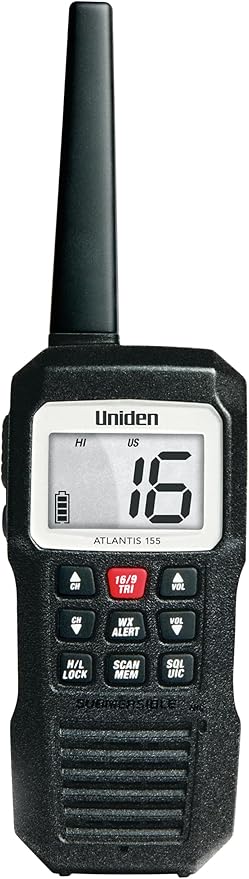
People who enjoy jetskiing and want a reliable, easy-to-use marine radio find the Atlantis 155 a great fit. Its main strength lies in its waterproof, floating design, making it perfect for staying connected and safe on the water with minimal fuss.
Getting started is straightforward since it uses standard AAA batteries, which last around 10 hours. The large LCD screen with day and night backlighting makes reading the display simple, even in bright sun or low light.
It fits comfortably in hand without being bulky, and its floating feature means you won’t lose it easily if dropped in the water.
Communication works well within its 15-kilometer range, providing clear VHF channels for typical marine use. The build feels tough and designed to meet high waterproof standards, handling submersion without damage and clearing water from the speaker after getting wet. A common mention is praise for its durability, though some find the 16-channel limit a bit restrictive.
The strongest praise lies in the radio’s waterproof, floating ability combined with a large, easy-to-read display that adapts to light conditions. Most common complaint focuses on the limited number of available channels, which can feel restrictive in busy marine areas.
This radio works well for jetski riders who want a simple, dependable model that can handle drops in the water without worries. Those needing more channels or a lighter power setup might look for alternatives better suited to those requirements.
Pros
- Floats on water with waterproof design
- Large, clear LCD screen with day/night backlight
- Long battery life with standard AAA batteries
- Compact handheld shape for easy use
Cons
- Only 16 channels available
- Requires four AAA batteries, adding to carry weight
| Specification | Details |
|---|---|
| Number of Channels | 16 |
| Battery Average Life | 10 hours |
| Water Resistance Level | Waterproof (IPX8 / JIS8) |
| Talking Range Maximum | 15 kilometer |
| Number of Batteries | 4 AAA batteries required (included) |
9. Uniden MHS75 Waterproof Handheld VHF Marine Radio

Designed to handle wet and rough conditions, the Uniden MHS75 Waterproof Handheld VHF Marine Radio fits perfectly for jetski riders who need reliable communication without worrying about water damage. Its standout feature is the full JIS8 waterproof rating, making it ready for splash, spray, or even temporary submersion underwater.
Setting up is straightforward with just one AA battery required and included. Day-to-day use is simple thanks to its switchable power levels ranging from 1 to 5 Watts, letting you manage transmission range and conserve battery life.
The 16 channels cover essential marine frequencies, so you remain connected while out on the water. Lightweight with a floating design, it won’t sink if dropped during a ride.
Communication stays clear within a maximum talking range of about 15 kilometers, giving confidence for both short and longer distances. The radio feels solid and built tough to last through regular use in harsh environments.
Praise often centers on its waterproof durability and talk range, while some note that having just one battery might limit longer trips without spares.
The unit’s waterproof rating and floating capability get consistent praise for delivering dependable communication even after drops into water. The most mentioned drawback involves the single included AA battery, which can limit continuous use without bringing extras along.
Adventure seekers on jetskis who prioritize durability and dependable water resistance will appreciate this model. Users needing longer battery life or more powerful transmission might prefer a model with rechargeable or multiple batteries and higher wattage options.
Pros
- Fully waterproof with JIS8 certification
- Floating design prevents loss in water
- Adjustable power saves battery life
- Simple with 16 essential channels
Cons
- Only one battery included, limited battery life
- Power output maxes at 5 Watts only
| Specification | Details |
|---|---|
| Water Resistance Level | Waterproof (JIS8) |
| Number of Channels | 16 |
| Talking Range Maximum | 15 kilometer |
| Power Output | 1 / 2.5 / 5 Watts switchable |
| Battery Type | 1 AA battery (included) |
| Floating Design | Yes |
10. Standard Horizon HX891BTBK Marine VHF Radio

Standard Horizon HX891BTBK Marine VHF Radio stands out for its reliable communication and waterproof design, ideal for jetski riders who need clear and durable marine radio access. It suits anyone looking for a compact, Bluetooth-enabled device that handles typical marine safety demands confidently.
Setup is straightforward, with Bluetooth connectivity making it easy to pair with compatible two-way radios and accessories. Its lightweight size fits comfortably during rides, and the waterproof feature assures it holds up against splashes and wet conditions.
Channels are plentiful at 66, letting you access all necessary marine frequencies without fuss.
Performance on the water proves solid, with clear VHF reception and a talking range suitable for close proximity communication, capped at 6 feet for Bluetooth use. The lithium-ion battery offers stable power at 7.4 volts direct current. The radio’s build feels durable, fitting the needs of rugged marine use.
Users often praise its waterproofing, while some find the Bluetooth talking range somewhat limited.
Waterproofing and Bluetooth connectivity earn strong praise for handling marine conditions well, though many notice the Bluetooth talking range limits communication distance. The device fits well into active marine lifestyles.
Jet ski riders needing a durable, easy-to-connect radio will appreciate this model. Those wanting longer Bluetooth range or multi-battery options might consider alternatives better suited for extended communication.
Pros
- Waterproof design suits marine environments
- Bluetooth for hands-free connectivity
- Compact and lightweight for jetski use
- Access to 66 marine channels
Cons
- Bluetooth talking range limited to 6 feet
- Single battery requires recharging
| Specification | Details |
|---|---|
| Number of Channels | 66 |
| Bluetooth Connectivity | Yes |
| Talking Range Maximum | 6 feet |
| Voltage | 7.4 volts of direct current |
| Water Resistance Level | Waterproof |
| Batteries Required | 1 Lithium Ion battery |
11. Icom M94D VHF Marine Transceiver with DSC & AIS

Easy to hold and operate on a jetski, this marine radio suits riders wanting strong safety features in a compact design. Its built-in AIS receiver stands out, helping you track nearby vessels right on the screen and making emergency calls quick and straightforward.
Setup involves charging the 2400 mAh Li-ion battery and turning on the device to get GPS navigation going. You can easily save waypoints to guide your route and hear clear calls through the loud 1500 mW speaker, even over engine noise or wind.
Noise reduction keeps static low, so conversations stay understandable during your trips.
The radio transmits at 6 W power, offering a reliable talking range of up to 5 miles. Waterproof construction means it handles splashes and rain without trouble.
Reviews highlight that audio clarity is impressive, while some find the number of channels limited at just four. It feels solid but lightweight enough for handheld use.
The standout feature is the clear and loud audio output which helps maintain good communication even in noisy environments. A frequent complaint revolves around the limited number of channels, which may restrict communication options for some users.
Anyone prioritizing safety through AIS and long battery life will find this radio helpful on their jetski. Those needing more communication channels might want to consider alternatives with broader frequency options.
Pros
- Built-in AIS receiver for safer navigation
- Long battery life of up to 10 hours
- Very loud 1500 mW speaker for clear audio
- Simple GPS navigation with waypoint saving
Cons
- Only 4 channels available for communication
- Requires 1 AAA battery alongside Li-ion battery
| Specification | Details |
|---|---|
| Number of Channels | 4 |
| Power Output | 6 W |
| Battery Capacity | 2400 mAh Li-ion (BP-306) |
| Talking Range Maximum | 5 mile |
| Audio Output | 1500 mW |
| Water Resistance Level | Waterproof |
12. Retevis RM01P Marine VHF Radio

Lightweight and simple to operate, the Retevis RM01P Marine VHF Radio is great for anyone who needs reliable communication while out on rivers or lakes. Its standout feature is the floating design, which ensures it doesn’t sink if dropped in water, making it a practical choice for jetski riders and water sports enthusiasts.
Setting up the radio is straightforward with a belt clip and lanyard for easy carrying and one-handed use. With 88 channels and a 15-hour battery life, it stays ready for long outings.
The weather alert function adds a safety layer by keeping you informed of changes while you’re on the water. The IP67 rating means it handles splashes and even brief immersion without trouble.
It performs well in maintaining clear communication through its 3.5W transmit power. The build quality stands up to rough use, being dust-tight and resistant to rain. Users appreciate its floating capability and the ease of grip and operation.
Complaints mostly mention the radio’s power output as lower compared to higher watt models, which may affect range in some situations.
The floating design is highly valued, providing a clear advantage when the radio accidentally goes overboard. A frequent downside cited is the moderate transmit power, which can limit communication range compared to stronger models.
Anyone needing a straightforward marine radio for rivers and lakes will find this a dependable option. Those requiring greater transmission distance or battery standardization might consider looking at radios with higher power and common battery types.
Pros
- Floats if dropped in water
- Lightweight and easy one-hand operation
- Weather alert feature included
- Long 15-hour battery life
Cons
- Transmit power lower than some alternatives
- Uses a nonstandard battery type
| Specification | Details |
|---|---|
| Number of Channels | 88 |
| Transmit Power | 3.5W |
| Water Resistance Level | IP67 Waterproof |
| Battery Average Life | 15 hours |
| Frequency Range | VHF |
13. Uniden MHS338BT Floating Handheld Marine VHF Radio

Rugged and designed to float, the Uniden MHS338BT is perfect for jetski enthusiasts who need a tough, waterproof marine radio. Its standout feature is the full 6-watt transmit power that guarantees strong communication even in rough water conditions.
Setup takes just minutes with the drop-in charging cradle and included Li-ion battery. Day-to-day use is simple thanks to automatic backlight switching that adjusts from white in daylight to amber at night. Integrated GPS lets you save locations, and Bluetooth connectivity with iPhones makes pairing convenient.
Staying updated is easy with NOAA weather alerts and FM radio built in.
Performance is solid with a maximum talking range of about 5 miles, helping keep you connected safely on the water. Its IPX8 submersion rating means it can handle being dropped in water without issue, and the floating design adds security. Most praise highlights its reliable signal and sturdy build.
Common complaints mention the limited 25 channels and the bulkiness compared to smaller radios.
Strong communication range and a rugged, waterproof design with float capability make it reliable in serious water environments. The limited channel selection and size are often noted as drawbacks, especially for those looking for something compact or more versatile in channel options.
Those needing a tough, high-power marine radio with essential features and GPS will appreciate this model. Users wanting a lightweight radio with a broader channel range might want to explore other options better suited to casual or competitive jetskiing.
Pros
- Floats on water, reducing loss risk
- Full 6 WATT transmit power for range
- Integrated GPS with position saving
- Automatic backlight adapts to light
Cons
- Only 25 channels available
- Larger and heavier than some competitors
| Specification | Details |
|---|---|
| Transmit Power | 6 WATT |
| Water Resistance Level | Waterproof |
| Number of Channels | 25 |
| Talking Range Maximum | 5 mile |
| Connectivity Protocol | Bluetooth |
| Batteries | 1 Product Specific (included) |
Best Marine Radios for Jetski Comparison Table
| Product | Channels | Waterproof Level | Max Talking Range | Battery Life |
|---|---|---|---|---|
| Cobra BlueBound 350 | 98 | Waterproof | 25 mile | 12 hours |
| Uniden UM385BK Radio | 40 | Waterproof | 25 mile | – |
| Icom M25EVO Blue | 15 | Water Resistant | 5 mile | – |
| Uniden UM435BK Radio | 40 | Waterproof | 36 mile | – |
| Standard Horizon HX210 | 200 | Waterproof | 5 mile | – |
| Uniden Atlantis 275 | 25 | Waterproof | 36 mile | – |
| Retevis RM15 Marine | 88 | IP68 Waterproof | 16 km | – |
| Uniden Atlantis 155 | 16 | Waterproof | 15 km | 10 hours |
| Uniden MHS75 Waterproof | 16 | Waterproof | 15 km | – |
| Standard Horizon HX891BTBK | 66 | Waterproof | 6 feet | – |
| Icom M94D DSC AIS | 4 | Waterproof | 5 mile | – |
| Retevis RM01P | 88 | Waterproof (IP67) | – | – |
| Uniden MHS338BT Floating | 25 | Waterproof | 5 mile | – |
- Channels98
- Waterproof LevelWaterproof
- Max Talking Range25 mile
- Battery Life12 hours
- Channels40
- Waterproof LevelWaterproof
- Max Talking Range25 mile
- Battery Life–
- Channels15
- Waterproof LevelWater Resistant
- Max Talking Range5 mile
- Battery Life–
- Channels40
- Waterproof LevelWaterproof
- Max Talking Range36 mile
- Battery Life–
- Channels200
- Waterproof LevelWaterproof
- Max Talking Range5 mile
- Battery Life–
- Channels25
- Waterproof LevelWaterproof
- Max Talking Range36 mile
- Battery Life–
- Channels88
- Waterproof LevelIP68 Waterproof
- Max Talking Range16 km
- Battery Life–
- Channels16
- Waterproof LevelWaterproof
- Max Talking Range15 km
- Battery Life10 hours
- Channels16
- Waterproof LevelWaterproof
- Max Talking Range15 km
- Battery Life–
- Channels66
- Waterproof LevelWaterproof
- Max Talking Range6 feet
- Battery Life–
- Channels4
- Waterproof LevelWaterproof
- Max Talking Range5 mile
- Battery Life–
- Channels88
- Waterproof LevelWaterproof (IP67)
- Max Talking Range–
- Battery Life–
- Channels25
- Waterproof LevelWaterproof
- Max Talking Range5 mile
- Battery Life–
How to Choose the Best Marine Radio for Jetskis
Choosing the right marine radio for jetskis depends on durability, water resistance, and clear communication range to ensure safety on the water. Prioritizing these factors helps you steer clear of costly replacements and communication issues, making your outings safer and more convenient.
Portability and Size
Mounting a radio on a jetski means dealing with very limited space and movement. Radios that are bulky or heavy can throw off balance and make handling the jetski awkward, especially in rough water.
A compact device fits easily without getting in the way and doesn’t affect how the jetski handles during sharp turns or quick maneuvers. Weight also matters; a heavy radio feels top-heavy and can even shift while riding, which is distracting and unsafe.
Devices with waterproof casings rated to at least IPX7 or IPX8 are common since water splashes and rain are inevitable during use. This protection ensures the radio keeps working even when soaked or briefly submerged. Size-wise, models around 6 to 8 inches long and weighing under a pound work well on most jetskis without needing extra mounting modifications.
Transmission Power and Range
Strong communication ability becomes critical when far offshore or in poor weather. Radios with transmission power around 25 watts provide clear signals up to 20 miles or more, which is essential for calling help or staying in touch with other vessels. Lower power radios might cut out or sound scratchy, especially during fog or storms.
Consistent signal strength also depends on antenna quality and tuning. Some radios offer long-range capability that doesn’t dip even when the weather worsens, an important feature for safety.
Lack of good range might leave you unable to reach shore or emergency operators exactly when you need it most.
Battery Life and Power Options
Batteries that die mid-trip cause real problems, especially during long rides or unexpected waits on the water. Most popular models offer at least 8 to 10 hours of continuous use on a full charge, enough to cover an average day on a jetski without panic about running out of power. Rechargeable batteries add convenience but sometimes take a full day to recharge fully.
Some designs accept replaceable AA or lithium-ion batteries, offering flexibility if recharging isn’t possible right away. Energy-efficient radios maximize operating time by reducing power draw during standby or low usage.
Having both recharge and replace options is a practical feature during multi-day rides.
Ease of Use and Interface
Controls should work reliably even with wet or gloved hands since riders often don’t have dry fingers to tap tiny buttons. Bigger knobs, raised buttons, or rubberized keys help with this. Display visibility under direct sunlight can make or break quick reading of channel info or battery life; dim or small screens cause squinting and mistakes.
Emergency channels must be accessible with a single button press. Many marine radios feature dedicated SOS keys or programmable shortcuts for distress calls. A straightforward interface means less fumbling when time is critical, making operating the device safer and smoother on the move.
Durability and Safety Features
Hits, drops, and saltwater exposure are common hazards for any jetski-mounted device. Radios built with shock-resistant materials and corrosion-proof metal parts stand up to this abuse longer without failures. Plastic housings alone often don’t last.
Builtin distress features like DSC (Digital Selective Calling) or SOS signals add a vital safety layer by automatically sending alerts with GPS location. Mounts that secure the radio firmly prevent it from falling off during rough rides or jumps.
Losing the radio at speed can leave a rider stranded without communication.
- Impact-resistant casing
- Corrosion-proof finish
- DSC or SOS distress alerts
- Strong mounting brackets
Effective Communication Techniques for Jetski Safety Using Marine Radios
Strong communication is critical when riding a jetski, especially in busy or remote waters. Marine radios usually operate on VHF channels, allowing clear contact with nearby vessels and coast guards. Most models include channel 16, the international distress, safety, and calling frequency.
Keeping your radio within reach and knowing how to switch channels quickly can prevent dangerous situations. Using a push-to-talk button allows instant broadcasting, but make sure to release it promptly to listen.
Weather channels provide updates that can influence your outing, so tuning in occasionally is smart. Proper volume levels help hear incoming messages even against engine noise.
Key tips:
- Test your radio before heading out to confirm it transmits and receives.
- Inform someone onshore of your planned route and radio check-in times.
- Practice clear and concise communication, stating your location and nature of message.
- Keep your radio waterproof or stored in a protective case safe from water splash.
Maintaining and Troubleshooting Your Marine Radio for Long-Term Reliability
Routine maintenance is essential to keep a marine radio functioning reliably over time. Saltwater environments promote corrosion, so wiping exterior surfaces with fresh water after use helps prevent damage. Inspect antenna connections regularly to avoid loose fittings that reduce signal strength.
Batteries need checking and replacing periodically; most handheld marine radios use rechargeable batteries that can lose capacity over several seasons. Store the radio in a dry, cool place when not in use to avoid moisture buildup inside components.
Firmware updates may be available for some models and can fix bugs or improve performance, refer to the manufacturer’s instructions.
Troubleshooting basics:
- Check if the radio powers on; faulty batteries often cause failure.
- Verify the antenna is correctly attached and undamaged.
- Test reception in different locations to rule out interference.
- Reset to factory settings if random issues occur.
- Contact professional service for persistent problems beyond user fixes.
Comparing Handheld vs. Fixed Marine Radios: Which Is Best for Jetski Riders?
Handheld and fixed marine radios serve different needs for jetski riders. Handheld radios offer portability and flexibility; you can carry them around easily, which is handy if you want to communicate off the jetski or use the radio on shore.
They are typically waterproof and compact, designed to survive exposure to water and rough treatment. Fixed radios mount directly on the jetski and usually have higher power output than handhelds, enabling longer communication ranges. Their antennas are often larger, improving signal quality in open water.
The choice depends on how you use the jetski. A handheld radio suits riders who want a simple, lightweight device that stays with them at all times. Fixed radios are better for frequent and longer-distance communication but require installation and take up space.
Many riders carry both, using the fixed radio as primary communication and the handheld as backup or for flexibility.
People Also Asked
How Do I Choose the Right Marine Radio for My Jetski?
Select a marine radio with waterproof ratings and compact size suitable for your jetski. Check for easy mounting options and clear audio, which are important since you’ll need to hear communications over engine noise. Choosing a radio with at least 25 watts output ensures good range in open water.
What Is the Typical Battery Life of a Marine Radio on Jetskis?
Marine radio battery life on jetskis generally lasts 8 to 12 hours depending on usage and power settings. Radios with built-in rechargeable batteries are convenient but always carry a backup or charging method for longer rides. Turning the radio off when not needed helps conserve power.
Are Marine Radios Waterproof and Durable Enough for Jetski Use?
Marine radios designed for jetskis typically have waterproof and impact-resistant casings to withstand water spray and vibrations. Look for radios with IPX7 or higher water resistance ratings to ensure they can handle being splashed or briefly submerged. Avoid cheaper radios lacking these protections.
How Do I Properly Install a Marine Radio on My Jetski?
Securely mount the radio in a location that is both easy to access and protected from direct water impact. Use brackets designed for marine use and make sure all connections are sealed against moisture. Routing the antenna where it won’t get bent or broken during riding is also critical.
What Common Issues Should I Watch for with Jetski Marine Radios?
Common problems include water damage through poorly sealed connections and antenna damage from jetski crashes or falls. Interference from engine noise can affect clarity, so check for radios with noise-canceling features. Regularly inspect and clean contacts to prevent corrosion.
Conclusion
Choosing the right marine radio for a jetski means focusing on a few key things. The radio should be easy to operate with gloves, have good weather resistance, and offer clear communication. A compact size helps since space is limited on a jetski, and the radio needs to be durable enough for exposure to water and sun.
Consider how much space you have for mounting and how often you plan to use the radio, as that will guide your budget and feature needs. Check the comparison table and the detailed picks above to find a model that fits your specific setup and rides.
Picking one that matches your daily use will make it more reliable on the water.