Top 13 Best Low Cost Emergency Radio You Can’t Miss!
Many emergency radios might seem affordable at first but end up letting you down right when you need them most, like draining batteries too fast or being too bulky to carry during an evacuation. Finding the best low cost emergency radio means avoiding radios that break easily or have poor signal reception, which can be a common issue with cheaper models in emergency situations.
A reliable low cost emergency radio should have multiple power options, such as hand cranks, solar panels, and battery backups, to keep it running without access to standard power. Durable construction with water-resistant casings is essential, especially ones meeting at least an IPX4 rating for splash resistance.
Also, compact size and lightweight design matter for portability, usually aiming for something under 10 ounces and fitting comfortably in a small backpack or emergency kit.
Need a Quick Check?
| Image | Product | Price |
|---|---|---|
Our Top Picks 1  | Generic Portable AM/FM Radio | Check Price |
Our Top Picks 2  | Emergency Solar Hand Crank Radio | Check Price |
Our Top Picks 3  | PRUNUS J-166 AM/FM Radio | Check Price |
Our Selected Top 13 Low Cost Emergency Radio Picks for Every Need
This list features reliable emergency radios that offer essential functions without breaking the bank. Each review covers performance details, ideal users, and highlights strengths and weaknesses to help you find the most suitable option for your specific needs and situations.
1. Portable AM/FM Transistor Radio
Plastic casing and a compact design make it a practical choice for those wanting a reliable emergency radio without spending much. It works well for anyone looking to catch AM, FM, and shortwave broadcasts in a single device.
Its main strength is the DSP anti-jamming chip that improves signal sensitivity across wide frequency ranges.
Setup is straightforward since it comes with a rechargeable lithium-ion battery and charges via USB, which means no need to hunt for batteries constantly. The telescopic antenna extends easily for better reception, and switching between AM, FM, and SW bands happens with a dial.
The LED and LCD display give clear feedback on frequency, making tuning simple even in low light. Listening to news or music is clear thanks to the built-in 5W speaker.
Reception quality stands out as the strongest point, picking up ultra-wide signals effectively, but it lacks water resistance, so care is needed in damp environments. The build feels solid for a low-cost radio, though it’s mostly plastic and fairly lightweight, which suits portability, though it might not withstand heavy drops.
Clear sound is praised, but some might find the speaker volume a bit low for noisy settings.
Reception across AM, FM, and shortwave bands performs very well thanks to the DSP anti-jamming chip, providing solid signal strength in various environments. The most common complaint involves the speaker volume, which can be insufficient in louder surroundings, limiting outdoor listening comfort.
Ideal for anyone wanting a versatile emergency radio with reliable signal pickup and rechargeable convenience. Those needing tougher outdoor durability or louder audio might want to look at radios with water resistance or stronger speakers instead.
Pros
- Wide frequency reception including shortwave
- Rechargeable battery with USB charging
- Clear sound from 5W speaker
- Compact and portable design
Cons
- Not water resistant for outdoor use
- Speaker volume may be low in noisy areas
| Specification | Details |
|---|---|
| Power Source | Battery Powered |
| Number of Batteries | 1 Lithium Ion batteries required. (included) |
| Radio Bands Supported | 4-Band (AM/FM/SW1/SW2) |
| Frequency | 108 MHz |
| Connectivity Technology | USB |
| Additional Features | Rechargeable |
2. Emergency Solar Hand Crank AM/FM Weather Radio
High-sensitivity reception stands out right away, making this radio a solid choice for those needing reliable emergency updates. It works well for outdoor activities where power isn’t guaranteed, relying on hand-crank or battery operation. Its biggest strength lies in staying connected during power outages or remote adventures.
Setting it up is straightforward, and it’s ready to go as soon as you pull out the telescopic antenna. Daily use involves switching between AM and FM bands, with the option to charge via hand crank or USB.
The compact size and portable design make it easy to carry on hikes or camping trips. Hearing alerts through the SOS alarm adds another layer of safety.
The radio delivers clear sound quality and dependable reception, even in areas with weak signals. It handles both AM and FM with stable output power at 5 watts.
Built with waterproof features and a sturdy design, it feels solid in hand. One downside noted is the single AAA battery, which might need frequent replacement compared to rechargeable options.
Many appreciate the radio’s reliable reception and durability in tough conditions, especially with its waterproof casing and hand-crank feature. Commonly mentioned drawbacks include the reliance on a single AAA battery which might not last during extended use.
People needing a lightweight, dependable emergency radio for camping or power outages will find this model suitable. Those looking for longer battery life or a wider frequency range may want to explore other options.
Pros
- Clear sound and strong reception with DSP chip
- Includes hand crank and USB charging options
- Waterproof design adds durability outdoors
- Compact and easy to carry
Cons
- Uses one AAA battery which may drain quickly
- Limited frequency range at 20 hertz
| Specification | Details |
|---|---|
| Power Source | Battery Powered |
| Speaker Maximum Output Power | 5 watts |
| Tuner Type | AM/FM |
| Additional Features | Hand Crank, Portable, Rechargeable, SOS Alarm, Waterproof |
| Hardware Interface | Radio Frequency |
| Voltage | 3.7 volts |
3. PRUNUS J-166 Portable AM/FM Radio
Small size and portability make it a top option for anyone needing a basic emergency radio. It fits easily in an emergency kit and can be clipped or hung, which suits those who want something lightweight and practical. The main strength is how easy it is to carry during everyday activities or emergencies.
Setup requires just two AA batteries, and the mechanical tuning dial keeps things straightforward without confusing menus. Day-to-day use is simple thanks to the back clip and lanyard, allowing hands-free carrying during exercises or walks.
The radio supports AM and FM bands, and its auxiliary 3.5mm jack extends compatibility to headphones when privacy or better sound is needed.
Reception on both AM and FM is clear enough for casual listening, though it depends on location and antenna positioning. The build keeps it lightweight and shockproof, ideal for portable use, but the lack of water resistance means extra care is needed outdoors.
The biggest praise is its portability and straightforward design; the most common complaint relates to the absence of water resistance.
Portability receives strong praise making it easy to carry anywhere, but many find the lack of water resistance limiting for outdoor conditions. The simple design appeals to users wanting a no-fuss experience, although manual tuning may feel outdated to some.
People who want a straightforward, lightweight radio for casual listening or emergency kits will appreciate the design and features. Those needing water protection or digital tuning might consider other options that better fit those specific needs.
Pros
- Compact and lightweight design
- Easy mechanical tuning
- Comes with clip and lanyard
- Compatible with headphones
Cons
- Not water resistant
- Requires manual tuning
| Specification | Details |
|---|---|
| Dimensions | 2.7 x 5 x 1.1 inch |
| Weight | 4.2 oz (without batteries) |
| Radio Bands Supported | AM/FM |
| Power Source | 2 AA batteries |
| Audio Output Mode | Stereo |
| Hardware Interface | 3.5mm Audio |
4. DreamSky AM/FM Portable Radio

During a power outage or when camping out in a remote spot, having a reliable radio can make a big difference. Well-suited for seniors and anyone needing a low-cost emergency radio, it shines with its strong reception that works even in isolated areas, ensuring you stay connected to AM/FM signals without constant interference.
Setting it up is straightforward; just plug it in or insert four AA batteries. The large analog dial makes tuning quick and easy, so you can find your favorite stations like news, sports, or music without any fuss. The earphone jack is handy for private listening, helping you enjoy broadcasts without disturbing others.
The radio delivers clear, loud sound through a big speaker, cutting down on static or cross-talk even when you’re far from cities. It’s built simply but reliably, focusing on function over frills. A number of reviews highlight its dependable reception as a strong point, although a few mention the analog dial can feel a bit imprecise while tuning.
Many appreciate the radio’s ability to pull in AM/FM signals clearly with little static, which is great for uncertain reception areas. The tuning dial can be a bit tricky to fine-tune, often requiring several attempts to lock onto the right frequency.
People wanting a straightforward, budget-friendly emergency radio that works well off-grid will find this meets those needs. Those looking for digital precision in tuning or longer-lasting battery life might want to explore other options.
Pros
- Strong reception even in remote areas
- Clear and loud sound output
- Simple large analog tuning dial
- Supports battery and AC power
Cons
- Analog dial tuning can be imprecise
- Requires four AA batteries for portable use
| Specification | Details |
|---|---|
| Radio Bands Supported | AM/FM |
| Power Source | AC Plug & Battery Powered |
| Number of Batteries | 4 AA batteries required |
| Frequency | 108 MHz |
| Hardware Interface | 3.5mm Audio (earphone jack) |
| Voltage | 110 volts |
5. Kaito Voyager Pro KA600 Emergency AM/FM Weather Radio

Covering AM, FM, LW, and SW bands along with NOAA weather channels, this radio suits those wanting reliable alerts during severe weather. Its wide range of frequencies ensures you stay informed no matter your location, making it a great companion for camping or emergencies.
Setup involves inserting 3 AA batteries or connecting via USB for power, which keeps it flexible. The digital tuning and LED display make finding stations straightforward, while the built-in flashlight and reading lamp help during dark conditions. Its compact, water-resistant body makes it easy to carry around daily or on outdoor trips without worry.
Performance is solid with clear reception across seven bands and dependable weather alerts. The radio feels sturdy and well-built despite its light weight. Most appreciate the bright flashlight feature, but some note that it requires frequent battery changes if USB power isn’t always available.
Many enjoy the clear reception across multiple bands and appreciate the flashlight’s brightness, making it useful for emergencies. At the same time, frequent battery replacements without USB power can become inconvenient.
Anyone needing a lightweight, broad-band emergency radio with good lighting features will find this useful. Folks wanting a rechargeable battery built-in or who dislike changing AA batteries often might look elsewhere.
Pros
- Covers AM/FM/LW/SW and NOAA channels
- Bright built-in flashlight and reading lamp
- Compact and water resistant for outdoor use
- Easy digital tuning with visible LED screen
Cons
- Battery usage can be frequent without USB power
- No separate rechargeable battery included
| Specification | Details |
|---|---|
| Tuner Type | AM, FM |
| Radio Bands Supported | 7-Band |
| Power Source | Corded Electric |
| Number of Batteries | 3 AA batteries required |
| Display Type | LED |
| Connectivity Technology | USB |
6. XHDATA D221 NOAA Weather AM/FM Shortwave Radio

People looking for a compact, easy-to-carry emergency radio that covers multiple bands will like this one. It works well for staying updated on weather alerts and listening to AM, FM, and shortwave stations during outdoor activities or power outages. Its small size and lightweight design stand out as its biggest advantage.
Setting it up is simple since it only requires two AA batteries, which keep it powered without much fuss. The radio fits comfortably in a pocket or handbag, making it handy to carry around. Tuning in to different bands like FM, AM, shortwave, and NOAA weather is straightforward thanks to a built-in AM antenna and clear controls.
It also connects to headphones or other devices via a 3.5mm jack for private listening.
Signal reception is solid across all supported bands, especially for the FM and NOAA weather frequencies. Built to be lightweight and portable, it’s easy to handle and doesn’t weigh down your bag.
The most praised feature is its excellent reception despite the small form factor. On the downside, it has no water resistance, meaning extra caution is needed in wet conditions. Common feedback also points out that the sound quality can be basic, which is expected given its size and price.
The strongest praise highlights how well the radio picks up signals despite its small size, making it reliable for emergency updates and general listening. The main complaint centers on the lack of water resistance, which means users must keep it dry to avoid damage.
This radio suits people who want a lightweight, pocket-friendly device for quick access to weather and radio stations. Those needing a more rugged or water-resistant option should consider alternatives better designed for harsh outdoor conditions.
Pros
- Compact size and lightweight for easy portability
- Good signal reception across multiple radio bands
- Simple controls and easy tuning
- Works with headphones and other devices
Cons
- No water resistance for outdoor use
- Sound quality is basic and not very loud
| Specification | Details |
|---|---|
| Radio Bands Supported | 4-Band (FM, AM, SW, NOAA) |
| Power Source | 2 AA batteries required |
| Size | 125*74*30mm |
| Weight | 125g (without batteries) |
| Hardware Interface | 3.5mm Audio |
7. AM/FM Shortwave Radio with NOAA Weather Alert

Designed to catch radio signals across four bands, this AM/FM Shortwave Radio with NOAA Weather Alert is great for anyone needing dependable access to emergency broadcasts on a budget. It stands out for picking up faint stations clearly while keeping you informed with real-time weather alerts from NOAA.
Getting started is straightforward: it runs on a rechargeable lithium polymer battery and connects easily to headphones or external speakers via Bluetooth or a 3.0 USB Type C port. The built-in flashlight and SOS alarm add practical emergency functions, and a digital display helps you switch between AM, FM, shortwave, and weather bands quickly.
The sleep timer is a thoughtful feature for nighttime listening.
This radio performs solidly with a 5-watt stereo speaker, delivering crisp sound across difficult-to-reach frequencies thanks to an advanced DSP chip. The casing feels durable for a portable unit, though some find the size a bit bulky. Many appreciate its clear reception and easy alerts, while the most frequent complaint concerns battery life, which can run short under heavy use.
Solid reception across multiple bands and handy weather alerts make it trusted during unexpected situations. Battery life is the most common drawback, so frequent recharging will be necessary for continuous operation.
Ideal for those prioritizing broad radio coverage and emergency features in one device. People wanting a lighter, longer-lasting radio may want to look elsewhere.
Pros
- Supports 4 radio bands including shortwave and weather
- Rechargeable lithium polymer battery included
- Built-in flashlight and SOS alarm for emergencies
- Bluetooth connectivity for external devices
Cons
- Battery life can be limited with extended use
- Slightly bulky design for carrying around
| Specification | Details |
|---|---|
| Radio Bands Supported | 4-Band, AM/FM/SW/WB, Shortwave |
| Power Source | Battery Powered (1 Lithium Polymer battery included) |
| Connectivity Technology | Bluetooth |
| Hardware Interface | USB 3.0 Type C |
| Speaker Maximum Output Power | 5 watts |
8. WALFRONT Emergency Solar Hand Crank AM/FM Weather Radio

WALFRONT Emergency Solar Hand Crank AM/FM Weather Radio suits anyone needing a reliable low-cost emergency radio with flexible charging options. Its biggest strength lies in its triple charging methods, solar, hand crank, and Type C, making it a solid choice for power backup in outages or outdoor activities.
Setting up the radio is straightforward, with a clear battery indicator showing power levels at 25, 50, 75, and 100 percent. Charging can be done through a USB-C port, by cranking the handle, or leaving it in the sun.
Day-to-day use includes tuning into AM, FM, and weather band channels to stay updated on conditions during emergencies or travel.
This radio delivers consistent reception on AM and the weather band, ensuring important broadcasts come through clearly. It’s built with a 2000mAh battery that also works as a power bank for small USB-C devices. Most praise focuses on the dependable backup power options, while some users find the crank charging labor-intensive during extended use.
The strongest positive is the flexibility in charging with solar, USB-C, and hand crank options, which ensures power during outages or outdoor use. The common complaint centers around hand cranking, which can become physically demanding if used extensively.
People needing a compact radio with multiple charging choices for emergency preparedness or outdoor trips will find good value here. Those wanting multi-band radio support or less physical effort during manual charging might consider other models.
Pros
- Three charging methods: solar, USB-C, and hand crank
- Battery indicator shows 25-100 percent power levels
- Acts as a power bank for USB-C devices
- Supports AM, FM, and weather band channels
Cons
- Hand crank charging can be tiring over time
- Only one radio band supported technically
| Specification | Details |
|---|---|
| Power Source | AC/DC |
| Connectivity Technology | Ethernet |
| Tuner Type | AM |
| Radio Bands Supported | 1-Band |
| Battery Capacity | 2000mAh |
9. Ready America 70801 Emergency Power Station

Living with a hand-crank emergency power station makes you appreciate a device that charges your phone and provides light without relying on batteries. Perfect for anyone wanting a straightforward, low-cost radio that’s ready when the power goes out.
Its biggest strength is the hand crank that charges everything on demand without hassle.
Using it feels simple: just a minute of cranking delivers enough power for up to half an hour of light or 15 minutes on the radio. The built-in flashlight is handy during nighttime outages, and the multiple plugs cover older iPhones and common USB devices. No setup beyond grabbing it off the shelf, just turn the crank when you need power, no batteries to worry about.
Performance is solid for emergencies, providing reliable AM/FM reception with an easy-to-read LED display. The sturdy plastic build feels durable, but it’s not water resistant, which might matter in some situations.
Most high praise focuses on how the hand crank works well without batteries; the main complaint centers on the relatively short talk time it provides after cranking.
One minute of cranking yielding 30 minutes of light or 15 minutes on the radio is well appreciated for quick emergency power. However, the two-minute talk time for cell phones can feel limiting when trying to conserve power during long outages. The device’s lack of water resistance is also a notable downside in harsher environments.
Those needing a simple, no-fuss emergency radio with flashlight and phone charging will find this suits their needs well, especially for indoor use. Folks who expect longer phone use or require a device for outdoor or wet conditions might want to explore more rugged or higher-capacity options instead.
Pros
- No batteries needed thanks to hand crank
- Multiple plugs including USB and Mini-USB
- Four functions in one device
- Simple to use during power outages
Cons
- Short cell phone talk time after cranking
- Not water resistant for outdoor use
| Specification | Details |
|---|---|
| Power Source | hand_powered |
| Radio Bands Supported | AM/FM |
| Connectivity Technology | USB |
| Frequency | 108 MHz |
| Built-In Flashlight | Yes |
| Compatibility | Smartphone |
10. Ambient Weather WR-77 Emergency Radio

Compact and easy to carry, the Ambient Weather WR-77 works well for anyone wanting a reliable emergency radio without spending much. Its best feature is the ability to charge smartphones using standard AA batteries, which keeps it ready for unexpected power needs.
Packing the radio into a coat or shirt pocket is easy thanks to its small size and light weight. It tunes into AM, FM, and WeatherBand stations, keeping you updated with essential broadcasts. Charging your phone is simple through the USB port, powered by regular alkaline batteries, so no special chargers are needed.
Just pop in fresh batteries whenever you want to stay prepared.
The radio picks up all its supported frequencies clearly and the LED display is easy to see. Most people say it’s sturdy enough for daily carry and emergency use, though some mention the sound volume isn’t very loud at maximum.
The sturdy build makes it tough enough for a glove compartment or bag, while the plastic case feels solid but not heavy.
The radio reliably charges smartphones on the go powered solely by regular AA batteries, which users appreciate for emergency readiness. Common complaints focus on the volume level being quieter than expected during use in noisy environments.
Those prioritizing lightweight portability and basic emergency functions will find it suits their needs well. People wanting stronger sound output or rechargeable batteries might prefer to look for alternate radios with those features.
Pros
- Compact and easily portable
- Charges smartphones via USB
- Uses standard AA batteries
- Accesses AM, FM, and WeatherBand
Cons
- Sound volume isn’t very loud
- No rechargeable battery option included
| Specification | Details |
|---|---|
| Connectivity Technology | USB |
| Tuner Type | AM, FM |
| Power Source | Battery Powered |
| Radio Bands Supported | AM, FM |
| Voltage | 5 volts |
| Display Type | LED |
11. PRUNUS J-150 Portable AM/FM SW Bluetooth Radio

Plastic and compact design make this radio easy to handle and carry, suited for anyone needing a low-cost emergency radio that charges in multiple ways. Its biggest strength lies in having three power options, making it reliable during power outages or outdoor activities.
Setup is straightforward with USB charging for daily use and a handy solar panel that collects energy outdoors. Two D batteries can be inserted for backup, which is especially useful during emergencies. Bluetooth connection allows streaming from smartphones or tablets, while the built-in AM/FM/SW tuners cover a wide frequency range.
The LCD display helps tune stations without much hassle.
Sound quality is decent for its size, with stereo audio output giving clear reception on AM and FM bands. Build quality feels durable though the plastic case shows some budget compromises. Users appreciate its multiple power sources, especially the solar panel.
The main drawback is that it is not water resistant, so caution is needed in wet conditions.
Multiple power options including solar charging attract praise for reliability on the move or during outages. Its main complaint revolves around lack of water resistance, meaning it cannot be safely used in damp or rainy conditions.
People who need a versatile and portable emergency radio suitable for dry environments will find value here. Those requiring rugged, weatherproof radios should look for models designed specifically for wet conditions.
Pros
- Three power supply options for flexibility
- Compact and lightweight with a handy carry handle
- Bluetooth 5 connectivity for external devices
- Includes rechargeable 1200mAh battery and solar panel
Cons
- No water resistance, so cannot be used in wet environments
- Requires two D batteries for backup, which are not included
| Specification | Details |
|---|---|
| Power Source | Solar Powered /Battery Powered/ USB Powered |
| Number of Batteries | 2 D batteries required. (included) |
| Connectivity Technology | Bluetooth |
| Radio Bands Supported | AM, FM |
| Display Type | LCD |
12. Emergency Solar Hand Crank NOAA Weather Radio

Impressive battery life stands out on this emergency solar hand crank NOAA weather radio, making it suitable for anyone wanting to stay informed and powered during blackouts or outdoor adventures. Its ability to receive weather alerts and provide emergency power is a big plus for home backup and survival kits.
Setting up the radio is straightforward, with multiple power options including solar panel, hand crank, USB-C input, and AAA batteries. Daily use benefits from a bright 5W flashlight and a 120dB SOS alarm that can be triggered in emergencies. AM, FM, and 7 NOAA weather channels keep you updated, while USB-A and Type-C output ports let you charge phones or other devices when power sources are scarce.
The radio performs consistently well in picking up clear NOAA weather updates and standard AM/FM stations. Its build is tough, featuring water-resistant (IPX6), dustproof, and shockproof qualities, perfect for rugged outdoor conditions. Praised most for its large 12000mAh rechargeable battery, the common complaint involves its size making it slightly bulky for compact emergency kits.
The biggest praise involves its massive battery which powers several functions beyond just the radio, while the most frequent complaint is about its bulkiness, making it less travel-friendly for those wanting ultra-light gear. The reliable alert system also earns steady appreciation.
People who need a durable, multi-function emergency radio with strong battery life will find it very useful. Those seeking a smaller, lighter option for backpacking might prefer a more compact model with fewer features.
Pros
- Large 12000mAh rechargeable battery lasts long
- Multiple power inputs: solar, crank, USB-C, AAA
- Strong 120dB SOS alarm for emergencies
- Water-resistant and shockproof for tough conditions
Cons
- Relatively bulky and heavy for small kits
- Hand crank requires effort to charge fully
| Specification | Details |
|---|---|
| Battery Capacity | 12000mAh Rechargeable Battery |
| Power Sources | Solar Panel | Hand Crank | 12000mAh Lithium Battery | USB-C Input 5V/2A | 3 AAA Batteries |
| Radio Bands Supported | 7-Weather Band, AM/FM/NOAA |
| Additional Features | 120dB SOS Alarm & 5W Flashlight |
| Water Resistance | IPX6 Water-Resistant |
13. NOAA Weather Hand Crank Solar Emergency Radio
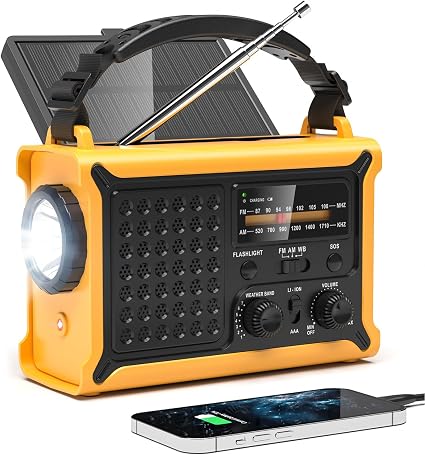
Reliable NOAA weather alerts and long-lasting backup power make this emergency radio a solid choice for anyone who wants to stay informed during outages. Best suited for those who need dependable AM/FM and weather station reception plus multiple ways to keep it charged.
Setting it up is straightforward; the radio tunes into 7 NOAA channels plus AM/FM bands right away. Daily use is easy with hand crank, solar panel, or USB charging options. Built-in flashlight and SOS alarm add practical features.
It also doubles as a phone charger, which is handy during extended emergencies.
The signal comes through clear thanks to a high-sensitivity chip and noise reduction, with a reasonable 5W speaker output. The built-in 12000mAh battery holds a solid charge for radios and devices alike. Some people notice the need to keep it tuned exactly to WB for alerts, and a few find the size a bit bulky for pocket carry.
Reception for NOAA weather channels is solid and clear thanks to a high-sensitivity chip and noise reduction, but alerts only come through when the radio is on and tuned to WB, which some users find inconvenient. The 12000mAh battery reliably powers the radio and phone charging for long periods.
Ideal for those who want a reliable emergency radio with multiple charging options and flashlight features. Not the best fit if you need a compact radio for easy portability or want alerts without tuning requirements.
Pros
- Multiple power sources including solar and hand crank
- Clear NOAA weather and AM/FM radio reception
- Built-in flashlight and SOS alarm for emergencies
- 12000mAh battery supports phone charging
Cons
- Must stay tuned to WB for NOAA alerts to work
- Size may be bulky for some users
| Specification | Details |
|---|---|
| Power Source | Hand Crank | Solar Panel | Type-C Input 5V/2A | 12000mAh Rechargeable Battery | 3*AAA Battery |
| Tuner Type | AM/FM/NOAA Weather Radio |
| Battery Capacity | 12000mAh rechargeable battery |
| Radio Bands Supported | FM:87.5-108 MHz / AM:520-1710 KHz / 7 NOAA Weather Band: 162.400-162.550 MHz |
| Speaker Output Power | 5 watts |
Best Low Cost Emergency Radios Comparison Table
| Product | Power Source | Radio Bands Supported | Additional Features | Connectivity Technology |
|---|---|---|---|---|
| Generic Portable AM/FM Radio | Battery Powered | 4-Band | Rechargeable | USB |
| Emergency Solar Hand Crank Radio | Battery Powered | AM/FM | Hand Crank, SOS Alarm, Waterproof | USB |
| PRUNUS J-166 AM/FM Radio | Battery Powered | AM/FM | Dust Resistant, Shockproof | Auxiliary |
| DreamSky Portable AM/FM Radio | Battery Operated | AM/FM | Strong Reception, Loud Sound | AM FM |
| Kaito Voyager Pro KA600 Radio | Corded Electric | 7-Band | Built-In Flashlight, Rechargeable | USB |
| XHDATA D221 NOAA Shortwave Radio | Battery Powered | 4-Band | Rechargeable, Portable | Auxiliary |
| NOAA Weather AM/FM Shortwave Radio | Battery Powered | 4-Band | Flashlight, SOS Alarm, Sleep Timer | Bluetooth |
| WALFRONT Solar Hand Crank Radio | AC/DC | 1-Band | Adjustable | Ethernet |
| Ready America 70801 Power Station | Hand Powered | AM/FM | Built-In Flashlight | USB |
| Ambient Weather WR-77 Radio | Battery Powered | AM/FM | Portable | USB |
| PRUNUS J-150 Bluetooth Radio | Solar/Battery/USB | AM/FM | Bluetooth Speaker, Solar Panel | Bluetooth |
| Solar Hand Crank NOAA Radio | – | AM/FM | SOS Alarm, Water-Resistant | USB |
| NOAA Solar Hand Crank Radio | Hand Crank/Solar/Battery | AM/FM/NOAA | Flashlight, SOS Alarm | Auxiliary, USB |
- Power SourceBattery Powered
- Radio Bands Supported4-Band
- Additional FeaturesRechargeable
- Connectivity TechnologyUSB
- Power SourceBattery Powered
- Radio Bands SupportedAM/FM
- Additional FeaturesHand Crank, SOS Alarm, Waterproof
- Connectivity TechnologyUSB
- Power SourceBattery Powered
- Radio Bands SupportedAM/FM
- Additional FeaturesDust Resistant, Shockproof
- Connectivity TechnologyAuxiliary
- Power SourceBattery Operated
- Radio Bands SupportedAM/FM
- Additional FeaturesStrong Reception, Loud Sound
- Connectivity TechnologyAM FM
- Power SourceCorded Electric
- Radio Bands Supported7-Band
- Additional FeaturesBuilt-In Flashlight, Rechargeable
- Connectivity TechnologyUSB
- Power SourceBattery Powered
- Radio Bands Supported4-Band
- Additional FeaturesRechargeable, Portable
- Connectivity TechnologyAuxiliary
- Power SourceBattery Powered
- Radio Bands Supported4-Band
- Additional FeaturesFlashlight, SOS Alarm, Sleep Timer
- Connectivity TechnologyBluetooth
- Power SourceAC/DC
- Radio Bands Supported1-Band
- Additional FeaturesAdjustable
- Connectivity TechnologyEthernet
- Power SourceHand Powered
- Radio Bands SupportedAM/FM
- Additional FeaturesBuilt-In Flashlight
- Connectivity TechnologyUSB
- Power SourceBattery Powered
- Radio Bands SupportedAM/FM
- Additional FeaturesPortable
- Connectivity TechnologyUSB
- Power SourceSolar/Battery/USB
- Radio Bands SupportedAM/FM
- Additional FeaturesBluetooth Speaker, Solar Panel
- Connectivity TechnologyBluetooth
- Power Source–
- Radio Bands SupportedAM/FM
- Additional FeaturesSOS Alarm, Water-Resistant
- Connectivity TechnologyUSB
- Power SourceHand Crank/Solar/Battery
- Radio Bands SupportedAM/FM/NOAA
- Additional FeaturesFlashlight, SOS Alarm
- Connectivity TechnologyAuxiliary, USB
How to Choose the Right Low Cost Emergency Radio
Key factors like battery life, signal range, durability, and ease of use matter most when selecting a low cost emergency radio. Choosing the right features ensures reliable communication during emergencies, preventing extra expenses and headaches from frequent replacements or poor performance.
Power Source and Battery Life
Many emergency radios come with a mix of power options like solar panels, hand cranks, and battery compartments. Relying solely on batteries can be risky since they run out and may not be easy to replace during a crisis. Having a built-in solar panel or a hand crank provides alternative ways to keep the radio operational without external power.
Radios with a strong solar panel can last several hours after a full charge, while a hand crank usually offers a shorter burst of power, enough to catch critical broadcasts.
Rechargeable batteries add convenience but check how easy it is to swap out batteries. Some models use standard AA or AAA cells, which are easier to find and replace than custom rechargeable packs.
On average, battery life varies widely, yet a good device lasts at least 10-12 hours on continuous use when powered by batteries or solar. Being able to recharge via USB also helps if you have access to external power.
Signal Reception and Tuning
In areas with weak signals, radios that handle AM, FM, and NOAA frequencies with high sensitivity can make a big difference. Radios with digital tuning make it simpler to lock onto a frequency without constant manual tweaking, but manual tuning radios sometimes pick up faint signals better through fine adjustments.
Signal clarity often drops indoors or in rough terrain, so a device with an external antenna or strong reception components works better.
Reception range varies according to antenna quality and tuner design. Many radios capture emergency broadcasts clearly within 50-100 miles of a source, but some cheaper models struggle outside strong signal zones. A steady, static-free sound output helps during stressful moments when you need quick information, not frustration from constant dropouts or interference.
Durability and Build Quality
Emergency radios often face rough handling, so build quality matters. Radios made with hardened plastic or rubber coatings resist drops and knocks better than thin, brittle casings.
Water resistance rated at least IPX4 is helpful when caught in rain or damp conditions, while dust protection keeps buttons and switches working smoothly during outdoor use. Compact design makes it easier to carry without adding extra bulk to emergency supplies.
Some radios have reinforced corners or recessed buttons to avoid accidental damage. Port covers prevent moisture or dirt from getting inside charging ports or battery compartments.
Choosing a model designed for durability means less worry about it breaking just when you need it most, keeping functionality intact under tough conditions.
Additional Emergency Features
Extra features like built-in flashlights and SOS alarms add practical value in emergencies beyond just broadcasting news. A bright LED flashlight can serve as a useful light source at night, eliminating the need to carry separate gear.
The SOS alarm, usually a loud, distinctive sound, can help signal for help if stranded. USB phone charging capability is a real advantage when power is out and mobile communication is critical.
Designs that integrate these functions without compromising signal quality show clear thoughtfulness. Some radios offer multiple functions controlled by easy switches or buttons, which means you can switch from listening to emergency updates to using the flashlight or charger quickly.
Overloading a device with too many features can sometimes reduce the radio’s effectiveness, so a balanced approach is important.
Ease of Use and Interface
Simplicity in controls and display readability can save time and frustration in stressful moments. Radios with large, well-marked buttons and clear labels are easier to operate under pressure or with gloves on. Displays that illuminate or use high-contrast fonts help in dim light, allowing the user to identify frequencies and battery status at a glance.
Access to emergency channels via dedicated buttons cuts down the time needed to tune in.
User-friendly design suits all skill levels. A radio that works smoothly without requiring detailed technical knowledge prevents fumbling in urgent situations.
Large dials or digital displays with clear indicators make tuning more straightforward. Radios that ‘just work’ without confusing menus or settings are the ones people trust during emergencies.
How to Maximize Battery Life During Emergencies
Emergency radios often rely on batteries that may drain quickly when needed most. Conserving battery life during an emergency helps ensure access to information over an extended period. Lower the volume to reduce power consumption, especially when listening for important updates.
Turn off non-essential features like flashlights or charging functions unless absolutely necessary. Many radios include hand-crank or solar charging options; using these can supplement power and extend usability.
Carry extra batteries and replace them promptly when they lose charge. Store your radio with fresh batteries installed to avoid corrosion or leakage.
Regularly check that the charging mechanisms are functioning so you are not caught off guard. Simple adjustments to usage habits can make a significant difference in how long your radio stays operational during a crisis.
Tips for Maintaining and Storing Your Emergency Radio
Proper upkeep and storage can lengthen the life of an emergency radio. Store it in a cool, dry place away from direct sunlight to prevent damage to internal components.
Remove batteries if the radio won’t be used for several months to avoid leakage and corrosion. Clean the exterior and battery contacts with a dry cloth periodically to ensure good connections. Test the radio every few months to confirm it works and charge any rechargeable batteries per the manufacturer’s instructions.
Keep the radio accessible so you can grab it quickly without searching. Regular maintenance avoids surprises during emergencies and ensures the radio remains reliable.
Comparing Low Cost Emergency Radios with Multi-Function Survival Devices
Low cost emergency radios focus primarily on delivering reliable access to AM/FM or NOAA weather alerts, often in a compact and easy-to-use design. Multi-function survival devices, however, combine radios with additional features such as built-in flashlights, power banks, emergency sirens, or even tools like compasses and knives. While the survival devices offer more versatility, they sometimes sacrifice radio quality or battery life due to added functions.
Radios dedicated to broadcasting tend to have clearer reception and longer use between charges. For those mainly concerned with receiving weather updates and emergency broadcasts at a lower price, simple radios are usually the more practical option.
However, if you want a single device to cover several emergency needs, a multi-function tool can be worth considering despite the higher cost and potential complexity.
People Also Asked
How Long Do Low Cost Emergency Radios Typically Last on Batteries?
Low cost emergency radios typically run between 20 to 40 hours on standard batteries, depending on usage. Conserving power by reducing volume or turning off unnecessary features helps extend battery life during an emergency.
Are Low Cost Emergency Radios Compatible with Weather Alert Systems?
Many affordable emergency radios include NOAA weather alert compatibility, allowing access to real-time weather warnings. It is important to confirm the model specifically supports these alerts before purchase to ensure you’re prepared.
What Safety Features Should I Look for in an Emergency Radio?
Look for radios with multiple power sources such as hand crank, solar, and battery. A built-in flashlight and SOS alarm can also be valuable for safety during power outages or when signaling for help.
How Do I Properly Maintain and Care for an Emergency Radio?
Store the radio in a cool, dry place and test it occasionally to keep batteries fresh and functions working. Replace batteries yearly and clean connectors to prevent corrosion, ensuring reliability when you need it most.
What Common Problems Do Users Face with Inexpensive Emergency Radios?
Common issues include weak reception, short battery life, and crank mechanisms that fail after limited use. Checking user reviews for durability and buying from known brands can help avoid radios prone to these problems.
Conclusion
Choosing a low cost emergency radio comes down to durability, battery options, and ease of use. The radio should have a reliable power source, like hand crank or solar charging, plus backup batteries if possible. It needs to be simple to operate during stressful situations and durable enough for outdoor or rough conditions.
Consider how often you might need the radio and where you will store it. A smaller, cheaper model can work for occasional use, while frequent users might want something more rugged.
Check the comparison table and the picks above to find the one that fits your space and budget best.