Top 13 Best Long Range Marine Radio You Can’t Miss!
Spending long hours on open water without a reliable communication device can quickly turn from inconvenient to dangerous. Many boaters have learned the hard way that not all radios reach far enough or hold a signal during bad weather.
The best long range marine radio must deliver clear, consistent connectivity over extended distances to keep you in touch with shore support or other vessels, especially in emergencies.
Key factors that make a good long range marine radio include transmit power, build quality, and frequency range. Radios rated at 25 watts provide stronger signals and longer coverage on VHF channels, which is standard for marine use. Waterproof and corrosion-resistant materials ensure the radio withstands saltwater exposure.
Size and ease of mounting also matter for quick access and safe storage, while an intuitive interface helps maintain communication without distraction while underway.
Need a Quick Check?
| Image | Product | Price |
|---|---|---|
Our Top Picks 1  | Cobra BlueBound 350 | Check Price |
Our Top Picks 2  | Uniden UM725G Marine | Check Price |
Our Top Picks 3  | Icom M94D VHF AIS | Check Price |
Our Selected Top 13 Long Range Marine Radio You Can Trust
This list features reliable long range marine radios designed for various boating needs. Each review covers performance details, ideal user types, and highlights key strengths and weaknesses to help you choose the best option for your marine communication requirements.
1. Cobra BlueBound 350 VHF Handheld Marine Radio
Cobra BlueBound 350 VHF Handheld Marine Radio is a compact device designed for boating enthusiasts who need reliable long-range communication. Its standout feature is a bright orange floating core, which makes it easy to spot and retrieve if dropped overboard, making it perfect for use on vessels of all sizes.
Setting up the radio is straightforward, with a clear digital display that switches between day and night modes for good visibility in any lighting. Power levels can be adjusted between 1, 3, and 6 watts, helping you save battery life or boost range when needed. The battery saver mode extends usage time, and the radio is waterproof, so it handles wet marine environments without worry.
The radio delivers strong performance with a maximum talking range of 25 miles, suitable for many marine situations. The build feels solid, and the waterproof rating adds confidence.
Users often praise how easy it is to use and spot in the water, but some note battery life could be better, especially on higher power settings.
The bright floating core makes it highly visible and easy to find if lost in water, which stands out in everyday use. Most often mentioned downside is the battery life, especially when using the highest 6-watt power level.
Anyone needing a simple, visible, and reliable marine radio with decent long-range capability would appreciate this model. Larger vessels or those requiring extended talk time per charge might want to look for radios with longer battery life or higher power options.
Pros
- Bright orange floating core for easy retrieval
- Adjustable power levels for range and battery saving
- Day/night selectable digital display
- Waterproof for marine conditions
Cons
- Battery life can be short on high power setting
- Compact size may feel small for some users
| Specification | Details |
|---|---|
| Number of Channels | 98 |
| Power Output | 1/3/6 Watts |
| Talking Range Maximum | 25 mile |
| Battery Average Life | 12 hours |
| Water Resistance Level | Waterproof |
| Voltage | 7.4 volts |
2. Uniden UM725G Marine VHF Radio
Feels solid and dependable every time you switch it on, it suits boaters who need clear long-range communication without fuss. Its biggest strength is the privacy of boat-to-boat text messaging, letting conversations stay between you and your crew rather than anyone nearby overhearing.
Setup is straightforward, and day-to-day use matches the busy marine environment well. The waterproof rating means it handles splashes and storms with no worry.
Switching between US, Canada, and international channels is simple, and the dual power output helps tailor transmission strength from 1 to 25 watts. NOAA weather alerts keep you updated, and the speaker microphone adds convenience while onboard.
It performs consistently over distances up to 36 miles, letting you stay in touch across wide stretches of open water. The build feels rugged and waterproof to IPX8 standard.
Strong praise centers on the private text messaging feature, while some mention the digital display could be easier to read in bright sunlight as a downside.
Private text messaging stands out as the clear highlight, offering discreet communication without broadcasting to nearby boats. The waterproof design also earns praise for reliability in wet conditions. Most users find the display challenging to see clearly when the sun is very bright, which can slow menu navigation.
The radio fits well for boaters prioritizing secure long-range communication and weather updates, especially those who value protected group messaging. Users needing a more extensive channel selection or easier screen visibility under glare might prefer a different model.
Pros
- IPX8 submersible waterproof rating
- Private boat-to-boat text messaging
- Dual output power (1 or 25 watts)
- NOAA weather channels with alerts
Cons
- Digital display hard to read in bright sunlight
- Limited to 25 channels
| Specification | Details |
|---|---|
| Number of Channels | 25 |
| Talking Range Maximum | 36 mile |
| Voltage | 12 volts_of_direct_current |
| Water Resistance Level | Waterproof |
| Connectivity Protocol | NMEA 0183 or NMEA 2000 |
3. Icom M94D Marine VHF Transceiver with DSC & AIS
Ideal for boaters who need reliable communication and situational awareness, the Icom M94D Marine VHF Transceiver with DSC & AIS stands out with its built-in AIS receiver. It suits anyone wanting quick access to vessel traffic info and a straightforward way to make distress calls.
Setting up the radio is simple, and daily use is supported by clear screen visuals showing nearby vessels with AIS. The DSC function speeds up making individual calls, which comes in handy during busy trips.
Navigation also feels easier thanks to GPS waypoints that guide you along without extra gadgets.
Its 6-watt power helps keep communication going clearly up to 5 miles, while the waterproof design handles rough marine conditions. The loud 1500 mW speaker performs well in noisy environments like marinas or engine rooms. Most people appreciate the long 10-hour battery life and the noise reduction feature, though some find the number of channels limited to four.
The radio receives praise for its clear and loud audio output along with real-time AIS vessel tracking displayed on screen, which helps in keeping tabs on nearby boats. Some users mention the channel count is on the low side, limiting choice in crowded marine radio frequencies.
Those looking for a compact marine radio with integrated AIS and easy DSC calls will find this product well suited to their needs. Boaters needing more than 4 channels or requiring multi-battery setups could consider other options.
Pros
- Built-in AIS receiver for vessel traffic awareness
- 1500 mW audio for clear calls in noisy areas
- Up to 10 hours of battery life on a single charge
- Waterproof for harsh marine conditions
Cons
- Limited to only 4 channels
- Requires single AAA battery for operation
| Specification | Details |
|---|---|
| Power Output | 6 W RF transmit |
| Battery | 2400 mAh Li-ion, up to 10 hours |
| Audio Output | 1500 mW speaker |
| Talking Range Maximum | 5 mile |
| Channels | 4 |
| Water Resistance | Waterproof |
4. Icom IC-M73 Handheld VHF Marine Radio
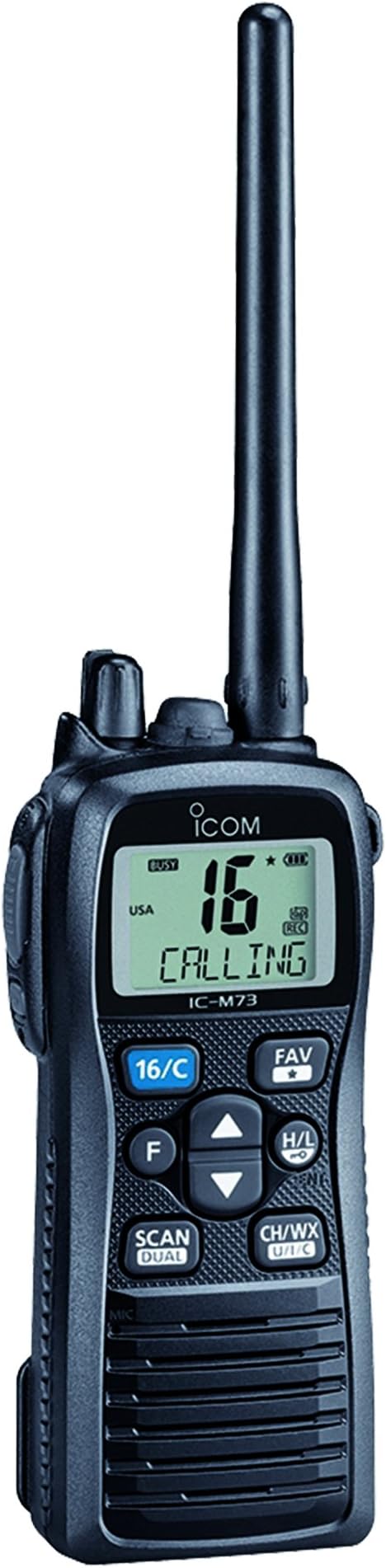
Built with a waterproof design and an easy-to-hold hourglass shape, this radio suits anyone needing reliable communication on the water. Its biggest strength lies in lasting power, with an 18-hour battery life ensuring long-range contact throughout your day on the boat.
Setup is straightforward, coming with a charger and a cigarette lighter adapter for easy power access. Holding the device feels comfortable with its shape, and the optional speaker/mic lets you communicate hands-free when needed.
Channel selection across 128 options covers a wide frequency range, and the VHF connection offers stable maritime communication.
Providing up to 6 watts of transmit power, it achieves a talking range of about 6 miles in ideal conditions. The solid, waterproof build means it can handle splashes or brief submersion without worry. Strong battery life stands out, while some reviews mention that the size might feel a bit bulky in smaller hands.
Many appreciate the radio’s strong battery life, lasting through long days on the water without needing a recharge. Users also note the sturdy waterproof build, but a common downside is that the size may be bulky for those with smaller hands.
Ideal for boaters who want dependable marine communication and don’t mind a somewhat larger unit. Those needing a lighter or more compact option might look at other radios with lower transmit power or fewer features.
Pros
- Waterproof design suitable for marine environments
- Long battery life of 18 hours per charge
- Comfortable hourglass shape for steady grip
- Includes charger and cigarette lighter adapter
Cons
- Can feel bulky for small hands
- Maximum range limited to about 6 miles
| Specification | Details |
|---|---|
| Number of Channels | 128 |
| Transmit Power | 6 Watts |
| Talking Range Maximum | 6 mile |
| Battery Average Life | 18 hours |
| Frequency Range (Tx) | 156.025–157.425MHz |
| Water Resistance Level | Waterproof |
5. Midland GXT1000VP4 GMRS Two-Way Radios 2 Pack

Long-range communication stands out most with these radios, designed for adults needing reliable connections across campgrounds or job sites. They suit anyone looking to stay in touch beyond normal phone coverage, offering impressive reach through 50 channels and privacy codes.
Right out of the box, the two radios come fully charged and ready, making setup quick. Charging is convenient with the included desktop charger and rechargeable battery packs.
The EVOX hands-free feature means you can talk without pressing buttons, and when power dips, switching to AA batteries keeps you going without pause. Weather alerts add a safety layer during outdoor activities.
Communication clarity is excellent, with a maximum talking range of 36 miles under ideal conditions that fits most outdoor needs. The build holds up well to weather, being water resistant. A frequent praise revolves around sound quality, while a common criticism relates to the battery life, which lasts around 10 hours before needing a recharge or battery swap.
Clear sound quality receives consistent praise, making communication easy over long distances. Users note the battery life requires attention, as the rechargeable packs last around 10 hours, and relying on AA batteries adds extra load.
Those needing reliable, long-distance two-way radios with weather alerts will find these well suited. People wanting longer battery endurance or lighter backup options might want to explore alternatives. These radios fit best for outdoor enthusiasts who appreciate hands-free operation and solid range.
Pros
- Comes fully charged with desktop charger included
- EVOX hands-free voice activation feature
- Built-in NOAA weather alerts for safety
- Water resistant for outdoor use
Cons
- Battery life limited to about 10 hours per charge
- Uses 8 AA batteries as backup, adding weight
| Specification | Details |
|---|---|
| Number of Channels | 50 |
| Talking Range Maximum | 36 mile |
| Battery Average Life | 10 hours |
| Water Resistance Level | Water Resistant |
| Voltage | 6 volts |
6. Retevis RB48 FRS Two Way Radio

Built for tough marine environments, the Retevis RB48 FRS Two Way Radio stands out with military-grade durability that handles harsh conditions with ease. It fits perfectly for anyone needing a reliable long-range communication device without worrying about water, dust, or drops.
Setting it up is simple, with 22 channels and straightforward controls that work well even with gloves on. The rechargeable 2000mAh battery holds up through long days, and USB-C charging options give flexibility. Weather alerts keep you ready for changes, making daily use straightforward and dependable out at sea or on rugged terrain.
Performance shines when it comes to clear signal transmission across large areas, up to 300,000 sq.ft.
or 25 floors. Its MIL-STD-810H certification means it can survive drops, dust, and temperature extremes from -20 to 60 °C. Praised for durability and signal clarity, the most common complaint is the dual batteries, which may feel bulky for some users.
Reports commonly praise how well the radio withstands rough treatment and keeps a stable, clear signal over long distances. A frequent gripe involves the two-battery setup, which some find cumbersome during extended use.
Ideal for marine and outdoor users who need a tough, reliable radio to stay connected in demanding environments. Those wanting a slimmer design or alternative frequency options might consider other models instead.
Pros
- Military-grade durability for harsh conditions
- Up to 20 hours battery life with USB-C charging
- Clear, stable transmission over long distances
- Easy operation even with gloves
Cons
- Dual batteries add some bulk
- Limited to FRS frequency range only
| Specification | Details |
|---|---|
| Number of Channels | 22 |
| Battery Average Life | 18 hours |
| Water Resistance Level | Waterproof (IP67) |
| Frequency Range | FRS |
| Drop Resistance | 2 meters, 1000 drops tested |
7. Uniden UM385BK Fixed Mount Marine VHF Radio

Being out on the water often means needing a reliable way to communicate, especially when conditions change quickly. This radio suits boaters and mariners who want a strong signal and weather updates to stay safe. Its biggest strength is the combination of long-range communication and weather alert features in one compact unit.
Setting up the radio is straightforward, with a fixed mount that keeps it accessible while steering. The waterproof design means it handles rain and splashes without concern.
Triple watch mode lets you monitor multiple channels at once, and the handheld mic makes it easy to transmit without letting go of the wheel. Weather alerts keep you informed about changing conditions from the moment a storm starts.
Performance during communication is solid, with a maximum talking range of 25 miles on 40 marine VHF channels. The build feels sturdy and made to withstand marine environments, complying with IPX4 waterproof standards. The clearest praise highlights its reliable weather alerts and long-range reach, although some note the microphone’s bulkiness as a minor downside.
Reliable weather alerts and a good communication range stand out as the biggest benefits. The only recurring issue is the handheld mic’s size, which some find inconvenient over extended periods.
Ideal for those who prioritize storm warnings and channel flexibility on their boat. Those needing a radio with higher waterproof standards or a smaller microphone might want to explore other options.
Pros
- Triple watch monitoring capability
- Weather alert with S.A.M.E technology
- Handheld mic usable at the wheel
- Broad range with 40 marine channels
Cons
- Microphone feels bulky during long use
- IPX4 rating doesn’t protect against full submersion
| Specification | Details |
|---|---|
| Number of Channels | 40 |
| Talking Range Maximum | 25 mile |
| Voltage | 12 volts |
| Water Resistance Level | Waterproof |
| Connectivity Protocol | DSC (Digital Selective Calling) |
8. Uniden Atlantis 275 Handheld VHF Marine Radio

With 6 Watts of power, this compact handheld VHF marine radio suits those who need long-range communication on the water without lugging bulky gear. Its top advantage is the clear display combined with floating, waterproof design, making it a dependable choice for boating or fishing trips.
Easy to set up with just one included AA battery, it fits comfortably in your pocket or on deck. The large LCD screen changes from paper white for daytime to red backlight at night, so you can read it no matter the conditions. Being submersible and able to clear water from its speaker means you don’t have to worry about splashes or drops.
Performance matches the promise with a 36-mile range that holds up well in open water. The unit floats and meets IPX8 waterproof standards, so durability is strong against elements.
Reviews highlight how handy the emergency strobe and flashlight features are, though some note the limited 25-channel selection might restrict certain communication needs.
The largest LCD screen ensures messages are clear both day and night, while the waterproof and floating design protects it from water damage even if dropped overboard. The emergency strobe and flashlight add extra security in low visibility conditions. Some users find the 25 channels less versatile for diverse marine communication needs.
Ideal for boaters who want a rugged, easy-to-carry radio with solid range and emergency features. Those requiring a broader channel selection or longer battery life may want to consider other options better suited to those demands.
Pros
- Floats and meets IPX8 waterproof standard
- Largest LCD screen in its class for easy reading
- Includes emergency strobe light and built-in flashlight
- Compact size fits comfortably in pocket or on deck
Cons
- Limited to 25 channels which may restrict communication
- Runs on single AA battery which may affect operation time
| Specification | Details |
|---|---|
| Talking Range Maximum | 36 mile |
| Water Resistance Level | Waterproof |
| Number of Channels | 25 |
| Number of Batteries | 1 AA batteries required. (included) |
| Connectivity Protocol | VHF |
9. Icom M25EVO Marine VHF Radio

Ideal for boaters and kayakers who need a reliable, long-lasting communication device, this marine VHF radio stands out for its waterproof, floating design. It suits anyone who spends time on the water and wants a lightweight radio that can handle rough conditions without worry.
Setting up the radio is straightforward with its compact, ergonomic design making it easy to carry and handle throughout the day. Charging is quick and convenient using the USB-C port, so you can power up from many sources. Its weather-resistant build keeps it protected from splashes and rain, which is crucial during unpredictable marine outings.
Communication is clear within a 5-mile range, covering most common marine situations well. The device is sturdy, meeting IPX7 standards to survive water exposure and even floats if dropped overboard.
Most users appreciate its long 11-hour battery life, while some mention that the channel selection is a bit limited with only 15 channels available.
Users often praise the floating feature combined with waterproof protection as very reassuring during marine activities. The main critique comes from the limited number of channels, which can restrict communication options in crowded or complex marine environments.
Boaters and kayakers who value durability, lightweight design, and reliable battery life will appreciate this radio. Those needing broader channel options or longer communication range should consider alternative models better suited to those demands.
Pros
- Floats and flashes if dropped in water
- Lightweight and easy to carry all day
- Long-lasting 11-hour battery life
- Fast USB-C charging everywhere
Cons
- Limited to 15 channels only
- Range maxes out at 5 miles
| Specification | Details |
|---|---|
| Number of Channels | 15 |
| Battery Life | 11-hour lithium-ion |
| Talking Range Maximum | 5 mile |
| Water Resistance Level | Water Resistant to IPX7 |
| Weight | 7.8 oz |
| Charging | USB-C fast charging |
10. Standard Horizon HX210 Floating Handheld VHF Radio

Designed for serious boating enthusiasts, the Standard Horizon HX210 stands out with its floating and waterproof build that can handle drops in water up to 3.3 feet for 30 minutes. It’s ideal for those who need a reliable handheld VHF radio with a good range and safety features like an emergency strobe light.
Getting started involves simply charging the 1850 mAh Li-Ion battery in the rapid desktop charger for about three hours. The radio’s compact design fits well in hand, and navigating channels is straightforward thanks to the E20 easy menu system and oversized dot matrix display. Switching between USA, International, and Canadian channels takes just a few clicks, and having a built-in FM radio comes in handy during downtime.
Communication works well with selectable output powers of 6W, 2.5W, and 1W, maintaining clear signals up to an advertised 5-mile range in suitable conditions. The waterproof case feels sturdy, built tough for marine environments, but the biggest user downside tends to be the limited maximum range when compared to fixed radios. Many appreciate the water-activated emergency strobe that adds a layer of safety without fuss.
Strong points include its waterproof floating design and intuitive menu system which make it dependable on the water. The most frequent complaint is the limited maximum talking range, especially compared to higher-powered units or fixed radios.
People boating near shore who want a compact, reliable emergency radio will be satisfied. Those requiring an extended range or user-replaceable batteries might consider other models better suited to those needs.
Pros
- Floats and survives immersion in water
- Long-life 1850 mAh Li-Ion battery
- Easy to use with clear dot matrix display
- Includes emergency water-activated strobe light
Cons
- Maximum range only about 5 miles
- Battery pack not user-replaceable
| Specification | Details |
|---|---|
| Number of Channels | 200 |
| Water Resistance Level | IPX7 Waterproof (3.3 feet for 30 minutes) |
| Talking Range Maximum | 5 mile |
| Battery Type | 1 Lithium Ion battery (1850 mAh) |
| Output Power | Selectable 6W / 2.5W / 1W |
| Frequency Range | 76 – 108 MHz (FM) |
11. Midland GXT67 PRO GMRS Two-Way Radio

Midland GXT67 PRO GMRS Two-Way Radio delivers impressive long-range communication with a solid 5-watt output. Ideal for outdoor enthusiasts who need reliable connection across vast distances and challenging terrain.
Its standout feature is the ability to push the legal transmitting power limit, maintaining clear signals even in dense landscapes.
Setting it up is straightforward thanks to a no-fuss interface that avoids complicated programming. The radio comes pre-programmed with 22 channels plus 28 privacy codes, letting you connect quickly and privately.
Daily use benefits from weather alerts and silent operation, making it practical in all environments. The lithium-ion battery lasts around four days on a single charge, which keeps things convenient during extended trips.
The radio effectively covers long distances, with a maximum talking range of about 100 miles in open areas, and can connect to GMRS repeaters to extend reach further. It’s built with durability in mind, boasting an IP67 waterproof rating and dust-proof design. Most praise praises its long-range performance and reliability, though some users find the battery life could be longer when used continuously.
Many users appreciate the strong, clear communication over long distances and the radio’s rugged waterproof design. The most common issue is the battery life, which some find shorter when the radio is used heavily throughout the day.
Anyone needing long-range coverage in outdoor or remote settings will find this radio very reliable. Those seeking longer battery life or more indoor-friendly models might want to consider alternatives better suited for lighter use or urban environments.
Pros
- Full 5-watt power for maximum legal range
- Pre-programmed channels and privacy codes
- IP67 waterproof and dust proof build
- Includes weather and call alerts
Cons
- Battery life could be better with heavy use
- May struggle indoors or in very dense urban areas
| Specification | Details |
|---|---|
| Number of Channels | 99 |
| Battery Average Life | 4 days |
| Water Resistance Level | Waterproof |
| Frequency Range | 462-467 MHz |
| Voltage | 5 volts_of_direct_current |
12. Motorola Talkabout T605 Waterproof Two-Way Radios 2 Pack

Carrying radios that float and stay waterproof makes time on the water far less stressful. Great for anyone who needs reliable communication in marine environments, these Motorola radios stand out for their long 35-mile range that really holds up across open spaces.
Getting started is a breeze since pairing is straightforward and the radios run on rechargeable batteries with USB-C charging. The backlit display helps seeing channels and settings easily, even after dark. Having 22 channels with 121 privacy codes means finding a free line is quite simple no matter where you are.
Communications come through clearly at long distances, meeting the expectations for both range and durability. Their rugged waterproof design resists water and means less worry about drops or splashes. Some users mention the battery life averages about 9 hours, which covers most day trips but might fall short on extended outings.
Strong communication range combined with waterproof durability make these radios well-suited for marine settings. Many appreciate how they float and stay easy to find if dropped. Common feedback points to battery life that covers most outings but could limit longer trips without recharging.
Those spending regular days on the water and looking for trustworthy, license-free radios will find these a solid fit. Users needing very long battery life or smaller devices might want to explore other options.
Pros
- Floats face up to prevent loss in water
- Water-activated flashlight built in
- Large number of channel combinations
- Rechargeable with USB-C for convenience
Cons
- Battery lasts around 9 hours, may need recharge
- Requires two 12V batteries, slightly bulky
| Specification | Details |
|---|---|
| Talking Range Maximum | 35 mile |
| Number of Channels | 22 |
| Water Resistance Level | Waterproof (IP67) |
| Battery Average Life | 9 hours |
| Connectivity Protocol | FRS |
| Charging | USB-C Charging |
13. Icom M424G Fixed Mount VHF Radio with GPS

Reliable and rugged, the Icom M424G suits those needing a solid fixed mount VHF radio with GPS for marine communication. Its best feature is the IPX7 submersible protection, so it stays functional even after accidental immersion, making it perfect for serious boaters focused on safety and durability.
Setup involves connecting with compatible devices like the Ma-500tr AIS Transponder and programming weather channels for quick alerts. Daily use is straightforward with dual/tri-watch functions letting you monitor key channels without missing calls. The Aqua Quake draining function helps clear water from the speaker after exposure, which is handy in wet conditions on deck.
Communication performance is reliable up to 5 miles, covering the classic VHF frequency range between 156.000 MHz and 174 MHz. The build feels sturdy, designed to endure marine environments.
Many appreciate the weather alerts and submersibility, while some mention the limited 21 channels can restrict options for more complex setups.
Many praises highlight its waterproof design and reliable weather alerts, which add confidence during rough marine conditions. The common complaint is the channel limit, restricting flexibility if more channels are necessary for complex communication needs.
Those who prioritize rugged durability and straightforward operation will find this radio well suited. People needing a broader channel range or longer communication reach should look for other marine radios with expanded features.
Pros
- IPX7 waterproof rating protects against immersion
- Integrated GPS improves navigation and safety
- Weather channel alerts keep you informed
- Aqua Quake function clears speaker water efficiently
Cons
- Limited to 21 channels, restricting communication options
- Maximum talking range of 5 miles may not suit all needs
| Specification | Details |
|---|---|
| Number of Channels | 21 |
| Frequency Range | 156.000 MHz – 174 MHz |
| Talking Range Maximum | 5 miles |
| Water Resistance Level | Waterproof (IPX7, 1M depth for 30 minutes) |
| Compatible Devices | Ma-500tr AIS Transponder |
| Additional Features | Aqua Quake draining function, Dual/tri-watch, Weather alerts |
Comparison of Best Long Range Marine Radios
| Product | Channels | Max Range | Water Resistance | Battery Life |
|---|---|---|---|---|
| Cobra BlueBound 350 | 98 | 25 mile | Waterproof | 12 hours |
| Uniden UM725G Marine | 25 | 36 mile | Waterproof | – |
| Icom M94D VHF AIS | 4 | 5 mile | Waterproof | AAA battery |
| Icom IC-M73 Handheld | 128 | 6 mile | Waterproof | Lithium Ion battery |
| Midland GXT1000VP4 2-Pack | 50 | 36 mile | Water Resistant | AA batteries |
| Retevis RB48 FRS Radio | 22 | – | Waterproof | – |
| Uniden UM385BK Fixed | 40 | 25 mile | Waterproof | – |
| Uniden Atlantis 275 | 25 | 36 mile | Waterproof | AA battery |
| Icom M25EVO VHF | 15 | 5 mile | Water Resistant | – |
| Standard Horizon HX210 | 200 | 5 mile | Waterproof | Lithium Ion battery |
| Midland GXT67 PRO | 99 | 100 mile | Waterproof | Lithium Ion battery |
| Motorola Talkabout T605 | 22 | 35 mile | Waterproof | 12V batteries |
| Icom M424G GPS Fixed | 21 | 5 mile | Waterproof | – |
- Channels98
- Max Range25 mile
- Water ResistanceWaterproof
- Battery Life12 hours
- Channels25
- Max Range36 mile
- Water ResistanceWaterproof
- Battery Life–
- Channels4
- Max Range5 mile
- Water ResistanceWaterproof
- Battery LifeAAA battery
- Channels128
- Max Range6 mile
- Water ResistanceWaterproof
- Battery LifeLithium Ion battery
- Channels50
- Max Range36 mile
- Water ResistanceWater Resistant
- Battery LifeAA batteries
- Channels22
- Max Range–
- Water ResistanceWaterproof
- Battery Life–
- Channels40
- Max Range25 mile
- Water ResistanceWaterproof
- Battery Life–
- Channels25
- Max Range36 mile
- Water ResistanceWaterproof
- Battery LifeAA battery
- Channels15
- Max Range5 mile
- Water ResistanceWater Resistant
- Battery Life–
- Channels200
- Max Range5 mile
- Water ResistanceWaterproof
- Battery LifeLithium Ion battery
- Channels99
- Max Range100 mile
- Water ResistanceWaterproof
- Battery LifeLithium Ion battery
- Channels22
- Max Range35 mile
- Water ResistanceWaterproof
- Battery Life12V batteries
- Channels21
- Max Range5 mile
- Water ResistanceWaterproof
- Battery Life–
How to Choose the Right Long Range Marine Radio
Choosing a good long range marine radio depends on factors like transmission power, range, waterproof rating, and ease of use. Selecting the right features ensures clear communication in emergencies and saves money by avoiding unnecessary capabilities or replacements caused by poor durability.
Transmission Range and Power
Long-distance communication on open water can be frustrating when your device suddenly cuts out or sounds faint. Devices with a power output of 25 watts tend to offer a much stronger and more reliable signal than those with 1 to 5 watts, which often struggle beyond a few miles. The maximum effective range is heavily influenced by this power level, but also by antenna quality and surrounding conditions.
Clear transmission is essential, especially if bad weather reduces visibility. Radios with 25-watt output typically maintain communication clarity up to 20 miles in optimal conditions, but that range can drop significantly with interference. Devices with built-in noise reduction and automatic gain control help maintain signal quality over long distances, reducing the chance of missed calls or garbled messages.
Durability and Weather Resistance
The salty marine environment quickly ruins devices not designed for it. Radios made from corrosion-resistant metals like stainless steel or marine-grade plastics last longer and stay functional despite constant exposure to water and salt spray. True waterproof ratings such as IP67 or IP68 mean the radio can handle submersion without damage.
Build quality also plays a major role; units with sealed buttons and reinforced housings resist impacts better. Shockproof ratings and dust resistance ensure your radio keeps working through rough handling and dirty decks. Skimping on these features often results in a broken or unreliable device after just a season.
User Interface and Ease of Use
Operating a marine radio should be straightforward, especially in emergencies where hesitation wastes precious seconds. Radios with large, clearly labeled buttons make channel changes quick.
Displays with backlighting or anti-glare coatings improve readability under sun or at night, reducing eye strain and mistakes.
Having preset channels and scanning functions saves time by automatically switching to active frequencies. This setup avoids missing important calls and simplifies operation for anyone not familiar with complex menus or jargon found on some models.
Battery Life and Power Options
Battery life becomes critical during longer trips, especially when power outlets are scarce. Radios with at least 8 to 10 hours of continuous usage ensure communication throughout the day without frequent recharges.
Rechargeable lithium-ion batteries are common and typically last for hundreds of cycles, but access to replaceable backup batteries can be a lifesaver if charging isn’t an option.
Some models support charging via USB or 12V boat outlets, offering flexible options for keeping the radio powered. Ease of swapping batteries at sea means you don’t have to power down and miss transmissions, which can happen with complicated designs.
Safety and Compliance Features
Effective safety protocols depend on radios that support emergency channels, including DSC (Digital Selective Calling), which sends automated distress alerts with your exact location. Models lacking this feature require manual distress calls, increasing response time in crisis situations.
Built-in distress signal buttons trigger loud alerts to nearby vessels and rescue services. Ensuring the radio adheres to marine communication standards like FCC or ITU certifications confirms it is legal to operate and reliable under official rescue procedures. Choosing devices without these can lead to communication failures or legal issues on the water.
Maximizing Signal Range: Expert Tips for Clear Marine Communication
Placement of the marine radio antenna significantly affects the clarity and distance of communication. Mounting the antenna as high as possible on the vessel, away from metal obstructions, helps reduce signal interference and increases range. Keeping the antenna cable in good condition is also important; cracks or corrosion can weaken the signal.
Use an antenna designed specifically for marine environments, as they are built to resist saltwater corrosion and maintain performance over time. Regularly check for loose connections and secure them promptly to avoid drops in signal. Operating the radio at the recommended wattage can also prevent signal distortion and ensure you’re transmitting at the optimum power for your equipment.
-
Practical tips:
- Inspect antenna connections before every trip.
- Keep the antenna clear of overhead obstacles.
- Consider a signal amplifier only if manufacturer-approved.
Essential Maintenance Practices to Extend the Life of Your Marine Radio
Daily exposure to saltwater, sun, and wind can wear down marine radios quickly, so rinsing the device gently with fresh water after use helps remove salt buildup. Avoid harsh cleaning chemicals; mild soap and water applied with a soft cloth is sufficient.
Check the battery regularly, corrosion on terminals or low battery power can cause intermittent function or total failure.
Store the radio in a dry, ventilated space when not in use to prevent moisture accumulation inside the casing. Testing all functions before each outing ensures any issues are identified early. Keep firmware and software updated if your radio supports digital features, since manufacturers often release updates to fix bugs or improve performance.
-
Maintenance checklist:
- Rinse and wipe down after exposure to saltwater.
- Inspect and clean battery contacts monthly.
- Run a full function test before departure.
Comparing Long Range Marine Radios to Satellite Communication Systems
Long range marine radios operate on VHF and sometimes UHF frequencies, providing reliable voice communication within line-of-sight range, which can extend up to 30 miles depending on conditions. Satellite communication systems offer broader coverage, allowing contact anywhere on the globe, but they rely on subscription services and have higher equipment costs.
Marine radios excel during emergencies by providing direct access to Coast Guard and other vessels in the vicinity, which satellite systems might not connect to automatically. However, satellites can transmit data beyond voice, including GPS and weather updates, which marine radios alone cannot provide.
-
Key differences:
- Marine radios: no ongoing fees, limited to horizon range.
- Satellites: global reach, require subscriptions.
- Marine radios: instant distress signaling on dedicated channels.
- Satellite systems: advanced features like text messaging and tracking.
People Also Asked
How Long Does a Marine Radio Typically Last on the Water?
A marine radio can last several hours on a full battery, depending on its power output and how frequently it is used. Radios that operate continuously at maximum power drain batteries faster, so adjusting transmission power can help extend usage time on the water.
What Size Marine Radio Antenna Works Best for Long Range?
A 5-foot marine radio antenna is often considered the best size for long-range communication because it balances height and portability. It should be mounted as high as possible on the boat for better line-of-sight and radio wave propagation.
Are Long Range Marine Radios Compatible with All Boat Types?
Long range marine radios generally work with all boat types, but installation may vary depending on the boat’s size and structure. It’s important to ensure a good antenna setup appropriate for your specific boat to achieve the best signal.
What Common Problems Should I Watch for with Marine Radios?
Common problems with marine radios include poor reception due to antenna damage, corrosion of connections, and interference from other electronics. Regularly inspect and clean antenna mounts and cables to avoid signal loss.
How Do I Properly Care for My Long Range Marine Radio?
Proper care involves keeping the radio and antenna dry and clean, checking for corrosion, and ensuring connections are tight. Storing the radio away from direct sunlight and moisture when not in use will help maintain its functionality.
Conclusion
Range, durability, and ease of use are the main factors to consider when choosing a long range marine radio. The radio should reliably reach distant contacts, hold up against harsh marine conditions, and be simple enough to operate during critical moments.
Battery life and channel options also play an important role for extended trips.
Make sure the radio fits the space you have on your vessel and matches your budget without compromising essential features. Think about how often you plan to use it to decide the best balance between cost and capability.
The comparison table above can help you match these needs to the right model for your situation.