Top 13 Best Long Distance Telescope That Will Blow Your Mind
Picking the best long distance telescope often comes after dealing with blurry images and shaky views from cheaper models. Some telescopes fail to bring distant objects into clear focus, making those distant mountains or faraway wildlife frustratingly vague. Others might offer powerful zooms but become heavy and unwieldy, turning a pleasant observation into a tiring chore.
The quality of the lens glass and the diameter of the objective lens greatly influence clarity and brightness; a good telescope typically starts at 50mm for serious long-distance viewing. Magnification matters, but anything beyond 20x risks image shakiness without a tripod. Solid build materials improve durability, while features like waterproofing and lens coatings protect optics and make cleaning easier.
A good fit with comfortable eye relief ensures long sessions do not strain your eyes.
Need a Quick Check?
| Image | Product | Price |
|---|---|---|
Our Top Picks 1  | SOLOMARK 130mm Telescope | Check Price |
Our Top Picks 2  | Hawkko 90mm Refractor | Check Price |
Our Top Picks 3  | Digital Auto-Focus Refractor | Check Price |
Our Selected Top 13 Long Distance Telescope for Different Needs
This list features a variety of long distance telescopes designed for different uses and preferences. Each review explains how well the telescope performs, highlights its strengths and weaknesses, and suggests which type of user it is best suited for, helping readers find the right option for their needs.
1. SOLOMARK 130mm Astronomical Telescope
Bright, detailed views make this 130mm telescope a solid pick for amateur astronomers wanting high contrast and sharp images of the night sky. Its biggest strength lies in its large aperture combined with fine alt-azimuth controls, which help track celestial objects smoothly.
Setting it up takes just a few minutes thanks to the precision alt-az mount with both coarse and micro adjustment knobs, letting you fine-tune your target without vibrations. Switching between the 10mm and 20mm eyepieces gives clear views at 65X and 32.5X magnification, making day and night viewing straightforward. No power source is needed, and the multi-coated glass keeps glare and distortion low for easier daytime observation too.
Image clarity is excellent, capturing bright, sharp stars and terrestrial details well thanks to the fully coated 130mm objective lens. The telescope’s manual focus lets you zero in precisely on your subject.
Most praise notes the smooth friction-controlled tracking and solid build quality, while some mention the manual focus can be tricky to master at first, especially at high magnifications.
The most praised feature is the smooth friction-controlled tracking that lets users follow objects without vibration. The most common complaint is about the manual focus system, which demands some trial and error to use effectively at higher magnifications.
Astronomy enthusiasts who want bright, clear images and can spend time adjusting focus will appreciate this telescope. Those needing quick setup and autofocus features might find it less convenient and should look for other models better suited for easy operation.
Pros
- 130mm aperture for bright, detailed views
- Dual eyepiece set for versatile magnification
- Coarse and micro adjustment knobs for smooth tracking
- Multi-coated optical glass reduces glare
Cons
- Manual focus can be difficult at high magnification
- May require patience for precise object tracking
| Specification | Details |
|---|---|
| Objective Lens | 130mm aperture |
| Focal Length | 650mm |
| Eyepieces | WAK10mm and WAK20mm (65X and 32.5X magnification) |
| Mount Type | Alt-azimuth with fine adjustment controls |
| Focus Type | manual focus |
| Power Source | none required |
2. Hawkko 90mm Refractor Telescope
Hawkko 90mm Refractor Telescope offers powerful astronomical viewing for beginners and adults who want to explore distant landscapes and the moon. Its main strength lies in the large 90mm aperture lens paired with a 900mm focal length, providing impressive magnification from 36X up to 270X for clear, bright images.
Setup is straightforward thanks to the stable stainless steel AZ mount tripod, offering smooth 360° rotation and easy height adjustments between 28 and 46. The manual focus is simple to use, while the straight-through finderscope helps in locating objects quickly. The product is portable enough for outdoor use, and the included accessory kit makes it a great choice for everyday stargazing or scenic viewing.
Optical performance is strong due to the professional-grade full multi-layer coating that boosts light transmittance by 73%, making images sharp and bright. The build quality feels solid with the stainless steel tripod, although manual focusing can sometimes require fine adjustments. The common praise highlights clarity and magnification, while the main drawback is the manual focus system needing patience for precise tuning.
The telescope is praised for producing clear, bright images with its multi-coated optics and large aperture. Most users find the manual focus a bit tricky, needing some patience and attention to get sharp views, especially at higher magnifications.
People wanting powerful magnification and portability will appreciate this model, especially beginners aiming to explore the moon or distant landscapes. Those looking for automatic tracking or motorized mounts might want to consider other options.
Pros
- Large 90mm aperture lens for bright images
- Stable stainless steel AZ mount tripod
- Wide zoom range up to 270X magnification
- Adjustable tripod height from 28″ to 46″
Cons
- Manual focus requires careful adjustments
- Not motorized or computerized for tracking
| Specification | Details |
|---|---|
| Aperture | 90mm |
| Focal Length | 900 millimeters |
| Magnification Range | 36X to 270X |
| Mount Type | Altazimuth Mount |
| Tripod Height | 28″ to 46″ |
| Focus Type | Manual Focus |
3. Digital Auto-Focus Refractor Telescope
Feels like bringing the stars right to your backyard, perfect for those serious about clear planetary and wildlife observation. Power to zoom in up to 350x truly stands out, letting you see details others miss with crisp and vivid clarity.
Setup gets straightforward with an auto-focus system that takes out much of the hassle. A digital eyepiece with ±4 diopter vision adjustment means you can quickly get the perfect view without fiddling constantly.
The fold-out screen works well for sharing the view with friends or family without crowding the eyepiece, and the rechargeable battery keeps it running without a tangle of cords.
Optical performance holds up well across various conditions, producing sharp 4K images when springing for astrophotography or simply pointing it at distant landscapes. The build feels solid and thoughtfully designed, though some users mention the need to watch battery life and occasional glitches with wireless app control.
The anti-glare hood truly cuts down distracting light, making longer observation sessions easier on the eyes.
High-contrast views and crisp 4K details impress consistently, making it a treat for detailed observation. Some users note the wireless app control doesn’t always work smoothly, and the nonstandard battery system requires careful charging management during extended sessions.
Those who want sharp, vivid long-distance views with easy focus and group sharing will appreciate this telescope. People needing longer battery life or flawless wireless features may want to consider other models better suited for on-the-go astrophotography or continuous use.
Pros
- Clear 4K views with starlight-grade sensor
- Auto-focus simplifies target acquisition
- Fold-out screen allows group viewing
- Anti-glare hood reduces light disturbance
Cons
- Battery life needs close attention
- Wireless app control can be unreliable
| Specification | Details |
|---|---|
| Focus Type | Auto Focus |
| Focal Length | 300mm |
| Finderscope | Reflex |
| Additional Features | Auto Focus, Dual Screens, Wireless App Control, Remote Control, 4K Astrophotography, Starlight-grade optical sensor, Anti-glare hood, Rechargeable battery |
| Number of Batteries | Nonstandard Battery batteries required |
4. 80mm Refractor Telescope with AZ Mount

Ideal for amateur astronomers looking for clear views of the night sky, this 80mm refractor telescope impresses with its bright imaging thanks to a large aperture and fully coated optics. Its main appeal lies in balancing portability and optical power, making it a solid choice for casual stargazing and nature observation.
Setting up is straightforward with an adjustable aluminum tripod that grows from 17.7 to 52, accommodating users of different heights comfortably. The included backpack stores everything compactly, which is handy for taking it outdoors.
Manual focusing with the Kellner eyepiece lets you sharpen views precisely, while the altazimuth mount offers smooth movement when tracking objects. The upgraded phone adapter makes it easy to attach your smartphone for pictures or videos through the eyepiece.
Performance delivers clear and bright images due to the 80mm aperture and 600mm focal length. The fully coated lenses significantly improve light transmission while reducing reflections, enhancing detail visibility. Build quality feels solid enough for recreational use, with the stable tripod being a highlight.
Some users note manual focus requires patience, and the finderscope may take time to align accurately before use.
Bright and clear views stand out thanks to the 80mm aperture and quality fully coated optics. The biggest hassle reported relates to manually focusing, which needs patience to get sharp images. Aligning the finderscope can also be time-consuming during setup.
Anyone seeking a portable telescope with decent magnification for casual stargazing will find this a good option. People wanting quick autofocus or professional-grade optics might want to explore other models designed for advanced use.
Pros
- Large 80mm aperture captures bright images
- Adjustable tripod fits both adults and kids
- Phone adapter included for smartphone use
- Comes with a convenient backpack for portability
Cons
- Manual focus can be slow to adjust
- Finderscope alignment may require extra effort
| Specification | Details |
|---|---|
| Eye Piece Lens Description | Kellner |
| Mount | Altazimuth Mount |
| Focus Type | Manual Focus |
| Finderscope | Reflex |
| Focal Length Description | 80 millimeters |
| Zoom Ratio | 66 multiplier x |
5. Celestron SkyMaster 25×70 Binoculars

Constructed with large 70mm objective lenses and a solid Porro prism design, these binoculars suit anyone looking for powerful, long-distance viewing on land or in the night sky. Their standout feature is 25x magnification, offering detailed views that bring distant objects into clear focus.
Setting up requires a tripod due to their size and weight, with a built-in ¼”-20 adapter making attachment quick. Day-to-day use involves manual center focus, which stays sharp across the field of view.
Multi-coated lenses and BaK-4 prisms improve image brightness, making dawn, dusk, and nighttime observations clearer and more enjoyable.
Performance shines in delivering bright, sharp images, especially in low light, thanks to high-quality prism and lens coatings. The focus control is precise but demands a steady hand or tripod support.
The body feels sturdy and water-resistant, yet the weight means handheld use can tire the arms fast. Many note excellent clarity, while some find the binoculars bulky for casual carry.
Bright, sharp views stand out as the strongest feature thanks to BaK-4 prisms and multi-coated lenses. Common complaints focus on weight and the need for a tripod, making handheld use uncomfortable over longer periods.
People aiming for clear, long-distance views during low light will appreciate these binoculars, especially when set up on a tripod. Those wanting something light or handheld for casual use may want to explore smaller, less powerful models.
Pros
- High 25x magnification for detailed viewing
- Bright images with BaK-4 prisms and multi-coated lenses
- Compatible with standard tripods via built-in adapter
- Water-resistant design for outdoor use
Cons
- Requires tripod due to size and weight
- Manual focus can be tricky without steady support
| Specification | Details |
|---|---|
| Magnification Maximum | 25 x |
| Objective Lens Diameter | 7 centimeters |
| Prism Type | Porro Prism |
| Eye Relief | 13 millimeters |
| Field of View | 2.7 degrees |
| Water Resistance Level | Water Resistant |
6. 18×70 Astronomy Binoculars

Massive 70mm objective lenses paired with 18x magnification stand out right away, ideal for anyone wanting detailed views far beyond standard binoculars. Best suited for serious astronomy buffs or those needing powerful long-distance vision with excellent light gathering.
Setup involves attaching to a tripod mount, which stabilizes the view for clear, steady observations. Manual center focus and diopter adjustment allow fine-tuning to personal eyesight.
Fully multi-coated lenses and BAK-4 prisms improve visibility in low-light conditions. Eye relief of 18mm provides comfort for extended use. Smartphone compatibility makes capturing views possible with some effort.
Performance is strong with sharp, bright images thanks to big lenses and good coatings. Build feels solid and waterproof, handling rough conditions well.
Common feedback praises image clarity and magnification power, while some users mention the need for a tripod due to weight and handling challenges.
Clarity and sharpness are highly valued thanks to the BAK-4 prisms and coatings, while the main drawback is its weight and the necessity of a tripod mount to maintain steady views. These binoculars perform best in stable setups rather than handheld for long sessions.
Anyone needing strong magnification and excellent low-light ability will appreciate this model, particularly for astronomy and long-range outdoor activities. Those looking for lightweight, handheld convenience might want to look at smaller or less powerful optics instead.
Pros
- 18x high magnification for distant details
- Large 70mm lens gathering bright light
- Waterproof build for outdoor use
- Suitable for low-light viewing
Cons
- Requires tripod for steady viewing
- Manual focus can be tricky at high power
| Specification | Details |
|---|---|
| Magnification Maximum | 18 |
| Objective Lens Diameter | 7 centimeters |
| Prism Type | Roof Prism with BAK-4 glass |
| Eye Relief | 18 |
| Water Resistance Level | Waterproof |
| Focus Type | Center Focus |
7. Gskyer 70mm AZ Refracting Telescope

Designed for amateur astronomers interested in clear views of the moon and stars, this refracting telescope stands out with its 70mm aperture and fully coated optics for sharp images. It suits anyone wanting solid magnification combined with smartphone compatibility for capturing moments.
Setup is straightforward, thanks to the altazimuth mount allowing smooth manual adjustments. Swapping eyepieces and using the 3x Barlow lens triples magnification easily, helping to zoom in on distant objects.
The included wireless camera remote and smartphone adapter make astrophotography accessible, letting you explore and record celestial details via your phone’s screen without hassle.
Images appear bright and detailed through the coated glass lens, making stargazing quite vivid. It’s well-built with a manual focus system that offers precision control, though some mention it can take patience to fine-tune for perfect clarity.
The finder scope with crosshairs simplifies locating objects, praised for its ease of use even for beginners.
Images are crisp and bright thanks to the fully coated lenses and good aperture size, while some users find manual focusing a bit fiddly until accustomed. The wireless camera remote is a helpful addition for capturing photos without disturbing the telescope.
This telescope suits anyone wanting a reliable setup for casual star and moon watching with occasional astrophotography. Those needing quick autofocus or fully portable options might prefer other models.
Pros
- 70mm aperture with fully coated optics
- Includes 3x Barlow lens for extra magnification
- Wireless remote for smartphone astrophotography
- Easy to locate objects with 5×24 finder scope
Cons
- Manual focus may require patience to adjust
- Powered by adapter, limiting portability
| Specification | Details |
|---|---|
| Eye Piece Lens Description | Barlow |
| Mount | Altazimuth Mount |
| Focus Type | Manual Focus |
| Power Source | Adapter |
| Finderscope | Reflex |
| Focal Length Description | 400 millimeters |
8. 70mm Refractor Telescope with LCD Display

Looking up at the Moon or distant objects often means struggling with bulky or complicated gear. The 70mm Refractor Telescope with LCD Display fits well for beginners and families seeking both digital and optical viewing options.
Its main strength lies in offering an easy way to see lunar details either through a screen or classic eyepiece, making nighttime exploration flexible.
Assembly is straightforward and can be completed quickly, so you spend less time setting up and more time observing. Manual focus combined with a straight-through finderscope helps zero in on targets with decent precision. Battery-powered operation means no cords to manage, and the included wireless remote control allows capturing photos or videos without disturbing the image.
The built-in 4.5-inch LCD display makes viewing possible without any extra devices.
Delivering clear views of the Moon and some near celestial objects, this telescope meets expectations for a beginner model. The fully multi-coated optics improve brightness, but the 400mm focal length and 70mm aperture limit how far and detailed the observation can be. The altazimuth mount supports smooth up-and-down, left-and-right motions.
Some mention the weight and manual focus requiring patience. It offers a solid balance between digital convenience and traditional optics.
This telescope receives praise for its convenience of viewing directly on the 4.5-inch screen without relying on a phone. Most users mention the manual focus requires some patience to get sharp lunar details and that the battery pack might run down quicker than desired. The balance of digital and optical options satisfies many but demands attentiveness in focusing.
Anyone wanting easy setup with flexible viewing modes will appreciate this model, especially families or those new to telescopes. More advanced users or those looking for longer observation sessions may prefer a solid-powered telescope with automated focusing systems for better precision and endurance.
Pros
- Dual viewing options: LCD display and optical eyepiece
- Built-in 4.5″ LCD requires no smartphone connection
- Wireless remote control for photo and video capture
- Easy assembly with manual focusing
Cons
- Manual focus can be tricky for precise adjustments
- Single battery power limits extended use time
| Specification | Details |
|---|---|
| Mount | Altazimuth Mount |
| Focus Type | Manual Focus |
| Power Source | Battery Powered |
| Finderscope | Straight-Through |
| Focal Length Description | 400mm |
| Field Of View | 4.6 degrees |
9. 20-60×80 Waterproof Spotting Scope
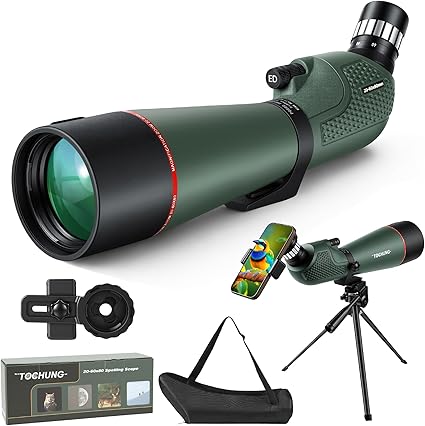
With a powerful 20x to 60x continuous zoom and a large 80mm aperture lens, this spotting scope suits anyone looking for sharp long-distance viewing. Its biggest strength is how clearly it holds onto details even at high magnification, making it great for birdwatching or shooting ranges.
Setting it up on a tripod is straightforward, and manual focus lets you quickly lock onto targets. The fully multi-coated optics keep your view bright and clear.
The waterproof and fogproof design means it handles outdoor use well, and the smartphone adapter lets you easily capture what you see.
It offers bright, sharp images with high contrast, handling long distances with precision. Made to withstand weather, the waterproof and fogproof build stands up to rough conditions. Most people praise the zoom range, though some mention manual focus needs a steady hand to stay sharp at max zoom.
The zoom range delivers detailed observation over long distances with impressive clarity. Many find the waterproof and fogproof feature helpful for outdoor use, yet manual focus requires steady hands to avoid blurry images at high zoom levels. The smartphone adapter adds convenience for sharing views.
People who need sharp, distant views in various outdoor settings will appreciate this scope. Those wanting quick autofocus or a more compact setup may look for other options. Tripod dependence limits portability for casual or fast-paced activities.
Pros
- Clear and bright images even at full 60x zoom
- Waterproof and fogproof for outdoor reliability
- Universal smartphone adapter included
- Large 80mm objective lens for better light gathering
Cons
- Manual focus can be tricky at high magnification
- Requires tripod for steady viewing at max zoom
| Specification | Details |
|---|---|
| Mount | Tripod Mount |
| Focus Type | Manual Focus |
| Field Of View | 1000 yard |
| Zoom Ratio | 20x-60x |
| Additional Features | Fully Multi-Coated Optics, Waterproof & Fogproof, Universal Smartphone Adapter |
10. Dwarf Mini Portable Astronomy Telescope

Anyone keen on stargazing during outdoor trips will find this telescope easy to carry and quick to set up. Lightweight and pocket-sized, it fits neatly into a backpack, making it ideal for hikers, campers, or travelers seeking clear views without heavy gear.
Its standout feature is how easy it is to control and explore the night sky directly from your phone.
Getting started takes just moments with the smartphone app, which includes a star map to help you select targets with ease. The telescope swivels a full 360 degrees and tracks objects automatically, meaning you don’t have to fiddle with complicated adjustments.
Its manual and auto focus options give you control over clarity, while the battery power lets you explore away from power outlets without hassle.
The optics deliver a solid view with a 150 mm focal length and a 2.45-degree field of view, suitable for spotting planets and stars at a distance. The build is compact and sturdy enough for travel, thanks to basic anti-reflection coating that reduces glare but doesn’t feel deluxe.
Users praise the app’s ease of use, but some point out that the focus can be a little tricky to nail perfectly at times.
Quick setup through the app is a major highlight, allowing exploration within minutes of unpacking. The automated tracking paired with the smartphone interface makes star finding straightforward. However, the manual focusing can sometimes be difficult to perfect, which may frustrate users wanting sharper images.
Those who want a lightweight, travel-friendly telescope with digital convenience will appreciate this model. More serious astronomers looking for advanced optics and precision focus might need a more specialized option instead.
Pros
- Compact and lightweight for easy transport
- App-controlled with built-in star map
- Auto GOTO and 360° pivot for tracking
- Works with smartphone for intuitive use
Cons
- Focus can be challenging to adjust precisely
- Basic anti-reflection coating, not premium optics
| Specification | Details |
|---|---|
| Weight | 1.85 lbs (840g) |
| Focal Length | 150 mm |
| Field Of View | 2.45 degrees |
| Mount | Altazimuth and Equatorial Mount |
| Power Source | Battery Powered (1 Nonstandard Battery included) |
| Focus Type | Manual-and-Auto |
11. Celestron StarSense Explorer DX 130AZ

Smartphone docking and a unique sky recognition system set this telescope apart for beginners eager to explore the night sky with ease. It suits anyone wanting a guided experience pinpointing stars and planets without previous knowledge of astronomy, making stargazing accessible and interactive through its app-driven interface.
Setup involves placing your phone in the dock, launching the StarSense Explorer app, and following on-screen arrows to find celestial objects. Manual focusing takes some adjustment, but the included 25mm and 10mm eyepieces cover different viewing preferences. Without any external power needed, you just focus and look.
Using the StarPointer™ red dot finderscope helps get you close where the app directs before fine-tuning. It works well in various light conditions, including city skies.
The telescope’s optics deliver clear views of planets, nebulae, and star clusters at its 650mm focal length. Its manual focus can feel slow for some, yet the glass mirrors with aluminum and SiO₂ coatings offer decent image brightness.
StarSense technology is praised for accurately identifying star patterns, while the most common complaint is the limited zoom ratio of 1, which restricts viewing distant or smaller objects in detail.
The StarSense technology accurately maps your location to show stars and planets, making stargazing straightforward for beginners. Many mention the manual focus as a bit slow, which can require patience, especially when tracking smaller objects.
Anyone wanting a guided, app-assisted stargazing experience will appreciate this setup. Those seeking high zoom or fast focusing might want to explore other telescopes designed for more detailed or advanced viewing.
Pros
- Smartphone-powered sky tour simplifies star locating
- Includes two eyepieces for varied viewing
- Manual operation, no batteries or power needed
- StarSense app targets best objects to see nightly
Cons
- Zoom ratio limited to 1, reduces detailed viewing
- Manual focus adjustment can be slow to lock in
| Specification | Details |
|---|---|
| Focal Length | 650.0 millimeters |
| Eyepieces | 25mm and 10mm |
| Mount | Altazimuth Mount |
| Finderscope | StarPointer™ red dot finderscope |
| Power Source | Manual Operation Without External Power Source |
| Coating | Glass mirrors coated with aluminum and SiO₂ |
12. SVBONY SV28 100mm Spotting Scope

SVBONY SV28 100mm Spotting Scope offers impressive long-distance viewing, suited for wildlife enthusiasts and target shooters. Its biggest strength is the large 100mm aperture that delivers bright, detailed images, especially in low light conditions.
Setting up the scope involves attaching it to the altazimuth mount, which allows smooth manual focus adjustments. Zooming between 25x and 75x magnification makes it easy to lock onto distant subjects. The fully multi-coated lenses ensure a brighter view, and compatibility with smartphones lets you capture those clear moments directly.
Performance meets expectations with sharp images that highlight even subtle details in wildlife or shooting targets. The build feels solid and reliable, built with BAK4-Porro prisms for quality optics.
Praised mostly for its brightness and zoom range, the scope’s most frequent drawback is the manual focus, which can be tricky without steady hands.
The brightest views come from the 100mm lens coupled with FMC coating, praised for making low-light wildlife observation clearer. Users often note the manual focus requires care for sharp images, especially at higher zoom levels.
Ideal for those prioritizing brightness and variable magnification without complex electronics. Those wanting automated tracking or simpler focusing might consider other models.
Pros
- Large 100mm aperture for brighter images
- Wide zoom range from 25x to 75x
- Fully multi-coated lenses improve light transmission
- Smartphone compatibility for easy photo capture
Cons
- Manual focus can be challenging to steady
- Mount lacks motorized movement options
| Specification | Details |
|---|---|
| Lens Aperture | 100mm |
| Magnification Range | 25x to 75x |
| Focus Type | Manual Focus |
| Coating | Fully multi-coated (FMC) |
| Mount Type | Altazimuth Mount |
| Compatible Devices | Smartphone |
13. Celestron Ultima 22-66×100 Spotting Scope

Long-distance viewing feels clear and detailed with this angled zoom spotting scope, making it suited for outdoor enthusiasts who want a reliable all-around optic. Its adjustable magnification and large objective lens provide a bright image even on distant subjects, which stands out as its biggest strength.
Setting up involves mounting it on an equatorial tripod, and focusing manually is straightforward thanks to the smooth controls. The 22-66x zoom allows easy adjustment based on how far or close the view is.
The included accessories like the soft carrying case, eyepiece pouch, and lens cloth make daily use smoother, while the built-in T-adapter option supports camera compatibility for digiscoping projects.
Its multi-coated optics deliver sharp images with good contrast and brightness, and the large 100mm lens gathers plenty of light. The build quality feels solid and durable, with waterproof and fogproof features adding reliability outdoors.
Most praise highlights the clear picture quality, though some mention the manual focus can take time to dial in perfectly at high zoom.
Strongest praise highlights the crisp and bright image quality delivered by the large, multi-coated lenses combined with the zoom range. The most common complaint centers on the manual focus, which some users find difficult to adjust precisely, especially at maximum zoom levels.
This scope suits people who want detailed long-range views and don’t mind manual focus work. Those who need quick, easy focusing or simpler mounts might want to explore alternative models better suited for fast adjustments and user-friendly setups.
Pros
- Large 100mm objective lens for bright images
- Angled 45° viewing for comfortable long sessions
- Includes essential accessories for ease of use
- Fogproof and waterproof design for outdoor reliability
Cons
- Manual focus can be slow at higher magnifications
- Equatorial mount may be challenging for beginners
| Specification | Details |
|---|---|
| Eye Piece Lens Description | 22-66x zoom |
| Mount | Equatorial Mount |
| Focus Type | Manual Focus |
| Coating | Multi-Coated |
| Focal Length Description | 540 millimeters |
| Field Of View | 45 degrees |
Best Long Distance Telescopes Comparison Table
| Product | Aperture Diameter | Focal Length | Mount Type | Focus Type |
|---|---|---|---|---|
| SOLOMARK 130mm Telescope | 130mm | – | Alt-azimuth | Manual |
| Hawkko 90mm Refractor | 90mm | 900mm | Altazimuth | Manual |
| Digital Auto-Focus Refractor | – | 300mm | – | Auto |
| 80mm Refractor AZ Mount | 80mm | 80mm | Altazimuth | Manual |
| Celestron SkyMaster 25×70 | 70mm | – | Tripod | – |
| 18×70 Astronomy Binoculars | 70mm | – | Tripod | Center Focus |
| Gskyer 70mm AZ Refractor | 70mm | 400mm | Altazimuth | Manual |
| 70mm Refractor LCD | 70mm | 400mm | Altazimuth | Manual |
| 20-60×80 Waterproof Scope | 80mm | – | Tripod | Manual |
| Dwarf Mini Portable Telescope | – | 150mm | Altazimuth/Equatorial | Manual-and-Auto |
| Celestron StarSense 130AZ | 130mm | – | Altazimuth | Manual |
| SVBONY SV28 100mm Scope | 100mm | – | Altazimuth | Manual |
| Celestron Ultima 22-66×100 | 100mm | 540mm | Equatorial | Manual |
- Aperture Diameter130mm
- Focal Length–
- Mount TypeAlt-azimuth
- Focus TypeManual
- Aperture Diameter90mm
- Focal Length900mm
- Mount TypeAltazimuth
- Focus TypeManual
- Aperture Diameter–
- Focal Length300mm
- Mount Type–
- Focus TypeAuto
- Aperture Diameter80mm
- Focal Length80mm
- Mount TypeAltazimuth
- Focus TypeManual
- Aperture Diameter70mm
- Focal Length–
- Mount TypeTripod
- Focus Type–
- Aperture Diameter70mm
- Focal Length–
- Mount TypeTripod
- Focus TypeCenter Focus
- Aperture Diameter70mm
- Focal Length400mm
- Mount TypeAltazimuth
- Focus TypeManual
- Aperture Diameter70mm
- Focal Length400mm
- Mount TypeAltazimuth
- Focus TypeManual
- Aperture Diameter80mm
- Focal Length–
- Mount TypeTripod
- Focus TypeManual
- Aperture Diameter–
- Focal Length150mm
- Mount TypeAltazimuth/Equatorial
- Focus TypeManual-and-Auto
- Aperture Diameter130mm
- Focal Length–
- Mount TypeAltazimuth
- Focus TypeManual
- Aperture Diameter100mm
- Focal Length–
- Mount TypeAltazimuth
- Focus TypeManual
- Aperture Diameter100mm
- Focal Length540mm
- Mount TypeEquatorial
- Focus TypeManual
How to Choose the Right Long Distance Telescope
Choosing the right long distance telescope involves focusing on lens quality, magnification power, and stability to ensure clear, sharp views. Prioritizing these features prevents frustration and additional costs from poor performance or costly upgrades, making your investment worthwhile and enjoyable.
Portability and Weight
Carrying a bulky or heavy model during longer trips quickly becomes tiresome. Devices weighing around 2 to 3 pounds strike a good balance between ease of transport and optical quality.
Compact sizes that fit into a backpack without other gear being forced out work best. Quick-release caps, simple twisting focus rings, and foldable eyepieces can save several minutes during setup and adjustment, which makes a difference outdoors.
A tough outer casing really counts while trekking or stowing in varying conditions. Aluminum or rugged plastic shells resist dents and scrapes better than cheaper coatings that chip or crack over time. Rubberized grips or bumpers also help absorb shocks and prevent slipping in damp or cold weather.
Mount and Stability
The mount or tripod attachment can make or break steady viewing. Heavier, metal-based mounts provide sturdiness but add weight to carry. Lightweight aluminum mounts with locking knobs strike a useful compromise.
Compatible tripods should offer a ball head or pan handle for smooth horizontal and vertical adjustments.
Watching distant objects loses its appeal if every slight touch causes vibrations. Tight, well-machined gears and cushioned pivots reduce shake notably. Lock mechanisms allow the device to hold a position firmly so that the image stays rock solid even in light wind or on uneven ground.
Field of View and Magnification
Spotting targets across large areas means having a wide field of view to avoid constantly repositioning the device. Models offering at least 1000 to 1300 feet at 1000 yards help cover more ground quickly.
Adjustable magnification lets users shift from sweeping vistas to zooming in on specific details without carrying multiple lenses.
Sharpness often suffers as magnification increases. Expect quality optics to retain clear images around 15x to 20x magnification, with minimal blurring or distortion. Extra coatings on lenses reduce glare and improve contrast, making higher zoom levels practical during long sessions.
Ease of Use and Maintenance
Simple focusing beats complicated knobs that make it harder to get a crisp image quickly. Smooth, large-diameter focus rings allow precise adjustments even with gloves on. Simple, single-action focus systems tend to be more reliable and less prone to damage.
Devices used outdoors need protection from rain, dust, and moisture. Weatherproof sealing and water-resistant coatings guard both glass elements and internal components.
Removable eyepieces give better access for cleaning; lens covers keep surfaces safe while stowed. Routine wiping with microfiber cloths helps maintain performance without risking scratches.
Maximizing Viewing Experience: Tips for Long Distance Telescope Usage
Choosing the right location makes a noticeable difference for long distance viewing. Clear air and minimal light pollution contribute to sharper images. Setting up away from city lights helps reduce glare.
Use a stable tripod to avoid shaking, especially when using higher magnifications. Focus slowly and adjust the eyepiece for a crisp image.
Atmospheric conditions also play a role. Look for nights with low humidity and no wind. Early mornings or late evenings often provide steadier air.
Avoid looking through windows or glass surfaces, as they can distort the view. Using lens caps and covers preserves optics when not in use.
- Plan sessions around the weather to avoid foggy or dusty conditions.
- Check alignment regularly before extended viewing.
- Allow the telescope to acclimate to outdoor temperatures to prevent image distortion.
Proper Cleaning and Maintenance to Extend Your Telescope’s Lifespan
Dust and fingerprints can degrade image quality over time. Clean the lenses only with a soft brush or air blower to remove loose particles first.
Avoid touching optics directly, which can cause smudges or scratches. Use lens cleaning solution sparingly with a microfiber cloth for stubborn spots.
Store the telescope in a dry, dust-free environment. Keep covers on lenses when not in use. Regularly inspect for moisture inside the tube, which can cause mold or corrosion.
Using silica gel packets in the storage case helps absorb excess humidity.
- Do not disassemble optical components absent specific guidance from the manufacturer.
- Check and tighten screws periodically to maintain stability.
- Wipe down exterior surfaces with a damp cloth to remove grit and dirt.
Comparing Long Distance Telescopes with Binoculars and Spotting Scopes
Long distance telescopes have higher magnification and narrower fields of view compared to binoculars and spotting scopes. This makes them better for detailed observation of distant objects but requires steady support.
Binoculars provide wider views and ease of use for scanning larger areas. Spotting scopes fall in between with compact designs and moderate zoom.
Telescopes are generally bulkier and less portable. They often need tripods for stability, while binoculars can be handheld comfortably. Spotting scopes usually come with lighter tripods or mounts for easier transport.
The choice depends on how and where the device will be used.
- Binoculars are great for casual birdwatching or enjoying scenic views.
- Spotting scopes balance portability with magnification.
- Telescopes are best for detailed long-range viewing, especially in fixed locations.
People Also Asked
How Do I Properly Care for a Long Distance Telescope?
Keep the lenses clean using a soft brush or microfiber cloth to avoid scratches. Avoid touching lenses with your fingers and store the telescope in a dry, dust-free place to prevent mold and damage.
What Size Telescope Is Ideal for Long Distance Viewing?
A 70mm to 90mm objective lens diameter is a good balance for clear long distance viewing without making the telescope too bulky. Larger lenses gather more light but add weight and require a stable tripod.
Are There Safety Tips When Using a Long Distance Telescope?
Avoid looking directly at the sun through the telescope as it can cause serious eye damage. Use the telescope only in safe, stable locations to prevent falls or accidents while adjusting the equipment.
How Long Does a Typical Long Distance Telescope Last?
A well-maintained telescope can last over ten years. Regular cleaning and storing it safely reduce the wear on optics and mechanical parts, preserving its clarity and functionality.
What Are Common Problems with Long Distance Telescopes?
Fogging of lenses and difficulty in focusing are common problems. Using anti-fog wipes and ensuring the telescope is at outdoor temperature before use can reduce these issues.
Conclusion
Choosing a long distance telescope comes down to three main things: clarity of the lens, ease of use, and stability of the mount. A clear image matters most since that’s the point of looking far away. The mount needs to hold the telescope steady to avoid frustration during observations.
Also, finding a model that is straightforward to set up can make regular use much more enjoyable.
Think about where you will keep and use the telescope before buying. Some take up more space or require more time to set up than others, which might not fit your routine or budget well.
Check the comparison table and earlier sections above to see which models align best with your needs and living situation.