Top 12 Best Handheld 800MGHz Police Scanner Revealed!
Trying to rely on a handheld 800mhz police scanner that cuts out or struggles to pick up crucial signals quickly turns frustrating. The difference between clear, consistent reception and missing important transmissions often comes down to which model you pick.
Rough plastic cases and weak antennas usually lead to dropped calls or static when timing is most critical.
The best handheld 800mhz police scanner should have a durable build to withstand drops and daily handling, often using ABS plastic reinforced with rubberized edges. Antenna design matters a lot, with telescoping or flexible models generally offering better reception across the 800mhz range.
Battery life also plays a key role, with effective units running 10 to 12 hours on a charge, enough for extended shifts without constant recharging.
Need a Quick Check?
| Image | Product | Price |
|---|---|---|
Our Top Picks 1 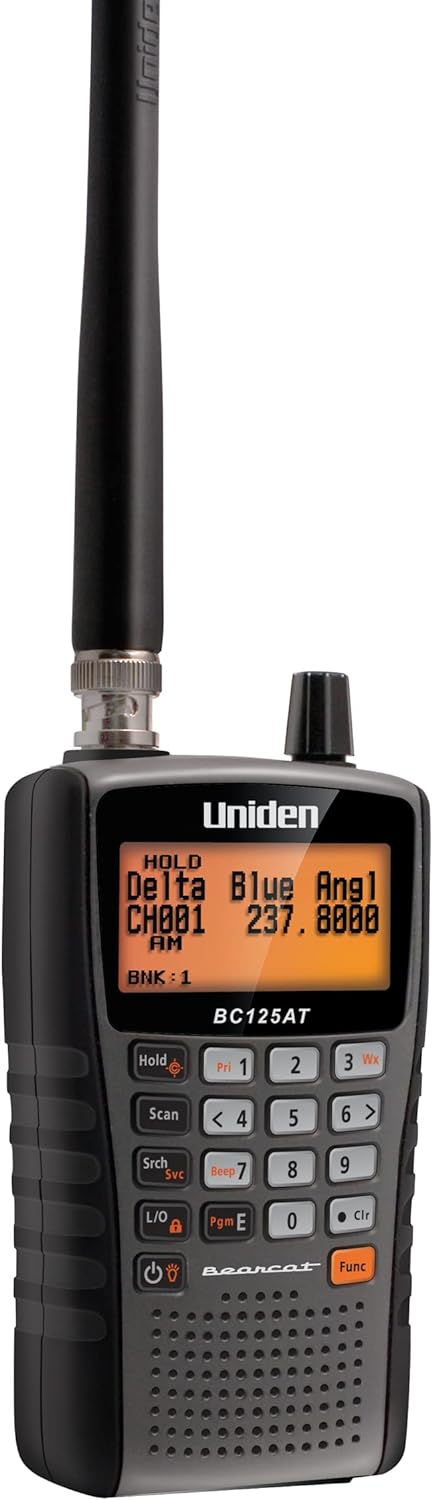 | Uniden Bearcat BC125AT | Check Price |
Our Top Picks 2  | Uniden SDS100 Scanner | Check Price |
Our Top Picks 3  | Uniden BCD436HP HomePatrol | Check Price |
Our Selected Top 12 Handheld 800mgz Police Scanner Worth Your Money
This list features reliable handheld police scanners operating on the 800MHz frequency, ideal for enthusiasts and professionals alike. Each review covers performance, user suitability, and highlights key advantages and limitations to help you make an informed choice.
1. Uniden Bearcat BC125AT Analog Handheld Scanner
Uniden Bearcat BC125AT Analog Handheld Scanner is known for its reliable analog signal reception packed into a compact design. People looking for a straightforward, easy-to-use police scanner that handles analog transmissions well will find this model appealing.
Its standout feature is the Close Call RF capture technology, which quickly picks up nearby signals.
Setting it up is simple; it runs on just two AA batteries included in the box. The 500 alpha-tagged channel capacity lets you organize frequencies for quick access.
Daily use involves scanning within its wide frequency range, from low to UHF bands, while the Do Not Disturb mode can be turned on to avoid interruptions during transmissions. The digital display helps to track and manage channels without confusion.
Performance is solid for analog channels, picking up most local transmissions clearly within its 50-kilometer range. The build feels lightweight but not particularly rugged, lacking water resistance, so it works best indoors or in dry conditions.
Positive notes include its precise Close Call feature, but many mention the limitation of not supporting newer digital trunking systems, which some emergency services now use.
The scanner picks up analog signals very well and quickly tunes to nearby transmitters, which is appreciated for local monitoring. However, its inability to handle digital radio signals from modern emergency services in some cities limits its usefulness in those areas. The battery life supports extended use, but there’s no protection from moisture.
Those relying primarily on analog channels and wanting a straightforward scanner for local police and fire communications will find it a good fit. Users needing coverage for digital or trunked systems should look for models designed for those technologies instead.
Pros
- 500 alpha-tagged channels for easy frequency management
- Close Call RF capture technology detects nearby transmissions
- Compact and lightweight for handheld use
- Digital display clarifies channel information
Cons
- Does not support digital trunked radio systems
- Not water resistant, unsuitable for wet environments
| Specification | Details |
|---|---|
| Number of Channels | 500 |
| Frequency Range | 25-54 MHz, 108-174 MHz, 225-380 MHz, 400-512 MHz (UHF) |
| Battery Average Life | 10 hours |
| Voltage | 3 volts |
| Compatible Devices | Personal Computer |
2. Uniden SDS100 Digital Handheld Scanner
Handling radio traffic with clear reception is what makes scanning satisfying, and this device handles it well. Perfect for those who want reliable access to digital and analog signals, the single biggest strength is its True I/Q receiver that keeps signals clear even in crowded or weak signal areas.
Setting it up requires just entering a zip code, which is refreshingly simple compared to manual programming. Daily use is smooth thanks to the customizable color display showing only the info you want. Updates to the HomePatrol database come through the Sentinel software, keeping local radio systems current without much fuss.
Its compact size and USB connection make it easy to recharge and store scans.
The SDS100 excels in picking up digital signals, even where other scanners struggle with simulcast or weak environments. Its build feels sturdy and thoughtfully designed for handheld use, with a microSD card slot for extra storage. Most praise revolves around its clear digital performance, while complaints often point to the complexity of some advanced features beyond the basic setup.
Clear digital reception in difficult environments stands out as the strongest praise. Many find that the advanced features add complexity beyond the initial simple setup, making the interface less intuitive for some.
Those needing strong digital and trunk tracking will appreciate this scanner’s capabilities. Users looking for a straightforward experience without a learning curve might want to consider simpler options.
Pros
- Improved digital performance in weak signal areas
- Simple zip code programming for easy setup
- Customizable full-color display
- Weekly updates for accurate signal database
Cons
- Advanced features may confuse new users
- Some users find the interface complex
| Specification | Details |
|---|---|
| Scanner Type | Digital Handheld Scanner |
| Connection Type | USB |
| Resolution | 24 Bits |
| Color Depth | 24 |
| Media Type | MicroSD Card |
3. Uniden BCD436HP HomePatrol Digital Handheld Scanner
Uniden BCD436HP HomePatrol Digital Handheld Scanner fits people looking for a simple but powerful handheld police scanner. Its biggest strength lies in its easy setup that requires no programming, making it accessible for anyone interested in tracking public safety and other emergency communications.
Setting up involves just turning on the scanner and entering your zip code. The built-in TrunkTracker V automatically handles the programming, so daily use is straightforward. Important features such as GPS connectivity and Close Call RF Capture allow quick detection of nearby frequencies, while an extra-large display makes reading information easy even on the go.
It covers a broad frequency range and scans at 85 channels per second, offering solid performance for tracking police, fire, EMS, and aircraft communications. The build focuses on usability, but is not water resistant, so care must be taken outdoors. Praise often highlights how easy it is to operate, while some mention the lack of water resistance as a drawback.
Most praise centers on the scanner’s simple operation and automatic programming by entering a zip code. A common complaint involves the lack of water resistance, which limits use in wet conditions. The scanner performs well for its intended frequencies but requires caution around moisture.
People wanting a straightforward, quick-to-set-up scanner paired with GPS will appreciate this model. Those needing a rugged, water-resistant device or rechargeable battery feature might want to look elsewhere.
Pros
- Simple one-step setup with zip code input
- Fast scanning speed of 85 channels per second
- Large, easy-to-read display screen
- Close Call RF Capture detects nearby activity
Cons
- Not water resistant for outdoor use
- Depends on AAA batteries, not rechargeable
| Specification | Details |
|---|---|
| Number of Channels | 85 |
| Frequency Range | 25-512 MHz, 758-824 MHz, 849-869 MHz, 894-960 MHz, 1240-1300 MHz |
| Battery Type | 3 AAA batteries required |
| Battery Average Life | 8 hours |
| Connectivity Protocol | GPS |
4. Uniden SDS150 Digital Radio Scanner

Lightweight and durable, the Uniden SDS150 Digital Radio Scanner suits those needing reliable reception without bulk. Its standout feature lies in improved sensitivity and filtering, cutting down on interference for clearer monitoring of digital and analog frequencies.
Getting it set up is straightforward, thanks to the simplified interface and digital display that make tuning and scanning intuitive. Battery life lasts long enough to cover extended outings, and the included charge cradle keeps it ready.
Bluetooth connectivity pairs smoothly with smartphones, while the built-in GPS supports location-based scanning through the U/AWARE app.
Signal reception covers a broad 1300 MHz range with support for multiple advanced trunking and digital formats, offering professional-grade coverage. The scanner is water-resistant and light enough for daily use, although some users have noted the single nonstandard battery as inconvenient for quick swaps. Its ruggedness stands out as a positive, while changing batteries can slow down field work.
Clear reception and filtering make monitoring straightforward and reliable, especially with digital signals. Battery life and the nonstandard battery type are often mentioned as inconvenient during active use.
Those who prioritize signal clarity and portability will appreciate this scanner. Users needing quick battery swaps or longer unattended operation might want to explore alternatives.
Pros
- Enhanced signal reception reduces interference
- Built-in GPS supports app-assisted scanning
- Lightweight yet rugged for daily use
- Bluetooth pairs with smartphones easily
Cons
- Uses a single nonstandard battery
- Battery changes can disrupt field use
| Specification | Details |
|---|---|
| Frequency | 1300 MHz |
| Connectivity Technology | Bluetooth |
| Power Source | Battery Powered |
| Display Type | digital |
| Radio Bands Supported | AM, NFM, FM, WFM, or FMB |
| Tuner Type | TrunkTracker X, APCO P25 Phase I & II, Motorola, EDACS, LTR DMR Tier III*, Hytera XPT*, Single-Channel DMR* NXDN 4800/9600*, EDACS ProVoice* |
5. Uniden Bearcat SR30C Analog Handheld Scanner

Compact size stands out immediately, making it ideal for those who want a handheld police scanner that won’t weigh them down. Perfect for beginners and occasional listeners, it offers a wide range of preset frequencies, helping you stay informed without any complicated setup.
Getting started is pretty straightforward thanks to preloaded channels covering everything from police and fire to NOAA weather. Day to day, the ability to program it via PC adds flexibility, letting you tweak what you listen to without much fuss. It runs on AA batteries or USB power, which keeps it versatile for both at-home and on-the-go use.
The scanner covers over 32,000 frequencies, giving solid coverage for analog signals with a clear audio output through headphones. Build quality feels durable, though it’s mainly plastic, which keeps it light but might not withstand heavy impacts. Many appreciate the Close Call RF Capture feature for picking up nearby activity, but some users find the mono sound limiting for detailed listening.
Many users praise the close call RF capture feature for detecting nearby transmissions quickly, helping catch important updates. At the same time, the mono audio output is often noted as a drawback, especially for those who want clearer, more detailed sound while monitoring.
People looking for a simple, affordable scanner that’s easy to carry will find this a good match. Those who need digital frequency support or a tougher build for rough environments might want to consider other options instead.
Pros
- Compact and lightweight design
- Includes preset banks for quick access
- PC programming available via USB
- Runs on AA batteries or USB power
Cons
- Mono audio limits sound clarity
- Plastic build feels less rugged
| Specification | Details |
|---|---|
| Frequency | 32000 MHz |
| Power Source | USB, Battery-Powered |
| Number of Channels | 500 |
| Radio Bands Supported | 1-Band |
| Additional Features | Close Call RF Capture, Turbo Search, PC Programming |
6. Uniden Bearcat BCD160DN Digital Handheld Scanner
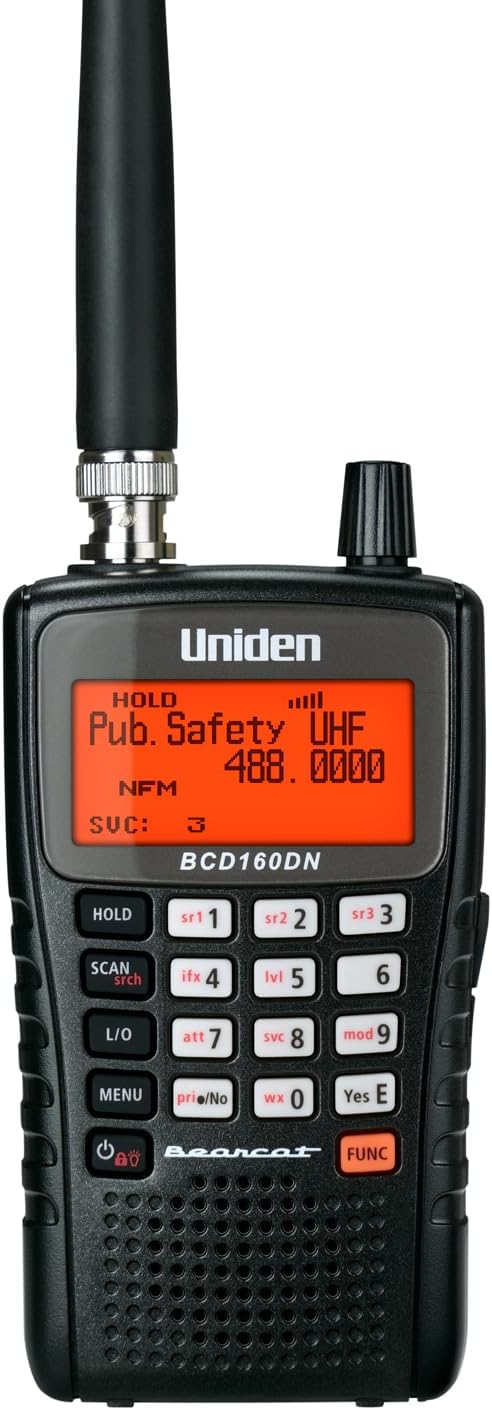
Uniden Bearcat BCD160DN is a digital handheld scanner ideal for those who want fast, reliable detection of signals without fuss. Its strongest point is rapid decoding of various tones and codes, making it easier to pinpoint what you’re listening to compared to simpler scanners.
Setting up involves connecting it via USB and using its Band Scope and search features to quickly lock onto channels. Day-to-day use benefits from its instant CTCSS and DCS code detection, which saves time when scanning through conventional digital signals. The free firmware updates add more decoding options, keeping it current without replacement.
Performance is solid for scanning digital voice systems like DMR and NXDN. It’s well-built with user convenience in mind, though it does not support trunking or encrypted transmissions. The main praise centers on how fast and accurate the decoding is.
Common complaints mention the lack of trunking support limiting its use for some radio networks.
The scanner is praised for quickly revealing tone and code information, which makes tracking down signals straightforward. Common frustrations arise from its inability to handle trunked systems or encrypted transmissions, limiting its reach in some scenarios.
People focused on conventional digital voice systems will find it very capable and user-friendly. Those needing trunk tracking or encryption removal should look at other models designed for those functions.
Pros
- Instant CTCSS and DCS code detection
- Firmware updates add new digital voice decoding
- Includes Band Scope for easier signal detection
- Supports major digital formats out of the box
Cons
- No trunking system support
- Cannot decode encrypted signals
| Specification | Details |
|---|---|
| Scanner Type | Radio Scanner |
| Connection Type | USB |
| Decoding Support | DMR, NXDN, APCO P25 Phase 1 & 2 (via update) |
| Exclusive Features | Band Scope, Rapid System/Channel Tagging |
| Signal Types | Conventional digital, Narrow-band reception |
7. Whistler WS1010 Analog Handheld Scanner
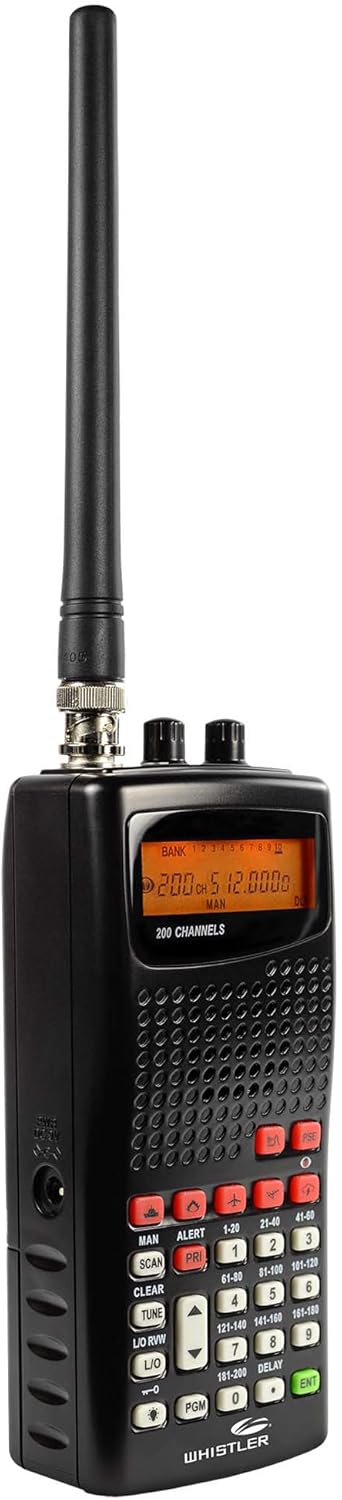
Tracking local police, fire, or weather frequencies can get tricky without a reliable scanner. The Whistler WS1010 works well for hobbyists or storm spotters wanting a straightforward, handheld device primarily focused on analog signals.
Its biggest strength lies in its wide 400 channel memory that keeps all those important frequencies ready and organized.
Setting up takes some time since programming from a PC is possible but requires extra cables and software. Once programmed, day-to-day use is smooth, you can quickly check marine, fire/police, and weather bands from the ready-made service banks.
The Spectrum Sweeper feature helps scan new nearby transmissions, while the weather alerts for specific counties bring useful, timely warnings during storms.
The compact size and light weight make it easy to carry during outdoor activities. It tunes into signals clearly and stores a large number of frequencies, which is impressive for its size. Some users mention the reliance on AA batteries may be inconvenient, and programming software isn’t built-in, so some setup hassle exists.
Otherwise, it delivers reliable performance in a sturdy handheld design.
The scanner’s strength comes from being able to store many frequencies with quick access, helping spotters and hobbyists keep up-to-date easily. The most common frustration involves the extra effort needed for programming since it isn’t fully standalone out of the box.
People wanting a portable, analog scanner with dedicated weather features will find it useful. Those looking for something more plug-and-play or rechargeable might want to explore other options.
Pros
- Large 400 channel memory capacity
- Preprogrammed service banks for ease
- Effective weather alert system included
- Compact and lightweight for portability
Cons
- Requires extra cables and software for PC programming
- Runs on AA batteries which can be less convenient
| Specification | Details |
|---|---|
| Channel Memory | 400 frequencies in 10 banks |
| Dimensions | 1.56 x 2.37 x 5.68 inches |
| Weight | 7.7 ounces |
| Batteries | 4 AA batteries (included) |
| Weather Alerting | SAME and All Hazards for specific counties |
8. Uniden BCD325P2 Handheld TrunkTracker Scanner

Scanning up to 25,000 channels with Close Call RF capture technology makes this a great pick for anyone wanting to track nearby signals quickly. It suits people interested in local police and emergency communications who want to easily hear what’s happening around them.
Setting it up is straightforward thanks to the Quick-Key System Access with 100 keys, letting you jump to your most used systems fast. Daily use revolves around tuning into signals near you automatically, aided by GPS compatibility for location-based scanning. The Advanced Dynamic Memory System helps keep your saved channels organized without constant adjustment.
Performance is solid for tracking local police and emergency communications, as the scanner supports APCO Project 25 Phase II systems ensuring you catch modern digital transmissions. The build feels durable with a clear display at 2400 dpi.
Many appreciate how easy it is to access specific frequencies quickly, but some find the 20-watt output a bit on the low side for longer-distance reception.
Many users praise how quickly it locks onto nearby radio signals using the Close Call RF technology, making local scanning straightforward. The most frequent complaint relates to the wattage, which some feel is not powerful enough for scanning distant transmissions.
Anyone focused on monitoring local emergency or police activity will find this scanner very effective. Those needing stronger range or simpler interfaces might consider other models better suited to those requirements.
Pros
- Tracks 25,000 channels with ease
- Quick-Key access for 100 favorite systems
- Close Call RF capture finds nearby signals
- Supports latest APCO Project 25 Phase II
Cons
- 20 watts may limit longer-range reception
- Some find feature setup a bit complex
| Specification | Details |
|---|---|
| Scanner Type | Radio |
| Connection Type | gps |
| Resolution | 2400 dpi |
| Wattage | 20 watts |
| Optical Sensor Technology | CCD |
| Media Type | USB |
9. Radioddity GM-30 Plus GMRS Handheld Radio

Great for outdoor enthusiasts or anyone needing reliable GMRS communication, this handheld radio stands out with its extensive channel capacity. It provides plenty of options to stay connected over long distances, making it especially useful for group activities and emergency preparedness.
Setting up is straightforward, thanks to the one-click frequency copy function that lets you match channels across devices quickly. Managing channels across ten zones is simple, and the ability to customize 970 channels means you can tailor it to specific group needs or local frequencies. Its water-resistant design also adds a layer of durability for everyday adventures or rough conditions.
The radio performs well in a variety of environments, offering up to a 15-mile range on clear channels. The build feels solid and durable enough to handle outdoor use, while battery life is decent with the included lithium-ion cell.
Most users find its 8-band receiver very versatile, though some mention that the size and bulk can be a bit cumbersome for all-day carry.
Many appreciate the wide channel options and easy copying of frequencies between units, allowing consistent communication in various settings. The main complaint revolves around size and complexity, which can make it less convenient for those looking for a simple, lightweight scanner.
Perfect for those who want customization and range in a rugged package, especially for group communications or outdoor use. Anyone prioritizing simplicity or compactness might prefer a smaller or more straightforward model instead.
Pros
- Up to 1,000 flexible channels
- One-click frequency copy between devices
- Water-resistant for outdoor use
- Includes GPS feature for added safety
Cons
- Somewhat bulky for everyday carry
- Complex interface for beginners
| Specification | Details |
|---|---|
| Number of Channels | 1000 |
| Talking Range Maximum | 15 mile |
| Voltage | 7.4 volts |
| Water Resistance Level | Water Resistant |
| Number of Batteries | 1 Lithium Ion batteries required (included) |
10. Uniden BearTracker 885 Hybrid CB and Digital Scanner
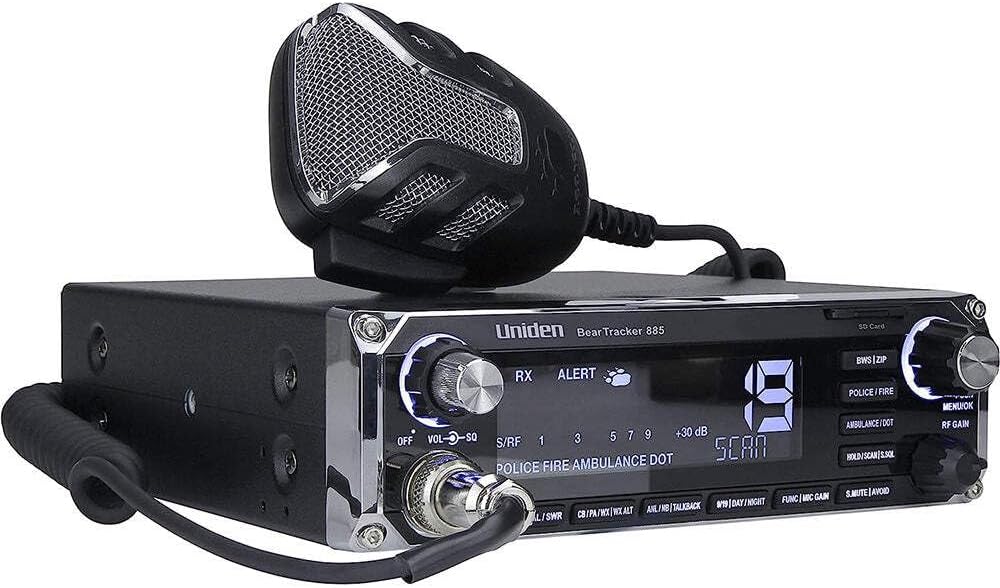
Uniden BearTracker 885 stands out by combining a CB radio with a digital police scanner and GPS for channel selection. Perfect for those needing updates on public safety communication across the US and Canada, its biggest strength is alerting you to nearby police, fire, and ambulance radio traffic automatically.
Setting up involves connecting the 12-volt power and tuning the antenna with the SWR meter for clearer reception. Everyday use benefits from features like a seven-color display that’s easy to read, NOAA weather alerts, and the BearTracker Warning System that signals active transmissions nearby.
The 40-channel CB radio adds versatility for personal or emergency communications.
Performance-wise, it excels at scanning public safety and CB channels clearly and reliably within its UHF range. Build quality answers most needs but lacks water resistance, which might be an issue outdoors.
Strongest praise highlights its accurate alerts, while the main complaint revolves around limited water resistance in practical use.
Most users appreciate the reliable alerts for nearby public safety transmissions and the smooth channel selection backed by the GPS. Complaints often focus on the lack of water resistance, making it less ideal for use in wet environments or harsh weather conditions.
People who spend most of their time indoors or in vehicles will find it dependable and feature-rich. Those needing a rugged outdoor scanner or longer talking range should consider alternatives better suited to rough conditions or extended communication distances.
Pros
- Automatic nearby channel selection via GPS
- Includes NOAA Weather alerts
- Seven-color display for easy reading
- Built-in SWR meter for fine antenna tuning
Cons
- Not water resistant, limited outdoor durability
- Maximum talking range only 1 meter
| Specification | Details |
|---|---|
| Number of Channels | 40 |
| Talking Range Maximum | 1 meter |
| Voltage | 12 volts |
| Tuner Type | UHF |
| CB Radio Power | 4-Watt RF |
11. Uniden BCD436HP Digital Handheld Scanner Bundle

Uniden BCD436HP Digital Handheld Scanner Bundle is designed for anyone needing reliable access to a wide range of frequencies across the USA and Canada. Its main strength lies in covering public safety, police, fire, EMS, and weather channels without requiring any programming, making it ideal for quick, out-of-the-box use.
Setup is straightforward since the scanner is pre-programmed to cover 1000 channels with no extra programming needed. Day-to-day use benefits from features like Close Call RF Capture to instantly lock onto nearby transmissions and GPS connectivity for location-based scanning.
The included Energizer recharge pro charger keeps batteries ready with easy tracking of charging status and automatic shut-off.
Performance delivers strong signal reception across multiple frequencies with reliable APCO 25 decoding for clear communications. The large display helps in viewing detailed information easily, though it is not water-resistant, which limits outdoor use in wet conditions. Most reviews highlight how powerful the scanning capability is, but some mention the build feels a bit bulky for extended handheld use.
The scanner offers powerful reception and easy access to a broad range of channels without programming. Charge alerts keep batteries in good shape, but the device’s size and lack of water resistance can be drawbacks for some users.
People who want quick, reliable scanning of public safety frequencies and easy battery charging will appreciate this tool. Those needing a lighter, weather-resistant scanner for outdoor use should look for other options.
Pros
- Covers extensive USA and Canada public safety frequencies
- Close Call RF Capture quickly detects nearby signals
- Energizer charger signals charging status clearly
- Large display shows detailed frequency info
Cons
- Not water resistant, limits outdoor usage
- Scanner feels bulky for prolonged handheld use
| Specification | Details |
|---|---|
| Number of Channels | 1000 |
| Additional Features | Close Call RF Capture, GPS Connectivity, Radio System Analysis and Discover Modes |
| Water Resistance Level | Not Water Resistant |
| Connectivity Protocol | GPS |
12. AT-D878UVII Plus Digital DMR & Analog Dual-Band Radio

Carrying a radio that handles both digital and analog signals smoothly really makes a difference. Perfect for law enforcement enthusiasts or communications hobbyists, it feels solid and reliable in your hand and shines with a massive channel capacity.
The ability to switch between VHF and UHF bands easily stands out as its key strength.
Setting it up involves plugging in the programming cable and using the software to load frequencies. Daily use benefits from the clear display and Bluetooth PTT feature, which makes hands-free operation simple during active scanning or communication. The included accessories like the charging cradle and USB-C battery cable ensure it’s ready to go without fuss.
The main job of picking up signals across a wide range works well, with a clear voice quality and up to 20-mile talking range delivering reliable contact. Build quality feels durable but without water resistance, so caution around moisture is needed.
Many appreciate how many channels it supports, though some note the lack of waterproofing as a drawback.
Many appreciate the wide channel support and dual-band versatility for reliable scanning and communication. The biggest downside noticed is the lack of any water resistance, meaning extra care around moisture is necessary to avoid damage.
Anyone needing broad frequency coverage and digital features will find it well suited. Casual scanners or outdoor users wanting a rugged, waterproof option might look for alternatives with better environmental protection.
Pros
- Supports both digital (DMR) and analog communication
- Large channel capacity of 4000 channels
- Bluetooth push-to-talk for hands-free use
- Includes useful accessories for charging and carrying
Cons
- Not water resistant, requires careful handling in wet environments
- Requires FCC license, limiting casual use
| Specification | Details |
|---|---|
| Dual-Band Frequency Range | VHF (136-174 MHz) & UHF (406-480 MHz) |
| Power Output | VHF (7W PK) & UHF (6W PK), 4 Power Levels selectable |
| Number of Channels | 4000 |
| Battery | 3100 mAh USB C Lithium Ion (included) |
| Talking Range Maximum | 20 mile |
Comparison of Top Handheld 800MHz Police Scanners
| Product | Channels | Frequency Range | Battery Type | Water Resistance |
|---|---|---|---|---|
| Uniden Bearcat BC125AT | 500 | 25-512 MHz UHF | 2 AA batteries | Not Water Resistant |
| Uniden SDS100 Scanner | – | – | – | – |
| Uniden BCD436HP HomePatrol | 85 | 25-1300 MHz | 3 AAA batteries | Not Water Resistant |
| Uniden SDS150 Scanner | – | – | Battery Powered | – |
| Uniden Bearcat SR30C | – | 32000 MHz | USB, Battery-Powered | – |
| Uniden BCD160DN Scanner | – | – | – | – |
| Whistler WS1010 Scanner | – | – | 4 AA batteries | – |
| Uniden BCD325P2 TrunkTracker | – | – | – | – |
| Radioddity GM-30 Plus | 1000 | 8-band receiver | 1 Lithium Ion battery | Water Resistant |
| Uniden BearTracker 885 | 40 | UHF | – | Not Water Resistant |
| Uniden BCD436HP Bundle | 1000 | – | – | Not Water Resistant |
| AT-D878UVII Plus Radio | 4000 | 136-480 MHz | 1 Lithium Ion battery | Not Water Resistant |
- Channels500
- Frequency Range25-512 MHz UHF
- Battery Type2 AA batteries
- Water ResistanceNot Water Resistant
- Channels–
- Frequency Range–
- Battery Type–
- Water Resistance–
- Channels85
- Frequency Range25-1300 MHz
- Battery Type3 AAA batteries
- Water ResistanceNot Water Resistant
- Channels–
- Frequency Range–
- Battery TypeBattery Powered
- Water Resistance–
- Channels–
- Frequency Range32000 MHz
- Battery TypeUSB, Battery-Powered
- Water Resistance–
- Channels–
- Frequency Range–
- Battery Type–
- Water Resistance–
- Channels–
- Frequency Range–
- Battery Type4 AA batteries
- Water Resistance–
- Channels–
- Frequency Range–
- Battery Type–
- Water Resistance–
- Channels1000
- Frequency Range8-band receiver
- Battery Type1 Lithium Ion battery
- Water ResistanceWater Resistant
- Channels40
- Frequency RangeUHF
- Battery Type–
- Water ResistanceNot Water Resistant
- Channels1000
- Frequency Range–
- Battery Type–
- Water ResistanceNot Water Resistant
- Channels4000
- Frequency Range136-480 MHz
- Battery Type1 Lithium Ion battery
- Water ResistanceNot Water Resistant
How to Choose the Best Handheld 800MHz Police Scanner
The most important factors to consider are frequency coverage, ease of use, and durability, as these ensure reliable scanning and long-lasting performance. Choosing the right features prevents frustration and costly replacements, making the scanner a practical and efficient tool.
Frequency Range and Compatibility
Many scanners miss out on parts of the 800 MHz range, which means important local channels can go unheard. In daily use, this leads to frustrating blind spots during scanning, especially if your region uses frequencies outside the typical VHF or UHF bands. Strong listening means confirming the device covers the full 806 to 869 MHz spectrum and can handle frequencies down to around 25 MHz.
Agencies increasingly use trunked systems and digital formats like P25, so compatibility with these modes becomes crucial. Without support for trunking or digital decoding, the scanner simply won’t tune in properly to many department communications.
Look for models that mention P25 Phase I and II support, plus conventional analog reception. This ensures access across a wide range of public safety transmissions, avoiding wasted time on dead or scrambled channels.
Reliable models also let you update firmware for newer protocols, keeping the scanner relevant as agencies upgrade their systems.
Portability and Size
A bulky handheld scanner gets old fast, especially after long periods holding it. A compact size, roughly the dimensions of a thick paperback, and light weight under 1.5 pounds make a real difference for portable use.
Smaller units sit comfortably in one hand and slip easily into a jacket pocket or belt pouch, which suits both weekend hobbyists and professionals. Ergonomics count, too. Buttons should be arranged so you can operate volume, channel changing, and scanning with your thumb, avoiding awkward stretches that cause fumbling.
The outer shell must handle some rough handling; rubberized or hardened plastic bodies resist drops and scuffs common in outdoor or roadside environments. A scanner that feels solid yet not bulky will stay in use far longer without needing a replacement or repair.
Battery Life and Power Options
Extended outings require a scanner that can run for several hours without recharging. Battery life ratings around 8 to 12 hours match typical field use with moderate scanning activity. Devices offering rechargeable lithium-ion batteries tend to save money and waste, but replaceable AA or AAA battery options provide convenient backup if power runs out unexpectedly.
Scanners with low power consumption modes help stretch this further by dimming displays or pausing scan intervals. A clear battery status indicator, either a small screen icon or audible alert, prevents surprises mid-session.
Without this, you could miss important transmissions because the unit shut off suddenly. Models that accept USB charging add convenience for recharging on the go using battery packs or car adapters.
User Interface and Ease of Use
Spending time fiddling with tiny buttons or struggling to read a washed-out screen wastes precious minutes during a live scan. Displays that combine backlighting with a crisp, high-contrast LCD prove easiest to read in direct sunlight or dim environments. Simple menus that avoid nested layers allow quick access to favorites and scanning modes.
Controls should include programmable presets allowing instant switching between commonly used channels or trunked talk groups. Physical buttons for start/stop scanning or volume changes are faster than relying solely on touchscreen input.
Look for models with well-labeled keys and menus structured logically, this cuts down time spent navigating complex setups during fast-paced listening.
Audio Quality and Output Options
A speaker with thin or distorted sound makes it hard to catch crucial details in transmissions, especially sirens or urgent voices. Good handheld scanners offer clear, loud built-in speakers that fill a small room without distortion at max volume.
People who value privacy or require quieter settings like having a 3.5mm headphone jack or Bluetooth option for external audio. Noise reduction features help filter out static or background interference, offering crisper sound but rarely eliminating all noise. Audio enhancement options, like adjustable equalizers or bass boost, can improve voice clarity in noisy surroundings.
Prioritize models supporting multiple output methods to match your listening preferences during extended scanning sessions.
Optimizing Scan Settings for Clearer Reception
Adjusting the squelch control on a handheld 800MHz police scanner is key to reducing background static and improving audio clarity. Setting the squelch too low will let in noise, while too high a setting might block weaker signals.
Frequency precision also impacts reception; many scanners allow fine-tuning of individual frequencies by a few kilohertz, minimizing interference. Antenna placement matters, too. A handheld scanner with a flexible or extendable antenna can be oriented for better signal strength.
Environmental factors like nearby buildings or electronic devices can cause reception issues, so test scan performance in different locations whenever possible. Program commonly accessed frequencies first to avoid spending time manually searching during critical moments. Utilizing lockout features helps skip noisy or inactive channels, making scanning more efficient and focused on relevant communications.
Essential Maintenance Tips to Prolong Your Scanner’s Lifespan
Keeping the handheld 800MHz scanner in good working order starts with regular cleaning. Wipe down the exterior and antenna connections with a dry cloth to prevent dust build-up that can block signal paths.
Avoid using harsh chemicals or excessive moisture near openings or battery compartments. Replace batteries as needed and always use the recommended type to prevent leakage or power issues. Store the scanner in a protective case to minimize drops or impacts that could damage internal components.
Updating the firmware, if supported, ensures the scanner operates with the latest fixes and enhancements. Check connectors and antenna mounts for signs of corrosion or wear, replacing parts before problems develop.
Routine functional checks help spot reception or audio quality decline early, allowing timely servicing rather than unexpected failures in the middle of a scan session.
Comparing Handheld 800MHz Scanners with Mobile and Base Unit Models
Handheld 800MHz scanners offer portability that mobile and base units cannot match, making them ideal for field use. They tend to have smaller antennas, which can limit reception range compared to larger, fixed antennas on base models. Mobile scanners typically connect to your vehicle’s power and antennas, providing stronger, more consistent signal pickup while driving.
Base units often support more simultaneous frequencies and longer scanning sessions without battery concerns, useful for station setups. Handheld devices rely on batteries and have smaller screens, simplifying controls but sometimes limiting advanced features like trunking system support or large memory banks.
Choosing between types depends on use cases: handhelds suit occasional, on-the-go listening, while mobile and base options handle extensive scanning from fixed or vehicular locations more effectively.
People Also Asked
How Do I Properly Care for My Handheld 800MHz Police Scanner?
Keep the scanner clean and dry, avoid dropping it, and store it in a protective case when not in use. Regularly check the antenna and battery contacts for corrosion to maintain good signal quality.
Is the Handheld 800MHz Police Scanner Safe to Use Indoors?
The scanner is safe to use indoors, just keep it away from large metal objects or electronics that might interfere with the signal reception. Placing it near a window often improves the scanning range inside.
What Size Handheld 800MHz Police Scanner Fits Easily in a Pocket?
A handheld 800MHz police scanner that is around 5 to 6 inches tall and 2 to 3 inches wide typically fits comfortably in a standard pocket. Try holding one in your hand before buying to ensure it matches your comfort and portability needs.
How Long Does the Battery of a Handheld 800MHz Police Scanner Last?
The battery life usually ranges from 8 to 12 hours depending on the model and usage. Carrying a spare rechargeable battery or portable charger can keep you scanning during long outings or events.
What Common Problems Occur with Handheld 800MHz Police Scanners and Fixes?
Common issues include weak reception due to a damaged antenna and batteries draining quickly. Cleaning contacts, replacing old batteries, and tightening antenna connections often solve these problems without professional repair.
Conclusion
Choosing a handheld 800MHz police scanner comes down to clear reception, ease of programming, and battery life. These factors make sure you can pick up the signals you need without frequent interruptions or complicated setup. A scanner that holds its charge well and can be programmed efficiently stands out in daily use.
Consider how often you will use the scanner and where it will be used to decide on the size and budget. Small, lightweight models suit frequent use on the go, while more affordable options might be fine for occasional listening.
Check the comparison table above to match features and prices with your needs. This helps find a scanner that fits your routine without overspending.