Top 12 Best Hand Crank Walkie Talkies That Won’t Fail You
Many people who rely on walkie talkies understand the frustration when the gear dies at the worst moment. The best hand crank walkie talkies solve this by providing a reliable power source without batteries, preventing communication breakdowns during outdoor activities or emergencies.
A cheap or poorly designed crank radio often has a flimsy crank mechanism that breaks easily or a short battery life that leaves you stranded in the middle of nowhere.
Good hand crank walkie talkies have a durable, weather-resistant casing, often made from impact-resistant plastic or rubberized materials to handle drops and rough use. Their crank handles are built for frequent use without loosening, typically requiring about 1-2 minutes of cranking for a 10-15 minute transmission window.
Compact size and a snug fit make them easy to carry, while clear buttons and simple cleaning keep them practical in any environment.
Need a Quick Check?
| Image | Product | Price |
|---|---|---|
Our Top Picks 1  | Generic Long Range Walkie Talkies | Check Price |
Our Top Picks 2  | Emergency NOAA Walkie Talkies | Check Price |
Our Top Picks 3  | Kaito Voyager Ranger Radios | Check Price |
Our Selected Top 12 Hand Crank Walkie Talkies Picks for Every Need
This list features reliable hand crank walkie talkies designed for various uses, from casual outdoor activities to emergency situations. Each review explains how well the device performs, who it’s best suited for, and highlights its main advantages and drawbacks to help you decide.
1. Walkie Talkies Long Range 2-Way Radio
3-mile maximum range makes these walkie talkies great for connecting up to a small team outdoors. Designed for durability and clear communication, they fit well with hikers, campers, or families needing a reliable way to stay in touch during emergencies or over uneven terrain.
Setup is simple with 22 FRS channels and 99 privacy codes that work smoothly with other FRS radios. The lightweight build keeps them handy during long outings. An integrated flashlight and emergency alarm add extra security without complicating daily use.
Power comes from a rechargeable lithium ion battery included in the package.
Communication stays clear within the advertised 3-mile range under good conditions. The rugged build holds up well against drops and rough handling, thanks to a shockproof and dustproof design.
Common praise highlights the sturdy buttons and overall toughness. Some mention its lack of water resistance as a downside in wet weather situations.
The walkie talkies’ strong build and durable buttons stand out as a benefit for rough outdoor use. Many appreciate clear communication and easy channel switching. The main complaint is the lack of water resistance, which limits use in rain or wet environments.
People who spend time hiking, camping, or who want emergency tools appreciate this model. Those needing waterproof radios or longer ranges might want to look elsewhere for options suited to wetter or larger area needs.
Pros
- Shockproof and dustproof for tough conditions
- Compatible with most FRS radios
- Includes rechargeable lithium ion battery
- Emergency alarm and flashlight built-in
Cons
- Not water resistant, limited in wet conditions
- Range may decrease with obstacles or dense forests
| Specification | Details |
|---|---|
| Number of Channels | 22 |
| Talking Range Maximum | 3 mile |
| Water Resistance Level | Not Water Resistant |
| Number of Batteries | 1 Lithium Ion batteries required. (included) |
| Additional Features | Emergency Alarm, Integrated Flashlight, Lightweight, Long Range, Weather Alert |
2. Emergency Walkie Talkies with NOAA and FM
Great for outdoor enthusiasts and emergency preppers, these walkie talkies combine communication and weather alerts in one device. Their biggest strength lies in keeping you informed with automatic NOAA weather alerts alongside reliable long-range communication, making them ideal for hiking, camping, or staying safe during emergencies.
Getting started is straightforward since the rechargeable lithium-ion battery comes included. The 22 channels and 99 privacy codes let you find a clear line to talk up to 10 miles away on open ground. Auto-scanning and VOX hands-free operation make everyday use easier.
The built-in FM radio provides entertainment or news when you’re off the grid, and the flashlight is handy during nighttime activities.
Communication remains clear over significant distances and the devices hold up well to outdoor conditions with water-repellent design. Users praise the dependable weather alerts and solid signal clarity.
The most frequently noted downside is that the 10-mile range can be less depending on the terrain and obstructions encountered.
Strong weather alert features and clear communication over distances stand out as key benefits. The most common issue is the limited effective range depending on surroundings. This affects expectations more than functionality.
Anyone needing dependable emergency alerts and moderate-range communication will appreciate these walkie talkies. Those seeking extended range or waterproof models should explore other options better suited for rougher conditions.
Pros
- Weather alerts keep you informed of emergencies
- Rechargeable battery included for convenience
- Built-in flashlight useful in low light
- Clear audio with long-range capability
Cons
- Range decreases significantly in rough terrain
- Water repellent, not fully waterproof
| Specification | Details |
|---|---|
| Number of Channels | 22 |
| Talking Range Maximum | 10 miles |
| Water Resistance Level | Water Repellent |
| Number of Batteries | 1 Lithium Ion batteries required. (included) |
| Connectivity Protocol | FRS |
3. Kaito Voyager Ranger Rechargeable Walkie Talkies
Kaito Voyager Ranger Rechargeable Walkie Talkies stand out for their dual-crank power system, ideal for anyone who needs a reliable communication device in emergencies or off-grid situations. Its biggest strength is generating manual power instantly, making dead batteries a non-issue.
Setting up is straightforward, just charge the built-in battery or rely on the hand crank when other power sources aren’t available. Day-to-day use benefits from the 10 available channels, compatibility with other Kaito radios, and handy extras like the integrated flashlight and belt clip. Weather alerts keep you informed, which adds a layer of safety during outdoor use.
Signal range is solid for typical walkie talkie needs, and the build feels weather resistant enough for rough conditions. Most praise revolves around the crank system that really works when needed.
Some users mention that it runs on a nonstandard battery, which could make replacements less convenient.
The manual crank reliably provides emergency power, ensuring communication when other sources fail. The most common downside involves the uncommon battery type, which can complicate replacements and maintenance over time. The radio’s simplicity and weather alerts add significant value to those relying on it during unexpected outages or outdoor activities.
Anyone looking for dependable emergency communication with a backup power option will find it useful. It’s suited for outdoor enthusiasts and emergency kits. People wanting more channels or standard batteries for easy replacement might want to consider other models instead.
Pros
- Hand crank generates power without batteries
- Built-in NOAA weather alerts for safety
- Compatible with other Kaito radios on same channels
- Includes flashlight and belt clip
Cons
- Uses a nonstandard battery that might be hard to replace
- Limited to 10 channels for communication
| Specification | Details |
|---|---|
| Number of Channels | 10 |
| Water Resistance Level | Water Resistant |
| Number of Batteries | 1 Nonstandard Battery batteries required (included) |
| Connectivity Protocol | Two-Way Radio Frequency |
| Additional Features | Integrated Flashlight, Long Range, Rechargeable, Weather Alert |
4. Qniglo Rechargeable Emergency Walkie Talkies

Qniglo Rechargeable Emergency Walkie Talkies are designed for those wanting reliable communication paired with weather updates, making them great for outdoor enthusiasts and emergency preparedness. Their standout feature is the built-in NOAA Emergency Weather Alert Radio that monitors changing weather conditions automatically.
Setting up these walkie talkies is straightforward thanks to their rechargeable battery and auto channel scanning, allowing quick connection. Day-to-day, switching between 22 channels and 99 privacy codes helps keep conversations clear.
The VOX feature enables hands-free use, and the low battery alert ensures you don’t get caught off guard.
Performance-wise, these walkie talkies cover up to a 3-mile range, which is solid for casual to moderate outdoor use. The build is functional though not water resistant, so care is needed in wet conditions. The NOAA radio functionality is highly appreciated, while the lack of water resistance is the most frequent drawback.
The NOAA weather alert radio is highly praised for keeping users informed of severe weather in real-time, while the lack of water resistance is a common complaint that affects usability outdoors in wet conditions.
Those needing dependable weather updates alongside reliable walkie talkie features will appreciate these units. People expecting heavy-duty or waterproof radios should consider other options better suited to harsh environments.
Pros
- Includes rechargeable lithium ion battery
- Built-in NOAA weather alerts
- Voice-activated communication (VOX)
- Auto channel scanning with 99 privacy codes
Cons
- Not water resistant, avoid moisture exposure
- Range limited to 3 miles in open areas
| Specification | Details |
|---|---|
| Number of Channels | 22 |
| Talking Range Maximum | 3 mile |
| Number of Batteries | 1 Lithium Ion battery (included) |
| Connectivity Protocol | FRS, NOAA |
| Water Resistance Level | Not Water Resistant |
5. Midland XT511 Emergency 22-Channel Radio

Using the Midland XT511 feels straightforward and reliable when you need clear communication outdoors or in emergencies. Its greatest strength lies in offering multiple power options to keep you connected even when batteries run low or charging isn’t possible, making it ideal for camping, hiking, or prepping for power outages.
Setup requires just putting in the included 4 AA batteries, then scanning its 22 GMRS channels to find an active one. The privacy codes make it easy to have secure conversations without overhearing others.
The radio’s dust resistance and water resistance levels provide confidence in rough environments, and the call alert feature helps catch attention quickly during use.
Transmission quality holds strong up to the maximum 36-mile range under ideal conditions, while the radio’s solid build stands up well to outdoor use. Most praise praises its battery flexibility and water-resistant design, but some mention the average 8-hour battery life could limit longer outings.
Its 22 channels and extensive privacy codes allow a good mix of options without complications.
The strongest plus is the flexibility of power sources and secure communication through many privacy codes. On the downside, the battery life averages only 8 hours, which might require carrying extras for longer use. Built solidly for outdoor conditions, it handles dust and water exposure well.
Ideal for outdoor enthusiasts who want versatility in power and clear channels for private chats. Those needing longer battery life or more channels might want to look elsewhere for alternatives. Great for emergency kits and spotting quickly reachable call alerts.
Pros
- Offers five different power options
- Supports 3,144 privacy code combinations
- Water resistant and dust proof design
- Clear communication up to 36 miles
Cons
- Battery life around 8 hours can be limiting
- Only 22 channels despite many privacy codes
| Specification | Details |
|---|---|
| Number of Channels | 22 |
| Battery Average Life | 8 hours |
| Power Source | 5 types (including 4 AA batteries) |
| Water Resistance Level | Water Resistant |
| Talking Range Maximum | 36 mile |
| Additional Features | Call Alert, Dust Proof |
6. Retevis RT-5R Dual Band Walkie Talkies 2 Pack

Strong, long-range communication makes these walkie talkies great for outdoor enthusiasts who venture into rugged terrain. Dual band and 128 channels offer flexibility, while the shoulder mic adds convenience during active use. The standout feature is their ability to connect to repeaters, extending communication over mountainous areas.
Setup involves charging the included 1400mAh Li-ion batteries and basic programming with CHIRP software to customize channels. Day-to-day use feels solid; the walkie talkies respond well to both short chats and longer transmissions.
The shoulder microphone comes in handy, allowing hands-free listening and talking without holding the device constantly.
The radios deliver strong transmission signals and clear audio up to long distances, suited for environments where obstacles might block weaker devices. Build quality feels durable though the units are not water resistant, which is a consideration for wet conditions. Many users note the powerful signal and extended range, while some mention the lack of waterproofing as a drawback.
The radios get praised for their impressive transmission range and reliable connection in mountainous terrain, making them useful where other walkie talkies struggle. The most common issue reported is the lack of water resistance, which means caution is needed in wet or rainy environments.
This set suits those who need extensive range and flexibility, especially outdoors in rough landscapes. People expecting rugged waterproof devices for extreme weather might want to look for different options better designed for wet conditions.
Pros
- Long transmission range with strong signal penetration
- Customizable through CHIRP software
- Shoulder microphone allows hands-free communication
- Compatible with various GMRS walkie talkies
Cons
- Not water resistant
- Requires charging lithium-ion batteries
| Specification | Details |
|---|---|
| Number of Channels | 128 |
| Frequency Range | UV |
| Battery Type | 2 Lithium Ion batteries included |
| Battery Average Life | 12 hours |
| Voltage | 7.4 volts_of_direct_current |
7. Rechargeable Walkie Talkies 4 Pack

Plastic-bodied and lightweight, these walkie talkies suit families, campers, and small group outings who need reliable short-range communication. Their biggest strength lies in offering multiple useful features like 22 FRS channels and NOAA weather alerts without adding bulk or complexity.
Setup is straightforward thanks to USB-C charging that works with common power sources such as power banks, PCs, and car adapters. Day-to-day use includes easy volume and channel adjustments, plus a bright flashlight for low-light conditions. The large LCD screen and keypad lock keep it simple and help avoid accidental changes while you’re active outdoors.
Communication range is generally good for neighborhood and campsite use, reaching up to 3 miles in open land but dropping behind buildings and hills. The build feels durable yet light enough to carry all day. Most users appreciate the battery saver mode and VOX hands-free talk functionality.
Some mention that it isn’t water resistant, which requires care during wet weather or near water.
Strongest praise highlights the long standby time and flexible charging through USB-C, making it easy to keep powered on the go. A common complaint revolves around its lack of water resistance, which limits use in wet or rainy environments.
Those spending time in neighborhoods, campsites, or flat open areas will find this set very practical and simple. People needing walkies for wet conditions or longer line-of-sight range might want to search for more rugged or powerful units instead.
Pros
- USB-C charging for versatile power options
- Lightweight design easy to carry
- Bright flashlight included
- 22 FRS channels for flexible communication
Cons
- Not water resistant, needs careful handling
- Signal range reduced near buildings and trees
| Specification | Details |
|---|---|
| Number of Channels | 22 |
| Talking Range Maximum | 3 mile |
| Battery Type | 4 Lithium Ion batteries required (included) |
| Charging Port | USB-C |
| Water Resistance Level | Not Water Resistant |
8. Baofeng UV-5R Ham Radio Handheld

Strong signal strength is what stands out most about the Baofeng UV-5R Ham Radio Handheld. It works well for people who need reliable communication over longer distances, especially outdoors. Its versatility in covering VHF, UHF, and GMRS bands really makes it a solid pick for outdoor enthusiasts and hobbyists alike.
Setting up the radio involves installing the included two 9V batteries and attaching the foldable 18.89-inch tactical antenna for better range. Day-to-day use feels practical thanks to adjustable power settings and useful features like hands-free VOX talk, a built-in flashlight, and a keypad lock to avoid accidental changes.
Charging with a Type-C cable adds convenience during longer trips.
The radio performs strongly in sending clear signals even at longer distances thanks to its adjustable power output up to 8W and tactical antenna. Riders note the solid construction but also mention the lack of water resistance as a drawback.
The built-in flashlight and FM radio are handy extras, while the main gripe revolves around carrying two 9V batteries which can add weight.
Signal clarity and long communication range receive the most praise, thanks to the upgradeable tactical antenna and adjustable power output. The main downside noted is the lack of water resistance, making it less suited for very wet or rainy conditions. Carrying the two 9V batteries adds bulk compared to more compact options.
Those who need reliable, longer-range communication and appreciate a variety of features will find it a good fit. People planning to use it in wet environments or who want lighter, waterproof alternatives might want to look elsewhere. It suits outdoor hobbies, ham radio enthusiasts, and folks needing versatile band coverage.
Pros
- Expandable range with foldable 18.89-inch antenna
- VOX hands-free talk for convenient use
- Multiple power settings for customized range
- Type-C charging supports modern cables
Cons
- Not water resistant for wet environments
- Requires two bulky 9V batteries
| Specification | Details |
|---|---|
| Number of Channels | 128 |
| Frequency Range | VHF UHF |
| Power Output | Adjustable 8W high/medium/low |
| Battery | 2 9V batteries required (included) |
| Additional Features | Battery Saver Mode, Copy Frequency, Integrated Flashlight, Keypad Lock, Type-C Charger |
| Water Resistance Level | Not Water Resistant |
9. Radioddity X1 Pro GMRS Waterproof Radio

Built for serious outdoor use, these walkie talkies are perfect for camping and off-road adventures where reliability matters most. Their biggest strength lies in a waterproof design and a powerful battery that keeps them running long hours, even in tough conditions.
Setting the radios up is straightforward, especially with USB-C charging that works directly from vehicles or power banks. Carrying two 9V batteries provides backup power, so you won’t be caught off guard.
The 30 available channels make tuning into the right frequency simple, and voice-operated transmission helps keep hands free during active use.
Communication stays clear up to a 7-mile range, ideal for wide-open areas. The rugged ABS housing stands up to drops and harsh environments, backed by IP67 waterproofing that protects against mud and water immersion for up to 30 minutes.
Most praise focuses on durability, while some mention the need to manage battery swaps carefully.
The radios hold up exceptionally well against drops and harsh weather, and the waterproof feature works as promised during rain and mud exposure. Clear voice transmission across multiple channels makes long-distance talks reliable. Common drawbacks include keeping an eye on the battery supply, as continuous use requires frequent swaps.
People wanting durable, long-lasting communication during outdoor activities will find these radios a solid choice. Those looking for lighter or rechargeable-only options without battery swapping may want to explore alternatives better suited for short or casual use.
Pros
- IP67 waterproof for 30 minutes of submersion
- USB-C charging for quick and flexible power
- Long 7-mile maximum communication range
- Shockproof and drop-tested rugged build
Cons
- Requires managing two 9V batteries
- Battery swap needed to maintain continuous use
| Specification | Details |
|---|---|
| Number of Channels | 30 |
| Frequency Range | GMRS |
| Talking Range Maximum | 7 mile |
| Battery Average Life | 48 days |
| Voltage | 7.4 volts |
| Number of Batteries | 2 9V batteries required. (included) |
10. Baofeng MP31 GMRS Waterproof Radios 2 Pack

Staying connected on hikes or at campsites often means relying on radios that hold a charge and work in the rain. Baofeng MP31 GMRS Waterproof Radios 2 Pack fits well for groups needing reliable communication up to 5 miles away, especially outdoors.
Its waterproof design makes it great for active use without worrying about weather damage.
Getting started is straightforward since the radios come ready to use right out of the box. The 22 GMRS channels plus additional repeater channels mean you can find a clear frequency quickly. Battery-saving features and a low alert keep the radios running longer, and hands-free VOX makes chatting while busy easier.
Programming extra channels or settings is an option through a PC or keypad, offering flexibility for bigger groups or different situations.
Call quality stays clear within the 5-mile range if you stay in open areas. The build feels solid and water-resistant at an IP54 level, so splashes and light rain are not a worry. The most praised aspect is its reliable water resistance and simple use for groups.
Some users find the battery life limited for extended trips, which may require extra power sources.
Waterproof performance stands out as a key strength, alongside straightforward use in group settings. The common issue relates to battery life, which might need management during extended outdoor activities. Users praise the ruggedness, but some note range limitations depending on environment.
Those who spend time outdoors in various weather and need flexible channel options will appreciate this radio pack. People planning very long trips without recharging options may want to explore alternatives with longer battery life. Ideal for casual to moderate outdoor use within a few miles.
Pros
- Compatible with FRS and GMRS radios
- Built-in VOX hands-free function
- Waterproof design suitable for outdoors
- Multiple private codes for secure chats
Cons
- Battery life can be short for long outings
- Range reduces in heavily wooded or urban areas
| Specification | Details |
|---|---|
| Number of Channels | 38 |
| Talking Range Maximum | 5 mile |
| Water Resistance Level | Water Resistant (IP54) |
| Voltage | 3.7 volts |
| Connectivity Protocol | GMRS |
11. Radioddity GM-30 GMRS Handheld Radio 2 Pack
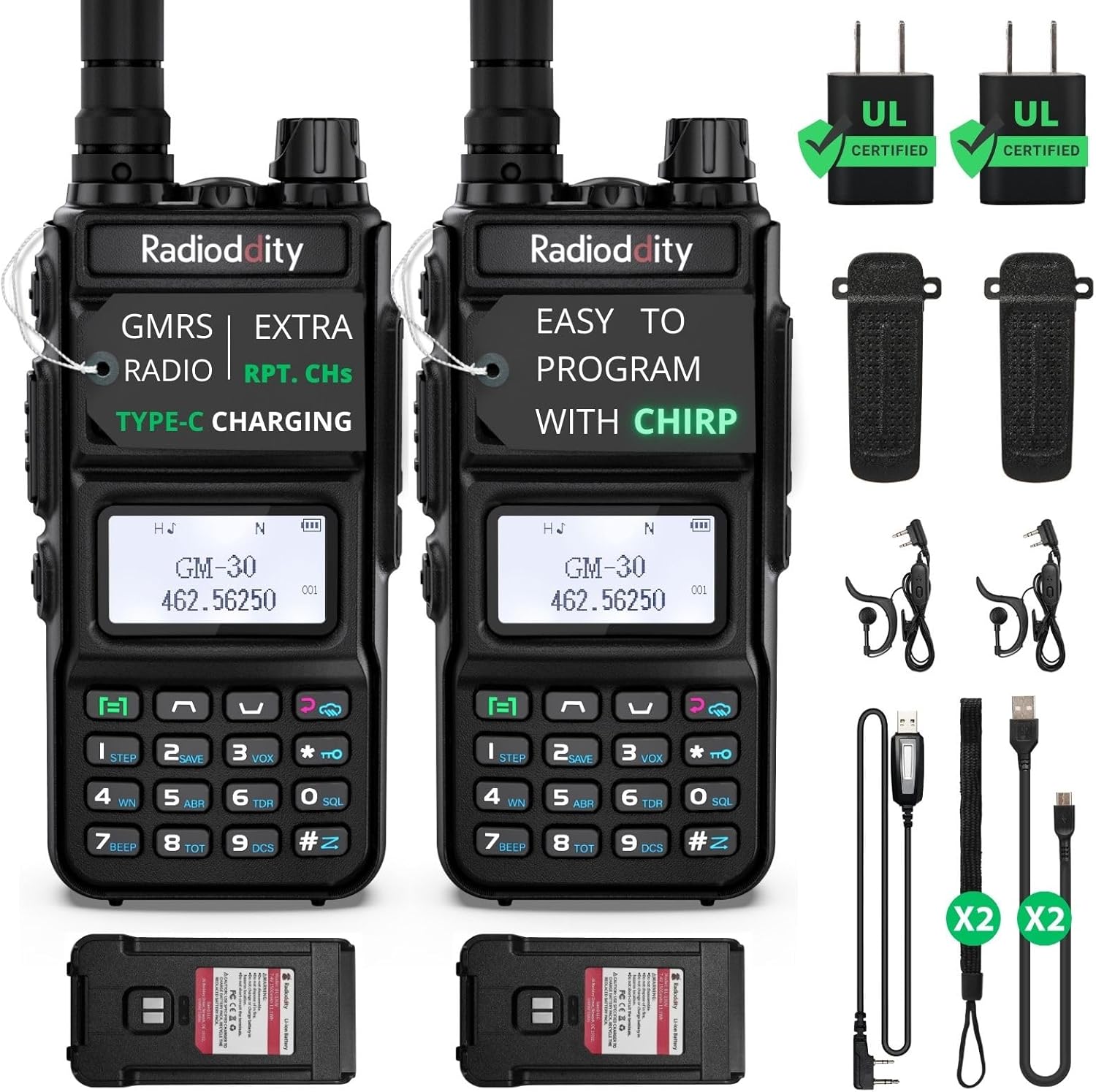
Up to 5 miles talking range stands out most in these Radioddity GM-30 GMRS radios. Perfect for outdoor adventures or neighborhood communication, they fit well where reliable distance and multiple channel options matter. Their biggest plus is having 250 channels with easy programming to keep conversations clear and flexible.
Starting to use the radios was straightforward with 30 preset channels ready to go, including 22 for GMRS and 8 for repeaters. Day-to-day, switching between UHF and VHF bands helps catch the right signals.
The dual watch mode means monitoring two channels at once, which comes in handy. Programming via PC or keypad allows tweaking settings without hassle, making it adaptable when on the move.
Range lives up to the 5-mile claim in good conditions, and the unit feels solid and water-resistant enough for outdoor use. Most praise focuses on the wide channel selection and scanning options, which work reliably.
Common complaints mention that despite water resistance, it’s not fully waterproof, and battery life could be better in high-use scenarios.
Channel options and scanning features get high marks, making communication clear and versatile. Water resistance protects against weather, yet concerns arise around battery longevity and lack of full waterproofing.
Those needing flexible channel settings and mid-range communication will appreciate these radios. People requiring longer battery life or full waterproofing might want to explore other models designed for harsher conditions.
Pros
- Supports both GMRS and UHF/VHF scanning
- Easy PC and keypad programming
- Dual watch for monitoring two channels
- Includes 2 rechargeable lithium-ion batteries
Cons
- Water resistant but not fully waterproof
- Battery life dips under heavy use
| Specification | Details |
|---|---|
| Number of Channels | 250 |
| Talking Range Maximum | 5 mile |
| Voltage | 7.4 volts |
| Water Resistance Level | Water Resistant |
| Number of Batteries | 2 Lithium Ion batteries required (included) |
12. Retevis H777 Rechargeable FRS Walkie Talkies 3 Pack

Ideal for outdoor enthusiasts and small teams, the Retevis H777 Rechargeable FRS Walkie Talkies 3 Pack offers solid compatibility across multiple devices. Its biggest strength lies in quick, easy communication on a shared frequency, making group coordination straightforward without the need for complicated setup.
Setting these walkie talkies up is simple, as all three come pre-set to the same frequency and tone, so you can start talking right away. The side buttons provide quick access to VOX hands-free use, an emergency alarm, and a built-in flashlight, handy for nighttime outdoor activities.
Pairing across devices is fast, saving time when switching units during group outings.
Communication across the included 16 channels works reliably up to 1.5 miles under ideal conditions. The build feels sturdy and water-resistant, ready to handle outdoor use and varying temperatures from -20 to 60 °C. Users appreciate the battery life of around 12 hours but mention some wish for a longer range or louder volume beyond the 70 dB limit.
Reliable communication on shared frequencies and quick access to emergency functions earn strong praise. Most users mention wishing for a greater range or more volume as the main drawback.
People needing straightforward and quick group communication in close-range outdoor settings will appreciate these radios. Those requiring longer distances or louder audio should consider other options.
Pros
- Pre-set frequency for instant group use
- Emergency alarm and flashlight included
- Easy one-touch operation for key functions
- Rechargeable lithium-ion battery included
Cons
- Maximum range limited to 1.5 miles
- Volume capped at 70 dB may be low outdoors
| Specification | Details |
|---|---|
| Number of Channels | 16 |
| Talking Range Maximum | 1.5 miles |
| Battery Average Life | 12 hours |
| Water Resistance Level | Water Resistant |
| Temperature Range | -20-60 °C |
| Voltage | 3.7 volts |
Best Hand Crank Walkie Talkies Comparison Table
| Product | Channels | Talking Range | Water Resistance | Power Source |
|---|---|---|---|---|
| Generic Long Range Walkie Talkies | 22 | 3 mile | Not Water Resistant | 1 Lithium Ion |
| Emergency NOAA Walkie Talkies | 22 | 10 miles | Water Repellent | 1 Lithium Ion |
| Kaito Voyager Ranger Radios | 10 | – | Water Resistant | 1 Nonstandard Battery |
| Qniglo Rechargeable Walkie Talkies | 22 | 3 mile | Not Water Resistant | 1 Lithium Ion |
| Midland XT511 Emergency Radio | 22 | 36 mile | Water Resistant | 4 AA batteries |
| Retevis RT-5R Dual Band Pack | 128 | – | Not Water Resistant | 2 Lithium Ion |
| 4 Pack Rechargeable Walkie Talkies | 22 | 3 mile | Not Water Resistant | 4 Lithium Ion |
| Baofeng UV-5R Handheld Radio | 128 | – | Not Water Resistant | 2 9V batteries |
| Radioddity X1 Pro GMRS Radio | 30 | 7 mile | Waterproof | 2 9V batteries |
| Baofeng MP31 GMRS Radios | 38 | 5 mile | Water Resistant | 2 Lithium Ion |
| Radioddity GM-30 GMRS Pack | 250 | 5 mile | Water Resistant | 2 Lithium Ion |
| Retevis H777 FRS 3 Pack | 16 | 1.5 miles | Water Resistant | 1 Lithium Ion |
- Channels22
- Talking Range3 mile
- Water ResistanceNot Water Resistant
- Power Source1 Lithium Ion
- Channels22
- Talking Range10 miles
- Water ResistanceWater Repellent
- Power Source1 Lithium Ion
- Channels10
- Talking Range–
- Water ResistanceWater Resistant
- Power Source1 Nonstandard Battery
- Channels22
- Talking Range3 mile
- Water ResistanceNot Water Resistant
- Power Source1 Lithium Ion
- Channels22
- Talking Range36 mile
- Water ResistanceWater Resistant
- Power Source4 AA batteries
- Channels128
- Talking Range–
- Water ResistanceNot Water Resistant
- Power Source2 Lithium Ion
- Channels22
- Talking Range3 mile
- Water ResistanceNot Water Resistant
- Power Source4 Lithium Ion
- Channels128
- Talking Range–
- Water ResistanceNot Water Resistant
- Power Source2 9V batteries
- Channels30
- Talking Range7 mile
- Water ResistanceWaterproof
- Power Source2 9V batteries
- Channels38
- Talking Range5 mile
- Water ResistanceWater Resistant
- Power Source2 Lithium Ion
- Channels250
- Talking Range5 mile
- Water ResistanceWater Resistant
- Power Source2 Lithium Ion
- Channels16
- Talking Range1.5 miles
- Water ResistanceWater Resistant
- Power Source1 Lithium Ion
How to Choose the Right Hand Crank Walkie Talkie
Consider factors like battery life, durability, signal range, and ease of use when selecting a hand crank walkie talkie. Choosing the right features ensures reliable communication during emergencies and outdoor activities, ultimately preventing frustration and unnecessary expenses from frequent replacements or poor performance.
Power and Battery Life
Cranking a hand-powered communication device can quickly drain the user’s energy unless the mechanism converts motion into charge efficiently. Some models require over a minute of cranking for just a few minutes of talk time, which proves frustrating in urgent situations. A good device balances cranking speed with storage capacity, typically featuring a backup rechargeable battery, often lithium-ion, that holds charge for extended standby periods.
Power consumption varies, especially between active use and standby, with the device generally needing under 200 mAh in use and much less when idle.
Devices with battery capacities around 1000 mAh or higher allow longer use without frequent recharging, while efficient hand cranks make emergency power readily accessible. Selecting one with clear specs on charging speed and backup battery type helps avoid unexpectedly dead units in the field.
Low power consumption during standby also ensures the device stays ready longer without manual recharging.
Range and Signal Clarity
Communication range numbers often cited by manufacturers usually only apply in open, unobstructed environments. Real-life performance can shrink drastically amid buildings, trees, or hills. A solid model maintains a reliable connection over at least 2 miles in suburban areas and has features like built-in noise reduction to keep conversations clear.
Signal resistance to interference from other electronics helps maintain audio quality in crowded or noisy environments.
Sound clarity depends on good microphone sensitivity and speaker quality, along with noise cancellation elements that reduce static and background noise. Radios with a clear frequency range and adjustable power settings allow users to adapt to various conditions, ensuring messages get through without repeated attempts.
Durability and Build Quality
Devices that use plastic shells with poor reinforcement can crack or break from common drops. Durable communication gadgets usually feature impact-resistant ABS or polycarbonate cases with sealed joints. They also carry water resistance ratings like IPX4 or higher, meaning they tolerate splashes or light rain during outdoor activities without internal damage.
Dust resistance is crucial for use in sandy or dusty environments and appears as an IP rating alongside water protection.
Good build quality means the device feels solid in hand without creaking or loose parts. It can survive drops of a few feet onto hard surfaces. Weatherproof seals around buttons and ports prevent corrosion and ensure reliability across seasons, reducing the need for frequent repairs or replacements.
Ease of Use and Ergonomics
A cramped button layout or flat buttons become a real nuisance, especially if you need to use the device while wearing gloves. Devices with large, raised buttons placed with intentional spacing facilitate quick operation without accidentally pressing the wrong controls. Size and weight significantly affect comfort during long outings; a device that is too bulky or heavy’ll tire the wrist.
Display readability outdoors matters since users often rely on these gadgets outside. Backlighting or high-contrast screens help users see battery status, channel numbers, or signal strength easily.
Simple menus and minimal button presses to switch channels streamline usage, particularly under stressful conditions or low lighting.
Additional Features and Compatibility
Having a range of channels and privacy codes allows users to avoid cross-talk from other nearby radios. Models supporting at least 20 channels and multiple privacy codes offer flexibility in crowded environments. Compatibility with other brands’ devices using shared frequencies is important for group activities and emergency scenarios.
Extra functions add practical value. Integrated flashlights can serve dual purposes outdoors, while SOS signals or emergency alerts provide added safety. These features increase utility without significantly adding to size or draining power when not in use, making the device more versatile for everyday carry or trips.
Effective Maintenance Strategies to Extend the Life of Hand Crank Walkie Talkies
Charging a hand crank walkie talkie regularly, even when not in active use, keeps its internal battery healthy. Avoid leaving it completely drained, as that can shorten battery longevity. Dust and moisture are frequent culprits for damage.
Wiping the device with a dry cloth and storing it in a cool, dry place reduces corrosion risk. Check the crank mechanism from time to time to ensure it turns smoothly without sticking, which might indicate debris inside.
Strong impacts can misalign internal components, so handle the walkie talkie carefully and avoid dropping it onto hard surfaces. Periodically test the radios to confirm they still connect well and adjust the antenna if reception seems weak.
Replacing worn-out batteries promptly also prevents poor performance. Simple, routine care makes a noticeable difference in how long these devices last, especially in emergency kits where reliability counts.
Common Usage Mistakes to Avoid for Optimal Performance
Leaving the walkie talkie turned on continuously can drain the battery faster, especially if the device is not designed for long standby times. Many users crank the handle too quickly or forcefully, which risks damaging the internal gears. It’s best to spin the crank steadily for about one to two minutes per charge cycle.
Forgetting to monitor signal range often leads to frustrating communication breakdowns. These radios work best within their specified range, which can vary depending on terrain and obstacles.
Talking too close to the microphone can cause distortion, so keep the device a few inches from your mouth. Using incompatible batteries or accessories may damage the unit or void warranties. Lastly, neglecting to secure the antenna properly reduces signal strength significantly.
These mistakes can reduce the effectiveness and lifespan of the walkie talkie.
Comparing Hand Crank Walkie Talkies with Other Emergency Communication Devices
Hand crank walkie talkies stand out for their independence from external power sources. Unlike battery-operated radios, they use a manual crank for recharging, making them suitable for long-term emergency use. In contrast, solar radios rely on sunlight and can be less reliable in cloudy or indoor conditions.
Cell phones provide broad connectivity but depend on cellular networks, which might fail during disasters. Two-way radios with rechargeable batteries need regular charging and spares, which are not always accessible.
Compared to satellite phones, hand crank walkie talkies usually have a shorter communication range but are more affordable and simpler to operate. They perform well for short-distance communication within groups, such as during hikes or neighborhood emergencies, where a reliable, ready-to-use device without dependency on external power is important.
People Also Asked
How Long Does a Hand Crank Walkie Talkie Battery Last?
Battery life varies, but most hand crank walkie talkies last several hours on a full manual charge. The crank generates power on the spot, so charging frequently during use is key to keeping them working.
Are Hand Crank Walkie Talkies Safe to Use During Storms?
Hand crank walkie talkies are generally safe during storms because they don’t rely on external power sources. Avoid using them near water or metal conductive materials while cranking to reduce any risk.
How Do I Properly Care for My Hand Crank Walkie Talkie?
Store the device in a dry place and crank it occasionally to keep the internal battery ready. Avoid over-cranking as it adds wear to the mechanical parts.
Will Hand Crank Walkie Talkies Work with Regular Walkie Talkies?
Many hand crank walkie talkies operate on standard frequencies and can communicate with regular models, but check if channel settings match. Some walkie talkies have limited range, so you might experience shorter communication distances.
What Common Problems Should I Expect with Hand Crank Walkie Talkies?
Common issues include limited battery charge time, weak audio, or crank mechanism wear. Regularly check the crank and speaker for dust or debris to keep the device functioning well.
Conclusion
Choosing hand crank walkie talkies usually comes down to battery life, range, and durability. A reliable battery system that can be recharged by hand crank ensures you’ll have power when electricity is unavailable.
Range matters depending on where you plan to use them, whether it’s around the house or out on trails. Durability helps the devices handle rough use and weather.
Think about how often you’ll use the walkie talkies and where. Smaller spaces might not require the longest range models, and budget can guide your choice between basic and feature-rich options.
Go back to the comparison table and top picks above to find the one that fits your needs best. That makes sure you’re not paying for extras you won’t use or missing important features you need.