Top 12 Best First Focal Plane Scopes You Can’t Miss
Struggling with reticles that shift size or become hard to read exactly when precision matters is a common issue among shooters using low-quality scopes. The best first focal plane scopes keep the reticle scale consistent with the target at every zoom level, which prevents misjudging holdovers or windage.
This consistency proves crucial whether chasing game at varying distances or dialing in on a distant target.
Key factors that separate good first focal plane scopes include durable, scratch-resistant lenses, often with multiple coatings to reduce glare and improve clarity. Typical magnification for these scopes ranges from 3x up to 15x or more, balancing field of view and detail. Built from aircraft-grade aluminum, a quality scope should also be waterproof and fog resistant to handle harsh environments while maintaining zero after recoil, all important for long-term reliability and safety.
Need a Quick Check?
| Image | Product | Price |
|---|---|---|
Our Top Picks 1  | Triton Orion LPVO | Check Price |
Our Top Picks 2  | Vortex Venom Scope | Check Price |
Our Top Picks 3  | Monstrum Beast ED | Check Price |
Our Selected Top 12 First Focal Plane Scopes for Different Needs
This list features a variety of first focal plane scopes designed for different uses and preferences. Each review explains how the scope performs, identifies the ideal user, and highlights the main advantages and potential drawbacks to help you make an informed choice.
1. Triton Orion 1-6x FFP LPVO Rifle Scope
Aircraft-grade aluminum construction offers a tough and reliable design for those needing a scope that stands up to rough handling. A true 1-6x magnification combined with a first focal plane reticle suits shooters who want quick target acquisition at low zoom and accurate holdovers at full magnification.
Its standout feature is the clear, sharp sight picture provided by Triton ED glass.
Setup involves mounting on a Picatinny rail, which is straightforward and stable. The argon-purged body and sealed construction mean it can handle being out in all weather, fog, or shock situations. Switching between 1x and 6x is smooth, allowing fast adjustments for different shooting distances with the BDCF1 cross BDC reticle aiding in quick, precise aiming.
The 24mm objective lens balances well between brightness and compactness.
Performance-wise, the scope delivers crisp images with true-to-life colors even in low light thanks to its Extra-Low Dispersion glass. The field of view at 1 foot feels tight but focused for short to medium ranges.
The build quality is solid and dependable with waterproof and fogproof features widely appreciated. Some critiques note the relatively small objective lens limits light-gathering compared to larger scopes.
Clear optics and durable construction earn high praise, enabling confident use in many conditions. Complaints mainly focus on the somewhat small objective lens limiting performance in extremely dark environments.
Anyone needing a durable, versatile scope for quick target acquisition and accurate shooting at multiple ranges will find this suitable. Those prioritizing a wider field of view or greater light gathering in dim light might want to look at other options with larger lenses.
Pros
- Accurate first focal plane reticle at all magnifications
- High-quality Triton ED glass for clear images
- Rugged, waterproof, and fogproof aluminum body
- Easy to mount on standard Picatinny rails
Cons
- Objective lens size limits brightness in very low light
- Field of view feels narrow at 1x magnification
| Specification | Details |
|---|---|
| Magnification Minimum | 1 x |
| Magnification Maximum | 6 x |
| Objective Lens Diameter | 24 millimeters |
| Mounting Type | Picatinny Mount |
| Reticle Type | BDCF1 Cross BDC |
2. Vortex Venom FFP Riflescope
Sharp clarity and a broad magnification range stand out immediately in this riflescope, designed for those who want dependable long-distance performance without fuss. It suits shooters who value precise ranging alongside rugged construction in a first focal plane optic.
Setting it up on a Picatinny mount is straightforward, and the 34mm shockproof tube means it can handle rough handling without losing zero. The fully multi-coated lenses and XD Optical System provide excellent light transmission, making target acquisition easier during varying light conditions. Adjustments on capped windage and exposed elevation turrets feel balanced for both quick tweaks and precise dialing.
It performs well by offering edge-to-edge sharpness and accurate subtensions through the 3-15x magnification range, thanks to the EBR-7C reticle. The build feels solid and withstands recoil effectively.
Praise often highlights the clear optics, while some users note the windage turret cap may slow rapid adjustments down a bit.
Clear optics and accurate ranging with the EBR-7C reticle stand out as the scope’s biggest strengths, while some find the capped windage turret slows down quick adjustments in the field. The 34mm shockproof tube gives it a sturdy feel that holds zero well under recoil.
Shooters who want reliable mid-to-long-range precision and clarity with user-friendly features will appreciate this scope. Those needing higher maximum magnification or faster windage changes during rapid fire might prefer other models.
Pros
- Wide 5x magnification range for various distances
- XD Optical System reduces color fringing
- Sharp image across entire lens field
- Balanced turret design for quick and precise adjustments
Cons
- Windage turret cap can hinder rapid wind adjustments
- Maximum magnification may be limiting for extreme long-range
| Specification | Details |
|---|---|
| Magnification Minimum | 3 x |
| Magnification Maximum | 15 x |
| Objective Lens Diameter | 44 millimeters |
| Reticle Type | EBR-7C (MOA) |
| Mounting Type | Picatinny Mount |
| Field Of View | 41.2 feet |
3. Monstrum Beast ED 1-8x FFP LPVO Scope
Strong optics with a true 1x sight picture make the Monstrum Beast ED 1-8x FFP LPVO a solid choice for shooters wanting clear visuals and useful magnification from close to medium ranges. Its biggest strength lies in crisp color contrast thanks to extra low dispersion glass usually found in higher-end gear. Ideal for tactical and hunting setups.
Setting up the scope is straightforward with great eye relief and an ultra-forgiving eye box that makes aligning your sight fast and flexible. The cantilever mount works well on most rifles, while quick-access windage and elevation turrets let you make clean adjustments without fuss. The Morpheus MOA reticle stays consistent throughout the magnification range, making target acquisition reliable day after day.
Image clarity at all zoom levels is impressive, with minimal chromatic aberration thanks to the ED glass and anti-reflective coatings. The scope’s build feels sturdy enough for regular field use.
Praised widely for brightness and sharpness, it occasionally draws criticism for smaller objective lens diameter which limits light gathering in very low-light conditions.
The scope delivers a sharp, colorful image and excellent brightness for price, praised for ease of adjustments and tracking but noted for the smaller 30 mm lens which can limit performance in dim conditions. Users appreciate the consistent reticle clarity throughout its 1-8x range.
The setup is suited to shooters wanting a versatile magnification range with quick transitions from 1x reflex style aiming to longer shots. Those who often shoot in very low light might consider scopes with larger objective lenses for better light gathering.
Pros
- True 1x sight picture for quick target acquisition
- Extra low dispersion glass reduces chromatic aberration
- Locking turrets with easy access
- Generous eye relief with forgiving eye box
Cons
- Objective lens size limits low-light performance
- Not the brightest compared to larger diameter scopes
| Specification | Details |
|---|---|
| Magnification Minimum | 1 x |
| Magnification Maximum | 8 x |
| Objective Lens Diameter | 30 millimeters |
| Mounting Type | Cantilever Mount |
| Reticle Type | Morpheus MOA |
4. Monstrum Hornet II 3-15×50 FFP Rifle Scope

Picking the right scope for accurate shot placement at varying distances can be tricky, especially when you need quick adjustments. The Monstrum Hornet II 3-15×50 FFP scope is designed for shooters looking for a versatile zoom range with a reliable first focal plane reticle, helping dial in shots with confidence at medium to long distances.
Setting up feels straightforward thanks to the integrated throw lever that makes zooming smooth and fast. The turrets click in 1/4 MOA increments and include a zero stop to easily return to your baseline elevation. Six levels of illumination on the reticle improve visibility without overwhelming it, and you can choose between MOA or MIL reticles to match your style or existing gear.
It performs well when it comes to range estimation and holdover corrections, with a solid aluminum build that handles outdoor use without feeling bulky at 1.4 kg. The crisp turret adjustments earn praise, while some mention the scope’s length and weight as a drawback for lightweight setups. Its black finish is practical and resists wear through frequent handling.
The scope gets strong praise for turret precision and the helpful zero stop feature. The most common downside mentioned is the overall weight and size making it less ideal for ultralight or compact builds.
Shooters needing a reliable mid- to long-range optic with precise adjustments will appreciate this scope. Those prioritizing minimal weight or a smaller profile might want to explore lighter scopes in a similar magnification range.
Pros
- Wide 3-15x zoom covers many shooting scenarios
- Zero stop turrets for quick return to baseline
- Six brightness levels on reticle illumination
- Durable aluminum build withstands rough use
Cons
- Feels heavy for long-range carry setups
- Scope length can affect rifle balance
| Specification | Details |
|---|---|
| Magnification | 3-15x |
| Objective Lens Diameter | 50 mm |
| Package Weight | 1.4 kg |
| Reticle Type | MM6 MIL Reticle, 6 illumination levels |
| Adjustment Click Value | 1/4 MOA |
| Package Dimensions (LxWxH) | 17.87 x 4.76 x 4.13 inches |
5. Sig Sauer Tango-MSR 1-6×24 FFP Hunting Scope
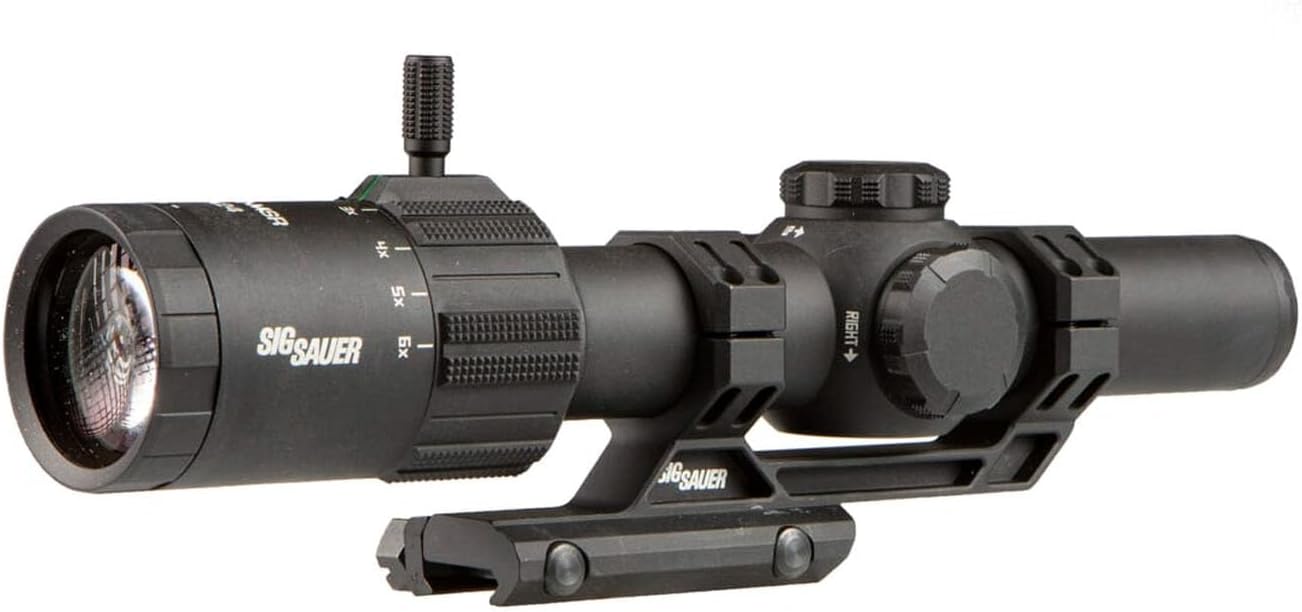
With a magnification range from 1 to 6x and a 24mm objective lens, the Sig Sauer Tango-MSR 1-6×24 FFP is built for hunters and shooters who need clear optics combined with versatile zoom for intermediate ranges. Its standout feature is the illuminated MSR BDC-6 reticle designed for precise bullet drop and wind drift compensation.
Setting up the scope is straightforward, and the cantilever mount ensures a secure fit on most rifles. The illuminated reticle’s free-floating center dot and hash marks make adjusting for distance and wind easier in various lighting conditions. The field of view at 124.8 feet is wide enough for quick target acquisition during fast transitions.
Optical clarity is excellent, thanks to industry-leading light transmission, helping keep targets sharp even in low light. The build feels rugged and durable, suitable for demanding environments.
Common praise focuses on the reticle’s precision and clarity, while some users note the illumination brightness could be improved for daylight visibility.
The reticle design clearly stands out for accuracy on holdover points and wind drift, making it easy to hit targets at various ranges. Some find the illuminated reticle’s brightness lacking under bright daytime conditions, which can affect quick aiming.
Hunters and tactical shooters looking for a versatile 1-6x scope will appreciate this model’s optical clarity and reticle features. Those needing higher magnification or stronger illumination for daylight might want to look elsewhere. Its solid construction suits active use across different shooting scenarios.
Pros
- Clear optics with excellent light transmission
- Illuminated MSR BDC-6 reticle for precise adjustments
- Wide field of view at all magnifications
- Suitable for intermediate range engagements
Cons
- Reticle illumination could be brighter in daylight
- Limited maximum magnification at 6x
| Specification | Details |
|---|---|
| Magnification Minimum | 1 x |
| Magnification Maximum | 6 x |
| Objective Lens Diameter | 24 millimeters |
| Field Of View | 124.8 feet |
| Reticle Type | Illuminated BDC Reticle |
| Mounting Type | Cantilever Mount |
6. EZshoot 5-25×56 FFP Rifle Scope

Hunters and shooters looking for a medium to long range first focal plane scope find the EZshoot 5-25×56 FFP Rifle Scope a solid pick. Its standout feature is the clear, MOA Christmas Tree reticle that stays accurate across all magnification levels, making holdover and range adjustments quick and precise.
Setup involves mounting it on a Picatinny rail, which fits securely and stays put during use. The moderate eye relief prevents strain without sacrificing comfort, and the fast focus eyepiece helps you lock in the reticle quickly in changing light or movement. Six red illumination settings adapt well for dawn or dusk hunting, while the included sunshade cuts down glare when aiming into the sun.
Performance at max 25x magnification offers excellent detail for longer shots without losing clarity. The glass-etched reticle stays crisp, with illumination enhancing visibility in low light.
The scope is built tough enough for field use, although some mention the reticle illumination could be brighter. Its lightweight design and forgiving eye relief suit extended hunting sessions well.
The MOA Christmas Tree reticle delivers precise and fast holdover adjustments with clear visibility, praised for aiding quick range estimations. A frequent downside noted is the reticle’s red illumination sometimes being too dim in very low light environments. The fast focus eyepiece helps users engage targets smoothly across magnifications.
Those hunting from medium to long distances who want accurate reticle readings under various light settings will appreciate this scope’s capabilities. Matching it with a Picatinny rail is straightforward. Shooters needing extremely bright reticle illumination for low-light conditions might consider other models.
Pros
- Consistent reticle accuracy across all magnifications
- Fast focus eyepiece for quick adjustments
- Six brightness levels of reticle illumination
- Sunshade included to reduce glare
Cons
- Reticle illumination could be brighter in some conditions
- Moderate eye relief may require careful positioning
| Specification | Details |
|---|---|
| Magnification Minimum | 5 x |
| Magnification Maximum | 25 x |
| Objective Lens Diameter | 5.6 centimeters |
| Reticle Type | MOA Christmas Tree |
| Mounting Type | Picatinny Mount |
7. DiscoveryOpt LHT 3-12×42 FFP Rifle Scope

DiscoveryOpt LHT 3-12×42 FFP stands out with its first focal plane reticle that keeps holdovers accurate at any zoom level. Ideal for hunters working in close to mid-range distances, it offers precise adjustments and bright optics to handle variable light conditions well.
Setting up is straightforward using the Picatinny or Weaver mount options. Adjusting the 1/4 MOA clicks feels reliable and crisp, making it easy to dial in exact windage and elevation. The multi-coated 42mm lens keeps views bright through dawn and dusk, helping maintain clear sight pictures during typical hunting sessions.
Performance remains solid throughout the zoom range, with the FFP reticle scaling perfectly for quick holdover checks. The build quality feels sturdy and dependable, though a few have noted it could be lighter on weight. The clearest praise centers on optical clarity while the common complaint involves the scope’s weight.
Optical clarity receives strong appreciation as it handles varying light beautifully, especially around dawn and dusk. A consistent concern involves the scope feeling heavier than expected, impacting comfort during longer use.
Hunters focusing on close to mid-range engagements who value crisp, bright views will be content with this scope. Shooters needing a lighter setup or higher magnification for long-range work might look for alternative options.
Pros
- Accurate holdovers at all magnifications
- Clear and bright sight picture in low light
- Precise 1/4 MOA adjustment clicks
- Compatible with common rifle mounts
Cons
- Noted weight may feel heavy for some users
- Maximum magnification capped at 12x for some tasks
| Specification | Details |
|---|---|
| Magnification Minimum | 3 x |
| Magnification Maximum | 12 x |
| Objective Lens Diameter | 42 millimeters |
| Reticle Type | FFP (first Focal Plane) MOA |
| Mounting Type | Picatinny Mount, Weaver Mount |
8. DiscoveryOpt HD 5-30×56 GEN2 FFP Rifle Scope
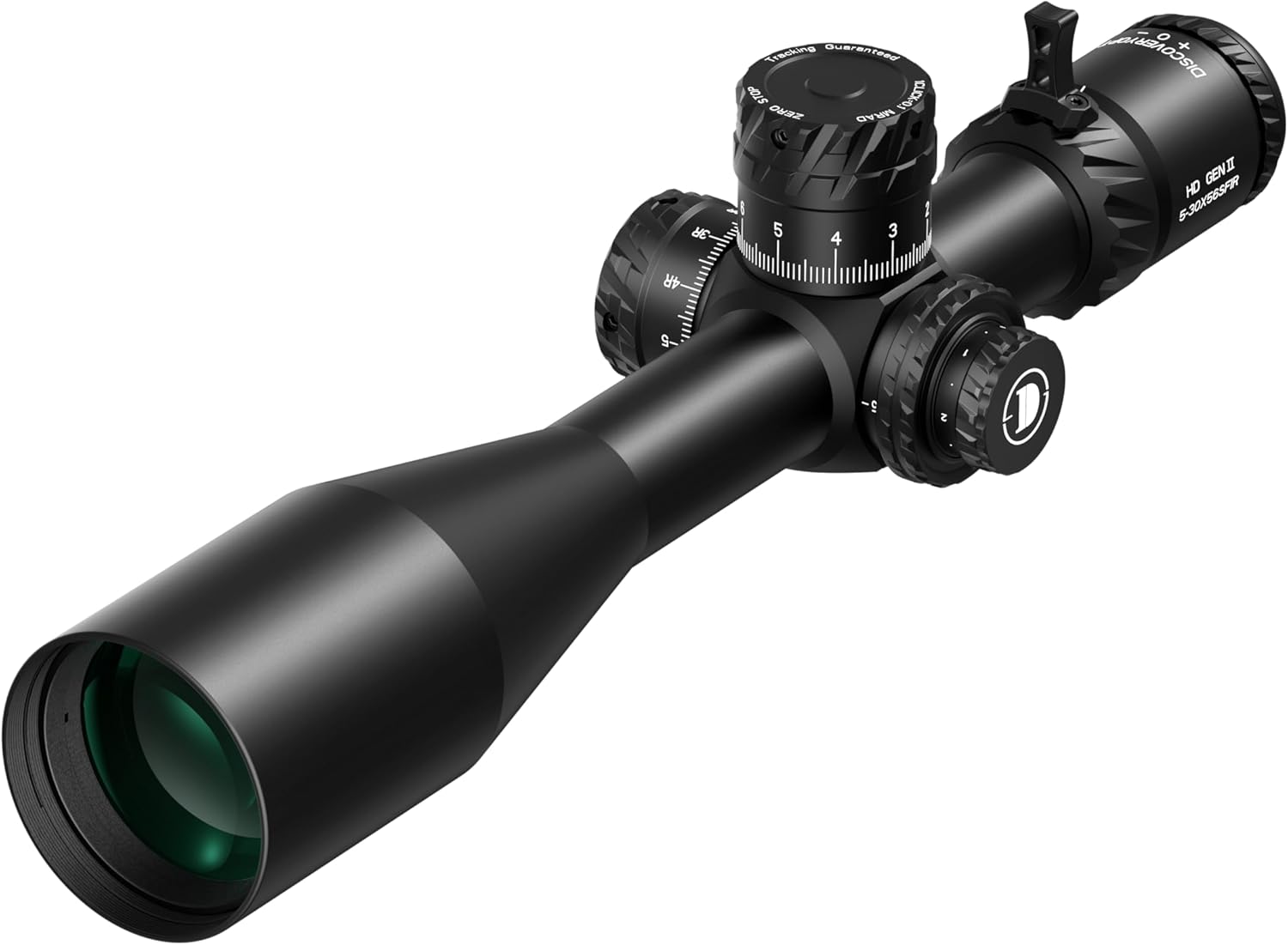
DiscoveryOpt HD 5-30×56 GEN2 FFP Rifle Scope delivers high power with clear visuals, ideal for long-range shooters who need precise adjustments. Its standout feature is the 34mm tube combined with a first focal plane reticle, which keeps measurements accurate at any zoom level, making it great for serious marksmen.
Setup on a Picatinny mount is straightforward, and the scope holds zero well once mounted. Adjusting magnification between 5x and 30x is smooth, giving a wide zoom range for different distances.
The turrets click crisply in 0.1 MRAD increments, with a zero stop that makes re-centering worry-free after dialing for shots at varied ranges.
The optics are bright and sharp edge-to-edge thanks to the fully multi-coated lenses, which helps in low light conditions. The build feels solid and durable, with the large tube allowing extensive windage and elevation travel. Reviewers note the crisp turrets and clear sight picture as positives while some find the scope a bit heavy for smaller setups.
Many appreciate the precise and confident adjustments enabled by the zero stop turrets combined with the bright, sharp image delivered through the fully multi-coated lenses. The most frequent complaint is the heavier and bulkier build, causing some difficulty when mounted on smaller or lighter rifles.
Those requiring precise long-range tracking and quick return to zero will find this scope very well suited. Shooters prioritizing lightweight gear or those focused mainly on short-range shooting might prefer to look for a more compact, lighter option.
Pros
- Sharp, fully multi-coated optics for clarity
- 0.1 MRAD click turrets with zero stop
- Wide 5-30x magnification range
- Large 34mm tube for extensive adjustment
Cons
- Heavier weight may not suit lightweight rifles
- Some users find it bulky for close-range use
| Specification | Details |
|---|---|
| Magnification Minimum | 5 x |
| Magnification Maximum | 30 x |
| Objective Lens Diameter | 5.6 centimeters |
| Reticle Type | Mrad Ffp (first Focal Plane) |
| Mounting Type | Picatinny Mount |
| Field Of View | 25 feet |
9. CVLIFE 6-24×50 FFP Rifle Scope

Feels solid and reliable in hand, the CVLIFE 6-24×50 FFP Rifle Scope suits shooters who need versatile magnification paired with a reticle that adjusts consistently across zoom ranges. Its standout feature is the first focal plane design that keeps holdover marks accurate no matter the zoom level, making it a dependable choice for medium to long-distance shots.
Setting up is straightforward, thanks to turrets that click audibly and tactilely in 1/4 MOA increments. The zero-stop on elevation and the lockable windage turret make it easy to return to zero. Day-to-day use benefits from the illuminated reticle with six red brightness levels, which really helps during low-light conditions or early mornings in the field.
The clarity through the 50mm objective lens is bright and sharp, fitting nicely with the 6 to 24 times zoom range for precise aiming. The build feels rugged enough for regular use, while the side focus helps fine-tune the image without fuss.
The reticle illumination gets praised often, though some find the objective lens diameter smaller than expected for brighter settings.
The ability to quickly reset to zero with tactile 1/4 MOA clicks and a zero-stop elevation turret gets highlighted positively. Most users appreciate the illuminated reticle in low light, but some mention the objective lens size limits brightness in certain conditions.
Those focused on medium to long-range shooting will value the zoom and reticle scaling here, especially in mixed light settings. Shooters wanting a brighter image under all conditions might look for scopes with larger objective lenses.
Pros
- First focal plane reticle scales with magnification
- Lockable, resettable windage turret
- Zero-stop elevation turret for quick zero returns
- Six-level red illuminated reticle for low light
Cons
- Objective lens smaller than some expect at 34 mm
- Brightness levels may not suit all lighting preferences
| Specification | Details |
|---|---|
| Magnification Minimum | 6 x |
| Magnification Maximum | 24 x |
| Objective Lens Diameter | 34 millimeters |
| Reticle Type | MOA |
| Mounting Type | Side Focus FFP |
10. Monstrum Banshee 2-10×30 FFP MPVO Scope

Great for shooters needing a mid power optic with consistent ranging, this scope offers 2-10x magnification and clear markings that scale with zoom. It suits those wanting both close-up speed and longer-distance precision thanks to its first focal plane design and the CM2 reticle.
Its biggest strength lies in accurate holdovers at any zoom setting.
Setting it up is straightforward with the cantilever mount and integrated throw lever, letting you quickly adjust magnification while keeping your target in sight. The 30mm objective lens brings enough light for bright images without extra bulk.
The 1 MOA hashmarks stay true no matter the zoom, making it easy to dial in shots without recalculating. On a daily basis, it feels balanced and the controls respond smoothly.
Image clarity stands out due to extra low dispersion glass that reduces color fringing, sharpening the scene even at max magnification. The build feels solid with good materials that hold zero well. Praise centers on crisp detail and reliable reticle scaling, while some mention that the 2x minimum magnification may not suit all very close shooting scenarios.
The strongest praise highlights the sharp and colorful image quality thanks to extra low dispersion glass, which helps maintain clear views through varying light conditions. The most common complaint is about the 2x minimum magnification, which some find less ideal for very close-target acquisition.
Those needing a mid power scope with precise ranging at different distances will find this an effective choice. Shooters focused on very close-range engagements might want to consider optics with lower minimum magnification for quicker target acquisition.
Pros
- Consistent 1 MOA hashmarks at all magnifications
- Smooth magnification adjustment with throw lever
- Sharp image quality from ED glass
- Solid cantilever mount for stability
Cons
- Minimum 2x magnification may limit very close shots
- Objective lens size restricts light gathering in low light
| Specification | Details |
|---|---|
| Magnification Minimum | 2 x |
| Magnification Maximum | 10 |
| Objective Lens Diameter | 30 millimeters |
| Mounting Type | Cantilever Mount |
| Reticle Type | CM2 Reticle |
| Thread Type | 1/2″ UNC |
11. Sig Sauer Tango-MSR 1-6×24 FFP Hunting Scope

Crafted with precision optics and a cantilever mount, this scope is designed for tactical shooters and hunters who need a reliable first focal plane reticle. Its biggest strength lies in exceptional light transmission and optical clarity, making it a solid choice for clear sight picture in various conditions.
Setting up involves mounting the scope securely on a rifle with its cantilever system, which provides good eye relief and positioning. The adjustable magnification from 1x to 6x, controlled via a convenient throw lever, allows quick zoom adjustments.
The illuminated MSR BDC-6 reticle with 11 brightness levels helps maintain visibility on different lighting conditions, making daily use straightforward and adaptable.
Performance-wise, the lens delivers sharp clarity with low dispersion glass that really helps in low-light environments. The scope feels solid and built to withstand regular handling, with a good balance in weight for hunting rifles. Users appreciate the quick magnification changes as the best feature, while some mention that the 24mm objective lens can limit light intake compared to larger scopes.
The scope stands out for its crystal-clear optics and easy magnification adjustment, but brightness controls can be tricky to fine-tune for some. Its smaller objective lens is a trade-off for compactness, affecting light intake in very dim light.
Hunters needing clear sight pictures across different lighting will appreciate this scope. Users prioritizing bigger lenses for low-light performance might want to consider alternative options.
Pros
- Excellent light transmission through low dispersion glass
- Illuminated reticle with 11 brightness levels
- Quick magnification changes with throw lever
- Reliable and sturdy cantilever mount
Cons
- Objective lens diameter limited to 24 millimeters
- Some find brightness settings complex to dial in
| Specification | Details |
|---|---|
| Magnification Minimum | 1 x |
| Magnification Maximum | 6 x |
| Objective Lens Diameter | 24 millimeters |
| Reticle Type | Illuminated MSR BDC-6 Reticle |
| Mounting Type | Cantilever Mount |
12. Monstrum G3 6-24×50 FFP Rifle Scope

A first focal plane rifle scope with a 6-24x magnification, ideal for shooters focused on mid to long distance targets. Its standout feature is an easily readable MOA reticle that stays accurate across all zoom levels, making range estimation quick and straightforward during use.
Setting it up is straightforward thanks to the adjustable objective lens that sharpens your target image and eliminates parallax, which is key for accuracy over long distances. The inline dial for reticle illumination lets you adjust brightness for varying light conditions, ensuring visibility without hassle. It mounts solidly on Picatinny rails, suiting tactical rifles well.
For performance, the scope maintains clear, sharp imagery even at maximum magnification out to 1000+ yards. Construction feels solid and reliable, built to handle regular field use.
The most praised element is its accurate MOA reticle with useful ranging marks, while some find the objective lens diameter a bit small for very low light setups.
Many users appreciate the clear MOA reticle that aids fast range estimation, especially since it doesn’t shift with magnification changes. A frequent concern involves the 50mm objective lens which some feel restricts brightness during dawn or dusk shooting.
Ideal for shooters needing precise adjustments and reliable range data in tactical or extended shooting scenarios. Those prioritizing wide field brightness or large eye boxes might want to explore larger objectives or different optic designs.
Pros
- First focal plane reticle accurate at all magnifications
- Adjustable objective for precise focus and parallax correction
- Inline illumination dial with multiple brightness settings
- High magnification range suitable for long distance
Cons
- Objective lens diameter may limit low light performance
- Limited field of view compared to some counterparts
| Specification | Details |
|---|---|
| Magnification Minimum | 6 x |
| Magnification Maximum | 24 x |
| Objective Lens Diameter | 50 millimeters |
| Reticle Type | MOA |
| Mounting Type | Picatinny Mount |
| Field Of View | 100 yard |
Best First Focal Plane Scopes Comparison Table
| Product | Max Magnification | Min Magnification | Objective Lens Diameter | Mounting Type |
|---|---|---|---|---|
| Triton Orion LPVO | 6x | 1x | 24mm | Picatinny Mount |
| Vortex Venom Scope | 3x | 3x | 44mm | Picatinny Mount |
| Monstrum Beast ED | 8x | 1x | 30mm | Cantilever Mount |
| Monstrum Hornet II | – | – | – | – |
| Sig Sauer Tango-MSR | 6x | 1x | 24mm | Cantilever Mount |
| EZshoot 5-25×56 | 25x | 5x | 56mm | Picatinny Mount |
| DiscoveryOpt LHT | 12x | 3x | 42mm | Picatinny/Weaver Mount |
| DiscoveryOpt HD GEN2 | 30x | 5x | 56mm | Picatinny Mount |
| CVLIFE 6-24×50 | 24x | 6x | 34mm | Side Focus FFP |
| Monstrum Banshee MPVO | 10x | 2x | 30mm | Cantilever Mount |
| Sig Sauer Tango-MSR V2 | 6x | 1x | 24mm | Cantilever Mount |
| Monstrum G3 6-24×50 | 24x | 6x | 30mm | Picatinny Mount |
- Max Magnification6x
- Min Magnification1x
- Objective Lens Diameter24mm
- Mounting TypePicatinny Mount
- Max Magnification3x
- Min Magnification3x
- Objective Lens Diameter44mm
- Mounting TypePicatinny Mount
- Max Magnification8x
- Min Magnification1x
- Objective Lens Diameter30mm
- Mounting TypeCantilever Mount
- Max Magnification–
- Min Magnification–
- Objective Lens Diameter–
- Mounting Type–
- Max Magnification6x
- Min Magnification1x
- Objective Lens Diameter24mm
- Mounting TypeCantilever Mount
- Max Magnification25x
- Min Magnification5x
- Objective Lens Diameter56mm
- Mounting TypePicatinny Mount
- Max Magnification12x
- Min Magnification3x
- Objective Lens Diameter42mm
- Mounting TypePicatinny/Weaver Mount
- Max Magnification30x
- Min Magnification5x
- Objective Lens Diameter56mm
- Mounting TypePicatinny Mount
- Max Magnification24x
- Min Magnification6x
- Objective Lens Diameter34mm
- Mounting TypeSide Focus FFP
- Max Magnification10x
- Min Magnification2x
- Objective Lens Diameter30mm
- Mounting TypeCantilever Mount
- Max Magnification6x
- Min Magnification1x
- Objective Lens Diameter24mm
- Mounting TypeCantilever Mount
- Max Magnification24x
- Min Magnification6x
- Objective Lens Diameter30mm
- Mounting TypePicatinny Mount
How to Choose the Right First Focal Plane Scope
Consider durability, clarity, and reticle design when selecting a first focal plane scope, as these factors affect accuracy and ease of use. Choosing the right features ensures reliable performance in various conditions, preventing costly upgrades or replacements down the line.
Reticle Design and Visibility
Reticle clarity suffers quickly in low light without proper illumination, making target acquisition frustrating or impossible at dawn or dusk. In bright daylight, a reticle that’s too dim or washed out forces squinting or guessing, reducing accuracy.
Choosing a model with a clear reticle that offers adjustable illumination helps maintain visibility across all lighting conditions. For hunting in dim environments, simple illuminated reticles with red or green options and variable brightness levels make a practical difference.
Reticle style significantly affects usability depending on the shooting task. Close-range tactical use benefits from precise dot or crosshair patterns with minimal clutter, while hunting longer distances often calls for a mil-dot or BDC style for range estimation.
Reticle thickness matters too; too thin and it disappears on dark targets, too thick and it obscures fine details. Balanced designs tailored to specific applications improve shot placement confidence.
Magnification Range and Zoom Quality
Variable magnification scopes can handle everything from close targets to longer shots but suffer when zoom is jerky or imprecise. Smooth, click-adjusted zoom rings let users dial in the perfect focal length without changing cheek weld or losing sight of the reticle. Poorly built scopes feel loose or catch between settings, which wastes time and focus.
Maintaining reticle size and clarity throughout the zoom range prevents reticle distortion or ghosting that can throw off aim. The reticle should scale consistently with magnification without changing thickness or sharpness. A clear, steady reticle aids quick target acquisition at all distances, making the scope practical outside a narrow zoom band.
Durability and Build Quality
Recoil from larger calibers can jar scopes out of alignment unless they are built tough enough to handle heavy kick. Scopes made with aircraft-grade aluminum offer a good strength-to-weight ratio, resisting dents and warping. Waterproof and fog-proof features keep the lens clear and prevent internal moisture, which is crucial in wet or humid environments.
Dust resistance reduces cleaning frequency and lens wear when hunting in dry or sandy conditions. Scopes with sealed construction and shock-resistant springs inside maintain zero even after hard knocks.
Over time, well-built models prove durable in harsh field use, while cheaper counterparts often fail under rough handling.
Adjustment and Zeroing Accuracy
Windage and elevation turrets with positive, tactile clicks help confirm each adjustment without needing to look away from the target. Turrets that feel mushy or have inconsistent click spacing can cause overshooting zero, adding frustration during sight-in sessions. A turret with defined stops or locking mechanisms prevents accidental movement once zero is set.
Repeatability is key; the scope must return precisely to zero every time after adjustments. Some models offer zero-reset dials so the shooter can quickly mark zero for fast reference.
Smooth, reliable adjustment performance minimizes wasted ammo and range time, which becomes very apparent after repeated use.
Size, Weight, and Mounting Compatibility
Heavy or bulky scopes affect rifle balance, causing fatigue during extended hunts or precision shooting. Compact models with moderate weight suit lightweight rifles and fast handling, while longer scopes with bigger objectives usually fit benchrest or precision setups better.
Weighing between 15 and 25 ounces generally fits most hunting rifles without feeling front-heavy.
Mounting compatibility is critical since not all scopes work with every base or rings. Scopes with standard 30mm or 1-inch tubes fit a wide range of mounts, but verifying ring height and base type ensures the scope aligns properly with the shooter’s eye. Secure mounting prevents movement and maintains point-of-impact, influencing how the rifle handles and shoots.
Common Mistakes to Avoid When Using First Focal Plane Scopes
First focal plane scopes adjust the reticle size relative to the zoom level, which means the reticle markings remain accurate at any magnification. One common mistake is using the scope at very low magnification and assuming the reticle subtensions are off. Another error is not accounting for this when switching to a second focal plane scope, leading to range estimation errors.
Hunters and shooters sometimes over-adjust the turrets during shots, forgetting that the reticle adjusts proportionally with zoom, which can result in miscalculations. It’s important to zero the scope correctly and understand how the reticle behaves across the magnification range.
Failing to read the manufacturer’s manual on reticle subtensions can also cause confusion, especially with mil-dot or MOA-based reticles. Taking time to practice with the scope at different zoom levels helps avoid these mistakes and improves accuracy in the field.
Maintenance and Care Tips for Ensuring Scope Longevity
Regular cleaning of the lenses with a microfiber cloth prevents buildup that impairs clarity. Avoid using household cleaners; lens-specific solutions protect coatings better.
Storage is critical. Keep the scope in a dry, padded case to avoid moisture and physical damage.
Humidity can fog internal lenses, leading to permanent damage if untreated.
- Check mounting screws frequently to ensure the scope remains secure after use.
- Use lens caps and flip covers whenever the scope is not in use.
- Inspect the turret mechanism periodically for smooth operation; dirt or grit can cause sticking or inaccurate adjustments.
Proper care extends the lifespan and maintains the performance that first focal plane scopes offer, especially for outdoor environments.
Comparing First Focal Plane Scopes with Second Focal Plane Alternatives
First focal plane scopes keep the reticle size proportional to magnification, which means holdover markings stay consistent regardless of zoom. This is an advantage for long-range shooting where quick adjustments are needed without recalculating reticle subtensions.
Second focal plane scopes have reticles that remain the same size no matter the zoom, making the image clearer at lower magnifications but requiring external calculations at higher zoom levels for accurate ranging. This can slow down target acquisition.
Cost is typically lower for second focal plane models, making them attractive for general shooting or hunting where quick range estimation isn’t critical. However, first focal plane scopes provide more versatility for tactical or precision shooting that involves varying distances.
Choosing between the two depends on whether consistent reticle scaling is necessary for your shooting style or if simpler, fixed reticle size suits your needs best.
People Also Asked
How Do I Properly Zero a First Focal Plane Scope?
Properly zeroing a first focal plane scope involves adjusting the windage and elevation turrets while aiming at a target at a known distance, usually 100 yards. Use a stable rest for consistent shots during this process to improve accuracy and confirm adjustments by shooting groups and noting points of impact changes.
Will a First Focal Plane Scope Fit My Rifle Mount?
A first focal plane scope will fit your rifle mount if the mount matches the scope’s tube diameter and ring size. Measure your rifle’s mounting rails and compare them with the scope specifications to ensure secure attachment and proper alignment without forcing any parts.
What Are Common Issues with First Focal Plane Scopes?
Common issues with first focal plane scopes include fogging inside the lens and parallax errors at certain distances. Regularly checking and maintaining the scope’s sealing and using the parallax adjustment knob can help reduce these problems during use in varied environments.
How Long Do First Focal Plane Scopes Typically Last?
First focal plane scopes can last 5 to 10 years or more with proper care and use. Their longevity depends largely on how often the scope is exposed to harsh conditions and whether it is cleaned and stored properly after use.
Can I Clean a First Focal Plane Scope Myself Safely?
You can clean a first focal plane scope yourself safely using a microfiber cloth and lens cleaning solution designed for optics. Avoid household cleaners and rough materials, and always blow off dust before wiping to prevent scratching the lenses.
Conclusion
Choosing a first focal plane scope comes down to a few key factors: clarity through different magnifications, reliable reticle illumination, and durability that fits your shooting conditions. Make sure the scope holds zero well and that the adjustments feel precise.
Weight and size also matter if you plan to carry it for long periods or mount it on lighter rifles.
Consider how and where you’ll use the scope most often before making a decision. Stick to a budget that balances quality with your shooting needs.
Revisit the comparison table and the detailed picks above to find the scope that fits your setup and shooting style best.