Top 10 Best Roller for Sealing Pavers That Will Amaze You
Applying sealer to pavers might seem straightforward, but using the wrong tool often leads to uneven coverage or wasted product. A cheap or poorly chosen roller can leave streaks, miss spots, or simply struggle to press the sealer into the cracks properly. That’s why the best roller for sealing pavers needs to deliver consistent pressure and coverage without wearing out too quickly during the job.
The key factors that separate good rollers are the material of the roller sleeve, the size of the roller relative to the surface area, and the weight of the roller itself. A dense foam or rubber sleeve works best for even, smooth application and is easier to clean after use.
Rollers between 9 and 18 inches cover enough ground without being unwieldy, and a slightly heavier roller helps press the sealer down without requiring extra force, which reduces fatigue over larger jobs.
Need a Quick Check?
| Image | Product | Price |
|---|---|---|
Our Top Picks 1  | Bon 9-Inch Foam Cover | Check Price |
Our Top Picks 2  | Gator 9-Inch Foam Roller | Check Price |
Our Top Picks 3  | FoamPro 22 Roller Cover | Check Price |
Our Selected Top 10 Roller for Sealing Pavers You Can Trust
This list features various rollers designed specifically for sealing pavers, each evaluated for their effectiveness, durability, and ease of use. The reviews detail how well they perform, who they are best suited for, and highlight their key advantages and disadvantages.
1. Bon 9-Inch Slit Foam Roller Cover
Using the Bon 9-Inch Slit Foam Roller Cover feels just right when sealing pavers or other rough surfaces. Its ability to get deep into uneven areas makes it a solid pick for anyone serious about neat, consistent sealing. The slit foam construction prevents the roller from flattening, which keeps the job looking good over time.
Putting it on a compatible roller frame is straightforward thanks to its 9-inch length and 3/4-inch nap, making it easy to handle during extended use. The foam grip width fits between 22-1/2 and 35, so it feels secure when rolling. It manages to stay effective on rough textures without shedding bits or losing shape, cutting down on touch-ups.
For sealing pavers, it gets the job done with deep penetration, helping the sealer settle evenly. The foam material is durable and resists matting, different from fabric rollers that flatten quickly.
People tend to appreciate how well it holds up, though some might wish for a larger size to cover more ground faster.
The strongest praise highlights how the slit foam roller maintains its shape and effectiveness on uneven surfaces without matting. The most common complaint centers around its single size, which some find limiting for bigger projects where a wider roll might speed things up.
Anyone sealing smaller to medium paver areas will appreciate the detail and durability it offers. People working on large surfaces might want to look for wider rollers to cover more ground faster, as this one is best suited to focused or precise sealing tasks.
Pros
- Good deep penetration on rough surfaces
- Does not mat down like fabric rollers
- Easy to fit onto standard roller frames
- Durable foam material
Cons
- Only available in a 9-inch length
- Not ideal for very large areas
| Specification | Details |
|---|---|
| Brand Name | Bon |
| Length | 9 inches |
| Nap Thickness | 3/4 inch |
| Grip Width | 22-1/2″ – 35″ |
| Model | 84-103 |
2. Gator Seal 9-Inch Slit Foam Roller
Great for anyone working with solvent based sealers on rough or semi-rough pavers, the Gator Seal 9-Inch Slit Foam Roller is all about giving a smooth, consistent finish without streaks. It’s especially aimed at people who want a tool made to handle tougher surfaces without breaking or leaving uneven patches.
Setup is straightforward since it’s a single roller. The 1/2-inch slit foam design soaks up sealer well and spreads it evenly, which means less dripping and fewer passes over the same spot. You simply dip and roll, and the 9-inch width strikes a nice balance between covering a good area and staying manageable on rough textures.
It performs excellently with solvent based sealers, providing smooth, streak-free results. The build feels sturdy and professional-grade, weighing 3 pounds which gives it a solid feel without being too heavy.
The most praised feature is how evenly it applies sealer even on tough surfaces. A common complaint is some difficulty cleaning the foam after use, especially with solvent residues.
The roller consistently applies sealer evenly on semi-rough and rough surfaces, resulting in smooth and streak-free finishes. However, cleaning the foam roller after applying solvent-based sealers can be tricky and requires extra effort to avoid damage or residue buildup.
People working regularly with solvent-based sealers on rough pavers will appreciate its professional build and effectiveness. Those who want an easier cleanup or need a multi-pack for larger projects might want to consider other options.
Pros
- Designed for solvent based sealers
- High absorbency foam for even application
- Works well on rough and semi-rough surfaces
- Professional-grade, durable construction
Cons
- Challenging to clean after use with solvent sealers
- Only included in a single roller package
| Specification | Details |
|---|---|
| Manufacturer | Alliance Designer Products |
| Item Weight | 3 pounds |
| Product Dimensions | 9 x 9 x 4.5 inches |
| Item Model Number | 4 Us |
| Color | Gray |
| Included Components | Slit Foam Roller |
3. FoamPro 22 9-Inch Slit Foam Paint Roller Cover
Slit foam material makes the FoamPro 22 ideal for spreading sealers on rough and uneven surfaces like pavers. Its biggest strength lies in the foam’s resilience, which allows it to penetrate deep into textured areas without falling apart easily. Best suited for those working on textured outdoor surfaces needing thorough coverage.
Setup is straightforward, fitting on any standard 9-inch roller frame. The 1/2-inch nap thickness strikes a balance by holding enough sealer for pavers and allowing good control during application.
Cleaning is simple thanks to the foam structure, which avoids trapping too much product and makes rinsing easier compared to fabric rollers.
Performance-wise, this roller cover does well tackling semi-rough and uneven surfaces with consistent sealer absorption and distribution. The foam’s split design keeps application smooth without leaving streaks.
The main complaint is foam wear over time under heavy use, which may require replacing the roller after several jobs. Build quality focuses on durability suitable for tougher textures.
Most praise focuses on the roller’s ability to deliver sealer evenly on rough textures without shedding. The foam structure holds enough product without dripping, making it reliable for detailed work on pavers. A common downside is that the foam wears out faster with repeated, intensive use.
Ideal for those sealing textured outdoor surfaces who want better coverage than typical fabric rollers. Not recommended for continuous heavy commercial use where a more durable or multiple pack might be necessary.
Pros
- Resilient foam penetrates deep into textured surfaces
- Fits standard 9-inch roller frames easily
- Effective for semi rough and uneven surfaces like pavers
- Easy to clean compared to fabric rollers
Cons
- Foam may wear down with heavy use
- Only one roller cover included per package
| Specification | Details |
|---|---|
| Size | 9″ x 1/2″ |
| Nap Thickness | 1/2 Inch |
| Material | Slit Foam |
| Suitable Surfaces | Semi rough and uneven surfaces |
| Brand | FoamPro |
| Unit Count | 1 Count |
4. 10 Gallon 22-Inch Lawn Steel Drum Roller

A solid 10 Gallon 22-Inch Lawn Steel Drum Roller fits well for anyone needing a dependable roller for sealing pavers or lawn care. Its biggest standout is the tough, powder-coated steel drum that resists rust and holds up well in various weather conditions.
Getting it ready involves a straightforward setup, as it comes with a 28-inch U-shaped handle designed for a comfortable grip. Using it daily, the handle reduces arm strain even during longer sessions, and the steel drum keeps rolling smoothly over uneven ground without bending or losing shape.
The roller performs steadily at its main job of compacting surfaces, thanks to a well-built steel drum that stays firm throughout heavy use. The strongest praise comes from its durable structure and resistance to outdoor wear, while the most common complaint centers around its weight, which some find a bit heavy to maneuver easily.
Long-lasting powder coating keeps the drum rust-free despite exposure, while some find the roller’s weight somewhat challenging to push around. Its construction favors durability over lightness.
People needing a tough, weather-resistant roller for everyday garden or paver work will appreciate this model. Those looking for a lighter or multi-piece option might consider alternatives.
Pros
- Heavy-duty powder-coated steel resists rust
- Ergonomic 28-inch U-shaped handle for comfort
- Maintains shape on uneven ground
- Reliable performance in rain or shine
Cons
- Heavier weight can make maneuvering tougher
- Single unit limits work speed on large areas
| Specification | Details |
|---|---|
| Brand Name | JustSmart |
| Model Number | 7hi-K-3poPXfneLAiZDYpYIMPcM85 |
| Unit Count | 1 Count |
| Manufacturer Part Number | 7hi-K-3poPXfneLAiZDYpYJZLdPKA |
| Drum Width | 22 Inch |
| Capacity | 10 Gallon |
5. Armor 18-Inch Paint and Sealer Roller Kit

Great for tackling sealing projects on pavers, this roller kit is made for those who want a solid tool that covers a lot of ground quickly with minimal hassle. Its biggest strength lies in the adjustable 12-18” roller frame paired with an extension pole, allowing ease of reach and broad coverage in one set.
Setting up is straightforward since it comes with everything needed: roller frame, roller tray, and three lint-free 18” roller covers. The telescoping extension pole, adjustable from 48 to 73 inches, makes working on large or awkward areas much easier without bending or stretching uncomfortably. The 1/2 nap polyester covers feel smooth and resist lint, making clean-up and switching between sealers or paints simple.
Applying sealer feels steady and even thanks to the roller’s wide coverage and lint-free rollers, making it suitable for both paint and sealer tasks. The build appears durable with a solid frame and easy-to-grip pole.
Most people praise how well it spreads coatings evenly, but some mention that the adjustable frame can feel a bit loose or tricky to lock firmly.
The kit is praised for its broad roller size and smooth coverage, making sealing pavers quicker and more even. A common downside comes from the adjustable frame’s occasional looseness, which can interrupt steady application unless frequently checked.
People working on medium to large outdoor surfaces will appreciate the wide roller and extension pole. Those needing a very tight, fixed frame might want to consider a different roller without adjustable parts for more stability.
Pros
- Adjustable roller size from 12 to 18 inches
- Comes with extension pole for better reach
- Lint-free 1/2″ nap polyester covers included
- Complete kit with tray and multiple covers
Cons
- Adjustable frame can feel loose during use
- Extension pole may require tightening periodically
| Specification | Details |
|---|---|
| Brand Name | Foundation Armor |
| Roller Frame Size | Adjustable 12-18″ |
| Extension Pole Length | 48-73″ telescoping |
| Roller Covers | (3) 18” lint free 1/2″ nap polyester |
| Included Components | Roller frame, extension pole, roller tray, 3 covers |
6. Wooster R232-9 Epoxy Glide 9-Inch Roller Cover
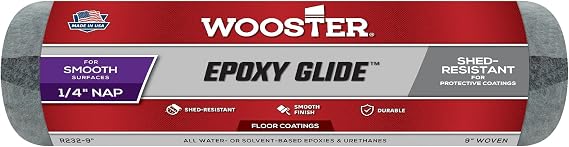
Working with epoxy or urethane sealers on pavers requires a roller that handles the job without leaving fibers behind. Perfect for those applying smooth coatings, the Wooster R232-9 Epoxy Glide 9-Inch Roller Cover stands out with its shed-resistant fabric, making it great for clean, professional finishes.
Setup takes only moments, attaching easily to standard roller frames without hassle. The 1/4 nap offers just the right smoothness for spreading sealers evenly.
Its dark grey color helps track epoxy coverage. Daily use involves smooth pickup and release of epoxy, speeding up the process without excess dripping. Maintenance is straightforward since the roller resists shedding fibers.
The roller’s main strength lies in its ability to deliver smooth, even coats without contaminating the surface with loose fibers. Built with shed-resistant fabric, it handles all epoxies and urethanes reliably.
Comments praise the fast results and steady flow, which help produce uniform seals. A noted drawback is the smaller size, which means covering large areas takes longer.
The roller is praised for its excellent release and flow that ensure fast, even application of epoxy without shedding. The common drawback is that its 9-inch width means covering large paver areas takes more time and effort compared to wider rollers.
Those sealing small to medium paver surfaces with epoxy or urethane will appreciate its performance and build. Anyone working on expansive areas might prefer a larger roller for quicker coverage.
Pros
- Shed-resistant fabric reduces loose fibers
- Smooth roller nap ideal for epoxy
- Easy application and release of sealer
- Made in the United States
Cons
- Size requires more passes on large surfaces
- Limited to use with epoxy and urethane coatings
| Specification | Details |
|---|---|
| Brand Name | Wooster |
| Model Number | Wooster – R232-9 |
| Unit Count | 1 Count |
| Nap Length | 1/4″ |
| Roller Size | 9 Inch |
| Fabric Type | Shed-resistant for epoxies and urethanes |
7. Wooster RR929-9 Super Fab FTP 9-Inch Roller Cover 3-Pack

With a 9-inch width and a green double-thick polypropylene core, this roller cover suits anyone sealing pavers on rough surfaces and values controlled finish without matting. Its biggest strength lies in the HydroFlow technology that manages paint release, reducing sagging during use.
Setting up involves slipping the roller cover on a standard roller frame. The proprietary golden yellow fabric resists shedding and holds a lot of paint, so you don’t need to reload frequently. Its non-matting surface helps the fabric last longer through multiple projects, making daily use consistent and reliable for sealing pavers.
The roller cover applies sealer evenly thanks to its fabric designed for rough surfaces. Build quality is solid with a water- and solvent-resistant core, which prevents cracking during normal use. The main praised feature is the fast coverage the roller provides, while the usual downside noted is occasional fabric wear after extended use.
The roller cover stands out for delivering fast, even coverage thanks to its unique fabric and HydroFlow tech. Regular users note the fabric lasts long but may show wear over prolonged heavy use. Its durability and paint release control are key benefits for everyday sealing tasks.
Those sealing rough pavers frequently will appreciate its capacity and controlled paint release. Users needing multiple rollers at once or looking for softer surfaces might consider other options due to the single-piece packaging and fabric focus on rough surfaces.
Pros
- Shed-resistant fabric for cleaner application
- High paint capacity reduces reloading frequency
- HydroFlow technology controls paint release well
- Durable fabric resists matting for longer life
Cons
- Fabric may wear after extended heavy use
- Not included in a multi-pack; sold individually
| Specification | Details |
|---|---|
| Size | 9 Inch |
| Material | Proprietary golden yellow fabric, Green double-thick polypropylene |
| Item Weight | 7.4 ounces |
| Product Dimensions | 2.3 x 9 x 12.2 inches |
| Intended Surface | Rough surfaces |
8. POWERTEC 12-Inch Long Handle J Roller

People working with pavers or laminates who need a precise tool for pressing down surfaces will find this roller useful. It suits those looking for even pressure distribution without damaging the material. Its biggest strength lies in applying consistent pressure to ensure good surface adhesion, making it ideal for floor and countertop work.
Setup is simple since it comes as one solid unit with a long handle and a fixed rubber roller. The day-to-day use involves rolling over surfaces to push out air bubbles and evenly press down materials like wood or plastic laminates.
The rubber roller protects the surface from scuffing while giving enough firmness to do the job thoroughly. It feels balanced in hand and easy to control because of its straight handle design.
Performance-wise, the roller applies uniform pressure well, helping glue stick properly and eliminating air pockets under laminates. Built with a 1-1/2” diameter by 3” wide heavy-duty rubber roller, it holds up under regular use without marring floors.
A common compliment is how smooth it rolls without causing damage, though some mention it’s best for smaller or medium projects due to its 12-inch width.
Consistent pressure application and surface protection are highlights, praised for smooth rolling without damage. Some find the 12-inch width too small for bigger projects, making it less efficient for large-scale paver sealing.
Ideal for medium and small jobs requiring careful surface care, this tool suits those focused on laminates and detailed work. Larger-scale applications could require a wider roller or more flexible options for better efficiency.
Pros
- Long handle offers good leverage and reach
- Rubber roller prevents scuffing floors
- Applies even pressure over surfaces
- Lightweight and easy to maneuver
Cons
- Roller width may be narrow for large areas
- Fixed handle limits versatility in some uses
| Specification | Details |
|---|---|
| Roller Diameter | 1-1/2 inches |
| Roller Width | 3 inches |
| Product Dimensions | 12 x 4.5 x 1.5 inches |
| Item Weight | 1.25 pounds |
| Material | Rubber |
| Handle Style | 12″ Fixed Long Handle |
9. LUMITECO Automotive Sound Deadening Wheel Roller

Designed specifically for sound deadening and heat abatement mats, this roller suits anyone needing smooth, bubble-free adhesion. Its standout feature is the dual steel bearings that create a smoother roll than most other rollers in the market.
On a daily basis, the polyurethane roller offers the perfect balance between firmness and a slight softness, making it reliable for pressing down mats without causing damage. The wooden handle provides a comfortable grip, while the steel roller bracket ensures durability. Setting it up means simply holding the handle and rolling evenly over the surface, which feels straightforward and stable due to the sturdy build.
In terms of performance, the roller efficiently reduces air bubbles, leading to better adhesion on mats and some wallpaper applications. It handles pressure evenly thanks to its upgraded bearings and solid materials.
The build combines a PU roller with a wooden handle and steel bracket, emphasizing sturdiness. Positive comments focus on how smoothly it rolls, while critiques mention a limited range of application beyond mats and wallpaper.
The smooth rolling action thanks to the steel bearings is the most praised feature, allowing easier adhesion of mats without air bubbles. However, some find it useful mainly for sound deadening mats and wallpaper, making it less versatile for other sealing tasks.
People working primarily with automotive mats or wallpaper will appreciate this tool’s specific design and materials. Those seeking a more versatile roller for varied surfaces might want to consider alternatives with adjustable or bigger rollers.
Pros
- Two steel bearings for smooth rolling
- Durable polyurethane roller with ideal hardness
- Wooden handle for comfortable use
- Reduces air bubbles effectively
Cons
- Best suited for mats, limited for other uses
- No adjustable roller size options
| Specification | Details |
|---|---|
| Brand Name | LUMITECO |
| Unit Count | 1 Count |
| Number of Items | 1 |
| Manufacturer | LUMITECO |
| Model Number | 1 |
| Manufacturer Part Number | LTSDR03A |
10. QWORK Dual Seam Roller with Flat and V-Shaped Heads

QWORK Dual Seam Roller with Flat and V-Shaped Heads works great for sealing pavers by offering two rollers designed for different surfaces and tight corners. Best suited for those tackling both broad and narrow sealing tasks, it stands out for its sturdy handle and reliable pressure application without slipping.
Using it day to day feels straightforward thanks to its dual design. The 2-inch flat roller smooths out larger areas quickly, and the narrow V-shaped roller easily reaches tight corners.
The solid wood handle provides a comfortable and secure grip during extended use, and the heat-resistant silicone roller maintains steady pressure without sliding on various materials.
The roller performs well at removing air bubbles and wrinkles, essential for clean seams. Its reinforced metal frame holds up under heavy use. Most praise highlights the consistent pressure and grip quality.
The main drawback mentioned is the lack of any extended manufacturer warranty, aside from a one-month refund window.
The product receives strong compliments for its reliable grip and even pressure, making it effective in smoothing surfaces and corners without slipping. A frequent point of dissatisfaction is the brief warranty period, which may concern users looking for longer-term guarantees.
Those working with a variety of sealing projects involving different surface types will appreciate the versatility and sturdy build. People needing longer warranties or multiple roller sets might look for other options that cover those needs better.
Pros
- Two rollers for large and tight spaces
- Solid wood handle for secure grip
- Heat-resistant silicone roller prevents slipping
- Reinforced metal frame for durability
Cons
- No warranty beyond one month refund policy
- Single pack limits having backup roller heads
| Specification | Details |
|---|---|
| Brand Name | QWORK |
| Number of Items | 1 |
| Model Number | WD52242 |
| Unit Count | 1 Count |
| Included Components | Dual Seam Roller with Flat and V-Shaped Edge Roller |
Best Rollers for Sealing Pavers Compared Side by Side
| Product | Size | Material | Included Components | Weight |
|---|---|---|---|---|
| Bon 9-Inch Foam Cover | 9 Inch | Slit Foam | Roller Cover | – |
| Gator 9-Inch Foam Roller | 9 x 9 x 4.5 Inch | Foam | Slit Foam Roller | 3 pounds |
| FoamPro 22 Roller Cover | 9 Inch | Foam | Painting Supplies | – |
| 10 Gallon Steel Drum Roller | – | Steel | – | – |
| Armor 18-Inch Roller Kit | 12-18 Inch | Polyester | Roller Kit | – |
| Wooster R232-9 Epoxy Roller | 9 Inch | – | Wooster R232-9 Roller | – |
| Wooster RR929-9 3-Pack | 9 Inch | Polypropylene Fabric | 3-Pack Roller Covers | 7.4 ounces |
| POWERTEC 12-Inch J Roller | 12 Inch | Rubber | – | 1.25 pounds |
| LUMITECO Wheel Roller | – | – | – | – |
| QWORK Dual Seam Roller | – | – | Dual Seam Roller | – |
- Size9 Inch
- MaterialSlit Foam
- Included ComponentsRoller Cover
- Weight–
- Size9 x 9 x 4.5 Inch
- MaterialFoam
- Included ComponentsSlit Foam Roller
- Weight3 pounds
- Size9 Inch
- MaterialFoam
- Included ComponentsPainting Supplies
- Weight–
- Size–
- MaterialSteel
- Included Components–
- Weight–
- Size12-18 Inch
- MaterialPolyester
- Included ComponentsRoller Kit
- Weight–
- Size9 Inch
- Material–
- Included ComponentsWooster R232-9 Roller
- Weight–
- Size9 Inch
- MaterialPolypropylene Fabric
- Included Components3-Pack Roller Covers
- Weight7.4 ounces
- Size12 Inch
- MaterialRubber
- Included Components–
- Weight1.25 pounds
- Size–
- Material–
- Included Components–
- Weight–
- Size–
- Material–
- Included ComponentsDual Seam Roller
- Weight–
How to Choose the Right Paver Sealing Roller
Choosing the right paver sealing roller depends on durability, ease of use, and even coverage to ensure a professional finish. Selecting the right roller helps avoid uneven sealing, saves time on repairs, and extends the life of your pavers, ultimately saving money and effort.
Weight and Size
Handling a roller that is too heavy can turn a straightforward sealing job into a tiring struggle. A roller weighing around 10 to 15 pounds applies firm pressure to push sealant deep into paver joints, ensuring proper adhesion. Lighter rollers might make the task easier but often leave sealant on the surface, reducing protection.
Size also matters; a 12 to 18-inch wide roller balances coverage with maneuverability. Using a roller that is too wide in tight areas like corners or small patios can be cumbersome and less precise.
For daily use, portability becomes important. Rollers under 20 inches in length and with manageable weight can be moved around easily and stored without taking much space.
A compact design helps when working on narrow pathways or storing the roller in a garage or shed.
Roller Material and Surface
The roller’s surface directly impacts the quality of sealant application. A smooth yet slightly textured nylon or synthetic cover avoids marks on pavers while spreading sealant evenly.
Rough or poorly finished rollers can cause uneven patches or scratches. Sealants often contain harsh chemicals, so durable materials like polyester or rubberized surfaces resist wear and maintain performance after repeated use.
Sealant type also dictates roller choice. Acrylic-based sealants typically work well with foam or microfiber rollers, while solvent-based sealants require chemical-resistant materials to prevent breakdown and contamination. Choosing the correct roller surface extends tool life and ensures consistent sealing without causing damage.
Handle Ergonomics and Adjustability
Extended sealing tasks quickly reveal the importance of a comfortable handle. Handles with ergonomic grips reduce hand strain and allow for longer sessions without excessive fatigue.
Non-slip rubber or textured grips improve control, stopping slips that might cause uneven sealant smears.
Adjustable handles improve comfort by accommodating different user heights and working positions. Telescoping designs or pivoting angles let the roller adapt to various surfaces and reduce back bending.
Small adjustments translate into smoother rolling and better final results.
Sealant Compatibility
A roller’s ability to handle different sealants hinges on its chemical resistance and surface design. Sealants vary in viscosity, with some water-based having a thinner consistency and solvent-based ones thicker and harsher on tools.
Durable rollers made from synthetic, chemical-resistant materials perform well across formulas without degrading or absorbing sealant.
Choosing a roller compatible with multiple sealant types prevents the need for multiple tools and avoids premature wear. Durable covering materials keep sealant from sticking and breaking down the roller, making the process cleaner and more efficient.
Maintenance and Cleaning
Cleaning the roller promptly after use prevents sealant buildup that can harden and distort the surface. Rollers with detachable covers or roller heads simplify this task by allowing removal and thorough washing.
A nonstick synthetic surface also helps sealant slide off more easily without special solvents.
Most sealants require cleaning with mild soap and water or the appropriate solvent recommended by the sealant manufacturer. Performing this cleaning after every use extends the roller’s service life and maintains even application quality. Neglecting this step causes clogs, uneven spread, and eventual tool replacement.
Proper Techniques for Using Rollers to Seal Pavers Effectively
Achieving a smooth, even coat when sealing pavers depends heavily on how the roller is used. Start by pouring a manageable amount of sealer into a tray to avoid overloading the roller, which can cause drips and uneven coverage. Roll in one direction first, then overlap lightly with cross-direction strokes to cover any missed spots and ensure total saturation.
Applying light pressure is key; too much force can push sealer out from between the pavers and create puddles. Smaller rollers offer better control around edges and intricate patterns, whereas larger rollers are suited to open areas.
Periodically reload the roller before it dries out to maintain a consistent layer. Let the first coat dry completely before applying a second to prevent tacky surfaces. Drying times vary with temperature and humidity, so plan the work when the conditions are optimal to avoid the sealer running or failing to bond properly.
Maintaining and Cleaning Your Roller for Prolonged Performance
Keeping a roller clean after sealing is important to prevent hardened residue, which can create rough textures on paver surfaces in future uses. Immediately after finishing, soak the roller in warm, soapy water if using water-based sealers.
For oil-based sealers, mineral spirits or paint thinner are necessary to remove the residue effectively. Avoid scrubbing vigorously with wire brushes as this can damage the roller nap and reduce its effectiveness. After cleaning, rinse thoroughly and spin or shake off excess water to accelerate drying.
Store the roller in a dry, ventilated area to maintain the nap’s condition. Regular inspections before each job ensure no buildup remains, which would otherwise affect how the sealer spreads. Replacement rollers are generally affordable and should be changed once they start shedding fibers or no longer hold sealer evenly.
Comparing Rollers with Alternative Tools for Paver Sealing Tasks
Rollers are favored for their even coverage and control on flat paver surfaces, but alternative tools bring advantages depending on the project. Brush applicators can reach tight joints and detailed layouts better but require more manual effort and tend to leave brush marks. Sprayers apply sealer quickly and evenly over large areas without physical contact, reducing the chance of displacement, but they necessitate protective gear and can overspray onto unwanted surfaces.
Squeegees move sealer into the gaps between pavers effectively, especially when filling joints with sand or resin, but their application can seem less uniform across the surface. Rollers provide a balance between speed, control, and thorough saturation, making them practical for most sealing jobs.
Consider the size of the area, surface texture, and personal comfort with the tool before choosing one for your sealing task.
People Also Asked
How Do I Properly Use a Roller for Sealing Pavers?
Apply the sealer evenly using the roller by working in small sections and spreading the liquid slowly to avoid pooling. Rolling too quickly can cause uneven coverage or missed spots, so keep a steady pace. 2 | A 9 to 18-inch roller works well for most paver projects, balancing coverage and maneuverability. Smaller rollers help in tight spaces or edges, while larger ones speed up open areas. 3 | Rollers with a medium nap are suitable for most paver surfaces, but rough or textured pavers benefit from a thicker nap roller for better sealer penetration. Using the wrong nap thickness can leave parts uncoated. 4 | Clean the roller immediately after use with warm water and mild soap if using water-based sealer, or appropriate solvents for oil-based products. Removing all residue prevents the nap from hardening and extends roller life. 5 | Protect your skin and eyes by wearing gloves and safety glasses since sealers can be irritating. Work in a well-ventilated area to avoid inhaling fumes, especially in enclosed spaces.
What Size Roller Do I Need for Sealing Pavers Effectively?
A 4-inch or 6-inch roller is the most practical size for sealing pavers. It’s small enough to handle the uneven surface without missing spots, yet big enough to cover a good area fairly quickly. Using an extension handle helps avoid bending over and improves control during application.
Can I Use the Same Roller on All Paver Types?
The same roller can be used on most paver types, but adjusting pressure and roller weight helps. For softer or more delicate pavers, a lighter roller avoids damage. Heavier rollers work better on harder pavers for proper sealing. Cleaning the roller after each use prevents buildup and keeps it working smoothly on different surfaces.
How Do I Clean and Maintain a Paver Sealing Roller?
Clean the paver sealing roller immediately after use by washing it with the appropriate solvent or water, depending on the sealer type. For water-based sealers, warm soapy water works well. Avoid letting the sealer dry on the roller, as it becomes difficult to remove and reduces performance. Store the roller in a clean, dry place to keep the fibers from stiffening.
What Safety Precautions Should I Take When Using a Roller?
Wear sturdy gloves and closed-toe shoes to protect your hands and feet while operating the roller. Keep your fingers clear of moving parts to avoid injury. Use the roller on flat, stable ground to prevent tipping or loss of control. Take breaks to avoid fatigue, which can lead to accidents or poor results.
Conclusion
The most important factors when choosing a roller for sealing pavers include the roller’s weight, the material it’s made from, and its size. A heavier roller helps achieve an even seal by pressing down firmly, while the material affects durability and how it handles different sealants. The size should match the area you’re working on to avoid missing spots or spending too much time on small sections.
Consider how much space you have, your budget, and how often you’ll use the roller before making a purchase. A smaller, lighter roller might be easier for occasional use or tight areas, while a larger, sturdier model suits bigger jobs. Check the comparison table and product details above to find the option that fits your needs best.