Top 13 Best Radios for Volunteer Firefighters That Save Lives
When communication fails on the fireground, it can be more than just frustrating, it can be dangerous. Volunteer firefighters often rely on the best radios for volunteer firefighters to keep in touch during chaotic and loud situations.
A cheap or ill-suited radio might lose signal, run out of battery quickly, or fail to resist water and impact, leaving a firefighter isolated just when coordination matters most.
The best radios for volunteer firefighters need to be durable enough to withstand drops and exposure to smoke and water, often meeting at least IP67 standards for dust and water resistance. Battery life is critical, with strong options running 12 hours or more on a full charge. Clear audio and powerful signal range, typically around 3 to 5 miles in urban settings, are essential for maintaining contact through buildings and varied terrain.
Need a Quick Check?
| Image | Product | Price |
|---|---|---|
Our Top Picks 1  | PoC Radios 2-Pack | Check Price |
Our Top Picks 2  | Retevis RB48 Walkies | Check Price |
Our Top Picks 3  | Motorola Talkabout T605 | Check Price |
Our Selected Top 13 Radios for Volunteer Firefighters Worth Considering
This list features carefully chosen radios designed for volunteer firefighters, highlighting their key features and real-world performance. Each review covers suitability for different needs, along with strengths and limitations, helping readers understand which model fits their specific requirements and working conditions.
1. PoC Radios 2-Pack
Offering unlimited range through a 4G LTE network, the PoC Radios 2-Pack suits volunteer firefighters who need reliable communication coast-to-coast without repeaters. Its biggest strength lies in the nationwide, uninterrupted connectivity that works across the U.S. and Canada.
Setting it up is straightforward with an intuitive interface that makes group calls, broadcasts, or private chats just a button away. You can merge multiple accounts on your own without vendor support, which simplifies managing teams during hectic situations.
The radios are waterproof, so they hold up well even if caught in the rain or wet environments.
The radios deliver impressive performance, reportedly covering distances up to 5000 kilometers, making them invaluable for extended operations. The explosion-proof, flame-resistant shell adds a significant safety factor for use in hazardous environments. The strongest praise focuses on the wide communication range and durability, while some find the digital display a bit basic compared to other models.
The radios excel in keeping communication open across huge distances without repeaters, while their safety features make them reliable in hazardous areas. Several mention the straightforward operation paired with some struggles navigating feature merging without vendor support.
Those working in large volunteer firefighting teams operating over wide areas will appreciate its coverage and safety. People new to PoC radios or expecting advanced display features might want to consider other options that offer simpler setup or a more modern screen.
Pros
- Unlimited range across U.S. and Canada
- Explosion-proof and flame-resistant design
- Easy one-click group and private calls
- Waterproof for tough environments
Cons
- Digital display can feel outdated
- No vendor help needed but setup could confuse novices
| Specification | Details |
|---|---|
| Talking Range Maximum | 5000 kilometer |
| Frequency Range | 462-467 Mhz, 467-470 Mhz |
| Number of Channels | 500 |
| Voltage | 3.6 volts |
| Connectivity Protocol | LTE |
| Water Resistance Level | Waterproof |
2. Retevis RB48 FRS Walkie Talkies
Military-grade durability sets these walkie talkies apart for volunteer firefighters needing reliable communication under tough conditions. They suit anyone who operates in harsh environments and values long-lasting, clear transmissions over a budget option.
Setup is straightforward, with 22 channels to choose from and easy operation even when wearing gloves. The IP67 waterproof rating and drop-proof design up to 2 meters means they handle wet, dusty, and rough scenes without fuss. Charging options include USB-C and a station, so keeping them powered during long shifts is manageable.
Performance covers a long radio range across multiple floors or large outdoor areas, with clear sound stability thanks to its FRS frequency range. Built to MIL-STD-810H standards, these radios resist drops, dust, and weather extremes.
Most praise focuses on their durability and battery life, while the main complaint is limited customization beyond the basic channels.
Durability and battery life are the highlights, with proven resistance to drops and the elements making them reliable in tough firefighting environments. The limited options for channel customization can feel restrictive for users wanting more control over frequencies.
Those needing solid, dependable communication equipment that stands up to harsh use will appreciate these radios. Users who want more tailored channel setups or a smaller, lighter radio might look for alternatives.
Pros
- Works with gloves on easily
- IP67 waterproof and dustproof
- Long battery life of up to 20 hours
- Tested to survive 1000 drops
Cons
- Limited channel customization options
- A bit bulky compared to pocket radios
| Specification | Details |
|---|---|
| Number of Channels | 22 |
| Battery Average Life | 18 hours |
| Water Resistance Level | Waterproof |
| Frequency Range | FRS |
| Military Durability Standard | MIL-STD-810H |
3. Motorola Talkabout T605 H2O Two-Way Radios 2-Pack
Staying connected in wet, unpredictable conditions is a challenge volunteer firefighters face daily. These radios suit those who need reliable communication that handles rain or accidental drops in water without fail.
Their biggest strength is the IP67 waterproof rating combined with a design that actually floats face up, preventing loss in water.
Setting up the radios involves quick pairing, which makes them ready to use without hassle. The backlit display helps in low-light situations, and the water-activated flashlight adds safety during night shifts or power outages. With dual power options and USB-C charging, keeping them powered through long days is simple.
Access to 22 channels and 121 privacy codes means there’s almost always a clear line for talking.
Communication remains clear across distances up to 35 miles under ideal conditions, which is enough for many emergency situations. Built tough to withstand rough use and weather, their waterproof feature stands out.
A common praise highlights the ease of use and durability around water. Some users find the battery life of 9 hours limiting for extended shifts without recharging.
Strongest praise focuses on how well these radios survive and function in wet environments, especially their floating design. The most frequent complaint is the 9-hour battery life, which some find insufficient for extended work periods without recharging.
Those working in areas prone to heavy rain or water hazards will appreciate this radio’s durability and safety features. Volunteers needing longer battery life or guaranteed maximum range might consider radios with extended battery options or higher power output.
Pros
- Floats face up, easy to retrieve in water
- Water-activated flashlight for low light
- Wide channel and privacy code options
- Dual power with USB-C charging
Cons
- Battery life could be longer for long shifts
- Range depends heavily on environment conditions
| Specification | Details |
|---|---|
| Water Resistance Level | Waterproof (IP67) |
| Number of Channels | 22 |
| Talking Range Maximum | 35 mile |
| Battery Average Life | 9 hours |
| Charging | USB-C |
4. FPCN30A 5W UHF Two Way Radio 6-Pack
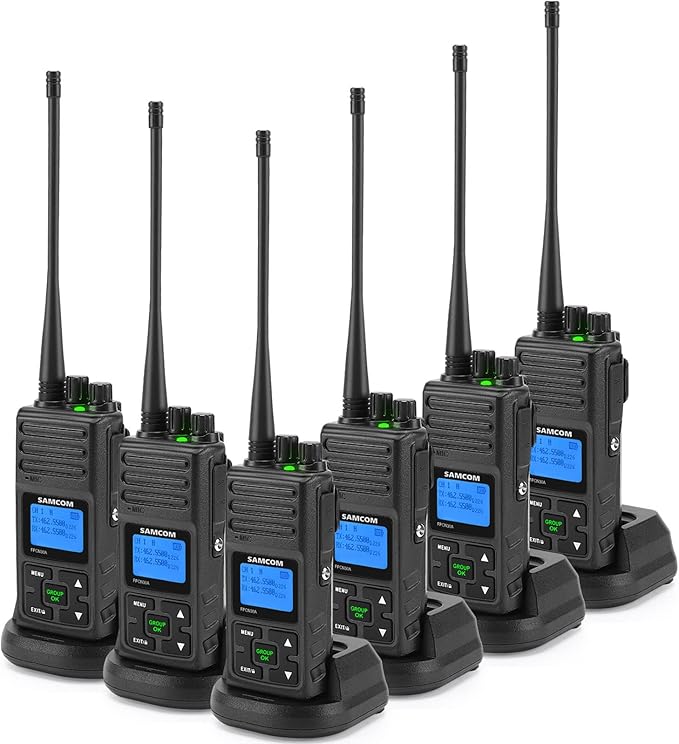
With 5 watts of power and a maximum range of 5 miles, the FPCN30A 5W UHF Two Way Radio 6-Pack fits teams needing reliable communication over wide areas. Its One-key GROUP call makes it ideal for volunteer firefighters coordinating multiple teams quickly and clearly during operations.
Setting up is straightforward, with 20 UHF channels for clear selection. The two big PTT buttons make it easy to switch between direct and group calls on the fly. Designed to be durable and weather-resistant, these radios stay functional through rain and rough handling, important for everyday use on emergency scenes or training drills.
The radios maintain solid communication even inside large buildings, coping well with concrete and steel obstacles. The shell is hard and drop-proof, which helps it hold up during physical work. Many have noted the strong group call feature as a major convenience, though a few mention that resetting the upgraded frequency can be tricky without watching the tutorial video.
Strong praise for the handy group call function that broadcast to multiple teams instantly. Some find resetting the upgraded frequency confusing without watching the provided video instructions. Radios are built tough and designed for clear communication even through tough terrain.
This set suits volunteer firefighters who need coordinated communication across large sites and buildings. Those requiring radios compatible with a wider array of devices or easier initial setup may want to look elsewhere.
Pros
- Long range coverage up to 5 miles
- One-key GROUP button for wide announcements
- Weatherproof and drop-proof design
- Two large PTT buttons for ease of use
Cons
- Frequency reset process requires video tutorial
- Only compatible with SAMCOM FPCN30A radios
| Specification | Details |
|---|---|
| Number of Channels | 20 |
| Frequency Range | UHF 406.1MHz-470Mz |
| Talking Range Maximum | 5 mile |
| Power | 5 Watts Stronger penetrating |
| Water Resistance Level | Water Resistant |
5. Rechargeable UHF Two-Way Radios 2-Pack

Volunteer firefighters looking for reliable communication tools will appreciate these Rechargeable UHF Two-Way Radios 2-Pack. Designed for dependable group coordination, they provide long battery life and clear audio, which are essential for emergency situations.
Their biggest strength lies in the extended battery performance, allowing long hours of use without worry.
Setup is straightforward by selecting from 16 preset channels via a simple rotating knob, making it quick to get on the right frequency. The VOX voice control function allows hands-free communication when gear is busy, and the built-in night flashlight adds convenience on low-light calls.
Charging the lithium-ion batteries is easy with the included charger, and accessories like earpieces and belt clips improve daily usability during calls.
These radios deliver clear communication within a 2-mile range, handy for coordinating across incidents. Their water-resistant design helps withstand tough weather conditions on the job. Most users praise the long average battery life of 96 hours, which stands out for extended shifts.
A common drawback mentioned is the limited channel count, which can restrict flexibility in busy areas.
The radios are highly rated for their 96-hour battery life, a key factor for long shifts without recharging. Users often point out the channel limitation as a drawback when more frequencies are needed in crowded radio environments. The water resistance and extra features like the night flashlight add practical value during emergency responses.
Those working in compact teams in moderate-sized areas will find these radios meet daily communication needs effectively. Anyone requiring wider coverage or more channel flexibility might want to explore models with longer range or additional channels for better adaptability.
Pros
- Long battery life supports extended emergency use
- Water-resistant build holds up in wet conditions
- Includes earpieces and belt clip for hands-free convenience
- Easy channel selection with rotating knob
Cons
- Limited to 16 channels, which may reduce options
- Maximum 2-mile range may fall short in vast areas
| Specification | Details |
|---|---|
| Number of Channels | 16 |
| Frequency Range | UHF |
| Talking Range Maximum | 2 mile |
| Battery Average Life | 96 hours |
| Water Resistance Level | Water Resistant |
| Voltage | 3.7 volts |
6. Rechargeable Two-Way Radios 4-Pack

Great for volunteer firefighters needing reliable communication, these two-way radios stand out with long-range capability reaching up to 2 miles in open spaces. Designed for practicality, they come in a 4-pack with multiple channels and privacy codes, making them ideal for coordinating teams in varied environments.
Setup involves simply rotating a channel knob to select from 16 preset options, which feels straightforward even in the rush of emergency situations. Voice-activated control helps keep hands free, while built-in scanning lets you monitor multiple channels quickly.
The radios include a night flashlight and alert you with a low battery alarm, supporting smooth daily use during both day and night shifts.
Communication remains clear at distances up to about 2 miles outdoors, though urban obstacles can reduce range noticeably. The units are water-resistant, making them more durable against weather conditions that firefighters might face. Lithium-ion batteries last up to 96 hours, offering extended use between charges.
Praise frequently centers on battery life and user-friendly features, while some users mention that range is noticeably limited in areas with many buildings or obstructions.
Users appreciate the radios’ extended battery life and simple channel selection, which supports clear communication during long shifts. A common drawback is that signal range drops noticeably in cities filled with buildings or heavy obstructions.
Volunteers working mostly outdoors or in rural areas will find these radios well suited to their needs. Those operating mainly in dense urban environments might want to consider radios featuring higher power or more advanced signal boosting.
Pros
- 165 privacy codes for secure communication
- Voice-activated transmission keeps hands free
- Built-in flashlight useful for low-light situations
- Long battery life lasting 96 hours per charge
Cons
- Range significantly limited by urban obstacles
- Requires charging all four radios separately
| Specification | Details |
|---|---|
| Number of Channels | 16 |
| Frequency Range | UHF |
| Talking Range Maximum | 2 mile |
| Battery Average Life | 96 hours |
| Water Resistance Level | Water Resistant |
7. Rapid Radios G1 LTE Walkie-Talkies

Rapid Radios G1 LTE Walkie-Talkies offer solid nationwide communication, ideal for volunteer firefighters who need reliable contact across wide areas. Its biggest strength is the uninterrupted communication without delay, even when managing groups of up to 200 people.
Setup is straightforward with a long-lasting battery that holds a charge for up to five days, reducing the need for constant recharging during shifts. The USB-C charging makes it easy to power up anywhere.
It connects through LTE, so coverage stretches coast to coast, which means you stay in touch beyond local limits. Noise-cancellation helps keep conversations clear despite surrounding activity.
The overall performance is consistent, with clear audio quality and no noticeable lag in communication. The build feels durable and resistant to water, suitable for tough environments.
Most praise revolves around its reliable range and battery life, while some find the water resistance decent but not waterproof, so it’s wise to avoid submersion.
Communication stays crystal clear across long distances with zero lag, making it reliable for large teams on the move. Water resistance protects against rain but wouldn’t withstand submersion or heavy splashes. Service requires renewal fees after the initial year, which impacts long-term costs.
Those needing strong, coast-to-coast coverage and group chat capabilities will find it suitable. It’s less ideal for users working in very wet conditions or those who want a walkie-talkie without ongoing service fees.
Pros
- Nationwide LTE coverage without dead zones
- Advanced noise cancellation for clear sound
- Long battery life up to 5 days
- Supports up to 200-person group talks
Cons
- Water resistant but not fully waterproof
- Extra service fees needed after first year
| Specification | Details |
|---|---|
| Coverage | Nationwide (coast to coast) |
| Battery Life | 5 days |
| Channels | 200 |
| Frequency Range | LTE/POC/4G |
| Water Resistance Level | Water Resistant |
| Voltage | 3.71 volts_of_direct_current |
8. Baofeng UV-5R Dual Band Ham Radio

Easy to carry and straightforward to operate, Baofeng UV-5R Dual Band Ham Radio suits volunteer firefighters who need reliable communication on a budget. Its biggest strength lies in offering dual-band operation with plenty of channels, which helps maintain contact in different scenarios without switching devices.
Getting started involves charging the single lithium metal battery that lasts up to 72 hours. The keypad lock prevents accidental changes while on the move. Dual-frequency display allows checking two channels at once, useful for staying tuned to multiple teams.
Power levels can be adjusted to save battery or boost transmission depending on range needs, up to 5 kilometers in clear conditions.
In its main role, this radio performs well with clear audio and a busy channel lock-out feature to avoid interference. The plastic build feels light but not very water-resistant, so caution around wet environments is necessary.
Reviews praise the long battery life and variety of channels, while common complaints mention its lack of water resistance and occasional complexity in menu settings.
The radio is praised for its excellent battery life and wide channel selection, supporting extended shifts without needing frequent recharges. The lack of water resistance is the most common drawback, requiring careful handling in damp or rainy conditions.
Those needing affordable, versatile radios with decent range and multiple channels will find this model fits well. Anyone who expects rugged, weatherproof gear should look toward more specialized options better built for outdoor exposures.
Pros
- Dual-band display with 128 channels
- Long battery life of 72 hours
- Adjustable high/low transmission power
- Busy channel lock-out to reduce interference
Cons
- Not water resistant
- Menu navigation can be confusing
| Specification | Details |
|---|---|
| Frequency Range | 144-148 MHz, 420-450 MHz |
| Number of Channels | 128 |
| Battery Average Life | 72 hours |
| Talking Range Maximum | 5 kilometer |
| Voltage | 4 volts |
9. Retevis RB48 Waterproof Walkie Talkies

Hardy and reliable for tough conditions, Retevis RB48 Waterproof Walkie Talkies suit volunteer firefighters needing clear communication in rough environments. Its biggest strength lies in military-grade durability, surviving extreme weather and harsh impacts without missing a beat.
Setting up takes moments thanks to its license-free FRS operation and straightforward controls. Day-to-day use is practical with 22 channels, a dual push-to-talk button that works well with gloves, and an 18-hour battery life from included 4 D batteries.
Weather and vibration alerts keep you aware while working in unpredictable conditions.
The walkie talkies deliver solid range of up to 3 miles, making communication reliable during emergencies. Built tougher through industrial components and reinforced interiors, they resist drops, dust, and immersion. Most appreciate the rugged design and dependable signal, though some mention the bulkiness of using 4 D batteries in the field.
Military-standard durability ensures these radios hold up through multiple harsh tests including dust, rain, shock, and extreme temperature changes. The most common complaint centers on the size and weight added by the 4 D batteries needed for operation, which can feel cumbersome during long shifts.
Those needing a rugged, waterproof radio with simple controls and strong alerts will find these fit the bill. Anyone wanting a lighter model or longer range might want to explore other options better suited to those specific needs.
Pros
- Works well with gloves on
- Rugged enough for extreme conditions
- Long 18-hour battery life included
- Vibration and weather alerts added
Cons
- Uses bulky 4 D batteries
- Range limited to 3 miles max
| Specification | Details |
|---|---|
| Number of Channels | 22 |
| Frequency Range | FRS |
| Battery Average Life | 18 hours |
| Water Resistance Level | Waterproof |
| Talking Range Maximum | 3 mile |
10. Rechargeable Two-Way Radios 6-Pack

Constructed to be water resistant with a straightforward UHF design, these radios suit volunteer firefighters needing reliable communication in groups. Their biggest strength lies in the long-range capability, allowing up to 3 miles of talk distance in open environments, ideal when staying connected across large or rural areas.
Setup is simple with a rotating knob to access 16 preset channels, making channel selection quick even under stressful conditions. You can program various audio codes on each channel, and features like VOX voice control and scanning help keep communication hands-free and efficient.
The included night flashlight adds practical value during low-light situations, and everything comes ready in a six-pack with chargers, batteries, and earpieces included for a complete set.
Communication generally performs as expected over long distances with clear audio on the UHF frequencies. The build is solid enough to handle routine use around firefighting gear and water exposure. The strongest praise often points to the extensive battery life offering up to 96 hours of talk time.
Common criticisms revolve around limited maximum range compared to professional-grade radios, which might be noticeable in densely built-up areas or heavy urban settings.
Users appreciate that the radios can last multiple days without charging and provide a clear signal over the advertised 3 miles in rural or open spaces. Many find the range limiting in heavily obstructed or dense environments, putting constraints on communication distances. The durability and long-lasting battery life contribute significantly to daily operation.
Those working in moderately sized outdoor areas or dispersed volunteer teams will be well served by these radios. People requiring broader range coverage in industrial or urban firefighting may want to look for professional-grade options with extended communication capabilities.
Pros
- Long battery life lasts up to 96 hours
- Water resistant design handles outdoor conditions
- Includes useful night flashlight feature
- Complete six-pack with charger and accessories
Cons
- 3-mile range may fall short in urban areas
- Not compatible with all two-way radios beyond Pxton brand
| Specification | Details |
|---|---|
| Number of Channels | 16 |
| Frequency Range | UHF |
| Talking Range Maximum | 3 miles |
| Battery Average Life | 96 hours |
| Water Resistance Level | Water Resistant |
11. Midland GXT1000VP4 GMRS Two-Way Radios 2-Pack

Long-distance communication stands out with these radios, designed for those needing reliable connection far beyond typical phone signals. Best for volunteer firefighters working in large outdoor areas or tough environments requiring clear, long-range contact and weather alerts for safety.
Setup comes with two fully charged units, rechargeable battery packs, and a desktop charger, ready to use right away. Day-to-day use benefits from 50 channels and 142 privacy codes allowing you to stay connected without interference.
Weather-resistant design and NOAA alert scanning help monitor severe conditions during shifts or rescues, crucial for staying informed in unpredictable environments.
Performance excels across distances up to 36 miles, making communication dependable even in remote locations. The build combines water resistance with solid materials designed for rough use. Clear voice activation allows hands-free operation, though switching from rechargeable packs to AA batteries to extend power can require carrying extra cells.
Some mention bulkiness but praise overall durability and signal quality.
Strong praise revolves around the effective long-distance range and reliable weather alerts that keep users connected and aware of changing conditions. The most common complaint points to the need for extra AA batteries once the rechargeable packs are depleted, which can be cumbersome during extended use.
Anyone requiring sturdy radios with clear transmission across long distances will appreciate these units, especially in outdoor or emergency scenarios. Those seeking a more compact or lightweight radio set might want to explore other models better suited for ease of carry or minimalist gear.
Pros
- Long-range communication up to 36 miles
- Built-in NOAA weather alert scanner
- Rechargeable battery packs + AA battery option
- Hands-free voice activation with EVOX
Cons
- Switching to AA batteries can be inconvenient
- Somewhat bulky for pocket carry
| Specification | Details |
|---|---|
| Number of Channels | 50 |
| Talking Range Maximum | 36 mile |
| Water Resistance Level | Water Resistant |
| Battery Average Life | 10 hours |
| Voltage | 6 volts |
12. Airiton Rapid AI-K28 LTE PoC Walkie Talkies 2-Pack

Perfect for volunteer firefighters who need reliable communication far beyond typical walkie talkie range, the Airiton Rapid AI-K28 makes cellular network coverage its biggest advantage. It ensures that no matter where the call comes from, connection stays strong up to 10,000 miles, avoiding the range limits of traditional radios.
Setup comes down to inserting the included SIM card, which offers unlimited data for life without extra cost. Using LTE Push-to-Talk means instant connection to team members whether private one-on-one or larger group calls.
Carrying two 9V batteries is simple but worth noting since no built-in rechargeable option exists. The device relies completely on cellular signals, so indoor coverage depends on local network strength.
Communication through national cellular networks delivers surprisingly consistent performance wherever coverage exists. The radio’s solid FCC certification confirms its compliance and reliability. The biggest upside is the unrestricted range and encrypted call options for security.
However, the lack of water resistance might be a drawback around wet conditions, and battery life depends entirely on replaceable 9V cells, which run out relatively fast during heavy use.
Users appreciate the vast communication range and how simple it is to connect after inserting the SIM card. The most common complaint involves the device’s lack of water resistance, making it vulnerable in harsh weather conditions during firefighting activities.
Those operating in areas with dependable cellular networks and prioritizing distance will find this radio a strong fit. Teams working in wet or rough outdoor environments may want to consider radios with water resistance or built-in rechargeable batteries instead.
Pros
- Unlimited range within cellular coverage
- Lifetime free SIM card service included
- Supports private and encrypted group calls
- FCC certified for reliability
Cons
- Not water resistant
- Requires replaceable 9V batteries
| Specification | Details |
|---|---|
| Number of Channels | 200 |
| Talking Range Maximum | 10000 mile |
| Water Resistance Level | Not Water Resistant |
| Number of Batteries | 2 9V batteries required |
| Connectivity Protocol | LTE |
13. TD-G19 LTE PoC Two-Way Radios 2-Pack

Keeping in touch during emergencies is critical, especially for volunteer firefighters spread across wide areas. Radios that work smoothly, don’t require constant plan renewals, and connect easily across networks can make a huge difference.
The TD-G19 LTE PoC radios stand out by offering lifetime free data service with broad network support, ideal for teams needing reliable communication without hassle.
Setting up the TD-G19 radios involves activating the pre-installed SIM card, which means you skip the usual tedious setup steps like registering IMEIs or calling service centers. Managing teams happens right in the companion app, where you can organize communication easily.
Daily use is straightforward thanks to Bluetooth support for headphones and microphones, and the AI noise reduction keeps conversations clear even in noisy environments.
Built to handle long-range communication, these radios tap into 4G/LTE networks from AT&T, Verizon, and T-Mobile, covering huge distances, up to 12,430 miles in ideal conditions. They feel rugged and water-resistant enough to hold up in tough situations.
Reviews highlight that the lifetime free data service is a real plus, while some users note the reliance on cellular coverage limits off-grid use as a drawback.
Strongest praise focuses on the lifetime free data service paired with wide network coverage thanks to support from AT&T, Verizon, and T-Mobile. This avoids monthly fees and complex setups. The main complaint centers on its dependency on cellular signals, making it unsuitable off-grid or in places without LTE access.
Volunteers operating in good 4G/LTE areas will appreciate the easy setup and long battery life, while those needing communication in remote or satellite-only regions should consider alternatives that offer offline capabilities.
Pros
- Lifetime free data service, no renewals needed
- Supports top three US carriers for wide coverage
- Bluetooth support for accessories
- AI noise reduction for clear communication
Cons
- Requires 4G/LTE coverage; no satellite or off-grid use
- Uses two lithium polymer batteries that need charging
| Specification | Details |
|---|---|
| Frequency Range | 4G/LTE (AT&T, Verizon, T-Mobile) |
| Talking Range Maximum | 12,430 mile |
| Battery Average Life | 72 hours |
| Number of Channels | 200 |
| Connectivity Protocol | Bluetooth |
| Water Resistance Level | Water Resistant |
Best Radios for Volunteer Firefighters Comparison Table
| Product | Channels | Range | Water Resistance | Battery |
|---|---|---|---|---|
| PoC Radios 2-Pack | 500 | 5000 kilometer | Waterproof | 3.6 volts |
| Retevis RB48 Walkies | 22 | – | Waterproof | 3.7 volts |
| Motorola Talkabout T605 | 22 | 35 mile | Waterproof | 2 12V batteries |
| FPCN30A UHF 6-Pack | 20 | – | Weatherproof | – |
| Rechargeable UHF 2-Pack | 16 | 2 mile | Water Resistant | 2 Lithium Ion |
| Rechargeable Radios 4-Pack | 16 | 2 mile | Water Resistant | 4 Lithium Ion |
| Rapid Radios G1 LTE | 200 | 100000 mile | Water Resistant | 3.71 volts |
| Baofeng UV-5R Radio | 128 | 5 kilometer | Not Water Resistant | 1 Lithium Metal |
| Retevis RB48 Waterproof | 22 | 3 mile | Waterproof | 3.7 volts |
| Rechargeable Radios 6-Pack | 16 | 3 miles | Water Resistant | 6 Lithium Ion |
| Midland GXT1000VP4 | 50 | 36 mile | Water Resistant | 8 AA batteries |
| Airiton AI-K28 LTE | 200 | 10000 mile | Not Water Resistant | 2 9V batteries |
| TD-G19 LTE Radios | 200 | 12430 mile | – | Rechargeable |
- Channels500
- Range5000 kilometer
- Water ResistanceWaterproof
- Battery3.6 volts
- Channels22
- Range–
- Water ResistanceWaterproof
- Battery3.7 volts
- Channels22
- Range35 mile
- Water ResistanceWaterproof
- Battery2 12V batteries
- Channels20
- Range–
- Water ResistanceWeatherproof
- Battery–
- Channels16
- Range2 mile
- Water ResistanceWater Resistant
- Battery2 Lithium Ion
- Channels16
- Range2 mile
- Water ResistanceWater Resistant
- Battery4 Lithium Ion
- Channels200
- Range100000 mile
- Water ResistanceWater Resistant
- Battery3.71 volts
- Channels128
- Range5 kilometer
- Water ResistanceNot Water Resistant
- Battery1 Lithium Metal
- Channels22
- Range3 mile
- Water ResistanceWaterproof
- Battery3.7 volts
- Channels16
- Range3 miles
- Water ResistanceWater Resistant
- Battery6 Lithium Ion
- Channels50
- Range36 mile
- Water ResistanceWater Resistant
- Battery8 AA batteries
- Channels200
- Range10000 mile
- Water ResistanceNot Water Resistant
- Battery2 9V batteries
- Channels200
- Range12430 mile
- Water Resistance–
- BatteryRechargeable
How to Choose the Best Radio for Volunteers
Key factors include durability, clear sound quality, and reliable battery life to ensure effective communication during emergencies. Choosing the right radio prevents costly replacements and avoids communication issues that could hinder volunteer firefighters’ safety and efficiency.
Durability and Build Quality
Radios frequently get dropped or exposed to dirt and water at emergency scenes. Electronics without proper protection often fail fast, leaving you without vital communication. Devices with at least an IP67 rating resist dust and can handle being momentarily submerged in water, which matches well with typical firefighting risks.
A shockproof design that meets military standards (like MIL-STD-810G) greatly reduces the chance of damage from accidental drops. Radios built with rugged plastic or reinforced rubber housing stand up better to impacts and rough handling. These features make a real difference during day-to-day use, ensuring the radio keeps working even after the harshest shifts.
Battery Life and Power Options
Firefighters often need radios that last through long shifts. Batteries that drain too fast mean losing communication or carrying spare packs.
A battery life of at least 12 hours on a single charge covers most shifts comfortably.
Rechargeable batteries are more cost-effective and environmentally friendly, but having the option to swap in disposable batteries adds security in prolonged emergencies. Fast charging capabilities, such as reaching 80% in under 2 hours, reduce downtime. Backup power solutions like external battery packs or USB charging provide flexibility on the go.
Communication Range and Clarity
Effective communication depends on a radio’s range and sound clarity. Dense buildings and smoke can cut signal range drastically, so aiming for a device that reliably covers at least a mile in urban environments is important. Clear audio with minimal static allows messages to be understood without repetition, critical when seconds count.
Support for multiple channels helps avoid interference from other teams. Privacy codes reduce cross-talk, so communications remain confidential and distinct.
Radios with easy channel switching and these features improve operational safety and coordination.
User Interface and Ease of Use
Controls must be operable while wearing gloves. Buttons that are too small or placed awkwardly slow down use and cause frustration. Radios with large, well-spaced tactile buttons simplify changing channels or adjusting volume.
Displays that remain visible in low-light or smoky conditions prevent guessing and errors. Backlit screens or high-contrast LCDs make a difference in dark environments. A lightweight radio reduces arm strain during long shifts, keeping the device from becoming a burden over time.
Compatibility and Integration
Compatibility with existing team communication systems saves money and avoids confusion. Radios supporting common frequency bands and digital protocols fit smoothly into current workflows.
This compatibility is essential to stay connected during multi-agency responses.
Connecting external accessories like headsets and microphones keeps hands free and improves safety. Radios offering emergency alert features, like man-down alarms, add an extra layer of security.
Interdevice protocols that enable smooth communication enhance team coordination in critical moments.
Optimizing Radio Communication During Emergency Operations
Clear and reliable communication can make a big difference in emergency operations. Radios used by volunteer firefighters must have good range and solid signal clarity to cover large or obstructed areas. Choosing radios with adjustable power output helps when teams move between close quarters and open fields.
Key practical points for effective use:
- Standardize channel assignments before the operation starts to avoid confusion.
- Use simple, direct language and established codes to reduce misinterpretation.
- Test all radios and backup batteries prior to deployment.
- Keep radios on chest level with microphones oriented upward for better voice pickup.
Using radios that support group calling aids coordination, and emergency alert features can quickly signal distress without delay. Consistent communication checks during the operation help detect any equipment issues early.
Proper Maintenance and Care to Extend Radio Lifespan
Proper upkeep of radios prevents unexpected failures and keeps them ready for the next call. Regular inspection of antennas, buttons, and battery contacts is necessary to ensure no damage or corrosion is present.
Maintenance tips include:
- Charge batteries fully after each use and avoid leaving them on chargers constantly.
- Store radios in a dry, cool place to prevent moisture buildup that can cause electronic problems.
- Clean radio surfaces with a damp cloth and avoid harsh chemicals that can degrade components.
- Check speaker and microphone functionality before every shift.
Replacing worn-out batteries and carrying spares during shifts guarantees continuous operation. Routine software updates, if available, can fix bugs and improve performance.
Common Communication Mistakes Volunteer Firefighters Should Avoid
Common communication errors during firefighting can escalate risks and reduce efficiency. One frequent mistake is overcrowding channels with unnecessary chatter, which blocks critical information flow.
Avoid these pitfalls:
- Don’t speak too fast or mumble; clear enunciation matters.
- Refrain from transmitting long messages that could be split into concise parts.
- Failing to confirm message receipt can lead to missed instructions.
- Ignoring radio discipline by interrupting transmissions disrupts team coordination.
Always adhere to established communication protocols, stay on assigned channels, and use call signs clearly. This discipline keeps the team synchronized and reduces confusion in high-stress situations.
People Also Asked
How Do I Maintain a Radio for Volunteer Firefighter Use?
Keep the radio clean and dry after every use and regularly check the battery and antenna. Carrying a small cleaning cloth and a spare battery or charger during shifts helps avoid unexpected failures.
What Size Radio Is Ideal for Volunteer Firefighter Gear?
A compact radio that fits securely on chest or shoulder straps is best since bulky radios interfere with movement and gear access. Try to pick a size that doesn’t get caught on equipment or foliage.
Are Volunteer Firefighter Radios Compatible with Emergency Communication Systems?
Radios designed for volunteer firefighters usually work with local emergency systems but verify they operate on the correct channels and frequencies. Cross-checking with the local fire department avoids communication gaps.
How Long Do Volunteer Firefighter Radios Typically Last on One Charge?
Most radios provide around 8 to 12 hours of talk time on a full charge. Carrying extra batteries or a portable charger is practical for long shifts without guaranteed access to power outlets.
What Common Problems Should I Watch for in Firefighter Radios?
Common issues include battery degradation, antenna damage, and interference problems. Routine checks before calls and replacing worn-out parts keep the radio reliable during critical moments.
Conclusion
Clear communication is the top priority, so look for radios with strong signal range and reliable audio quality. Durability is also important because equipment needs to stand up to tough conditions.
Battery life matters too, since long shifts require radios that won’t die quickly.
Choose a radio that fits the size of your team and how often you will need to use it. Smaller crews might not need as many channels, while larger ones should consider expandability.
Check the comparison table and detailed reviews above to find the right balance of features, price, and performance for your situation.