Top 12 Best Astrophotography Scope Hacks You Can’t Miss
Capturing clear, detailed images of the night sky can be challenging without the right equipment. Choosing the best astrophotography scope is key to achieving sharp photos of stars, planets, and deep-sky objects. This type of telescope is designed specifically to offer the precision and stability needed for long exposure photography, making it suitable for hobbyists and advanced sky photographers alike.
This type of telescope is designed specifically to offer the precision and stability needed for long exposure photography, making it suitable for hobbyists and advanced sky photographers alike. The best astrophotography scope can improve image clarity and provide smooth tracking to follow celestial movements. In this review, we will explore important features such as optical quality, mount stability, and compatibility with cameras.
By the end, you should have a clearer idea of which scope fits your needs and budget for capturing stunning night sky images.
Explore Top Choices That Capture the Wonders of the Night Sky with Unmatched Clarity
| Image | Product | Price |
|---|---|---|
Our Top Picks 1  | Sky-Watcher EvoGuide 50DX Guide Scope | Check Price |
Our Top Picks 2  | SVBONY SV555 APO Refractor Telescope | Check Price |
Our Top Picks 3  | ZWO Seestar S30 Pro Smart Telescope | Check Price |
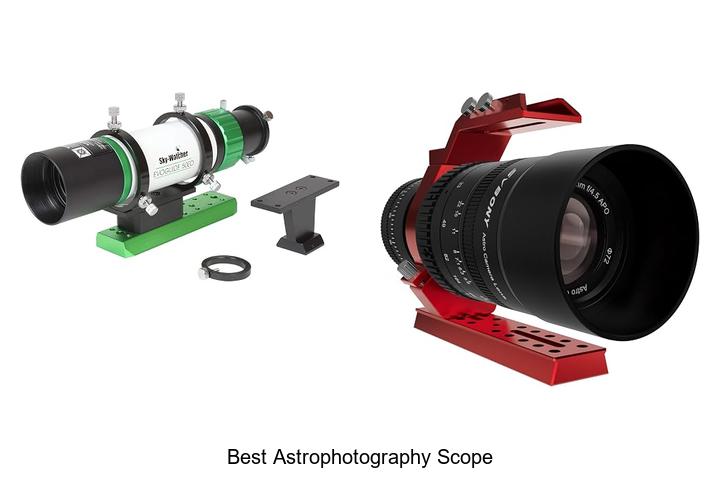
1. Sky-Watcher EvoGuide 50DX Guide Scope
Explore the night sky with remarkable clarity using the Sky-Watcher EvoGuide 50DX Guide Scope. Designed for precision and versatility, this guide scope suits both visual observers and those capturing the cosmos through astrophotography.
Its compact build and expert optical design allow users to witness contrast-rich views against deep, coal-black skies. Whether mounted on an advanced setup or used alongside a smartphone, it adapts effortlessly to your stargazing needs.
The EvoGuide 50DX features a 50mm aperture and a fast f/8 focal ratio, delivering sharp images with an impressive 242mm focal length. Its apochromatic doublet refractor utilizes specially matched ED glass that reduces chromatic aberrations, enhancing color fidelity and image contrast. This makes celestial objects stand out clearly with minimal distortions or fringing.
Included mounting options include a rugged aluminum finder stalk compatible with popular Sky-Watcher brackets and a V-style mounting rail, allowing secure attachment to various setups. The 25” helical focuser provides precise manual adjustments, ensuring quick and accurate focusing. With built-in T-threads, the scope can be easily converted into a fast astrograph using optional adapters.
Lightweight and compact, it offers both portability and ease of use for beginners and experienced users alike. Its fully coated optics enhance light transmission, contributing to brighter and more vivid views. This guide scope strikes a fine balance between performance and adaptability, making it a great companion for visual observation as well as guiding astrophotography rigs.
Pros
- High-quality ED glass delivers sharp, contrast-rich images
- Versatile mounting options fit various telescope setups
- Built-in T-threads allow easy astrograph conversions
Cons
- Optional adapter required for some astrophotography applications
The Sky-Watcher EvoGuide 50DX Guide Scope offers excellent optical performance in a compact and adaptable form. It is well-suited for detailed star tracking and guiding, providing bright, clear views that support both visual astronomy and imaging tasks. Its lightweight design combined with precise focusing and durable mounts ensures practical usability in the field.
| Specification | Details |
|---|---|
| Aperture | 50 mm |
| Focal Length | 242 mm |
| Focal Ratio | f/4.8 |
| Optical Design | Apochromatic Doublet Refractor |
| Focus Type | Manual Helical Focuser |
| Mounting Options | Aluminum Finder Stalk & V-style Mounting Rail |
| Compatibility | Sky-Watcher Finder Brackets, Guide Cameras, Smartphones |
| Optical Coating | Fully Coated |
| Additional Features | Built-in T-threads for adapter use |
From my perspective, the EvoGuide 50DX is a reliable accessory for those aiming to improve their astrophotography or enhance visual tracking accuracy. It blends portability with advanced glass technology, making it a compelling choice for users wanting sharp and rich-sky images without adding bulk.
2. SVBONY SV555 APO Refractor Telescope
Experience stunning celestial photography with the SVBONY SV555 APO Refractor Telescope. Its advanced optics promise remarkable image clarity, perfect for capturing stars, planets, and deep-sky wonders with ease.
Designed for both amateur and serious astrophotographers, this telescope blends compact portability with professional features. Discover crisp, vivid visuals whether at home or in the field.
The SV555 APO introduces a professional-grade Petzval triplet lens, eliminating common distortions like coma and chromatic aberration. This ensures crisp, flat-field images that bring distant galaxies to life.
Its precision focus mechanism has been upgraded for smoother adjustments and zero back-focus issues, allowing perfect framing of celestial objects. The focuser’s enhanced travel facilitates fine-tuning for clear star images or landscapes.
Compatible with full-frame sensors up to 44mm, this model supports DSLR, mirrorless, and specialty astronomy cameras. Vignetting is removed for wide-field astrophotography, ideal for expansive night sky shots.
With an adjustable aperture ranging from F4.5 to F22, imaging can be customized to diverse lighting and target conditions.
Additional convenience comes from the pre-installed electronic automatic focuser (EAF) adapter, compatible with ZWO EAF Gen1 systems. The included mount kit, featuring a 2” filter holder and a 360° rotatable tube, offers flexibility in positioning during shoots.
This telescope suits photographers aiming for high-quality, versatile astrophotography without bulky equipment. It balances optical excellence with portability for fieldwork and remote locations.
Pros
- Professional Petzval triplet lens provides sharp, aberration-free images
- Upgraded focus system ensures precise and smooth adjustments
- Lightweight design enhances portability for field and travel use
Cons
- Manual focus only; may require skill for perfect sharpness
Combining advanced optics, versatile settings, and a compact frame, the SVBONY SV555 APO Refractor Telescope offers exceptional astrophotography capabilities. It ranks well among similar products, standing out for its combination of image quality and portability.
| Specification | Details |
|---|---|
| Lens Type | Petzval triplet APO |
| Focal Length / Field of View | 44 millimeters |
| Aperture | Variable F4.5 to F22 |
| Focus Type | Manual focus, enhanced travel |
| Compatibility | DSLR, mirrorless, astronomy cameras |
| EAF Adapter | Pre-installed, supports ZWO EAF Gen1 |
| Mount Kit | Includes 2” filter holder, M72 thread, 360° rotatable tube |
| Weight | 90 grams lighter than previous model |
| Additional Features | Full-frame sensor compatibility, no vignetting |
From my perspective, this telescope fits well for those eager to upgrade their astrophotography setup without sacrificing portability. Its optical design and accessories support varied shooting conditions, making it a flexible choice for quality star imaging.
3. ZWO Seestar S30 Pro Smart Telescope
Discover the wonders of the night sky with the ZWO Seestar S30 Pro Smart Telescope. Designed to simplify stargazing, it offers intuitive controls and seamless connectivity for an enjoyable experience.
Whether you’re capturing celestial objects or exploring the stars, this telescope brings the universe closer than ever.
Blending portability with powerful features, the Seestar S30 Pro is crafted to suit beginners and casual sky watchers. Its smart technology and ultra-clear optics deliver sharp, vivid images anytime, anywhere.
The ZWO Seestar S30 Pro revolutionizes astrophotography by combining automatic GOTO targeting with smooth tracking. Turn it on, connect your smartphone, and let it find celestial bodies without manual adjustments.
It excels even in light-polluted urban areas thanks to its apochromatic optics and built-in light pollution filters. Stars appear crisper, and contrast levels are enhanced, allowing clearer night sky views and photos. Dual 4K cameras provide exceptional detail from distant nebulae to expansive landscapes.
One-tap imaging captures breathtaking views of the Milky Way, star trails, the Moon, and the Sun without complicated configurations. The intelligent software includes AI noise reduction and separates the sky from the foreground for balanced photographs. Compact and lightweight, it weighs only 64 pounds, supporting astronomy, birdwatching, and landscapes during travels.
Compact and lightweight, it weighs only 64 pounds, supporting astronomy, birdwatching, and landscapes during travels.
Pros
- Automatic GOTO targeting and tracking for effortless object finding
- High-resolution dual-camera 4K imaging for stunning astrophotography
- Portable, lightweight design ideal for outdoor adventure and travel
Cons
- Not designed for close planetary observations
The ZWO Seestar S30 Pro combines ease of use with impressive imaging quality, offering smart features that benefit newcomers and casual sky watchers alike. Its light-weight build and urban-friendly optics set it apart from traditional scopes, making any night sky exploration simple and rewarding.
| Specification | Details |
|---|---|
| Mount | Alt-Azimuth Mount (Supports Equatorial Mode) |
| Focus Type | Auto Focus, Manual Focus |
| Power Source | Battery Powered |
| Finderscope | Reflex |
| Compatible Devices | Smartphone, Tablet |
| Number of Batteries | 1 Nonstandard Battery (Included) |
| Coating | Fully Multi-Coated |
| Focal Length | 160mm |
| Field Of View | 4.6 degrees |
| Additional Features | App Controlled, Auto Tracking, EQ Mode, One-Tap Milky Way Imaging, Plan Mode |
This telescope is a solid choice for those starting with astrophotography or casual astronomy. Compared to other beginner scopes, its app-controlled automation and advanced optics provide richer imagery with less effort. It delivers satisfying results for users keen on exploring the cosmos during nights out or trips.
It delivers satisfying results for users keen on exploring the cosmos during nights out or trips.
4. Celestron NexStar Evolution 6 Telescope

Explore the universe with the Celestron NexStar Evolution 6 Telescope, designed to offer stunning views of celestial wonders. This telescope combines advanced optics with modern technology to provide a seamless stargazing experience for both beginners and more experienced observers.
Its compact design carries an impressive 6-inch aperture, making faint stars, planets, and deep-sky objects clearer and more vibrant than ever. With easy wireless control, you’re set to navigate the night sky with precision and convenience.
The NexStar Evolution 6 showcases a Schmidt-Cassegrain optical system enhanced with StarBright XLT coatings, which boost light transmission for sharper and brighter images. This optical quality allows for detailed observations of lunar craters, planetary features, and distant galaxies with minimal distortion. Complemented by 40mm and 13mm Plossl eyepieces, the telescope offers magnifications ranging from 38x to an impressive 115x, with a peak practical magnification of 354x for closer looks.
Complemented by 40mm and 13mm Plossl eyepieces, the telescope offers magnifications ranging from 38x to an impressive 115x, with a peak practical magnification of 354x for closer looks.
Built on a sturdy single fork arm mount attached to a stainless steel tripod, the telescope ensures excellent stability and smooth sidereal, lunar, and solar tracking. The built-in rechargeable battery offers up to 10 hours of operation, supporting long observation sessions without the hassle of external power sources. Installation and alignment are simplified through multiple methods including SkyAlign and 3-Star Align, speeding up the setup time and maximizing your observation period.
Wireless control via a smartphone or tablet is enabled through integrated WiFi and the easy-to-use Celestron SkyPortal app. This app features a vast database of over 120,000 celestial objects, allowing users to quickly find and explore stars, nebulae, and planets. The portable design, combined with powerful features, suits backyard astronomers and those traveling to darker skies alike.
The portable design, combined with powerful features, suits backyard astronomers and those traveling to darker skies alike.
Pros
- High-quality 6-inch Schmidt-Cassegrain optics with StarBright XLT coatings for clear views
- Integrated WiFi and SkyPortal app provide intuitive wireless control and extensive celestial database
- Long-lasting internal battery and solid mount ensure stable and extended observation sessions
Cons
- Manual focus requires careful adjustment for sharp image clarity
The Celestron NexStar Evolution 6 offers excellent optical performance and user-friendly features, making it a strong choice for stargazers seeking detailed views and convenient control. Its blend of sturdy design and wireless functionality places it ahead of many similar telescopes.
| Specification | Details |
|---|---|
| Optical Design | 6-inch Schmidt-Cassegrain |
| Coatings | StarBright XLT |
| Focal Length | 1500 mm |
| Eyepieces Included | 40mm (38x), 13mm (115x) Plossl |
| Mount Type | Single fork arm altazimuth |
| Focus | Manual |
| Power Source | Internal rechargeable battery |
| Control | Integrated WiFi with smartphone/tablet app |
| Field of View | 2.61 degrees |
From my experience, this telescope strikes a great balance between performance and convenience. Its wireless features paired with impressive optics make exploring the night sky less technical and more enjoyable.
5. SVBONY SV550 AP0 80mm ED Triplet Apochromatic Refractor OTA

Explore the night sky with the SVBONY SV550 AP0 80mm ED Triplet Apochromatic Refractor OTA. Designed to capture crisp, vivid celestial images, this telescope brings galaxies and star clusters into clear view. Its advanced optical system significantly reduces color distortion, providing sharp and detailed observation.
Its advanced optical system significantly reduces color distortion, providing sharp and detailed observation.
The SVBONY SV550 invites both casual stargazers and serious observers to experience astronomy with enhanced clarity. Compact yet powerful, it is crafted to satisfy users seeking precise astrophotography and visual exploration under the stars.
The SV550 AP0 features a triplet apochromatic design utilizing S-FPL51 low-dispersion ED glass paired with two correction lenses. This configuration minimizes chromatic aberration for vibrant and accurate color reproduction during observation or imaging.
The air-spaced triple optical lens arrangement greatly improves image contrast and clarity by virtually eliminating unwanted color fringes.
Equipped with a 5-inch magnesium alloy dual-speed toothed focuser, the telescope offers smooth manual focus adjustments. The 1:10 fine focus mechanism reduces vignetting on full-frame cameras and lowers the weight on supporting mounts.
Multiple light barriers inside the lens barrel and focusing seat enhance light extinction, resulting in sharper images with reduced glare and internal reflections.
With a focal length of 480mm and a 6-degree field of view, this refractor provides an ideal balance between wide-angle sky surveys and detailed views of Messier objects like M42 and M45. The fully multi-coated optics increase light transmission, making faint galaxies and star clusters easier to detect. This OTA complements equatorial mounts and is compatible with various astrophotography cameras, making it suitable for astronomers focusing on both visual and imaging pursuits.
This OTA complements equatorial mounts and is compatible with various astrophotography cameras, making it suitable for astronomers focusing on both visual and imaging pursuits.
Pros
- Triplet apochromatic optics minimize chromatic aberration for high-quality images
- Robust magnesium alloy dual-speed focuser enables precise manual focus control
- Light barrier design reduces internal reflections and stray light interference
Cons
- Manual focus may require patience for beginners new to astrophotography
The SVBONY SV550 AP0 80mm ED Triplet Refractor balances advanced optical engineering with practical features for clear night sky views. Its optical performance rivals many scopes in its class, and the durable construction ensures lasting reliability.
| Specification | Details |
|---|---|
| Aperture | 80mm |
| Optical Design | Triplet Apochromatic Refractor |
| Focal Length | 480mm |
| Field of View | 5.6 degrees |
| Coating | Fully Multi-coated |
| Focus Type | Manual Dual-Speed (1:10) |
| Focus Mount | 2.5-inch Magnesium Alloy Dual-Speed Toothed |
| Compatible Devices | Astrophotography Cameras and Visual Observation |
Choosing the SVBONY SV550 aligns well with those seeking precise optics suitable for both astrophotography and visual astronomy. Compared to similar scopes, it offers exceptional control over chromatic aberrations and ease of use through its quality focusing system. A rewarding tool for anyone wanting to delve deeper into the cosmos.
6. Celestron Origin Mark II Home Observatory

Explore the wonders of the night sky with the Celestron Origin Mark II Home Observatory. Designed to deliver strikingly clear and detailed views, this observatory combines innovative technology with professional-grade optics.
Ideal for astrophotography and live observation, it offers an immersive experience for anyone fascinated by celestial phenomena.
The Celestron Origin Mark II features a powerful 152mm aperture that collects ample light to reveal fine details in distant galaxies, nebulae, and star clusters. Its Rowe-Ackermann Schmidt Astrograph design ensures sharp and wide-field views without distortion, making it a great choice for high-resolution imaging. This telescope excels in flattening the field across entire images, enhancing deep-sky observation quality.
Engineered with precision, the unit delivers consistent optical performance, meeting the demands of serious astronomers. The equatorial mount paired with manual focus offers stable tracking and detailed adjustments for capturing celestial objects.
Technological integration allows users to connect smartphones, tablets, or cameras, enabling live feed casting to smart TVs and easy sharing of astrophotography results. Additional features include saving raw image files for post-processing and options suited for night-vision or land-based observation. The intelligent, all-in-one design creates a user-friendly experience for astrophotography combined with patented RASA optical technology, making it suitable for advanced users aiming to elevate their night sky observations.
The intelligent, all-in-one design creates a user-friendly experience for astrophotography combined with patented RASA optical technology, making it suitable for advanced users aiming to elevate their night sky observations.
Pros
- High-quality Rowe-Ackermann Schmidt Astrograph optics for crisp, wide-field views
- Large 152mm aperture gathers abundant light for detailed observation
- Integrated technology for live image casting and easy sharing
Cons
- Manual focus may require practice to achieve perfect sharpness
The Celestron Origin Mark II Home Observatory stands out with its blend of advanced optics and user-friendly technology. Its substantial aperture and flattened field design deliver exceptional image clarity, making it a strong option for astrophotographers. Equipped with smart device compatibility and robust build quality, it satisfies both observational and imaging needs.
Equipped with smart device compatibility and robust build quality, it satisfies both observational and imaging needs.
| Specification | Details |
|---|---|
| Aperture | 152mm (5.98″) |
| Optical Design | Rowe-Ackermann Schmidt Astrograph |
| Mount Type | Equatorial Mount |
| Focus Type | Manual Focus |
| Compatible Devices | Smartphone, Tablet, Camera |
| Eyepiece Lens | Plössl |
| Power Source | 1 Nonstandard Battery |
| Additional Features | Integrated astrophotography system with patented RASA optical technology |
For users seeking clarity and versatility in astrophotography, this observatory provides a reliable platform. While manual focusing may involve some learning, the overall design and features offer significant value.
It suits those ready to engage deeply with night sky imaging and observation.
7. Askar FMA180pro OTA Telescope

The Askar FMA180pro OTA Telescope is designed to deliver impressive clarity and precision for astrophotography and observation. Its advanced optical system ensures sharp images with minimal chromatic aberration.
Crafted with a six-element air-spaced APO design, this telescope incorporates two ED glass lenses for superior color correction. The 40mm aperture combined with a fast f/5 focal ratio and 180mm focal length provides bright, detailed views and excellent imaging potential.
Optimized for astrophotography, the FMA180pro includes a finder base and a 360-degree rotator that offers flexibility when framing shots. The M48 rear adapter and standard 55mm back focus make it compatible with a variety of cameras and mounts. This versatility adds excellent value, especially for photographers who require precision and adaptability.
The telescope’s compact design measures 5mm in length with a 40mm aperture, promoting easy transport and setup. High-quality CNC machining along with a matte-painted interior reduces reflections, improving image contrast.
High-quality CNC machining along with a matte-painted interior reduces reflections, improving image contrast. Manual focus control further enhances the observational experience, giving users excellent command over clarity.
Thanks to its multi-functional base, the FMA180pro can double as a finder scope on other telescopes, increasing its utility. This model is ideal for astrophotography enthusiasts who seek a lightweight yet highly effective optical instrument capable of capturing sharp and vivid celestial images.
Pros
- Advanced sextuplet air-spaced APO design with ED glass for outstanding chromatic aberration correction
- Compact and portable with integrated 360° rotator and finder base for versatile use
- High-quality CNC construction with matte interior coating to reduce stray light and enhance contrast
Cons
- Manual focus only, which may require careful adjustments during imaging sessions
The Askar FMA180pro OTA Telescope stands out as a powerful, portable astrograph that meets the needs of astrophotographers and observers alike. Its robust optical system and adaptable mounting options provide excellent image quality and usage flexibility.
| Specification | Details |
|---|---|
| Optical Design | Sextuplet Air-Spaced APO |
| Aperture | 40mm |
| Focal Ratio | f/4.5 |
| Focal Length | 180mm |
| Focus Type | Manual Internal Focusing |
| Mount Type | Altazimuth Mount Compatible |
| Finder Scope | Finder Base Included |
| Rear Adapter | M48 with 55mm Back Focus |
| Coating | Multi-Coated |
| Field of View | 2.86 degrees |
| Additional Features | Astrophotography Optimization, 360° Rotator |
This telescope excels in delivering precise color correction and sharp focusing in a compact frame. Its adaptable design suits both amateur astrophotographers and casual observers wanting better image quality without complex setups.
8. Celestron Advanced VX 8 Schmidt-Cassegrain Telescope

Discover the wonders of the night sky with the Celestron Advanced VX 8 Schmidt-Cassegrain Telescope. This telescope combines powerful optics and computerized technology to deliver stunning celestial views.
Its balanced design ensures smooth tracking of stars and planets, making long sessions comfortable and rewarding. Whether observing planets, star clusters, or distant galaxies, this instrument offers impressive performance in a compact form.
The 8-inch Schmidt-Cassegrain optical tube delivers sharp and bright images thanks to StarBright XLT coatings that maximize light transmission. With a focal length of 2032mm, the included 25mm eyepiece provides a substantial 102x magnification. Users can swap eyepieces for up to 480x magnification to suit different observing targets.
Users can swap eyepieces for up to 480x magnification to suit different observing targets.
The Advanced VX German Equatorial mount features computerized GoTo capabilities with a NexStar+ hand controller. It has a vast database of over 40,000 celestial objects that can be easily located and tracked.
The mount maintains precise alignment for long exposure astrophotography or prolonged visual sessions.
Sturdiness is a priority with the adjustable stainless steel tripod and robust mounting system. This setup keeps vibrations to a minimum for steady views. Additional accessories include a 6×30 finderscope, 90-degree mirror diagonal, and a versatile tripod making the telescope ready for immediate use.
It is an excellent tool for intermediate to advanced stargazers who want versatility combined with ease of operation.
Pros
- High-quality 8″ optics with StarBright XLT coatings for crisp images
- Computerized GoTo mount with extensive object database for easy tracking
- Sturdy adjustable stainless steel tripod ensures vibration-free viewing
Cons
- Manual focus may require practice for precise image adjustments
The Celestron Advanced VX 8 Schmidt-Cassegrain Telescope combines powerful optics and intelligent mount control to provide an immersive stargazing experience. Its solid build and thoughtful features make it a reliable companion for those passionate about astronomy.
Compared to similar models, it offers a balanced mix of aperture, precision, and usability that benefits a broad range of users.
| Specification | Details |
|---|---|
| Optical Design | 8″ Schmidt-Cassegrain |
| Focal Length | 2032mm (80″) |
| Eyepiece | 25mm Plossl |
| Magnification | 102x (up to 480x with optional eyepieces) |
| Mount | Advanced VX German Equatorial |
| Finderscope | 6×30 |
| Focus Type | Manual Focus |
| Coatings | StarBright XLT |
| Field of View | 0.57 degrees |
| Additional Features | Computerized GoTo tracking with NexStar+ controller |
| Compatible Devices | Camera, Smartphone |
This telescope is an excellent choice for those wanting to extend their astronomical pursuits beyond beginner-level gear. Its balance of quality optics, mount precision, and accessory inclusion make it a versatile instrument. Users will find it rewarding for both visual observation and introductory astrophotography tasks.
9. Smart Telescope Refractor Auto-Focus Digital Telescope
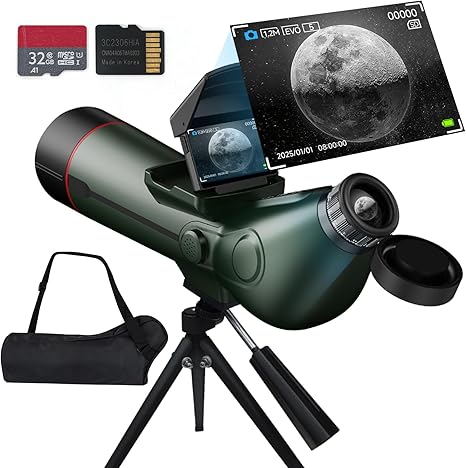
Discover the Smart Telescope Refractor Auto-Focus Digital Telescope designed to bring the cosmos closer than ever. Its advanced optics and user-friendly features make stargazing and astrophotography exceptionally clear and engaging.
Combining innovative technology with practicality, this scope accommodates both beginners and hobbyists. Its multi-functional design and stunning imaging capabilities offer endless opportunities under the night sky. Explore faraway celestial objects with ease, thanks to its enhanced performance and thoughtful accessories.
The heart of this telescope lies in its impressive 80mm aperture paired with a 300mm focal length, delivering sharp and vivid views. Its starlight-grade sensor supports magnification up to 350X, capturing crisp images even in low-light settings. The integrated 4K camera allows you to document celestial scenes without extra equipment.
A unique dual-screen system adds to the convenience by providing an eyepiece with adjustable diopter compensation and a foldable external screen for real-time viewing. The screen’s built-in sunshade maintains image clarity even during daylight hours. Operating the telescope is simple, with one-touch buttons to switch between photo and video modes, and ample support for up to 512GB of external storage.
Operating the telescope is simple, with one-touch buttons to switch between photo and video modes, and ample support for up to 512GB of external storage.
Equipped with a robust 4500mAh battery, it offers up to six hours of continuous use and several auto shut-off options to extend battery life. This makes it an excellent tool for extended observation sessions. The sturdy tripod ensures stability, making long-distance observations and nature spotting comfortable.
This telescope suits anyone passionate about astronomy, birdwatching, or photography seeking a versatile optical instrument.
Pros
- High-quality optics with 80mm aperture and 4K camera for sharp imaging
- Dual-screen display for flexible viewing options
- Long battery life with customizable auto shut-off
Cons
- Requires nonstandard batteries for operation
The Smart Telescope Refractor offers a compelling blend of clear optics, ease of use, and versatile features that make it a strong choice for those interested in sky observation and astrophotography. It stands out among similar models by combining high magnification and quality imaging with user-friendly controls and extended battery life.
| Specification | Description |
|---|---|
| Aperture | 80mm |
| Focal Length | 300mm (f/8.89) |
| Magnification | Up to 350X |
| Camera | 4K Starlight-Grade Sensor |
| Display | Eyepiece with Diopter Adjustment (+/-4), Foldable External Screen |
| Battery | 4500mAh, Up to 6 Hours Operating Time |
| Storage Support | Up to 512GB External |
From personal experience, this telescope delivers excellent image clarity with straightforward controls ideal for both casual observers and budding astrophotographers. The dual-screen setup provides a flexible way to enjoy views individually or with friends.
Its battery life offers the freedom for longer observation sessions, enhancing the overall user experience.
10. Explore Scientific ED 152mm Carbon Fiber Apochromatic Telescope

Exploring the cosmos demands precision and clarity, qualities well embodied in the Explore Scientific ED 152mm Carbon Fiber Apochromatic Telescope. Designed with advanced optical engineering, it elevates stargazing and astrophotography to new heights. Its sleek black carbon fiber structure promises durability while minimizing thermal expansion for steady imaging.
Its sleek black carbon fiber structure promises durability while minimizing thermal expansion for steady imaging.
Offering impressive 1216 mm focal length and excellent light-gathering capability, this telescope delivers stunning views of celestial bodies. Compact yet powerful, it supports both beginners and experienced astronomers seeking sharp, high-contrast images.
The Explore Scientific ED 152mm features an apochromatic triple-element objective lens that significantly reduces chromatic aberration. This results in crisp, true-color views vital for deep-sky observation and astrophotography. The carbon fiber tube keeps the assembly lightweight while maintaining structural integrity under various temperatures.
The carbon fiber tube keeps the assembly lightweight while maintaining structural integrity under various temperatures.
Equipped with an equatorial mount, smooth tracking becomes effortless, enhancing long exposure imaging capabilities. The Kellner eyepiece provides comfortable viewing through the Catadioptric design. Additionally, the reflex finderscope simplifies target acquisition in the night sky.
Additionally, the reflex finderscope simplifies target acquisition in the night sky. This model is particularly suitable for those aiming at advanced planetary and deep-sky imaging without bulky setups.
Its precision build highlights a Dawes limit of 76 arcseconds, ensuring fine detail resolution. The combination of robust optics and user-friendly mounting aids in exploring faint objects, including nebulae and galaxies. Compared to other scopes in its class, it balances superior optical quality and portability remarkably well.
Ideal for astrophotography hobbyists focused on detail and color fidelity.
Pros
- High-quality apochromatic lens reduces color fringing effectively.
- Lightweight carbon fiber tube enhances thermal stability and portability.
- Equatorial mount enables precise tracking and smooth operation.
Cons
- Relatively high cost may be a consideration for casual users.
Providing a blend of advanced optics and durable construction, the Explore Scientific ED 152mm fits well in any serious observer’s collection. It offers clarity and consistency for high-quality celestial imaging and detailed visual observation. The carbon fiber design and sensitive optics deliver dependable performance under varied conditions.
| Specification | Details |
|---|---|
| Model | ED 152mm Carbon Fiber Apochromatic Telescope |
| Focal Length | 1216 mm |
| Objective Lens | 152 mm triple-element apochromatic |
| Mount Type | Equatorial Mount |
| Eyepiece | Kellner |
| Finderscope | Reflex |
| Dawes Limit | 0.76 arcseconds |
| Additional Features | Carbon Fiber Edition for thermal stability |
Personally, I find this telescope to be an excellent investment for those who value detailed imaging and comfortable handling. Its lightweight design positively impacts setup and transport.
11. DWARFLAB Dwarf 3 Smart Telescope

Designed for travelers and stargazers, the DWARFLAB Dwarf 3 Smart Telescope offers incredible portability without compromising performance. Weighing only 3 pounds, it fits seamlessly into a standard backpack, making it easy to carry on any adventure. This telescope opens up opportunities for spontaneous exploration of the night sky and natural landscapes alike.
This telescope opens up opportunities for spontaneous exploration of the night sky and natural landscapes alike.
Equipped with dual lenses, the device captures stunning images both day and night. Its smart features, paired with advanced technology, allow users to capture clear photos effortlessly.
Whether observing the stars or capturing wildlife, this lightweight tool adapts to various scenes.
The DWARFLAB Dwarf 3 combines a telephoto lens and a wide-angle lens to deliver versatile imaging capabilities. The telephoto lens excels at photographing distant objects, including deep-space stars and planets, while the wide-angle lens is perfect for larger views like star trails or the Milky Way. During daylight, it works equally well by focusing on wildlife and landscapes or pinpointing your area of interest.
Its 4K auto-tracking system ensures smooth, crystal-clear shots by automatically following moving celestial bodies or wildlife. This technology allows users to capture sharp images without manual adjustments. The smart telescope links with a dedicated app that utilizes cloud processing to enhance images instantly, making professional-quality photography accessible without extra software or a PC.
The smart telescope links with a dedicated app that utilizes cloud processing to enhance images instantly, making professional-quality photography accessible without extra software or a PC.
The user interface is straightforward, welcoming users from age six to ninety-eight. Beginners can start capturing impressive astrophotography moments within minutes. The lightweight build and intuitive features make it an excellent pick for learners and experienced users alike.
Its compact design and powerful functions create a harmonious balance of convenience and performance.
Pros
- Ultra-lightweight and portable design fits standard backpacks.
- Dual-lens system for versatile day and night imaging.
- 4K auto-tracking technology produces sharp, clear images.
Cons
- Relies on smartphone or computer connectivity for full app features.
The DWARFLAB Dwarf 3 Smart Telescope stands out by combining portability with innovative imaging capabilities. Its seamless integration of hardware and cloud-powered software produces impressive results with minimal effort. Those seeking a reliable, versatile telescope will find great value in its compact size and powerful performance.
Those seeking a reliable, versatile telescope will find great value in its compact size and powerful performance.
| Specification | Details |
|---|---|
| Mount Type | Altazimuth Mount |
| Focus | Auto Focus |
| Finderscope | Straight-Through |
| Compatible Devices | Smartphone, Laptop, Personal Computer |
| Battery | 1 Lithium Ion (included) |
| Additional Features | 4K Tracking, Auto GOTO, EQ Mode, Lightweight |
This telescope offers an excellent blend of portability and advanced features, making it suitable for users at all skill levels. Its simple setup and smart technology help you capture remarkable celestial and terrestrial images effortlessly.
12. Vortex Crossfire HD Spotting Scope 20-60×80 Angled

Experience unmatched clarity and versatility with the Vortex Crossfire HD Spotting Scope 20-60×80 Angled. Designed for users seeking superior viewing quality, it offers impressive magnification and outstanding optical performance in a compact package.
This scope stands out as a reliable choice for detailed observation in various outdoor scenarios.
Equipped with an HD optical system, it utilizes premium glass elements to deliver sharp imagery and reduce chromatic aberration. The wide field of view accelerates target acquisition, while the anti-reflective coatings boost light transmission for exceptional brightness even in low-light conditions. Its angled design combined with adjustable eyecups ensures comfortable long-term use, with or without eyeglasses.
Its angled design combined with adjustable eyecups ensures comfortable long-term use, with or without eyeglasses.
The Vortex Crossfire HD is built to withstand rugged environments. Rubber armor adds durability and a secure grip, while nitrogen purging makes it waterproof and fogproof for lasting performance under adverse weather. A built-in sunshade on the objective lens reduces glare and protects from rain and snow.
A built-in sunshade on the objective lens reduces glare and protects from rain and snow. The helical focus mechanism allows swift and fine-tuned adjustments, making it easy to lock in a crisp view.
An Arca-Swiss compatible foot enables seamless mounting on most tripods, ready for immediate use. Its objective lens diameter of 80mm combined with 20-60x magnification versatile enough for birdwatching, wildlife observation, and detailed landscape scrutiny.
Pros
- High-definition optics reducing chromatic aberrations
- Wide field of view for faster target acquisition
- Waterproof, fogproof, and shock-resistant design
Cons
- Heavier than some compact spotting scopes due to robust construction
Delivering a harmonious blend of optical excellence and rugged practicality, the Vortex Crossfire HD Spotting Scope 20-60×80 is a smart investment for precise, long-distance observation. Whether used for terrestrial viewing or nature studies, it offers features that enhance clarity and user comfort. Below is a summary of essential specifications to guide your decision.
Below is a summary of essential specifications to guide your decision.
| Specification | Details |
|---|---|
| Objective Lens Diameter | 80 mm |
| Magnification Range | 20x to 60x |
| Design | Angled |
| Focus Type | Helical |
| Coatings | Anti-reflective on all air-to-glass surfaces |
| Durability | Rubber armor, shockproof, waterproof, fogproof |
| Additional Features | Arca-Swiss compatible foot, built-in sunshade |
For users valuing clear visuals alongside dependable weather resistance, this spotting scope delivers a balanced performance. Compared to less rugged scopes, it offers superior longevity and image quality, making it a dependable tool for extensive outdoor use.
Top Tips to Choose the Best Astrophotography Scope
Optical quality and aperture
Choosing the best astrophotography scope involves paying close attention to the size of the aperture, which determines the amount of light the telescope can gather and directly impacts the clarity and detail of celestial images. Larger apertures allow for capturing fainter stars and finer surface details on planets and deep sky objects. Optical coatings play a significant role in enhancing image contrast and brightness by reducing glare and light reflection on lens surfaces.
Depending on the preferred style of observation and photography, one can select from refractor scopes known for their crisp, high-contrast images and low maintenance, reflector scopes which typically offer larger apertures at a more affordable price but require occasional alignment, or compound scopes that combine features of both for versatile performance. Each type presents different advantages that suit various astrophotography goals, whether it’s wide-field views of star clusters or detailed shots of planetary surfaces.
Mount and stability
Choosing the right mount for astrophotography involves understanding the different types available and their impact on image quality. Equatorial mounts are designed to track the movement of stars by aligning with Earth’s axis, making them a popular choice for capturing clear, long-exposure photos of celestial objects.
Alt-azimuth mounts, which move up-down and left-right, tend to be simpler and more intuitive but may require additional tracking features for astrophotography. Stability plays a significant role in reducing vibrations that can blur images, so selecting a mount with a sturdy build and vibration dampening characteristics is beneficial. While portability allows for easier transportation and setup during outdoor sessions, it may come at the expense of some sturdiness.
Balancing between a lightweight design and robust construction helps maximize both convenience and stability during observations. By paying attention to these factors, one can enhance the astrophotography experience and capture sharper, more detailed images of the night sky.
Camera compatibility and connectivity
When choosing the best astrophotography scope, paying attention to camera compatibility and connectivity can greatly enhance the overall experience. Many scopes are designed to accommodate a range of cameras including DSLR, mirrorless, and specialized astrophotography models, allowing users to capture stunning celestial images with ease. The availability of adapters and extension tubes plays a key role in connecting different camera types securely to the scope, making the setup process smoother.
The availability of adapters and extension tubes plays a key role in connecting different camera types securely to the scope, making the setup process smoother. Additionally, some scopes come equipped with built-in WiFi or USB connectivity options, enabling convenient remote control and image transfer without the hassle of complicated wiring. Such features streamline the workflow and help ensure better control over exposure settings and framing during night sky photography sessions.
Focal length and field of view
When selecting a scope for astrophotography, matching the focal length to the intended imaging targets helps greatly in capturing detailed and pleasing images. Shorter focal lengths tend to be better suited for wide-field shots of deep space objects such as nebulae and galaxies, allowing you to capture more of the sky in one frame. Longer focal lengths, on the other hand, are preferred for photographing planets and the moon, where bringing out finer details is the goal.
The focal ratio influences exposure times significantly; scopes with lower focal ratios (faster optics) enable shorter exposures which reduce the risk of star trailing and can be beneficial for capturing faint objects. Using accessories like focal reducers can decrease the focal length and speed up the scope, widening the field of view, while focal extenders increase the effective focal length for closer views but require longer exposure times.
Balancing these elements based on what you wish to photograph and your camera’s capabilities helps create more satisfying results in astrophotography.
Tracking and automation features
The choice of a scope for astrophotography often hinges on its tracking and automation features since these greatly affect the ease and quality of capturing celestial images. Equatorial and altazimuth drives serve different functions, with equatorial drives aligning with the Earth’s rotation to provide smooth tracking of stars, which is particularly beneficial for long exposure astrophotography.
Altazimuth drives move the scope along vertical and horizontal axes, which is simpler but can introduce field rotation during extended shots. Autoguiding capabilities enhance precision by making small corrections to the scope’s movement, reducing star trailing and improving image sharpness during long exposures. Compatibility with popular astrophotography software allows for seamless control and automation of the telescope, enabling tasks like automated alignment, tracking, and image capture to be more straightforward.
Considering these aspects will help in selecting a scope that suits specific use cases, whether capturing wide-field views or detailed planetary images, making the process less time-consuming and more rewarding.
Budget and accessories
When selecting an astrophotography scope, balancing the amount you spend with the features you receive is key. Prioritizing the value for money means choosing a model that delivers clear optics and stable construction without exceeding your financial comfort.
Considering future upgradeability is also wise; scopes that allow you to add or replace components as your skills improve can extend the lifespan of your investment. Support options from manufacturers or retailers, including warranties or customer service, provide additional confidence during and after purchase.
Keeping these factors in mind helps establish a solid foundation for capturing remarkable images of the night sky without overspending or needing frequent costly replacements.
People Also Asked
What Features Should I Look For In The Best Astrophotography Scope?Look for a telescope with a sturdy equatorial mount for precise tracking, a large aperture (at least 6 inches) to capture faint celestial details, and good focal length for high-resolution images. Additionally, compatibility with cameras and computerized GoTo systems can greatly enhance your astrophotography experience.
Which Telescopes Are Considered The Top Choices For Astrophotography Beginners?The top telescope choices for astrophotography beginners are typically the Celestron NexStar 6SE and the Orion StarSeeker IV 130mm, due to their user-friendly features and good optics. These models offer automated tracking and decent aperture, making it easier for newcomers to capture clear images of celestial objects.
How Does Aperture Size Affect Astrophotography Performance In Scopes?A larger aperture size in scopes allows more light to enter, improving the ability to capture faint celestial objects and details in astrophotography. However, it can also increase the weight and cost of the scope, requiring better mount stability for clear images.
What Are The Best Budget-Friendly Scopes For Capturing Deep-Sky Objects?The best budget-friendly scopes for capturing deep-sky objects are typically Dobsonian reflectors and small apochromatic refractors, which offer good light-gathering ability and clarity without a high price tag. Popular models include the Orion SkyQuest XT6 and the Explore Scientific ED80, both balancing performance and affordability for amateur astrophotographers.
How Do Refractor And Reflector Telescopes Compare For Astrophotography Purposes?Refractor telescopes offer sharper and higher-contrast images with less maintenance, making them ideal for wide-field astrophotography. Reflector telescopes generally provide larger apertures at a lower cost, allowing for better light-gathering and deep-sky imaging but may require more frequent alignment and maintenance.
Conclusion
Selecting the best astrophotography scope involves balancing factors like optical quality, portability, and ease of use. High-quality scopes deliver sharp, detailed images of celestial bodies, but they may come with higher costs and a steeper learning curve for beginners.
This type of equipment is ideally suited for dedicated hobbyists who want to capture stunning night sky images with clarity and precision. Potential buyers should weigh their experience level, budget, and intended use before deciding.
Overall, the best astrophotography scope for you depends on your specific needs and goals, providing rewarding opportunities for capturing the wonders of the cosmos.